

Most nonprofits treat donor identity as a cleanup project. Someone notices the dedupe queue is out of control, a volunteer or junior staffer spends three weeks merging records, the board gets a nicer-looking donor count, and then everyone moves on. Eighteen months later the same mess is back — except now there are two new integrations feeding dirty data into the system faster than anyone can clean it.
That cycle is the real problem. Not the duplicates themselves, but the fact that identity gets handled as an event instead of a system. A master donor data strategy nonprofit teams can actually sustain looks nothing like a cleanup. It looks like a small set of rules, IDs, and review gates that run continuously, so the question "is this the same person?" has a defensible answer every single day, not just after a merge marathon.
This is the architecture piece. If you've already read about stopping duplicate records with a stepwise cleanup plan, think of this as the layer above that — the thing that keeps you from needing the cleanup again.
Why identity breaks differently at every stage of growth
The failure mode changes as the organization grows, and that's the part most teams miss. They solve the version of the problem they had two years ago.
At a small shop with one CRM and a couple thousand donors, identity breaks because of manual entry inconsistency. The same person comes in as "Bob Smith," "Robert Smith," and "Robert & Linda Smith" depending on who typed it. No system, just whoever was at the desk that day.
Once you add an online giving page, an email platform, and an events tool, identity breaks because of cross-system collisions. The same donor now exists in four places with four different identifiers — the CRM's internal ID, the payment processor's customer ID, the email tool's subscriber ID, and the event platform's attendee ID. Nothing ties them together except a fragile email match, and email is the one field people change constantly.
At mid-size, with integrations syncing in both directions, identity breaks because of feedback loops. A bad merge in the CRM propagates to the email tool, which pushes a "corrected" record back, which creates a new conflict. Now you have systems arguing with each other and no human is sure which one is right.
The pattern across all three stages: the organization never defined what a donor is in data terms. No canonical record, no single ID that every system agrees to point at. Each tool has its own idea of who the person is, and the "truth" is just whichever screen someone happens to be looking at.
The two keys that fix most of this: canonical donor IDs and household keys
Before any matching rules, you need two stable identifiers that never change meaning. Everything else hangs off these.
Stop missing fundraising opportunities.
Almosly helps you plan, track, and optimize every campaign with ease.
- Centralized donor and volunteer management
- Automated engagement workflows
- Impact and fundraising analytics
No credit card required
The canonical donor ID is a permanent, internal, meaningless number assigned to a person the first time they appear in your ecosystem. "Meaningless" is deliberate — it shouldn't encode name, email, or anything that can change. If Robert Smith changes his email, moves cities, and gets remarried, his canonical ID stays the same. Every system stores this ID as a foreign key, so when your email tool and your CRM both reference donor DNR-0000184213, you know they mean the same human.
The household key is a separate ID that groups donors who should be treated as one giving unit for soft-credit, mailing, and ask purposes. Most teams overreach here — they try to make the household the primary record and lose the ability to credit individuals. Keep them separate. A person belongs to exactly one household at a time, but the person record is primary and the household is an attribute.
| Field | Example | Rule |
|---|---|---|
canonicaldonorid | DNR-0000184213 | Immutable, system-generated, never reused |
household_key | HH-0000091774 | One per household; person points to it |
household_role | primary / member | Only one primary per household |
sourcesystemids | {crm: 55231, stripe: cusabc, email: sub99} | Map of external IDs this person owns |
match_confidence | 0.94 | Last computed match score (see below) |
review_status | auto / pending / confirmed | Gate state |
last_reconciled | 2026-02-11 | Date of last cross-system check |
The sourcesystemids map is the quiet hero here. Once every external identifier is attached to the canonical record, your sync logic stops guessing. It no longer matches on email — it matches on "which canonical ID owns this Stripe customer." That single change kills most of the feedback-loop problem on its own.
If you don't yet have the underlying field discipline to support this, the minimal nonprofit CRM data model with canonical fields and validation rules is worth reading first. Identity architecture assumes your base fields are already clean and typed.
Confidence-tier matching: stop merging on gut feel
The biggest mistake in donor dedup is binary thinking — records are either "a match" or "not a match," and a human decides. That doesn't scale, and it produces inconsistent decisions because two staffers judge the same pair differently.
The better approach assigns a confidence score to every candidate pair, then routes it by tier. High confidence auto-merges. Medium confidence goes to a human review queue. Low confidence gets left alone. You tune the thresholds, not the individual decisions.
| Signal | Match condition | Weight |
|---|---|---|
| Exact email match | normalized, lowercased | +0.45 |
| Exact phone match | digits only, last 10 | +0.30 |
| Name similarity | fuzzy ≥ 0.9 on last + first | +0.20 |
| Address match | normalized street + zip | +0.25 |
| Same payment fingerprint | processor customer ID overlap | +0.40 |
| Conflicting DOB | different non-null birthdates | −0.50 |
| Different suffix | Jr. vs Sr. mismatch | −0.35 |
Sum the weights, cap at 1.0, and route:
-
≥ 0.90 — auto-merge, log it, move on
-
0.65 – 0.89 — human review queue
-
< 0.65 — no action, keep separate
The negative weights matter more than people expect. A father and son at the same address with the same last name is the single most common false merge in nonprofit data. A Jr./Sr. penalty combined with a DOB conflict is what saves you from crediting the wrong person's major gift to the wrong record. That's not a hypothetical — that's an awkward phone call with a $25k donor.
One pattern worth naming explicitly: teams set the auto-merge threshold too low in the first month because the review queue feels overwhelming, then spend the next quarter un-merging. Start conservative. A queue that's too long is annoying. A wrong merge on a planned-giving prospect is a trust failure.
The human-review gate: where judgment actually belongs
Automation handles the obvious. Humans handle the ambiguous. The whole point of confidence tiers is to shrink the ambiguous bucket to something a single person can clear in twenty minutes a day instead of a three-week project.
-
Candidate surfaces into the pending queue with its score and the specific signals that triggered it.
-
Reviewer sees both records side by side — not raw database rows, but a clean comparison with conflicting fields highlighted.
-
Reviewer chooses
merge, keep separate, or escalate (for major donors, deceased flags, or anything touching a restricted gift).
-
Decision is logged against the canonical ID with the reviewer's name, timestamp, and reason.
-
Merged record retains full lineage — every source system ID, every prior value, so the merge is reversible.
That last point isn't optional. Irreversible merges are how organizations lose giving history. If you can't un-merge cleanly, reviewers will hesitate on every decision and the queue will stall.
Make merges reversible and document rollback steps so reviewers can act confidently.
-
Every merge has a named human or a logged auto-rule behind it
-
Reviewers can see why a pair was flagged, not just that it was
-
Major-donor and deceased-flagged records route to a senior reviewer
-
Merges are reversible with full field history preserved
-
The daily queue is clearable in under 30 minutes by one person
-
Escalations have an owner and an SLA (e.g., resolved within 2 business days)
When the queue regularly blows past 30 minutes, that's not a staffing problem — it's a signal your thresholds or your upstream data entry need adjusting. Treat a growing queue as a diagnostic, not just a chore.
Cross-system sync: directional rules beat bidirectional chaos
This is where most mid-size nonprofits quietly drown. They turn on two-way sync between the CRM, the email platform, and the giving pages, assume it "just works," and end up with a system where every tool can overwrite every other tool. No one owns the truth.
The fix is deciding, per field, which system is the authority and which systems are consumers. Authority writes, consumers read. You almost never want two systems with write authority over the same field.
| Field | Authority system | Consumers |
|---|---|---|
| Name, address | CRM | Email, events |
| Email subscription status | Email platform | CRM |
| Gift transactions | Payment processor | CRM |
| Canonical + household IDs | MDM layer / CRM | Everything |
| Event attendance | Event tool | CRM |
The workflow becomes directional and predictable. When a gift lands in the payment processor, it flows to the CRM tagged with the donor's canonical ID. When a donor unsubscribes in the email tool, that status flows into the CRM — but the CRM never pushes a subscription status back. Each field has exactly one source of truth, and conflicts stop happening because the systems aren't allowed to argue.
This also cleans up attribution downstream. A lot of the mess people blame on their reporting is actually an identity problem wearing an attribution mask — gifts credited to the wrong record, channels double-counting the same person. If attribution is a sore spot, the campaign attribution framework for multi-channel nonprofits assumes exactly the kind of stable identity layer described here.
Reconciliation cadence: the part everyone skips
Even a well-built identity system drifts. New integrations get added, someone imports a list without the canonical ID, a bulk upload creates orphans. Reconciliation is the recurring check that catches drift before it compounds.
Weekly — orphan sweep. Query for any record created in the last seven days with no canonical ID assigned, or any external ID not mapped to a canonical record. These are your new leaks. Assign IDs or route to review. This is a 15-minute job done weekly and a nightmare if left for quarterly.
Monthly — household integrity check. Look for households with zero primaries, multiple primaries, or members who've moved and should be split out. Marriages, divorces, and deaths all break household logic quietly. A monthly pass catches soft-credit errors before year-end tax receipts go out wrong.
Quarterly — cross-system count reconciliation. Pull the active donor count from each system and compare. If your CRM says 11,400 constituents, your email tool says 9,800, and your giving page processor says 6,200, those gaps should be explainable, not surprising. Unexplained drift between systems is the earliest warning that your sync rules broke somewhere.
A concrete example: a regional arts nonprofit with around 9,000 constituent records had never run structured reconciliation. Their "donor count" ranged from roughly 8,400 to 11,000 depending on which report someone pulled. After assigning canonical IDs, mapping source-system IDs, and running the weekly orphan sweep plus monthly household check for about four months, the duplicate rate dropped from an estimated 14% to under 3%. The part the development director actually cared about — their year-over-year retention number finally stopped swinging wildly, because they were comparing the same people to the same people. The number didn't get better. It got true, which matters more when you're reporting to a board.
Where enrichment fits — and where it doesn't
A quick caution, because this trips people up. Enrichment and identity are related but not the same job. Identity decides who a record is. Enrichment adds attributes to a record you've already identified. Running enrichment before your identity layer is stable just means paying to append wealth screening and demographic data onto duplicates.
Get the canonical IDs and matching rules working first. Then layer enrichment on top, with acceptance gates so appended data doesn't silently overwrite verified fields. If you're planning that work, the data enrichment cadence with acceptance gates pairs directly with this architecture — enrich the canonical record, never the raw duplicates.
When a full identity program makes sense — and when it doesn't
This isn't right for everyone.
When it makes sense: You're running three or more systems that share donor data. You have more than a few thousand records. You've done a manual cleanup at least once and watched it come back. You're syncing data bidirectionally and seeing conflicts. You're about to migrate CRMs and want to avoid importing the same mess.
When it's premature: One system, under a couple thousand records, manual entry by one or two consistent people. At that scale, strong validation rules and a tidy data model solve the problem without the overhead of a full identity layer. Building confidence-tier matching for 1,500 records is engineering for a problem you don't have yet.
Who should not do this alone: If you're syncing data that touches restricted gifts, planned giving, or legal designations, don't let a volunteer own merge decisions on those records. The architecture can be small-team. The judgment on high-stakes records shouldn't be.
A small-team implementation roadmap
You can stand up a working version of this in a quarter without hiring anyone. The sequence matters more than the speed.
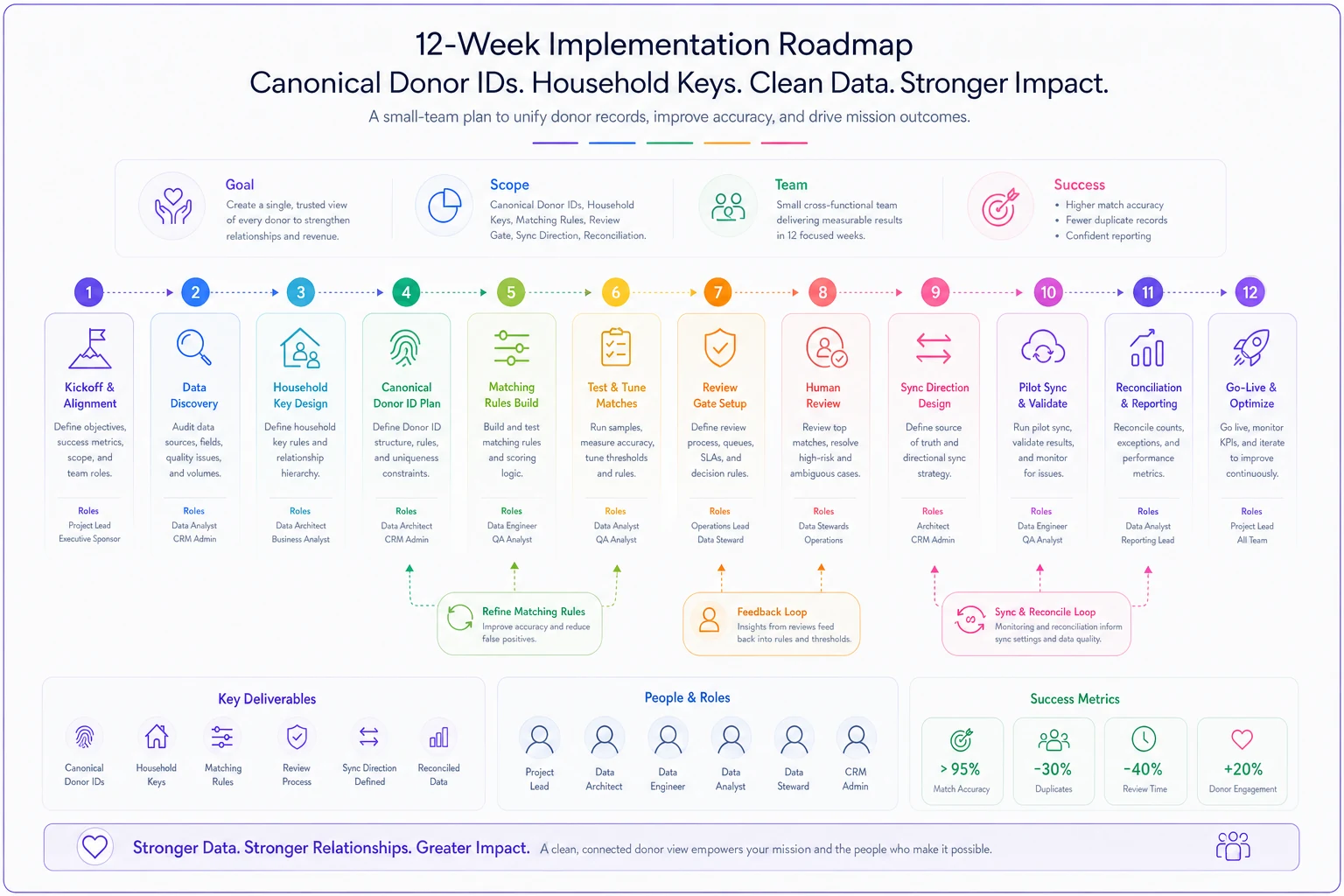
A simple visual of these steps helps align staff and makes it clear who owns each gate.
-
Weeks 1–2 — Define the schema. Lock in your canonical ID format, household key, and the source-system ID map. Decide which fields are authority vs. consumer across your systems.
-
Weeks 3–4 — Backfill canonical IDs. Assign IDs to existing records, highest-value donors first. Major and mid-level donors get verified by a human; the long tail can be rule-assigned.
-
Weeks 5–6 — Build the matching rules. Start with conservative thresholds. Run the scoring against your existing base and inspect the auto-merge bucket manually before trusting it live.
-
Weeks 7–8 — Stand up the review queue and the gate. Train one or two reviewers. Set the escalation path for high-stakes records.
-
Weeks 9–10 — Fix sync direction. Turn off bidirectional writes where they shouldn't exist. Establish the authority map in practice, not just on paper.
-
Weeks 11–12 — Start the reconciliation cadence. Run the first weekly orphan sweep and monthly household check. Document what you find so the next person can run it.
By the end you don't have a finished project — you have a running program. That distinction is the whole point. The cleanup ends. The identity system doesn't.
The shift that actually matters
Organizations that escape the cleanup-every-18-months cycle aren't the ones with the biggest data teams or the fanciest tools. They're the ones that stopped asking "how do we clean this up" and started asking "what are the standing rules that keep it clean."
Canonical IDs give you a stable anchor. Confidence tiers turn judgment into something consistent and repeatable. Review gates put humans exactly where they belong. Sync direction stops your systems from fighting each other. Reconciliation catches drift before it becomes a crisis.
None of these pieces is complicated on its own. The value comes from running them together, continuously, as a system — which is exactly why a one-off cleanup never holds and a sustained identity program does.
Organizations that escape the cleanup-every-18-months cycle aren't the ones with the biggest data teams or the fanciest tools. They're the ones that stopped asking "how do we clean this up" and started asking "what are the standing rules that keep it clean."
Canonical IDs give you a stable anchor. Confidence tiers turn judgment into something consistent and repeatable. Review gates put humans exactly where they belong. Sync direction stops your systems from fighting each other. Reconciliation catches drift before it becomes a crisis.
Ready to elevate your nonprofit impact?
Join 2,000+ nonprofits using Almosly to boost fundraising efficiency, deepen donor relationships, and scale philanthropic impact.