


Most nonprofits track the wrong thing when measuring campaign attribution. They obsess over the last touchpoint—the email link someone clicked, the event they attended, the appeal letter they received—and completely miss the actual journey that turned someone from a stranger into a committed donor.
The problem isn't tracking. It's that nonprofits build attribution systems backwards, starting with what's easy to measure instead of what actually matters for decisions.
The pattern is predictable. Development directors show me spreadsheets with hundreds of campaign codes, source fields stuffed with contradictory data, and reports that somehow claim their spring gala generated 140% of annual revenue. Meanwhile, they can't answer basic questions like which campaigns actually drive long-term donor value, or whether their direct mail program pays for itself when you factor in multi-year giving patterns.
The operational mess happens because nonprofits treat attribution like a tagging exercise instead of a decision framework. Every team creates their own tracking codes. Nobody agrees on attribution windows. The database fills with conflicting source data. And eventually someone builds a 47-tab Excel monster that requires three days to update after each campaign.
Why Multi-Channel Attribution Breaks Down Operationally
A typical nonprofit runs 15–30 concurrent campaigns across email, mail, events, peer-to-peer, social media, and major gift cultivation. Each channel operates on different timelines. A major donor might take 18 months from first contact to commitment. A peer-to-peer participant might donate within hours of hearing about your cause. Your year-end email campaign overlaps with Giving Tuesday, direct mail drops, and holiday events.
Traditional single-touch attribution assigns each donation to one source. But that $5,000 gift from a board member's contact didn't just happen because they attended your gala. They received seven emails, saw your annual report, had coffee with your executive director, and their company matched their donation. Crediting everything to "Gala 2024" makes your event look wildly successful while hiding the actual cultivation work that drove the gift.
The breakdown accelerates when different teams need different attribution views. Your events team wants to prove ROI on the spring benefit. Marketing needs to justify digital ad spend. Major gifts wants credit for cultivation touches. Grant writers need program-specific revenue breakdowns. Everyone starts creating shadow attribution systems in their own spreadsheets.
Around month eight of this chaos, someone senior asks why three different reports show three different campaign revenue totals. The development team schedules a two-hour meeting to "align on attribution methodology." Six weeks later, you have a 20-page attribution policy document that nobody follows because it requires manually updating seven different fields for every single donation.
The real problem is that you're trying to force complex donor behavior into simple buckets. A pragmatic attribution framework accepts that complexity and builds rules that capture what matters without creating operational nightmares.
Three Attribution Models That Actually Work for Small Teams
Forget complex multi-touch attribution algorithms. Small nonprofit teams need frameworks they can actually implement without a data scientist. Here are three approaches that balance accuracy with operational reality:
Stop missing fundraising opportunities.
Almosly helps you plan, track, and optimize every campaign with ease.
- Centralized donor and volunteer management
- Automated engagement workflows
- Impact and fundraising analytics
No credit card required
First-Touch with Influence Tracking
Credit the original source that brought someone into your database, then track influential touchpoints without changing attribution. This works well for nonprofits with long cultivation cycles.
Record the first meaningful interaction—not just email signups, but actions like event attendance, first donation, or volunteer signup. Then maintain a separate influence log for major touchpoints: gala attendance, meetings with leadership, peer-to-peer participation. You keep clean attribution while still documenting the full journey.
A food bank using this model might show: Original source: Corporate volunteer day (March 2023). Influences: Monthly newsletter subscriber, Turkey Trot participant, company match enrolled, year-end appeal responder. When this donor makes their $2,500 year-end gift, it credits to corporate partnerships—but you understand the full cultivation path.
Time-Decay with 90-Day Windows
Recent interactions get more credit than older ones, with a hard cutoff at 90 days. This matches how most donors actually behave—they give in response to recent asks, not campaigns from six months ago.
Set degradation rules: Last 7 days (100% credit), 8–30 days (50% credit), 31–90 days (25% credit), 90+ days (0% credit). When someone donates, look back through their recent interactions and assign proportional credit.
This model works especially well for nonprofits with seasonal giving patterns. Your holiday campaign gets appropriate credit for December donations, even if donors also attended your October gala. Digital campaigns show realistic ROI since recent email clicks matter more than old website visits.
Rule-Based Waterfall
Create a strict hierarchy of attribution rules. Major gift officer assignment overrides everything. Event attendance overrides digital. Email overrides passive website visits. This isn't perfectly accurate, but it's completely consistent and operationally sustainable.
-
Major gift officer portfolio (if assigned)
-
Event registration (last 60 days)
-
Peer-to-peer campaign participation
-
Direct mail response code
-
Email campaign click
-
Organic website/social media
-
Unknown/general
Every donation flows through these rules in order. The first matching condition wins. No debates, no confusion, no spreadsheet archaeology.
Building Attribution Rules That Don't Require a PhD
The best attribution framework is one your team actually uses. Complex models that require manual calculation guarantee inconsistent data.
Start with decision-based categories, not channel-based ones. Instead of "Email" vs "Direct Mail" vs "Events," use categories like "Active Solicitation," "Passive Cultivation," and "Peer-Driven." This helps you understand what types of engagement drive donations, not just which communication channel got the credit.
-
Major gifts
18-month window from first meaningful contact
-
Events
60 days post-event
-
Direct mail
45 days from drop date
-
Email appeals
14 days from send
-
Peer-to-peer
Duration of campaign plus 30 days
-
Organic/website
7 days from visit
Document edge cases before they happen. What about monthly donors who increase their gift after an event? (Credit the event for the increase amount only.) Employer matches? (Credit to whatever drove the original employee donation.) Memorial gifts prompted by another donor? (Create a separate "community-driven" attribution category.)
Enforce one attribution storage approach across systems to avoid mixed methodology and worthless data.
Build in verification checkpoints. If more than 30% of donations credit to "unknown," your rules have gaps. If one campaign shows 10x higher ROI than similar efforts, check for attribution errors before you celebrate. If your cross-team campaign coordination breaks down, attribution data gets murky fast.
The technical implementation matters less than consistency. Whether you use campaign codes, source fields, or custom attribution tables—pick one approach and enforce it. Mixed methodology creates worthless data.
Sample Fields and Priority Hierarchy for Small Nonprofits
Primary Attribution Fields (Required)
-
First Source
Original entry point into database
-
First Source Date
When they first engaged
-
Last Campaign
Most recent campaign interaction
-
Last Campaign Date
When that interaction occurred
-
Attribution Credit
Final attributed source for this donation
Influence Tracking Fields (Important)
-
Major Touch 1
Most significant non-attributed interaction
-
Major Touch 2
Second significant interaction
-
Cultivation Stage
Where donor sits in your pipeline
Operational Fields (Nice to Have)
-
Channel Category
High-level grouping (Digital/Events/Direct/Major)
-
Attribution Method
Which rule assigned credit
-
Override Reason
Why manual attribution was applied
-
LTV Attribution
Source that drove highest lifetime value
This structure handles 90% of attribution needs without overwhelming your database. More importantly, it's simple enough that development associates can code donations correctly without checking a manual.
Priority hierarchy for data entry:
-
Get the Attribution Credit field right
-
Maintain First Source integrity for new donors
-
Update Last Campaign for active donors
-
Track Major Touches for mid-level and above
-
Everything else is optional
Train your team on this hierarchy. When you're processing 200 year-end donations, nobody has time to fill every field. But if Attribution Credit and First Source are clean, you can run meaningful reports.
Connecting Attribution to Donor Lifetime Value (Finally)
Attribution without LTV context tells you what drove donations today, not what builds sustainable revenue. A peer-to-peer campaign might generate lots of small first-time gifts with 80% attrition. Your major donor cultivation program shows smaller immediate returns but drives multi-year commitments.
Build LTV calculations that match your donor reality. For most nonprofits, a simple model works:
-
Average gift amount × Expected gifts per year × Predicted retention years
-
Adjust by donor segment (monthly donors, major donors, event supporters)
-
Factor in soft credits like employer matches
Connect this to attribution by tracking cohort performance. Everyone who came in through your spring 5K—what's their collective 3-year value? Compare that to donors acquired through year-end appeals or corporate partnerships. This reveals which campaigns drive sticky donors versus one-time transactions.
Create LTV-based attribution reports that development leadership actually wants:
-
3-year value by original source
-
Retention rates by attribution channel
-
Average gift progression by acquisition type
-
Time to second gift by campaign
One performing arts nonprofit discovered their gala generated huge night-of revenue but terrible long-term retention. Donors gave once at the event and then disappeared. Meanwhile, their student matinee program—which barely broke even—brought in families who became sustaining members. They shifted resources accordingly and saw 24% higher retention rates year-over-year.
Your donor segmentation strategy should incorporate attribution data. Donors acquired through peer-to-peer campaigns need different cultivation than direct mail responders. Build segments like "Event-acquired, email-engaged" or "Digital-first major donor prospects" that combine source with behavior.
Required Fields That Everybody Skips (and Why They Matter)
Response Mechanism Not just the campaign, but how they responded. Did they click an email link? Use a reply device? Give through your website? Text-to-give? This matters for understanding channel effectiveness beyond just campaign tags.
An animal shelter noticed donations credited to direct mail were actually coming through their website donation form. Donors received the mailer but preferred giving online. Without tracking response mechanism, they nearly cut their direct mail budget—not realizing it was driving digital donations.
Solicitation Amount Track what you asked for, not just what you received. If you requested $500 and got $100, that's different intelligence than requesting $100 and receiving $100. This field reveals ask string effectiveness and helps calibrate future requests.
Attribution Override Flag Sometimes attribution rules fail. A board member brings in a major donor through personal cultivation that doesn't fit any campaign. Instead of forcing bad attribution, flag these as manual overrides and document the real story in notes.
Multi-Credit Percentage For donations that genuinely deserve split attribution—corporate partnership with employee match, event sponsor who also attended—track percentage splits. Don't just pick one source and lose the complete picture.
Days Since Last Touch Calculate and store how many days elapsed between the last campaign interaction and the donation. This reveals actual response windows for different channels and helps refine attribution rules over time.
The Minimal Attribution Dashboard That Actually Helps
Skip the 15-tab attribution workbook. Build one dashboard that answers real questions:
Weekly Attribution Snapshot
-
Current month donations by attributed source
-
Comparison to same period last year
-
Top 5 performing campaigns
-
Percentage of "unknown" attribution
-
Average days from last touch to donation
Channel Performance Grid
| Channel | Donations | Total Amount | Average Gift | New Donors | Retained Donors |
|---|---|---|---|---|---|
Don't overcomplicate this. You need to know if email drives volume but small gifts, while events generate fewer but larger donations.
Attribution Conflicts Report
-
Donations with multiple possible sources
-
Override frequency by user
-
Campaigns with attribution overlaps
-
Sources with unusual LTV patterns
This helps spot attribution problems before they corrupt your data. If your gala suddenly shows 3x normal attribution, investigate before running quarterly reports.
Donor Journey Paths
-
First source → Major touches → Attribution credit
-
Identify patterns like "Email subscriber → Event attendee → Major donor" or "Corporate volunteer → Monthly donor → Planned gift prospect."
Keep dashboard updates automated where possible. Manual attribution reports become "whenever someone has time" reports, which means never.
Common Attribution Mistakes That Destroy Data Quality
Even solid frameworks fall apart through small operational mistakes that compound over time.
Retroactive campaign creation Creating campaign codes after donations are processed means guessing attribution later. That spring appeal you forgot to code? Now 47 donations need manual reattribution, and nobody remembers which donors actually received the mailing.
Inconsistent date logic One team uses event date for attribution, another uses registration date, a third uses donation date. Your gala on November 15th ends up with donations attributed anywhere from October through December. Pick one approach and document it.
Shadow attribution systems When official attribution doesn't match team needs, they create their own tracking. Marketing keeps a "real" attribution spreadsheet. Events tracks their own metrics. Major gifts has separate reports. Now you have four versions of truth and no clean data.
Attribution inheritance from soft credits Employer matches inherit attribution from employee donations. Memorial gifts copy attribution from the notifying donor. Spouse soft credits duplicate household attribution. These inherited attributions inflate campaign results and hide true source performance.
Never sunsetting old campaigns Three-year-old campaign codes still appearing in dropdowns. Defunct programs still getting attribution. Test campaigns that ran once getting ongoing credit. Clean your campaign list quarterly or watch data quality erode.
Testing Attribution Accuracy with Sampling
You can't audit every donation, but sampling reveals systemic problems before they corrupt your entire database.
Pull 50 random donations from last quarter. For each, manually verify:
-
Does attributed source match actual donor journey?
-
Could multiple campaigns claim credit?
-
Is the attribution window reasonable?
-
Does response mechanism align with source?
If more than 10% fail verification, your rules need work. Common patterns that tend to surface:
Monthly donors getting credited to random campaigns when they're just making scheduled payments. The fix: Flag recurring donations and exclude from campaign attribution unless there's an upgrade or special gift.
Event attendees who donated months earlier getting retroactive attribution changes. The fix: Lock attribution after 30 days unless manually overridden with documentation.
Digital donations crediting to direct mail because donors mentioned receiving mailings in comments. The fix: Use response mechanism as primary attribution, campaign mentions as influence tracking only.
Run this sampling exercise quarterly, rotating who does verification. Different eyes catch different problems. The development coordinator might notice data entry issues while the marketing manager spots campaign overlap problems.
Document what you find and adjust rules accordingly. Your impact measurement process depends on clean attribution data, so these audits directly affect reporting accuracy.
When to Keep It Simple vs. When Complexity Pays Off
Not every nonprofit needs sophisticated attribution. Sometimes simple tracking beats a complex framework that nobody maintains.
Keep it simple when:
-
You run fewer than 10 concurrent campaigns
-
Most donations come through 2–3 primary channels
-
Your average gift is under $250
-
Donor journeys are typically short (under 30 days)
-
You have limited database expertise
A small environmental nonprofit with 90% of donations from email appeals doesn't need multi-touch attribution. Track email campaign codes, mark everything else as "other," and move on. Adding complexity would create overhead without improving any actual decisions.
Add complexity when:
-
Multiple teams need different attribution views
-
Donor journeys span several months
-
You run overlapping multichannel campaigns
-
Major gifts represent significant revenue
-
Attribution directly affects budget allocation
A health foundation running corporate partnerships, community events, direct mail, digital campaigns, and major gift cultivation needs more nuanced attribution. Different donor segments follow completely different paths. Simple last-touch attribution would hide critical cultivation work and mislead investment decisions.
The inflection point usually hits around $2M annual revenue or 15,000 active donors. Below that, operational overhead outweighs attribution precision. Above that, bad attribution starts costing real money through misallocated resources.
Real Scenario: How Overlapping Campaigns Created Attribution Chaos
A youth services nonprofit ran into attribution gridlock during their busiest season. They had a fall gala (October 15), year-end appeal (mailed November 20), Giving Tuesday campaign (November 28), and a monthly donor drive running the whole time—all overlapping.
Their original attribution "system" credited donations to whatever campaign code the gift processor happened to remember. The same donor might have three donations with three different attributions despite responding to the same appeal. Their gala allegedly raised $340K, but that included every donation from October through December from anyone who had attended.
The mess compounded when board members asked for campaign ROI reports. Marketing showed Giving Tuesday raised $67K. Events claimed the gala generated $340K. Direct mail reported $125K from year-end appeals. The numbers added up to 150% of actual revenue received.
Here's how they fixed it:
First, they implemented a time-based waterfall. Gala attribution only for donations within 14 days of the event. Year-end appeal got a 45-day window from mail drop. Giving Tuesday claimed donations on November 28–29 only. Everything else went to general annual fund.
Then they added influence tracking. That major donor who gave $25K at the gala? Credit to the gala—but with a note that they also received the year-end appeal and participated in Giving Tuesday. Their full journey became visible without destroying primary attribution.
They created standard operating procedures: Gift entry staff check response mechanism first (check, online form, event pledge card), then look for campaign codes, then apply the waterfall rules. No more guessing or arbitrary assignment.
After one year, attribution "unknown" dropped from 31% to under 8%. Campaign ROI reports finally made sense—the gala raised $180K (not $340K), but influenced another $95K in subsequent gifts. Year-end direct mail actually outperformed digital campaigns for major donors. They shifted budget accordingly and saw 18% revenue growth the following year.
More importantly, they could finally answer strategic questions. Which campaigns attracted new donors versus reactivating lapsed ones? What acquisition sources led to monthly sustainers? How many touches did major donors need before making significant gifts? Clean attribution data enabled actual analysis instead of guesswork.
Making Attribution Sustainable Without a Dedicated Data Team
The best attribution framework runs itself. You can't rely on having a data analyst on staff, and spending days each month cleaning attribution data isn't realistic for most teams.
Build attribution into gift entry workflows. Instead of coding attribution after the fact, make it part of the donation process. Online forms pre-populate campaign codes. Check batches include source codes. Event registration links contain attribution parameters. The data arrives clean instead of requiring cleanup.
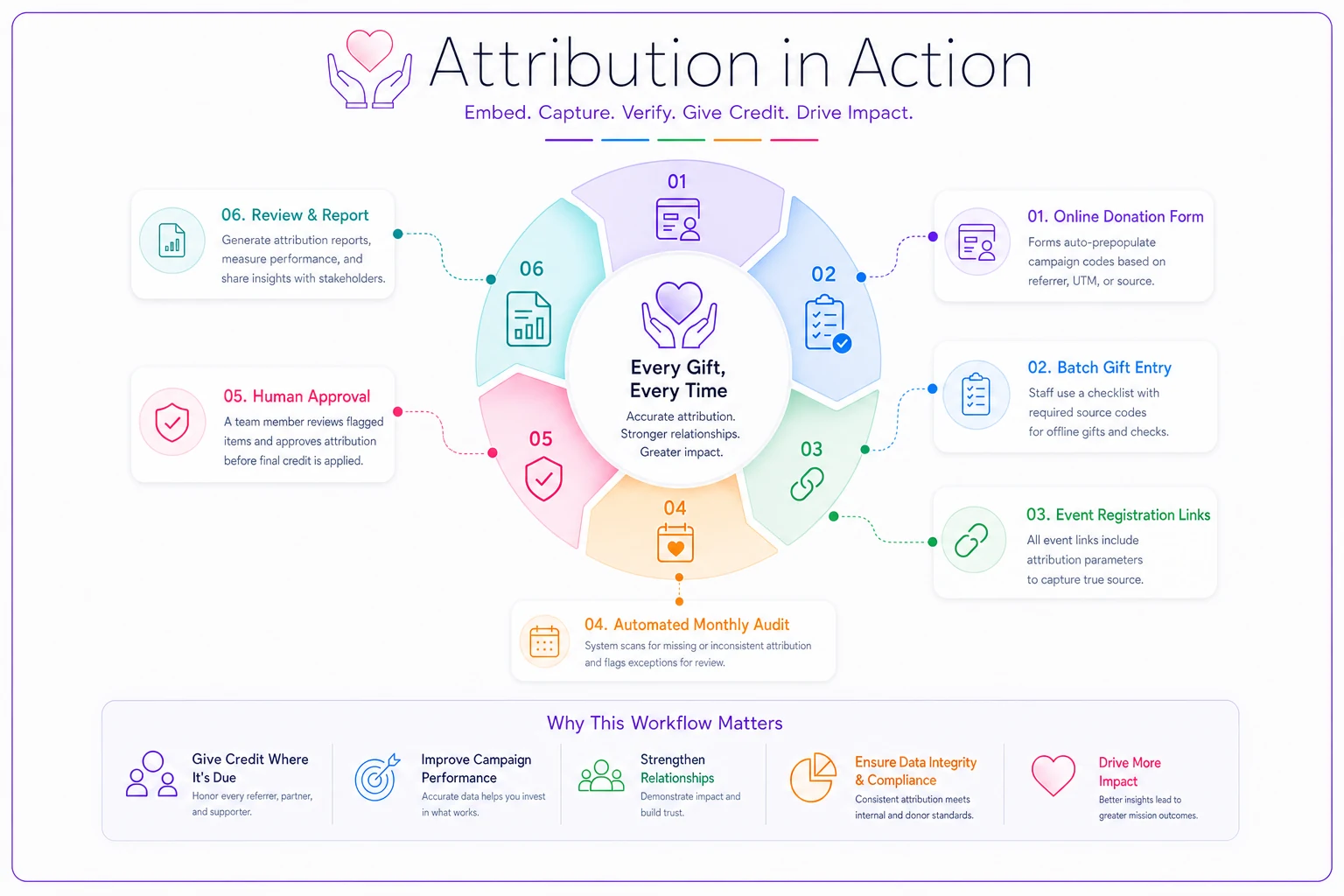
This visual shows how attribution data should flow into your systems so you don't need daily manual fixes.
AI-powered operational software can automate a lot of this. Modern platforms can read donation patterns, match against campaign timing, and suggest appropriate attribution—you review and approve rather than research and code every gift manually. That kind of automation eliminates the most tedious parts of attribution management while keeping the accuracy in human hands.
Create monthly attribution audits that take 30 minutes, not three days. Pull standard exception reports: unknown attribution over 10%, a single campaign claiming over 40% of monthly revenue, donors with conflicting attribution across gifts. Fix the outliers and move on.
Train every team member who touches donation data. They don't need to understand your entire attribution philosophy—just their specific part. Gift processors learn the waterfall rules. Event coordinators understand attribution windows. Database admins know when to override versus when to investigate.
Document decisions, not just rules. When you manually override attribution, note why. When you change attribution windows, record the reasoning. This institutional knowledge prevents recreating the same debates every year when someone questions why corporate partnerships gets credit for employee matching gifts.
The goal isn't perfect attribution—it's consistent, useful attribution that improves decision-making without creating operational burden. A simple framework that everyone follows beats a sophisticated system that only one person understands.
Campaign attribution in nonprofits isn't about tracking every touchpoint or building complex multi-touch models. It's about creating pragmatic rules that capture enough truth to make better decisions without overwhelming your team.
The frameworks outlined here—first-touch with influence tracking, time-decay windows, rule-based waterfalls—work because they match operational reality. Simple enough to implement consistently, but sophisticated enough to reveal meaningful patterns.
Start with the basics: pick one attribution model and stick with it for at least a year. Track five essential fields (First Source, Last Campaign, Attribution Credit, Response Mechanism, Days Since Touch). Build one simple dashboard that actually gets updated. Sample your data quarterly to catch problems early.
Attribution serves decision-making, not scorekeeping. The goal isn't to crown a winning campaign or perfectly allocate every dollar of credit—it's to understand which investments drive sustainable donor relationships and which just generate one-time transactions.
Your attribution framework should tell you where to spend the next dollar, not just where the last one came from. When you can answer questions like "What's the three-year value of donors acquired through peer-to-peer?" or "Which campaigns reactivate lapsed donors versus finding new ones?"—that's when attribution stops being a reporting exercise and starts being a strategic tool.
The perfect attribution system doesn't exist. But a good-enough system that your team actually uses will change how you understand donor behavior and allocate resources. Start simple, be consistent, and let the framework evolve as your fundraising operation grows.
Ready to elevate your nonprofit impact?
Join 2,000+ nonprofits using Almosly to boost fundraising efficiency, deepen donor relationships, and scale philanthropic impact.