

Most data cleanup projects fail for a boring reason: the schema that created the mess is still in place after cleanup ends. You spend six weeks deduping households, standardizing gift types, fixing employer fields — and four months later you're back where you started because nothing stopped the bad data from coming in again.
That's the actual problem this article addresses. Not "how to clean your database" — plenty of consultants will sell you that on a loop. The problem is the shape of your data. If your CRM lets a gift exist without a required designation, or lets three versions of the same household float around unlinked, cleanup becomes a permanent job function instead of a one-time fix.
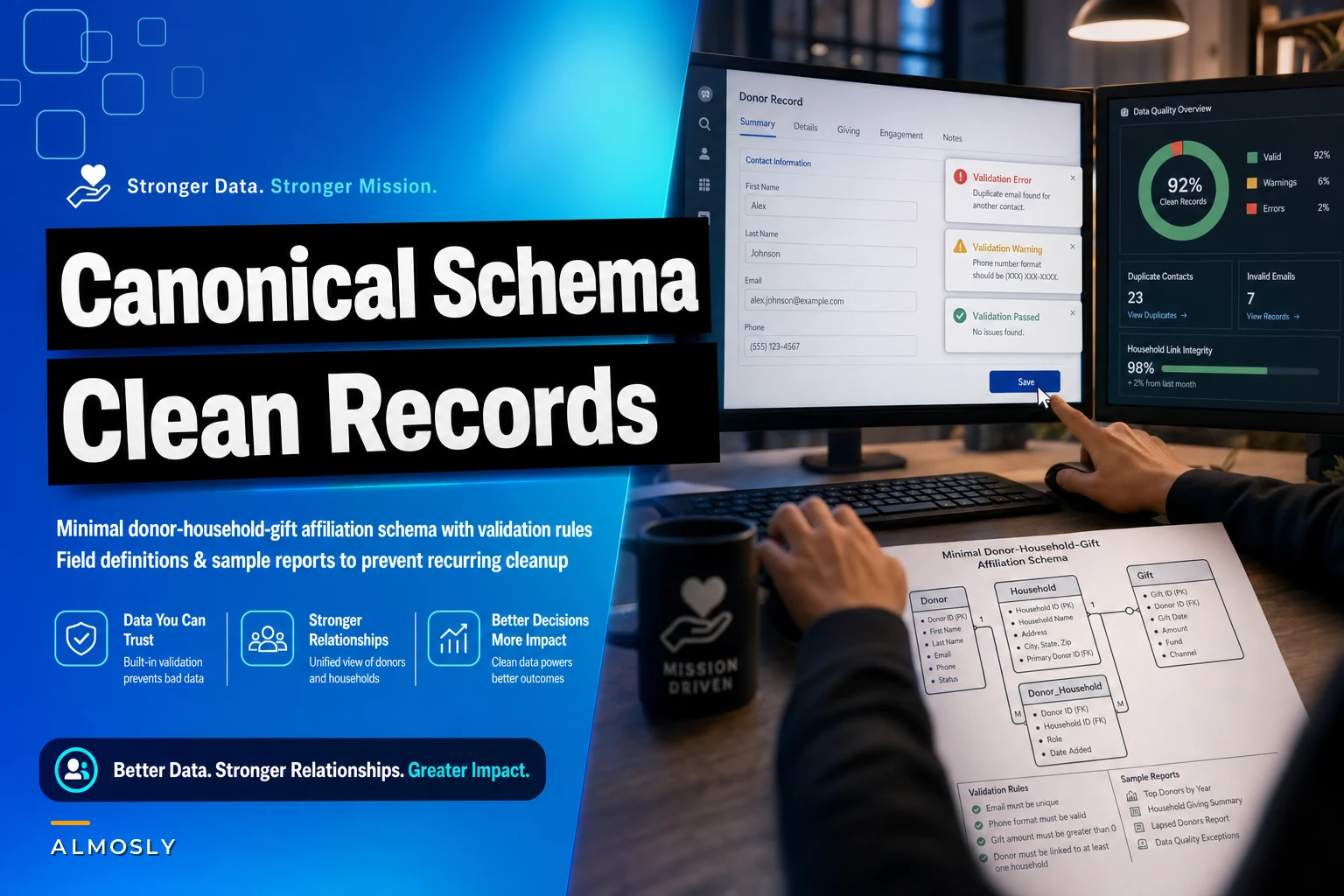
What follows is a minimal canonical data model — four core objects, defined fields, validation rules, and the reports that tell you when the model is breaking. It's intentionally small. The nonprofits that keep clean data don't have elaborate schemas. They have a few well-defended entities and rules that fire at the moment of entry.
Why cleanup keeps coming back
Cleanup recurs when your database allows contradictory truth. Two records both claiming to be "the" Anderson household. A pledge recorded as a gift. An employer typed as "IBM," "I.B.M.," and "International Business Machines" across three donor records.
None of those are cleanup failures. They're schema failures. The system permitted them, so a well-meaning staffer created them.
This usually happens when a nonprofit grows its team faster than it defines its data rules. Year one, one person enters everything and holds the conventions in their head. Year three, five people enter data and each carries their own. The database has no opinion, so it accepts all five versions. Six months later someone runs a mailing list and finds 400 apparent duplicates.
The fix isn't a person who cares more. It's a model that refuses bad input.
The four canonical objects
You need exactly four core entities to run a mid-sized nonprofit's fundraising data. More than that and you're building complexity you'll pay for later. Fewer and you'll jam mismatched data into shared fields.
Stop missing fundraising opportunities.
Almosly helps you plan, track, and optimize every campaign with ease.
- Centralized donor and volunteer management
- Automated engagement workflows
- Impact and fundraising analytics
No credit card required
| Object | Represents | Primary key | Never mix with |
|---|---|---|---|
| Donor (Constituent) | An individual person | constituent_id | Organizations, households |
| Household | A giving/mailing unit of 1+ people | household_id | Individual gift history |
| Gift | A single financial transaction | gift_id | Pledges, soft credits |
| Affiliation | A relationship (employer, board, spouse) | affiliation_id | Gift attribution |
The single most common structural mistake is collapsing Donor and Household into one record. A married couple who gives jointly is one household made of two constituents. If you flatten that, you can't answer "how many donors do we have" and "how many mailings do we send" with the same table — because those are different numbers and they should be.
The second most common mistake is treating a Gift as anything other than money that already moved. Pledges, matching commitments, planned-giving intentions — none of those are gifts. They belong in their own status fields or objects. Mixing them inflates revenue reports and creates the classic "we thought we raised $X but banked $Y" gap.
Field definitions that actually prevent drift
You don't need 200 fields. You need the right 30 or so, each with a defined format. Below are the fields that carry the weight. Everything else is optional metadata you can add later without breaking the model.
Donor (Constituent)
-
constituent_id— system-generated, immutable, never reused -
firstname,lastname— required, trimmed of whitespace -
preferred_name— optional, drives salutations -
email_primary— validated format, unique-per-constituent -
deceased_flag— boolean, drives suppression -
household_id— foreign key, required (even single-person households get one) -
status— enumactive,lapsed,donotcontact
Household
-
household_id— system-generated -
household_name— the mailing/formal name -
primaryconstituentid— the head-of-household pointer -
addressline1,city,state,postalcode— the single source of truth for mail -
mail_suppress— boolean
Gift
-
gift_id— system-generated -
constituent_id— who is credited (hard credit) -
household_id— denormalized for household rollups -
amount— decimal, must be > 0 -
gift_date— date the money moved, not the date entered -
gifttype— enumcash,check,card,ach,stock,inkind -
designation— enum from your fund list, required -
campaign_id— required, even if it's "unrestricted/general" -
payment_status— enumsettled,refunded,failed
Affiliation
-
affiliation_id— system-generated -
constituent_id— the person -
related_entity— employer, organization, or another constituent -
relationshiptype— enumemployer,spouse,boardmember,matching_org -
startdate,enddate— dates bound the relationship
The subtle point most schemas miss: end_date on affiliations. Without it, you keep crediting matching gifts to an employer someone left three years ago, or addressing a newsletter to a spouse who's no longer relevant. Relationships expire. Your model should account for that.
Validation rules — the part that stops recurrence
Fields alone don't prevent drift. Rules do. A validation rule is a condition the system checks before it saves a record. If cleanup is a mop, validation is fixing the leak.
-
Every gift requires a designation and a campaign. No blank funds. This single rule prevents the most painful year-end reconciliation problem — money you can't attribute.
-
Gift amount must be greater than zero. Refunds get a
refundedstatus, not a negative gift record that breaks totals. -
Email must pass format validation and be unique within a constituent. Blocks the "typo email" duplicates that fragment your outreach.
-
New constituent triggers a duplicate check on last name + postal code + email before saving. This is the biggest single defense against re-duplication.
-
A gift cannot be saved without a linked constituent and household. Orphan gifts are the reason your donor counts never match your revenue.
-
deceasedflag = trueforcesmailsuppress = trueand removes the record from active solicitation queries automatically. -
Employer names pull from a controlled list, not free text. "IBM" is one value, chosen from a dropdown, not typed.
Rule four deserves emphasis. Duplicates don't usually come from careless staff — they come from the entry moment where the system doesn't warn you a similar record already exists. A soft-match prompt ("3 possible matches found — link or create new?") at point of entry prevents somewhere between 80 and 90 percent of the duplicates that cleanup projects later chase down.
Building the rules into your workflow
Rules that live in a policy document don't fire. Rules that live in the database do. Most nonprofits actually have data conventions — they're just written in a Google Doc nobody opens.
-
Staffer opens a new gift entry form
-
System requires designation and campaign before the record can save
-
Constituent lookup runs a duplicate scan as the name is typed
-
Amount field rejects zero and negative values at input
-
Employer field pulls from a controlled dropdown list
-
System flags any gift date falling outside the current fiscal period
-
Record saves only when all required fields pass validation
When a staffer enters a gift, the form itself enforces the structure: designation is a required dropdown, campaign is a required dropdown, amount rejects zero and negatives, and the constituent lookup runs a duplicate scan as they type the name. Nothing saves until the required fields are valid. The staffer literally can't create the mess.
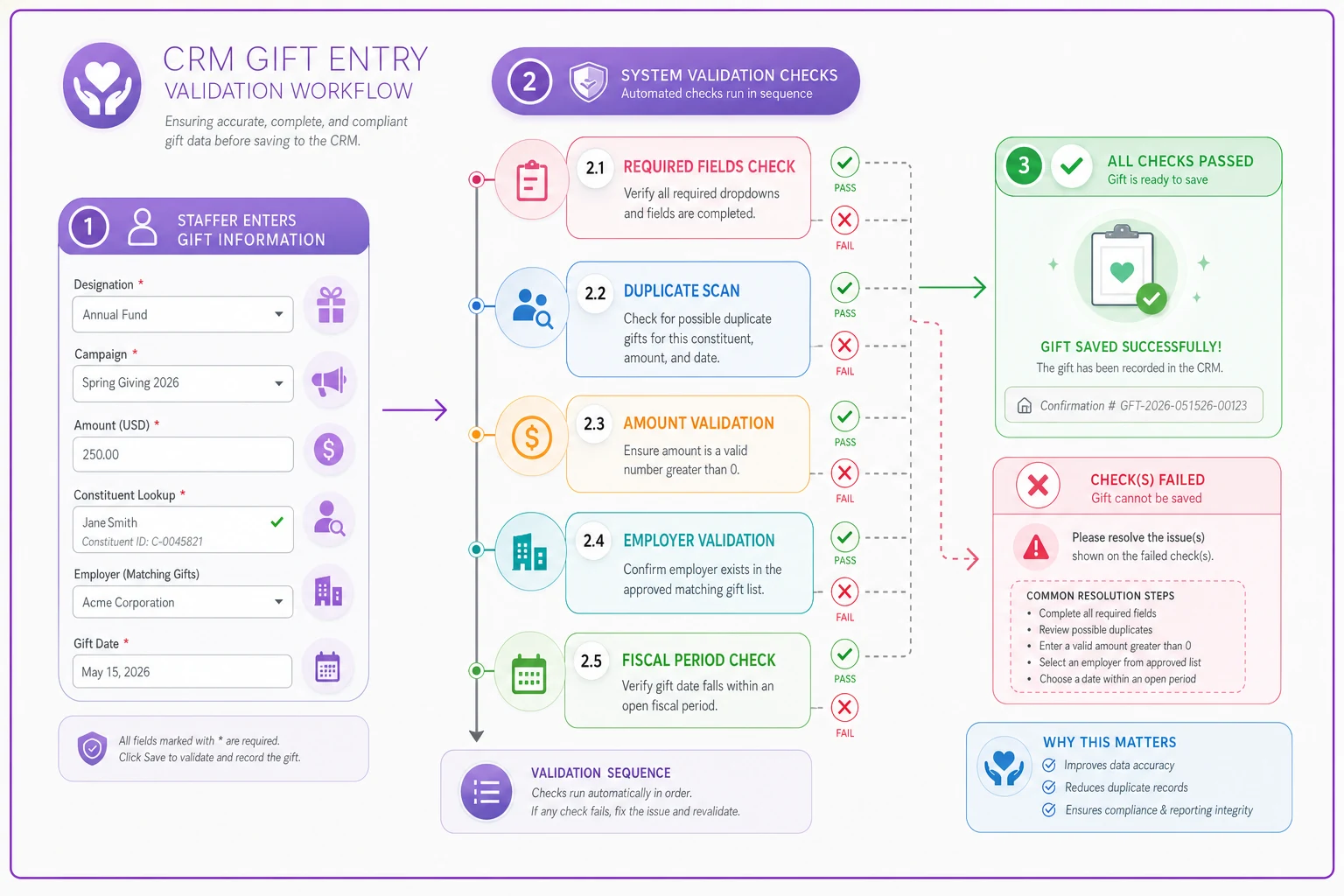
A quick diagram of the entry-time validation workflow.
This is where modern AI-assisted CRM platforms earn their place — quietly, not dramatically. Instead of relying on a human to remember that "Jon Smith at 4th Street" is probably the "John Smith" already in the system, the platform surfaces the likely match automatically, flags an employer that doesn't match your controlled list, and can catch a gift dated in the wrong fiscal period before it gets booked. It's not magic — it's applying your validation rules consistently, every time, without fatigue. Consistency is exactly what humans are worst at over time, and that's precisely where recurring cleanup is born.
Sample reports that tell you the model is holding
A canonical model only works if you can see it drifting. Three reports catch nearly every problem before it compounds. Run them monthly.
Schedule the Duplicate candidate report for regular delivery to the data steward so emerging clusters are reviewed weekly.
Report 1 — Orphan and integrity scan Lists any gift with no household, any constituent with no household, any gift with a blank designation or campaign, and any active constituent marked deceased. A healthy database returns zero rows here. If this report returns 40 rows, you've found the exact leak — not a vague "we have data problems."
Report 2 — Duplicate candidate report Groups constituents by matching last name + postal code, or matching email, and flags clusters of two or more. Reviewing five candidates a week is manageable. Reviewing 500 once a year is a project you'll keep postponing.
Report 3 — Designation and campaign completeness Percentage of gifts in the period with a valid designation and campaign. This should sit at 100%. Anything below tells you a rule isn't firing somewhere — often a bulk import that bypassed the entry form.
On that note: bulk uploads are the classic backdoor. They frequently skip validation entirely. Every batch import needs to pass the same rules as manual entry, or you've built a careful front door and left the loading dock wide open. If your related processes depend on clean fields — and they do — the payoff compounds. Both a workable donor segmentation taxonomy and any real impact-measurement process fall apart the moment designations and household links are unreliable.
A real scenario
A regional food-security nonprofit — roughly 8,000 constituents, three-person development team — ran a cleanup every spring before their annual report. Each round took about three weeks and surfaced somewhere around 600 duplicate or orphaned records. Same categories of problems, every year.
When they mapped their actual schema, the cause was obvious: no required designation on gifts, no duplicate check at entry, and Donor and Household stored in a single flattened table. Three staffers, three sets of conventions, no enforcement.
They didn't do a bigger cleanup. They rebuilt to the four objects above, added the seven validation rules at the entry form, and set the three monthly reports running. The next spring, the pre-report cleanup took about two days. The duplicate candidate report was surfacing five to ten records a month instead of hundreds all at once.
The number that mattered wasn't the record count. It was staff hours — roughly 90 hours of recurring cleanup a year dropped to something closer to 15.
When this makes sense — and when it doesn't
This makes sense when you have more than one person entering data, you've done at least one cleanup project already, or your donor and gift counts don't reconcile with finance. Those are signs the schema — not the staff — is the bottleneck.
This is a bad idea when you're mid-migration to a new CRM. Don't build validation rules on a system you're about to leave. Define the canonical model as part of the migration so the new system launches with the rules already in place. Retrofitting a live system you're about to abandon wastes effort that should go toward the new setup.
Who should skip this: a genuinely small operation — one person, a few hundred records, one annual appeal. At that scale a spreadsheet with strict column rules does the job, and the four-object model adds structure you won't use. The threshold is roughly when a second person starts entering data, or you cross a couple thousand records.
The core idea, kept simple
Recurring cleanup is a symptom. The disease is a schema that accepts contradictory data. You cannot out-discipline a system that lets anyone type an employer name three different ways or save a gift with no designation. Eventually someone will, and cleanup returns.
Define four objects. Enforce a short list of rules at the entry point. Run three reports monthly to catch drift while it's still five records instead of five hundred. The databases that stay clean are the ones where staying clean isn't a choice anyone has to make — the system just won't let it happen any other way.
Ready to elevate your nonprofit impact?
Join 2,000+ nonprofits using Almosly to boost fundraising efficiency, deepen donor relationships, and scale philanthropic impact.