
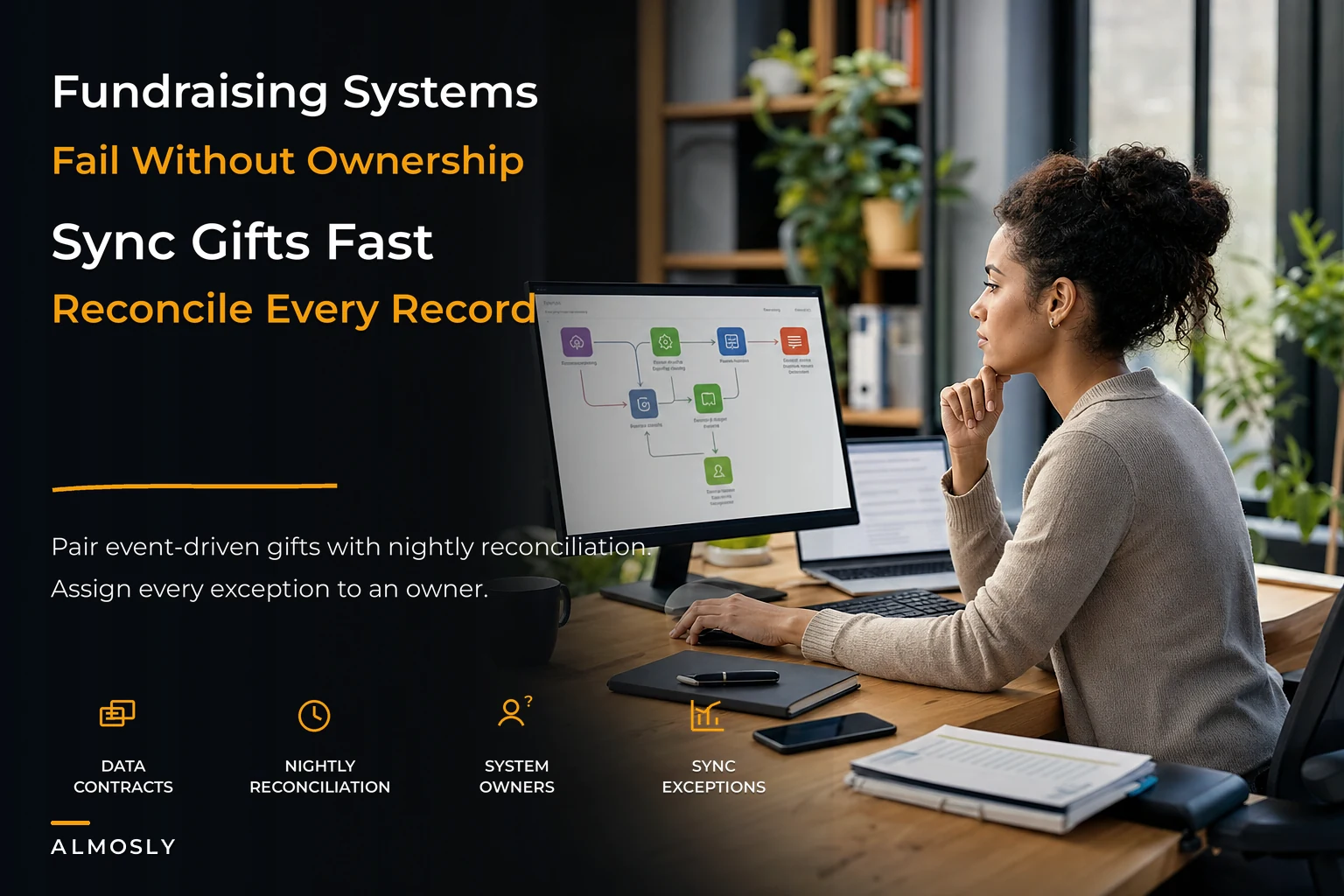

Most nonprofit tech stacks don't fail because someone picked the wrong CRM. They fail because nobody owns the seams between systems. The CRM talks to the payment processor, the payment processor feeds the accounting system, the email platform syncs some subset of contacts back, and the events tool lives off in its own corner pushing CSVs into whatever inbox will take them. Each tool works fine on its own. The space between them is where everything quietly rots.
This is an architecture problem, and mid-sized nonprofits hit it hardest. You're too big for one person to hold the whole data model in their head, but too small to have a data engineer who owns integrations full-time. So ownership gets distributed by accident — the development director "owns" the CRM, finance "owns" the accounting export, the digital person "owns" the email sync — and nobody owns the contracts tying them together. When a field changes shape, there's no one whose job it is to notice.
What follows is a practical architecture for that middle layer: who owns what, when to use real-time eventing versus scheduled batches, how to write field-level data contracts so systems stop silently breaking each other, and how to test the whole thing before it touches a donor record. Written for the people doing the implementation, not for a vendor shortlist.
Start by naming a canonical source of truth for every entity
Before any integration discussion, you need one decision made and written down: for each type of record, which system is the authority?
The most common cause of reconciliation hell is two systems both believing they own the donor's email address. The CRM has one version, the email platform has another, a donor updates it in the donation form, and now you have three versions with no rule for which wins. Multiply that across address, giving history, consent flags, and employer, and you get a stack where no report can be trusted.
Pick one system as canonical per entity — not per stack. A realistic assignment for a mid-sized org looks like this:
| Entity | Canonical source of truth | Everyone else gets |
|---|---|---|
| Constituent identity (name, contact, consent) | CRM | Read-only copy, synced |
| Transactions (gifts, refunds) | Payment processor → CRM | Accounting reads from CRM summary |
| Pledges & recurring schedules | CRM | Processor executes, reports back |
| Email engagement (opens, clicks, unsubscribes) | Email platform | CRM stores status flags only |
| Event registrations | Events tool → CRM | CRM holds final attendance |
| Financial ledger (GL, restricted funds) | Accounting system | CRM never overwrites GL |
The rule that saves you: a system that is not the canonical source may read a field but may never silently overwrite it. If the email platform collects a new address, it doesn't push a change — it raises a suggested update that the CRM's owner accepts or rejects. That one discipline eliminates most of the mystery-data problems that surface months later when someone asks why a donor's address reverted.
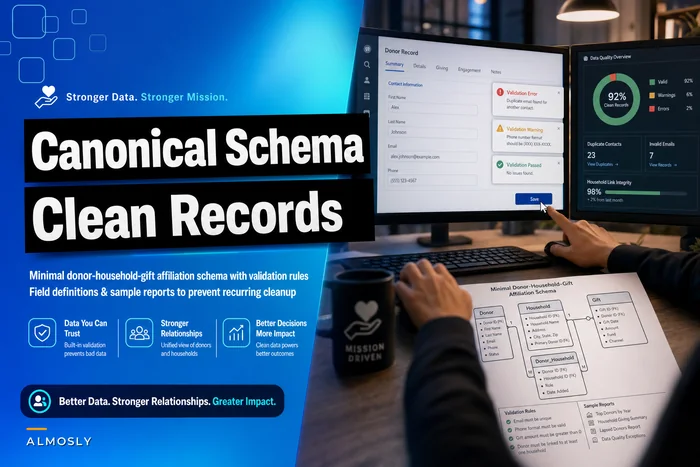
If your underlying data model is still messy, fix that before you wire anything together. Integrations amplify whatever structure they're built on. A clean, minimal CRM data model with canonical fields and validation rules is the precondition, not an afterthought — syncing duplicate and inconsistent records just spreads the mess faster.
Assign system ownership as a role, not a person
Ownership needs to survive turnover. If "Dana knows how the Stripe sync works" is your documentation, you don't have an architecture — you have a hostage situation.
Stop missing fundraising opportunities.
Almosly helps you plan, track, and optimize every campaign with ease.
- Centralized donor and volunteer management
- Automated engagement workflows
- Impact and fundraising analytics
No credit card required
For each system and each integration point, assign three roles:
-
System owner — accountable for the tool itself, its configuration, and its field definitions. Usually a program lead.
-
Integration owner — accountable for the pipe between two systems, including the data contract, failure alerts, and reconciliation. This is the role most orgs forget to fill.
-
Data steward — accountable for the quality and meaning of specific fields (what "active recurring donor" actually means, how consent is coded).
The integration owner is the critical gap in real operations. System owners naturally care about their own tool. Nobody wakes up thinking about the connection between two tools they each half-use. So when the payment processor adds a new status value and the CRM doesn't recognize it, there's no single person whose pager goes off. Name that person explicitly, per integration, in a one-page registry. It can be the same person across several pipes — but it can't be nobody.
``
Integration: Stripe → CRM (gift sync)
Integration owner: Dev Ops Manager
Source of truth: Stripe (transaction), CRM (constituent match)
Style: webhook (real-time) + nightly batch reconciliation
Alert channel: #ops-alerts Slack + email to owner
Last contract version: v2.3
Reconciliation cadence: daily automated, weekly human review
``
Eventing vs batch: pick per integration, not per stack
There's a tendency to standardize — "we're going to do everything real-time" or "we batch everything overnight." Both are wrong as blanket rules. The right integration style depends on how fast the data needs to be accurate and how costly a mistake is.
Real-time eventing (webhooks) suits things where a delay directly harms the donor experience: a gift confirmation, a receipt, a failed-payment notice, an event registration confirmation. Batch suits things where accuracy over a window matters more than immediacy — nightly financial reconciliation, enrichment updates, engagement scoring, bulk list syncs.
| Situation | Use webhooks (eventing) | Use ETL / batch |
|---|---|---|
| Donor-facing confirmation or receipt needed | ✅ | ❌ |
| Failed recurring payment needs recovery action | ✅ | ❌ |
| Financial reconciliation to the GL | ❌ | ✅ (nightly) |
| Data enrichment / wealth screening | ❌ | ✅ |
| Event check-in attendance | ✅ | ❌ |
| Engagement scoring recompute | ❌ | ✅ |
| High-volume historical backfill | ❌ | ✅ |
| Consent / unsubscribe propagation | ✅ | ✅ (both — event for speed, batch to catch misses) |
A pattern worth internalizing: the best stacks use webhooks for the event and batch for the truth. The webhook fires fast so the donor gets their receipt. The nightly batch re-pulls the full day's transactions and reconciles them against what the webhook claimed happened. Webhooks drop. They fire twice. They arrive out of order. If you treat a webhook as the final word, you will have gifts that never landed and donors who got double-receipted. The batch is what catches what the event stream missed.
The diagram below shows how that two-layer pattern flows in practice — the webhook path handles the immediate donor-facing action while the batch path runs the nightly truth check:
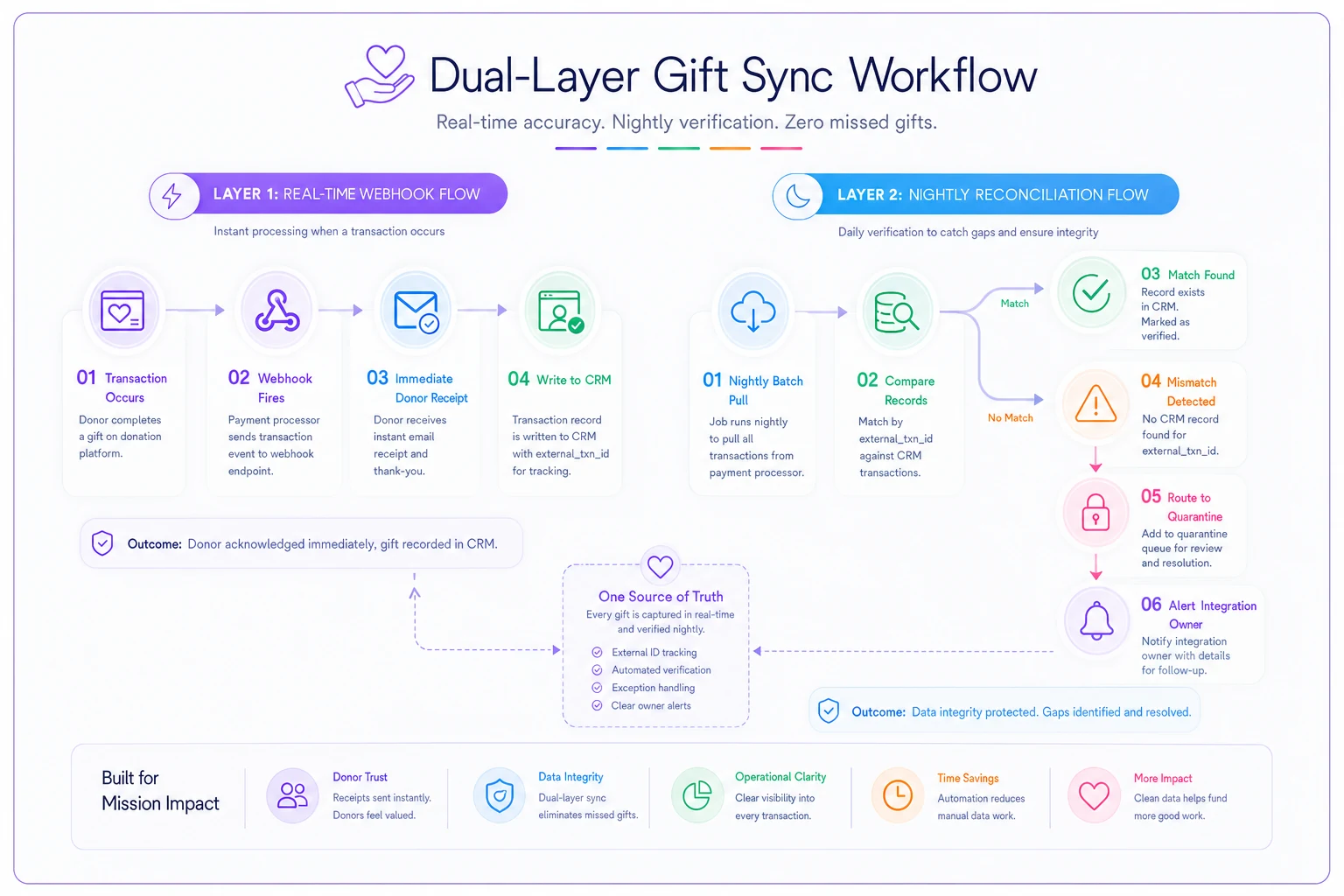
Consent is the one row where you genuinely want both. An unsubscribe should propagate immediately via event so you don't email someone who just opted out — but you also want a nightly batch sweep to confirm no opt-out got dropped, because a missed unsubscribe is a compliance problem, not just an annoyance.
Write field-level data contracts, not "we'll figure out the mapping"
A data contract is the agreement between two systems about exactly what a field is named, what type it holds, what values are allowed, and what happens when it changes. Without one, every integration is an informal verbal understanding that breaks the moment one side ships an update.
``json
{
"contract": "stripetocrm.gift",
"version": "2.3.0",
"fields": {
"externaltxnid": { "type": "string", "required": true, "immutable": true },
"constituentmatch": { "type": "string", "required": true, "matchon": ["email", "externalid"] },
"amountcents": { "type": "integer", "required": true, "min": 1 },
"currency": { "type": "string", "required": true, "enum": ["USD"] },
"giftdate": { "type": "string", "format": "date-time", "required": true },
"designation": { "type": "string", "required": false, "default": "unrestricted" },
"recurringid": { "type": "string", "required": false },
"status": { "type": "string", "enum": ["succeeded", "refunded", "disputed"], "required": true },
"sourcechannel": { "type": "string", "required": false }
},
"onunknownfield": "rejectandalert",
"onmissing_required": "quarantine"
}
``
Two decisions in that schema matter more than the field list. onunknownfield: rejectandalert means that if Stripe starts sending a field you didn't define, the integration doesn't silently swallow it — it flags it. That's how you catch upstream changes before they corrupt data. And onmissingrequired: quarantine means a malformed record goes to a holding area for human review instead of either failing the whole batch or getting imported half-complete.
The designation field is where real-world pain lives. If your payment form lets donors pick a fund but the CRM's designation list doesn't exactly match the processor's values, every mismatch becomes a manual fix. Lock the enum on both sides and make changing it a contract-versioned event. Getting designation and fee data right at the contract level is what makes clean payment routing and fee controls possible instead of a monthly accounting scramble.
Versioning the contract
Version every contract with semantic versioning, and make the rule explicit:
-
Patch (2.3.0 → 2.3.1) documentation or non-breaking default change. No code change needed downstream.
-
Minor (2.3.0 → 2.4.0) new optional field added. Consumers can ignore it safely.
-
Major (2.3.0 → 3.0.0) a field removed, renamed, retyped, or an enum value dropped. Requires coordinated deploy on both sides.
The failure mode to prevent: someone makes a "small" change to a field type — turning an integer amount into a string, say — and ships it as a patch. Downstream parsing breaks silently and gifts stop importing. If retyping a field always forces a major version, that conversation happens before the break, not after.
SLA, rollback, and reconciliation heuristics
An integration without an SLA is just a hope. You don't need enterprise-grade targets — you need agreed, written expectations so you know when something is actually broken versus just slow.
Reasonable SLAs for a mid-sized org:
-
Receipt/confirmation events delivered within 2 minutes, 99% of the time.
-
Gift-to-CRM sync record present within 15 minutes (webhook) or by next morning (batch).
-
Reconciliation window every transaction reconciled against the source within 24 hours.
-
Alert-to-acknowledgment integration owner responds to a failure alert within one business day.
Rollback heuristics
When a sync goes wrong, the instinct is to re-run it. Don't — not until you know why it broke. A re-run on top of a partial import creates duplicates, which is a far worse cleanup job than the original failure. Instead, work through this sequence:
-
Pause the integration at the first alert. Stop writing before you understand the failure.
-
Quarantine the affected batch — move the suspect records to a holding table, don't delete or merge.
-
Identify the blast radius. How many records, which fields, written since when? Your reconciliation log should answer this.
-
Reverse by external ID, never by internal row. Because
externaltxnidis immutable and unique, you can cleanly identify exactly which records this run created and roll back only those. -
Replay from the source of truth, not from a cached copy. Re-pull from the canonical system so you're reconstructing from authority, not from whatever the broken run left behind.
The immutable external ID in your contract is what makes step 4 possible. That's the quiet reason that field is marked immutable: true — it's your rollback anchor. Without a stable unique key from the source system, every rollback becomes guesswork.
Reconciliation heuristics
Reconciliation is comparing two systems that should agree and flagging where they don't. The heuristic that catches the most real problems: reconcile on count and sum first, then drop to record-level diff.
-
Daily
does the count of gifts in the CRM match the count in the processor for that date? Does the dollar sum match to the cent?
-
If counts or sums disagree, drop to record-level
which
externaltxnids exist in one system but not the other? -
Weekly human review
look at the quarantine table and the suggested-update queue. Clear them. If they're growing, a contract is drifting.
A growing quarantine pile is the single best early-warning signal you have. It means a system upstream changed shape and your contract is catching it — which is exactly what it's for, but only if a human actually looks.
A runnable integration testing checklist
Before any integration touches production donor data, run it through this. The implementation team should literally check off each item:
-
- [ ] Happy-path record flows end-to-end and lands correctly in the destination.
-
- [ ] Missing required field triggers quarantine, not a silent partial import.
-
- [ ] Unknown extra field triggers reject-and-alert, not silent acceptance.
-
- [ ] Duplicate webhook (same
externaltxnidtwice) results in one record, not two. -
- [ ] Out-of-order events (refund arriving before the gift) resolve to correct final state.
-
- [ ] Enum violation (unexpected status or designation value) is caught and flagged.
-
- [ ] Amount edge cases — zero, negative, very large, wrong currency — are rejected per contract.
-
- [ ] Constituent match ambiguity (two people, same email) routes to manual review, doesn't auto-merge.
-
- [ ] Batch re-run over the same window produces no duplicates (idempotency check).
-
- [ ] Rollback drill reverse a test batch by external ID and confirm only those records are removed.
-
- [ ] Reconciliation counts and sums match the source after a full test cycle.
-
- [ ] Alert delivery a forced failure actually reaches the integration owner's channel.
The one people skip is the rollback drill, and it's the one that matters most at 9pm when a sync has gone sideways. Practice the reversal on test data once and you'll move with confidence under pressure instead of improvising on live records.
A real scenario: the designation drift that cost a season of reports
A mid-sized human-services org — roughly $4M in annual revenue, around 11,000 active donors — ran gifts from their online form through a processor into their CRM via webhook only. No nightly reconciliation, no field contract. It worked fine for about two years.
Then marketing added three new fund designations on the donation form for a capital campaign. The CRM's designation picklist didn't have matching values. The webhook kept firing, gifts kept importing — but the new designations landed as blank, defaulting to "unrestricted." Nobody noticed because receipts went out fine and the total dollars matched.
The problem surfaced roughly ten weeks later when finance tried to report on restricted capital-campaign gifts and found around $90k sitting in unrestricted that donors had clearly designated otherwise. Re-attributing it meant pulling processor records, matching by transaction ID, and correcting gift by gift — a few weeks of someone's time, plus some awkward conversations with campaign donors about where their money had been sitting.
The fix was architectural, not heroic: they added a field contract with a locked designation enum, set it to quarantine any gift carrying an unrecognized designation, and added a nightly batch reconciliation comparing processor designations against CRM designations. The next time marketing added a fund, the first mismatched gift hit quarantine within a day and the integration owner got an alert — before a single record was misfiled. Same mistake, caught in hours instead of a quarter.
What changes as you grow
At a small scale, one person can hold the whole stack in their head and a weekly manual export is fine. The architecture above feels like overkill — and at that size, it is.
The shift happens when you cross into the mid-sized range: multiple tools, multiple people touching data, and enough transaction volume that manual eyes can't catch every anomaly. The number of possible breakpoints grows faster than your headcount. Two systems have one connection; five systems have ten possible connections, and you can't personally watch all ten.
Growth also changes the cost of a failure. A dropped gift when you process 50 a month is an annoyance you'll spot quickly. A dropped gift when you process 5,000 a month hides in the noise for weeks. The entire point of contracts, reconciliation, and quarantine is to replace the human attention that used to catch problems with a system that catches them automatically and escalates only the exceptions worth a human's time.
This is also where thoughtful automation earns its keep — not as a replacement for judgment, but as the thing that watches the seams tirelessly so your team doesn't have to. The same discipline you apply to integrations applies to any automated donor-facing logic riding on top of them; the principles in ethical AI governance for donor personalization depend entirely on the data underneath being correct and reconciled in the first place.
Where to start
If your stack is already tangled, don't try to redesign everything at once. Start with one decision and one document:
-
Pick the canonical source of truth for your constituent and transaction records. Write it down.
-
Name an integration owner for your single most important pipe — almost always payment-to-CRM.
-
Write the field contract for that one integration, with a locked enum on designation and status.
-
Add a nightly reconciliation on counts and sums for that pipe.
-
Run the testing checklist against it, including the rollback drill.
That's one integration, hardened. Then do the next one. Architecture at this level isn't a big-bang rebuild — it's making each seam explicit, owned, and tested, one at a time, until nothing in your stack can change shape without someone knowing.
If a larger CRM or platform decision is on the horizon, build these ownership and contract questions into the selection process itself rather than retrofitting them later. A phased approach to CRM roadmapping and procurement that includes integration ownership from the start prevents the most expensive kind of rework — the kind you discover a year after go-live, when the seams you never designed finally give.
If a larger CRM or platform decision is on the horizon, build these ownership and contract questions into the selection process itself rather than retrofitting them later. A phased approach to CRM roadmapping and procurement that includes integration ownership from the start prevents the most expensive kind of rework — the kind you discover a year after go-live, when the seams you never designed finally give.
Ready to elevate your nonprofit impact?
Join 2,000+ nonprofits using Almosly to boost fundraising efficiency, deepen donor relationships, and scale philanthropic impact.