
Most CRM regret isn't about picking the wrong platform. It's about scoping the project as one giant lift instead of a sequence. A nonprofit signs a contract, tries to migrate everything, integrate everything, and clean everything simultaneously — and eighteen months later they're either still not live or already talking about switching again. The tool gets blamed. The scope was the actual problem.
Roadmapping and procurement are really the same conversation, even though most orgs treat them as separate steps handled by different people. Procurement asks "what do we buy." Roadmapping asks "in what order do we turn it on." When those two get disconnected, you end up buying capabilities you won't touch for two years and skipping the foundational work that determines whether any of it holds together.
This is a systems piece, not a vendor-selection checklist. The goal is to show how the parts connect — data model, integrations, workflows, staff capacity — and why a phased scope (quick wins → integrations → optimizations) prevents the repeated migrations that quietly drain small and mid-sized nonprofits.
Why "buy it all now" scoping keeps failing
The pattern shows up almost identically across orgs of very different sizes. Leadership approves a budget, the vendor demo shows every shiny feature, and the implementation plan tries to deliver all of it in one push. What breaks isn't the software. It's the assumption that the org can absorb that much change while still running annual appeal, events, and grant reporting.
-
The data cleanup that should happen before anything else gets rushed, so bad records flow into every new workflow.
-
Integrations get built against processes nobody has finalized yet, so they break the moment someone changes a form.
-
Staff get trained on advanced features before they've internalized basic daily entry, so adoption stalls.
-
The org runs out of budget or political goodwill before the "optimization" work — the stuff that actually improves fundraising — ever gets touched.
The deeper issue is sequencing dependencies. You can't automate a stewardship sequence on top of donor data you don't trust. You can't integrate your email platform cleanly if your record structure is inconsistent. Skipping the order of operations is how you end up migrating again — not because the CRM failed, but because the foundation was never poured.
The three-tier scope, and what actually belongs in each
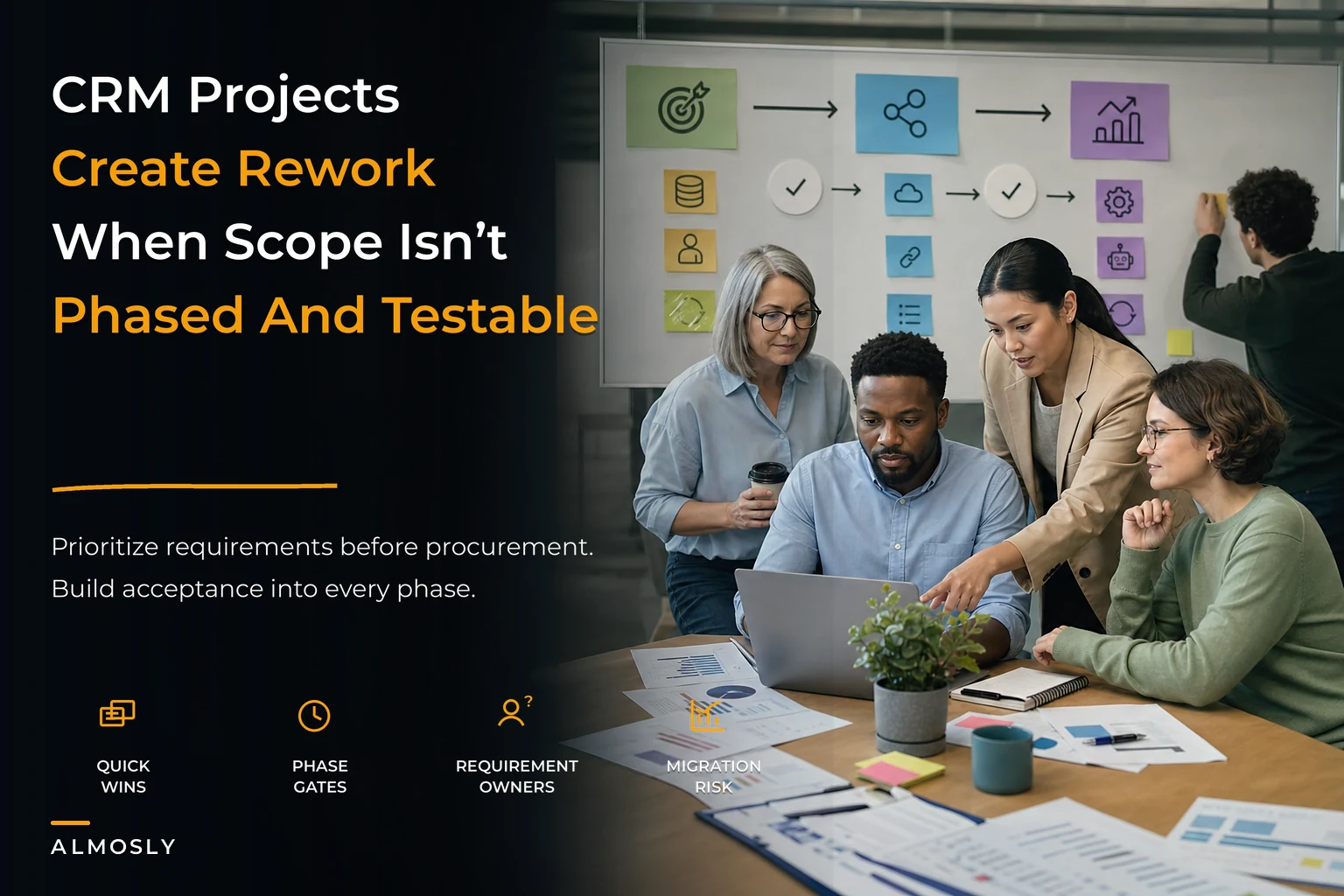
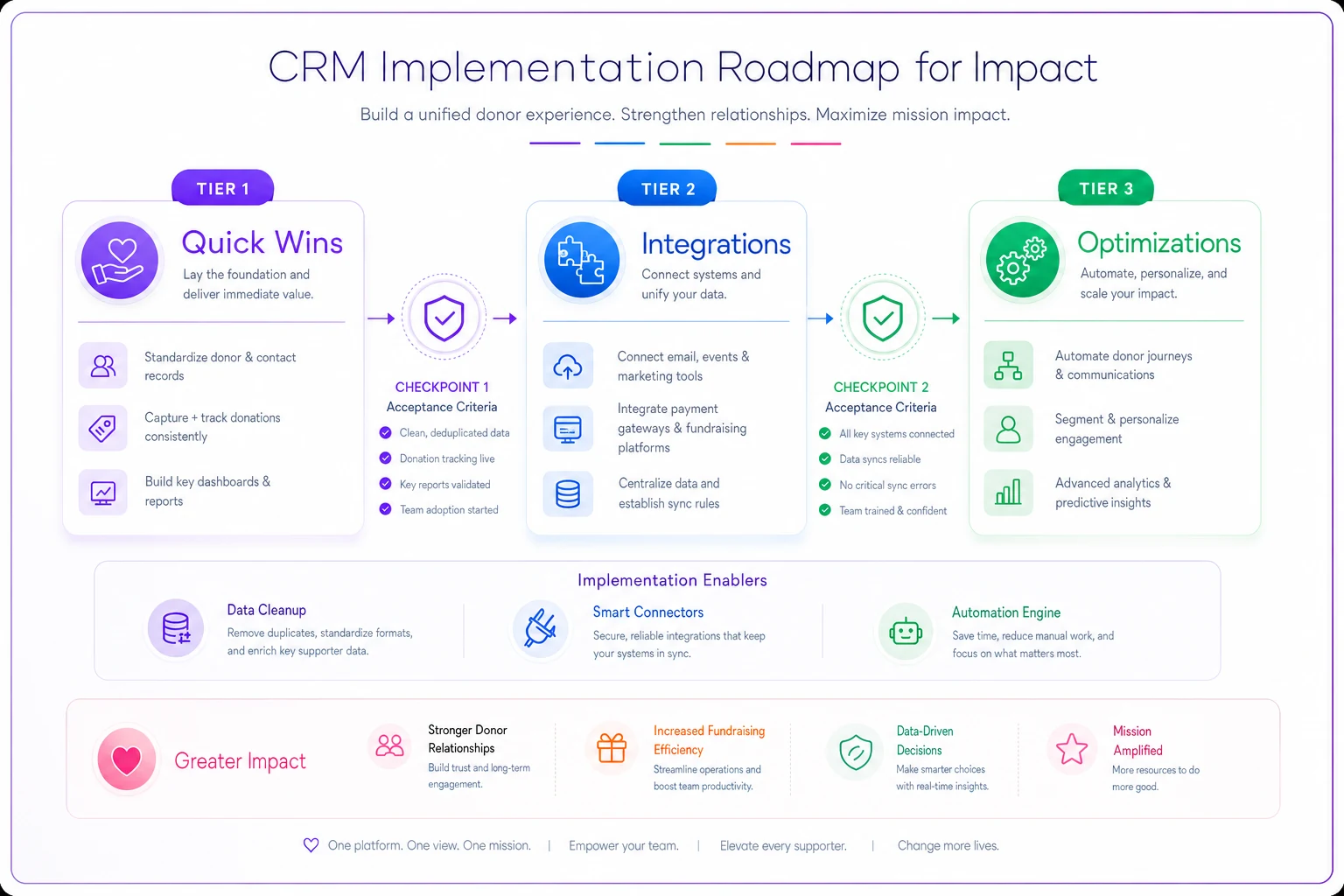
Think of the roadmap as three tiers with hard dependencies between them. Tier 1 exists to make daily work reliable and prove value fast. Tier 2 connects systems so data stops living in silos. Tier 3 is where you optimize — the segmentation, scoring, and automation that lift results. Most failed projects invert this, chasing Tier 3 features while Tier 1 is still broken.
Stop missing fundraising opportunities.
Almosly helps you plan, track, and optimize every campaign with ease.
- Centralized donor and volunteer management
- Automated engagement workflows
- Impact and fundraising analytics
No credit card required
Here's how the tiers break down and, just as importantly, why each one has to come before the next.
| Tier | Focus | What's in scope | Why it comes first |
|---|---|---|---|
| T1 – Quick wins | Reliable daily operations | Core record structure, canonical fields, gift entry workflow, deduplication, basic reports, staff training on entry | Nothing above this works if the underlying data is messy or inconsistently entered |
| T2 – Integrations | Connected systems | Email/marketing sync, payment processor, event tools, accounting reconciliation, web forms | Integrations built on unstable T1 data create silent errors that spread everywhere |
| T3 – Optimizations | Improved fundraising outcomes | Segmentation logic, prospect scoring, automated stewardship, predictive lapse flags, dashboards | Optimizations amplify whatever's underneath — including mistakes — so they go last |
This workflow shows the phased sequence and dependencies between the three tiers.
The single most common scoping error is dragging a T3 want ("we need automated major-gift scoring") into T1 because it was exciting in the demo. Scoring on top of unreliable data doesn't just fail — it fails invisibly, quietly mis-ranking prospects until someone notices six months later.
Tier 1: quick wins that aren't actually "quick"
The phrase "quick wins" is a little misleading. These are the fastest things to show value, but they include the least glamorous, most important work: getting your data model right and getting people to enter data consistently.
A realistic T1 scope for a mid-sized org looks like this:
-
Lock down canonical fields (constituent type, gift type, campaign, appeal, source) with validation rules so free-text chaos stops entering the system.
-
Run a real deduplication pass before go-live, not after.
-
Standardize the gift-entry workflow so every gift is logged the same way regardless of who enters it.
-
Build the five or six reports staff actually use weekly, so the new system immediately replaces the spreadsheet they've been hoarding.
-
Train on entry first, features later.
Orgs that spend an unglamorous six to eight weeks on this work recover the time many times over. Orgs that skip it spend the next year firefighting duplicate records and reconciliation errors. The migration prep itself deserves real attention — a donor-focused CRM migration checklist helps avoid the communication blackouts that happen when records move but donor-facing processes get forgotten.
Acceptance criteria for T1 (write these into your project plan before you start):
-
100% of active gift records map to a defined campaign and appeal.
-
Duplicate rate under a stated threshold (many orgs target under ~2% for active constituents).
-
Every staff member who enters gifts can complete the standard entry workflow unassisted.
-
The core weekly reports run without manual spreadsheet exports.
-
No field allows free text where a picklist should exist.
If those five aren't met, you are not ready for Tier 2. This is the checkpoint people are tempted to skip. Don't.
Tier 2: integrations, and where they quietly break
Integrations are where "we bought it, why isn't it working" complaints usually originate. The software connects fine. The problem is that integrations assume stable, predictable data on both sides — and if T1 wasn't finished, the connectors just carry the mess faster.
A typical failure looks like this: an org connects its email platform to the CRM before standardizing the "email opt-in" field. Now three different consent states exist across two systems, and every sync overwrites something. Nobody notices until a lapsed donor who unsubscribed a year ago gets an appeal, and the complaint lands on the ED's desk.
Sequence integrations by risk and dependency, not by which one the vendor set up easiest:
-
Payment processor / gift transactions — highest stakes, because errors here touch money and reconciliation.
-
Accounting sync — pair it with the payment integration so finance and development agree on the same numbers.
-
Email/marketing platform — only after consent and contact fields are canonical.
-
Web and event forms — because these are the front door where new bad data enters.
For each integration, write acceptance criteria around data behavior, not just "it connected":
-
What field is the source of truth when both systems disagree?
-
What happens to a record that fails to sync — where does it go, who reviews it?
-
How are duplicates prevented at the point of entry from web forms?
-
Is there a reconciliation report that proves the two systems match weekly?
That last one matters more than people expect. An integration without a reconciliation check is just a faster way to drift out of sync. When development and finance stop trusting each other's numbers, you get manual double-entry — the exact problem the CRM was supposed to eliminate.
Tier 3: optimizations that actually move fundraising
Only now do the features that sell CRMs in demos become safe to turn on. Segmentation, prospect scoring, automated stewardship journeys, lapse prediction — these are powerful precisely because they act on your data at scale. Which is also why they're dangerous on a shaky foundation.
A useful test before starting any T3 work: if this automation ran on autopilot for 90 days with no one watching, would it embarrass us or help us? If the honest answer is "embarrass," the T1/T2 work isn't done.
Good candidates for Tier 3, roughly in order of payoff for most mid-sized orgs:
-
Segmentation logic that feeds targeted asks instead of one-size-fits-all appeals.
-
Automated stewardship sequences with clear owner handoffs.
-
Lapse and expiry flags that surface at-risk recurring donors before they churn.
-
Dashboards that tie activity to outcomes so leadership stops asking for manual reports.
This is also where you should be measuring whether the whole project paid off. A CRM that collects data nobody analyzes is just an expensive filing cabinet — the work of turning that data into decisions is its own discipline, and there's a real operational impact-measurement process worth building alongside your T3 optimizations rather than assuming the dashboards will explain themselves.
A real scenario: what phasing looked like in practice
A mid-sized environmental nonprofit — roughly $2.3M annual revenue, about 9,000 active donor records, development team of four — had tried a full-scope migration two years earlier that stalled halfway. Half their records lived in the new system, half in the old, and staff were quietly maintaining spreadsheets for anything they didn't trust.
When they restarted with a phased scope, the first move was purely T1: no new features, just a data cleanup and a locked-down gift-entry workflow. It took about seven weeks and felt slow to the board. Duplicate records dropped from somewhere north of 8% to under 2%, and — the part that changed the mood — reconciliation between development and finance stopped requiring a monthly two-hour meeting to argue about numbers.
Tier 2 followed over the next couple of months: payment processor and accounting first, then email once consent fields were finally consistent. Only in month five did they touch anything in Tier 3, starting with lapse flags for recurring donors. The recovered-donor numbers weren't dramatic in isolation — a handful of saved monthly gifts each month — but across a year that's meaningful retained revenue that previously leaked out silently.
The outcome that mattered most wasn't a metric. It was that nobody brought up switching platforms again. The tool hadn't changed. The sequencing had.
Maintenance planning: the part that prevents the next migration
Repeated migrations are usually not caused by the old CRM going bad. They're caused by neglect — nobody owns the data model, fields multiply, workflows drift, and eventually the system is such a mess that "start over" feels easier than "fix it." Maintenance planning is how you break that cycle.
Build these into your operating rhythm, not a someday-list:
-
A named data owner. One person accountable for field structure and picklist changes. Without this, everyone adds fields and no one removes them.
-
A change-control rule. New fields or workflow changes get reviewed, not created ad hoc mid-campaign.
-
Quarterly deduplication and hygiene passes. Cleanup isn't a one-time migration task; it's a recurring habit.
-
A reconciliation cadence between development and finance that never lapses.
-
An annual roadmap review to decide what T3 capability to turn on next — so the system keeps improving instead of just aging.
Schedule quarterly deduplication the week after your largest appeal to catch fresh duplicates.
Orgs that assign ownership and review quarterly rarely migrate again. Orgs that treat go-live as the finish line are usually shopping for a replacement within two to three years.
When phasing is the right call — and when it isn't
Phasing works best when you have limited staff capacity, existing data that needs cleanup, and pressure to show value quickly to a board or funder. That describes most small and mid-sized nonprofits, so for the majority this is the safer path.
It's a worse fit in a couple of situations. If you're a brand-new org with almost no historical data, there's less to clean and sequence — you can stand up a lean system faster without heavy T1 work. And if you're under a hard deadline (a current system being sunset by a vendor in 60 days), you may not have the luxury of a slow T1 phase, though you should still resist turning on T3 features under deadline pressure.
Any org where the current data is messy, any org where one person is doing the CRM work alongside three other jobs, and any org that's already been through one failed implementation — those teams especially should not be trying to turn everything on at once. The discipline of phasing isn't bureaucracy for those situations. It's what keeps the project from collapsing under its own weight a second time.
Bringing it together
Nonprofit CRM roadmapping and procurement fail when they're treated as a shopping decision instead of a sequencing decision. The platform you choose matters far less than the order in which you turn it on and whether you maintain it afterward. Quick wins earn trust and build a clean foundation. Integrations connect systems only once that foundation is stable. Optimizations amplify results — and only pay off when there's something solid underneath.
The orgs that stop the migration merry-go-round aren't the ones with the fanciest CRM. They're the ones who scoped the work in tiers, wrote real acceptance criteria for each, and assigned someone to keep the system healthy after go-live. Do that, and the question shifts from "when do we switch again" to "what do we improve next." That's the whole point.
The orgs that stop the migration merry-go-round aren't the ones with the fanciest CRM. They're the ones who scoped the work in tiers, wrote real acceptance criteria for each, and assigned someone to keep the system healthy after go-live. Do that, and the question shifts from "when do we switch again" to "what do we improve next." That's the whole point.
Ready to elevate your nonprofit impact?
Join 2,000+ nonprofits using Almosly to boost fundraising efficiency, deepen donor relationships, and scale philanthropic impact.