

Most nonprofits treat payment processing as a thing that just happens. A donor clicks give, money shows up a few days later, and nobody looks too hard at the gap between the amount pledged and the amount that actually landed in the bank. That gap is where money quietly bleeds out — in fees you didn't route around, in failed charges that silently retried on a more expensive path, in settlements that never got matched to a donor record.
The frustrating part is that payment routing nonprofit fees aren't fixed costs. They're the output of decisions — which gateway handles which card, what happens when a processor times out, how you batch recurring charges — and most small teams never made those decisions deliberately. They inherited whatever the vendor set up on day one and never touched it again.
This is the operational layer between your treasury and your CRM. When it works, nobody notices. When it breaks, you get reconciliation nightmares, understated revenue in board reports, and donors marked as lapsed who actually paid.
Here's how the whole thing connects, where it falls apart as you grow, and how to build controls a two-person finance function can actually run.
Where the money actually leaks
Fee leakage isn't one big hole. It's a dozen small ones, and most of them never show up on a single line item you can point at.
-
Card-type blending. A flat blended rate feels simple, but it means your high-volume debit transactions end up subsidizing the occasional premium rewards card. On debit-heavy donor bases — common for recurring monthly giving under $50 — blended pricing can cost noticeably more than interchange-plus would.
-
Downgrade fees. When transaction data is incomplete (missing address verification, late settlement batches), cards get pushed into a more expensive interchange category. A nonprofit processing thousands of small recurring gifts might eat downgrade penalties on a meaningful share of them without ever seeing the category on a statement.
-
Failed-charge retries on the wrong path. A recurring donation fails, the system retries, and that retry goes through a higher-cost fallback. Multiply that across a monthly recurring book and the retry economics start to matter.
-
International and currency conversion. One major gift from an overseas supporter can carry conversion and cross-border fees that dwarf what the same dollar amount would cost domestically.
None of this shows up in a "total fees" summary. You have to route on purpose to control it, and routing on purpose requires a decision table.
The gateway routing decision table
The core artifact here is a routing decision table — a plain-language set of rules that says, for a given transaction, which processor path it should take. You don't need multi-gateway infrastructure to benefit from this thinking. Even a single-gateway setup has routing levers (retry logic, batch timing, AVS enforcement) worth tuning.
Stop missing fundraising opportunities.
Almosly helps you plan, track, and optimize every campaign with ease.
- Centralized donor and volunteer management
- Automated engagement workflows
- Impact and fundraising analytics
No credit card required
A workable table for a mid-sized nonprofit looks something like this:
| Transaction type | Primary path | Fallback path | Routing reason |
|---|---|---|---|
| Recurring debit, < $50, domestic | Interchange-plus gateway | Flat-rate backup | Debit interchange is cheap; don't blend it away |
| One-time card, > $500, domestic | Primary gateway, AVS enforced | Secondary gateway | Full AVS data avoids downgrade |
| International / non-USD | Cross-border-optimized processor | Primary with FX markup flagged | Minimize conversion fees, flag for review |
| Recurring retry (1st attempt) | Same path as original | — | Don't escalate cost on first retry |
| Recurring retry (2nd+ attempt) | Account-updater-enabled path | Manual outreach queue | Updater can fix expired cards before re-charging |
| Digital wallet (Apple/Google Pay) | Wallet-native rail | Card fallback | Wallet tokens often reduce fraud + downgrade risk |
The table itself is the deliverable. Print it, put it in your finance SOP, and make it the thing you review quarterly. The mistake most teams make is treating routing as a technical config buried in a vendor dashboard that only one person understands. When that person leaves, the logic becomes invisible, and nobody can explain why fees drifted up.
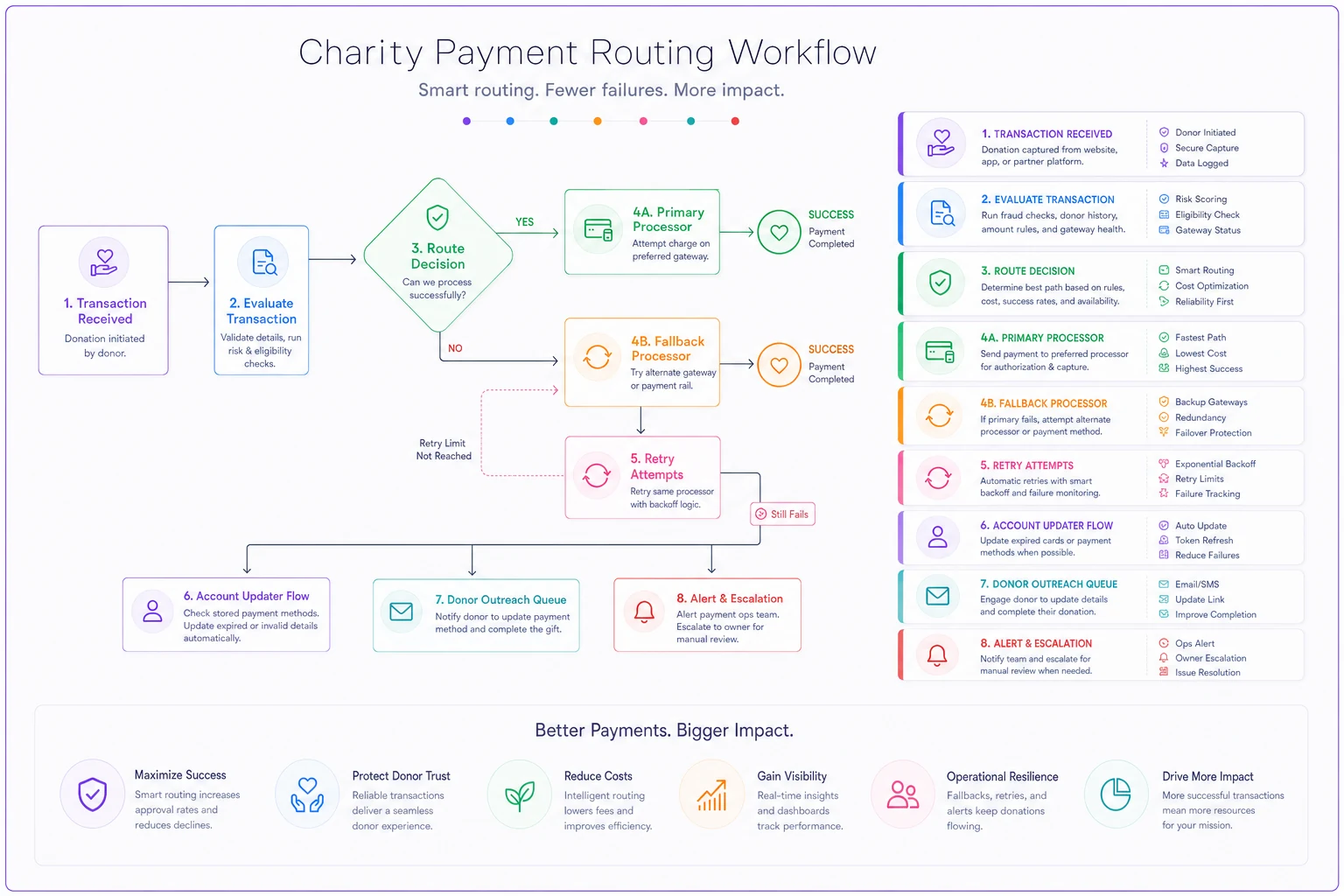
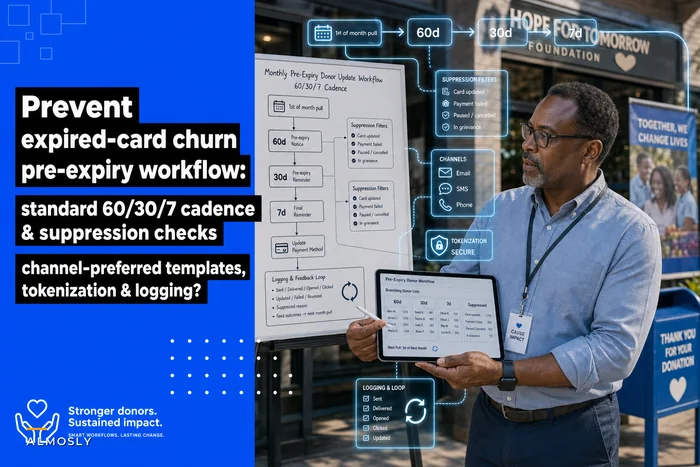
One practical note on retries: pairing the account-updater path with a donor outreach queue matters more than the routing itself. A card that keeps failing isn't really a routing problem — it's a donor-retention problem dressed up as a finance one. Building that catch deliberately is worth the time, and we've gone deep on the pre-expiry side of it in the pre-expiry donor update workflow.
The canonical payment record: one row, one truth
This is the part that actually causes reconciliation pain, and it has nothing to do with fees directly.
-
Transaction ID (the gateway's, treated as the source of truth)
-
Gross amount (what the donor was charged)
-
Fee amount (broken out, not netted)
-
Net settled amount (what actually hit the bank)
-
Settlement date (not the charge date — these differ)
-
Settlement batch ID (which deposit this rolls up into)
-
Donor/constituent ID (the CRM link)
-
Designation / fund (restricted vs unrestricted)
-
Payment method + card type (for fee analysis later)
-
Status (authorized, settled, refunded, disputed, failed)
Most systems store net amounts in the CRM and gross amounts in the gateway, and nobody reconciles the fee in between. So your board report shows one revenue number, your bank shows another, and the difference is "fees" that nobody can itemize. Carrying gross, fee, and net as separate fields on the same record is the single highest-leverage data change a small finance operation can make.
This same discipline is what makes manual and offline gift handling sane. The stepwise approach in the donation reconciliation and offline-gifts process assumes you've got a clean canonical record to match against. Routing and reconciliation are two ends of the same pipe.
Fallback-processor rules (and the trap inside them)
Fallbacks exist so a temporary processor outage doesn't cost you a gift during a campaign push. That's genuinely important — a 20-minute gateway hiccup during a year-end appeal can lose real money.
-
Fallbacks are time-boxed. A switch to fallback auto-expires and reverts after a set window unless manually extended.
-
Every fallback event generates an alert, not just a log entry. Someone has to acknowledge it.
-
Fallback volume gets a weekly review. If more than a small share of transactions ran through the backup, that's worth investigating.
-
Fallbacks never silently change donor-facing receipts. If the backup processor formats receipts differently, you've just confused donors mid-campaign.
A fallback is an exception path, and exception paths need owners. Unowned exception logic is how a "temporary" workaround becomes the permanent, expensive default.
The daily settlement reconciliation checklist
Daily is the right cadence — not because every day has a problem, but because catching a mismatch within 24 hours is straightforward and catching it 30 days later is archaeology. A small team can run this in under 15 minutes once the canonical record exists.
-
[ ] Pull the gateway settlement report for yesterday's batch(es)
-
[ ] Confirm each batch's net total matches the corresponding bank deposit (to the cent)
-
[ ] Confirm gross − fees = net on every batch; flag any batch where the fee ratio looks off
-
[ ] Match every settled transaction to a CRM gift record; list unmatched ones
-
[ ] Check for any transactions that charged but haven't settled within the expected window
-
[ ] Review the fallback-event log; confirm no unacknowledged switches
-
[ ] Confirm refunds and disputes are reflected in both the gateway and CRM
-
[ ] Log any anomaly to the exceptions queue with a named owner
Pro-tip: assign a named owner for the exceptions queue so anomalies don't sit in limbo between teams.
The unmatched-transaction list is the money-saver. In most small operations, unmatched transactions aren't fraud — they're timing gaps, a donor record that didn't link, or a designation that didn't carry through. Clearing them daily keeps revenue reporting honest and stops the month-end scramble where someone discovers the bank and CRM are off by a few thousand dollars and nobody can explain why.
Anomaly alerts worth setting up
Reconciliation is backward-looking. Alerts are forward-looking, and they're how you catch problems before they compound. The trick is setting thresholds loose enough to avoid alert fatigue but tight enough to catch real drift.
-
Fee-ratio drift. If total fees as a percentage of gross jumps outside its normal band for two or more days, something changed — a routing shift, a downgrade spike, a fallback that stuck.
-
Settlement delay. A batch that hasn't deposited within its normal window may mean a processor hold or a bank issue worth chasing early.
-
Failed-charge spike. A sudden cluster of recurring failures often signals a card-network issue or a bad batch update, not individual donor churn.
-
Unmatched-transaction accumulation. If the unmatched queue grows across multiple days instead of clearing, your CRM linkage is breaking somewhere upstream.
-
Single-transaction outliers. An unusually large charge — or an unusual refund — should ping a human, especially around major gifts.
The pattern that trips teams up: they set alerts on raw dollar thresholds instead of ratios and trends. A $200 fee day means nothing in isolation; a fee ratio that crept from its normal band to noticeably higher across a week means a lot. Watch the shape of the data, not just the absolute numbers. That's the same muscle that makes board-grade reporting possible without a dedicated analyst, which we covered in building board-grade dashboards without a data team.
A real scenario
A regional environmental nonprofit — roughly $2.1M in annual online giving, mostly a recurring monthly book of small gifts plus a year-end surge — ran everything through a single flat-rate gateway. No routing logic, net amounts pushed to the CRM, reconciliation done monthly by a part-time bookkeeper.
The symptoms: board revenue numbers that never quite matched the bank, a recurring book where about 1 in 12 charges failed and quietly retried through the default path, and a persistent month-end gap of a few thousand dollars that just got written off as "fees and timing."
They didn't switch vendors. They did three things. First, they split the canonical record into gross/fee/net fields so fees became visible per transaction. Second, they wrote a routing table that pushed small recurring debit charges toward interchange-plus pricing and routed second-attempt retries through an account-updater path tied to a donor outreach queue. Third, they moved reconciliation from monthly to a 10-minute daily check.
Over the following couple of quarters, the blended effective fee rate dropped enough to recover something in the low five figures annually at their volume. The month-end mystery gap mostly disappeared because mismatches got caught within a day. And the retry work — catching failing cards before they lapsed — pulled back a chunk of recurring revenue that had previously just churned out silently. None of it required a finance hire. It required deciding things on purpose.
When this level of rigor makes sense — and when it doesn't
When it's worth it: You're processing enough recurring volume that fee percentages translate to real dollars (somewhere north of $500k–$750k online annually is roughly where the math starts paying off), you have a recurring book where retries matter, or your board reports and bank statements keep disagreeing.
When it's overkill: If you're a small shop running under a few hundred thousand a year with mostly one-time gifts, a full routing table is more structure than you need. Start with the canonical gross/fee/net record and a weekly reconciliation — that alone fixes most of the pain. Routing optimization is a problem you grow into.
Who should not do this yet: If your CRM and gateway aren't reliably linked — if you can't match a bank deposit back to donor records today — don't start with routing. Fix the matching first. Routing logic on top of broken reconciliation just moves the confusion around faster.
Making it run without heroics
The reason this layer breaks as teams grow isn't that it's complicated — it's that it depends on one person remembering to check things. The routing table lives in someone's head, the daily reconciliation happens "when there's time," and the fallback that flipped on during a busy week never gets switched back.
Every control described here is simple. The hard part is making it happen consistently when the team is small and stretched thin. A workflow platform that centralizes the canonical payment record, runs daily reconciliation checks automatically, and fires anomaly alerts to a named owner handles the quiet, repetitive work — not because the logic is sophisticated, but because software doesn't forget to run the check on a Friday afternoon or during the year-end push. The decisions stay human — which cards route where, what counts as an anomaly, when to extend a fallback — while the matching and monitoring run on their own.
Treat payment routing and settlement as an operating system with owners, written rules, and daily checks — not as something the vendor handles. The nonprofits that do this don't just save on fees. They get revenue numbers they can trust, donors who don't lapse over a fixable failed charge, and a finance function that scales without a proportional scramble every month-end.
Ready to elevate your nonprofit impact?
Join 2,000+ nonprofits using Almosly to boost fundraising efficiency, deepen donor relationships, and scale philanthropic impact.