


Most nonprofits that start using predictive models for donor work don't fail because the model is wrong. They fail because nobody can explain why a particular donor got a particular ask, what data went into that decision, or whether that donor ever agreed to be analyzed that way in the first place. The model works fine. The governance around it doesn't exist.
That gap is where ethical AI nonprofit donor personalization actually lives — not in the algorithm, but in the operational scaffolding that decides what the algorithm is allowed to see, who checks its outputs, and what happens when it produces something embarrassing or harmful. This piece is about building that scaffolding before you need it, because the version you build after a donor complaint is always rushed, defensive, and incomplete.
The real problem isn't the model, it's the chain of custody
When a development team adopts personalization — propensity scoring, next-best-ask recommendations, churn prediction, wealth-triggered upgrade prompts — they usually inherit the model from a vendor or build something quick in a spreadsheet-adjacent tool. The score shows up in the CRM. Gift officers start acting on it. Nobody wrote down what features fed the score, and nobody mapped those features back to the consent the donor actually gave.
The pattern that breaks organizations goes like this: a donor gives you an email and a gift. Over time, your systems quietly accumulate inferred income brackets, household composition guesses, event attendance, email open behavior, and a wealth-screening overlay. A model then combines all of that into a "major gift readiness" score. The donor never agreed to be profiled by inferred wealth. They agreed to receive a thank-you and a newsletter.
Nothing illegal necessarily happened. But the distance between what the donor consented to and what the model consumed is enormous — and completely undocumented. The day someone asks "why did we solicit this person for a $25,000 gift two weeks after their spouse passed," you have no audit trail. That's the failure. The governance work exists to keep that distance short, visible, and defensible.
This builds directly on the kind of field-level consent structure covered in the nonprofit data governance framework — personalization governance is what sits on top of that foundation once models start consuming your consented data.
Consent mapping: the step almost everyone skips
Before a single feature goes into a model, you need a consent map. Not a privacy policy — a map. A table that connects every data field to the consent basis that permits its use for personalization.
Stop missing fundraising opportunities.
Almosly helps you plan, track, and optimize every campaign with ease.
- Centralized donor and volunteer management
- Automated engagement workflows
- Impact and fundraising analytics
No credit card required
The reason this matters operationally: consent is not binary. A donor can consent to transactional contact but not behavioral profiling. They can allow enrichment for stewardship but not for solicitation modeling. If your model treats all data as equally usable, you've erased those distinctions the moment the model runs.
A workable consent map looks like this:
| Data field | Source | Consent basis | Allowed for models? | Allowed model uses |
|---|---|---|---|---|
| Email address | Donor-provided | Explicit opt-in | Yes | Channel preference, send-time |
| Gift history | Transactional | Legitimate interest | Yes | Propensity, recency scoring |
| Inferred income | Third-party enrichment | None / implied only | No by default | Excluded unless re-consented |
| Event attendance | First-party | Implied | Yes | Engagement scoring |
| Open/click behavior | First-party tracking | Opt-in (if disclosed) | Conditional | Engagement only, not wealth proxy |
| Wealth screening overlay | Third-party vendor | None | No by default | Internal flag only, human-gated |
The important column is the last one. A field being technically available doesn't mean it's permitted for every model purpose. Income inference might be fine for suppression logic ("don't over-ask this person") but completely inappropriate as a driver for aggressive upgrade campaigns. The map forces you to make those distinctions on purpose instead of by accident.
Organizations that do this well tend to find the consent map becomes the one document that legal, development, and data staff actually agree on. It ends the recurring argument about "can we use this field" because the answer is written down and dated.
Minimal feature sets: the discipline of using less
There's a strong temptation to feed models everything. More features, better predictions — that's the instinct. For donor personalization, it's the wrong instinct, and not only for ethical reasons.
Every feature you add to a model is a feature you now have to govern, explain, monitor for drift, and defend if a donor asks. A model running on twelve well-understood, clearly-consented features is dramatically easier to audit than one running on eighty features where nobody remembers what half of them represent. Fewer inputs means a shorter chain of custody and fewer places for bias to hide.
A minimal feature set for most nonprofit personalization models looks something like:
-
Recency, frequency, and monetary value of giving
-
Channel engagement (opens, clicks, event RSVPs) where disclosed
-
Tenure and lifecycle stage
-
Explicit stated preferences (cause interest, contact frequency)
-
Campaign response history
Notice what's absent: inferred demographics, purchased wealth data, health or life-event inferences, and anything derived from sensitive categories. These can occasionally have a supervised role — flagging a prospect for a human to review — but they shouldn't be silent inputs to an automated ask.
Prioritize features that map cleanly to consent entries to simplify audits and reduce re-consent risk.
The mistake people make here is assuming a bigger feature set is a competitive advantage. In practice, models built on sensitive inferred data tend to produce the exact outputs that generate donor complaints: the tone-deaf upgrade ask, the solicitation that feels like surveillance. Restraint on inputs is cheaper than apologizing for outputs.
Anonymization and defaults that fail safe
The default behavior of your personalization system should be the safest behavior, not the most aggressive. This is a design decision most teams never make explicitly, so the default ends up being "use everything we have."
A few defaults worth hard-coding:
-
Default to pseudonymized training data. When you build or retrain a model, the training set shouldn't need names, exact addresses, or raw contact details. Model development runs on tokenized donor IDs. Re-identification happens only at the point of action, in the CRM, under a logged-in user.
-
Default to exclusion for sensitive categories. New enriched fields enter the system flagged as model-ineligible. Making them eligible requires a deliberate review, not a default-on checkbox.
-
Default to human review above a threshold. Any model output that triggers a significant action — a major-gift solicitation, a large automated ask, a lapse-prediction that removes someone from stewardship — gets a human checkpoint. Low-stakes personalization (which email variant, what send time) can run automatically.
This tiered approach is the same safety logic behind governance patterns for fundraising automations: the bigger the potential donor harm, the more friction and human oversight you deliberately insert.
Auditable model-check steps
An auditable model is one where any staff member — or an auditor, or a concerned donor's advocate — can trace a decision from output back to inputs and consent. If you can't reconstruct "this donor got this ask because of these factors, all of which they consented to," your model isn't audit-ready.
A practical model-audit checklist to run before deployment and on a recurring cadence:
-
[ ] Every input feature is listed in the consent map with a valid basis
-
[ ] No sensitive-category field is an automated input without documented re-consent
-
[ ] Training data was pseudonymized; re-identification points are logged
-
[ ] Model outputs include an explanation field (top contributing factors)
-
[ ] Output-to-action thresholds are documented and reviewed
-
[ ] A bias check was run across key donor segments (giving level, tenure, channel)
-
[ ] Suppression rules (deceased, recently bereaved, opted-out, in dispute) override model output
-
[ ] A named owner is assigned to the model, not a team
-
[ ] Date of last review and date of next scheduled review are recorded
That bias-check line deserves attention. Run your model's recommendations across segments and look for patterns that shouldn't be there. If long-tenured donors are systematically scored higher for upgrades while newer donors with identical giving behavior score lower, you've encoded an assumption that may not hold — and may quietly starve newer relationships of attention.
Test and validation protocols before anyone acts on a score
Models shouldn't go live the moment they produce numbers. They need a validation period where outputs are observed but not acted upon.
A reasonable sequence:
-
Shadow mode (2–4 weeks). The model scores donors, but no automated actions fire. Staff review scores against their own judgment and flag anything that looks wrong.
-
Spot-check calibration. Pull a sample — say 40 to 60 donors across the score range — and have experienced gift officers sanity-check the recommendations. Disagreements get logged and investigated, not dismissed.
-
Limited live pilot. Activate on a small segment with full monitoring. Watch complaint rates, opt-out rates, and gift-officer overrides.
-
Graduated rollout. Expand only after the pilot shows stable, defensible behavior.
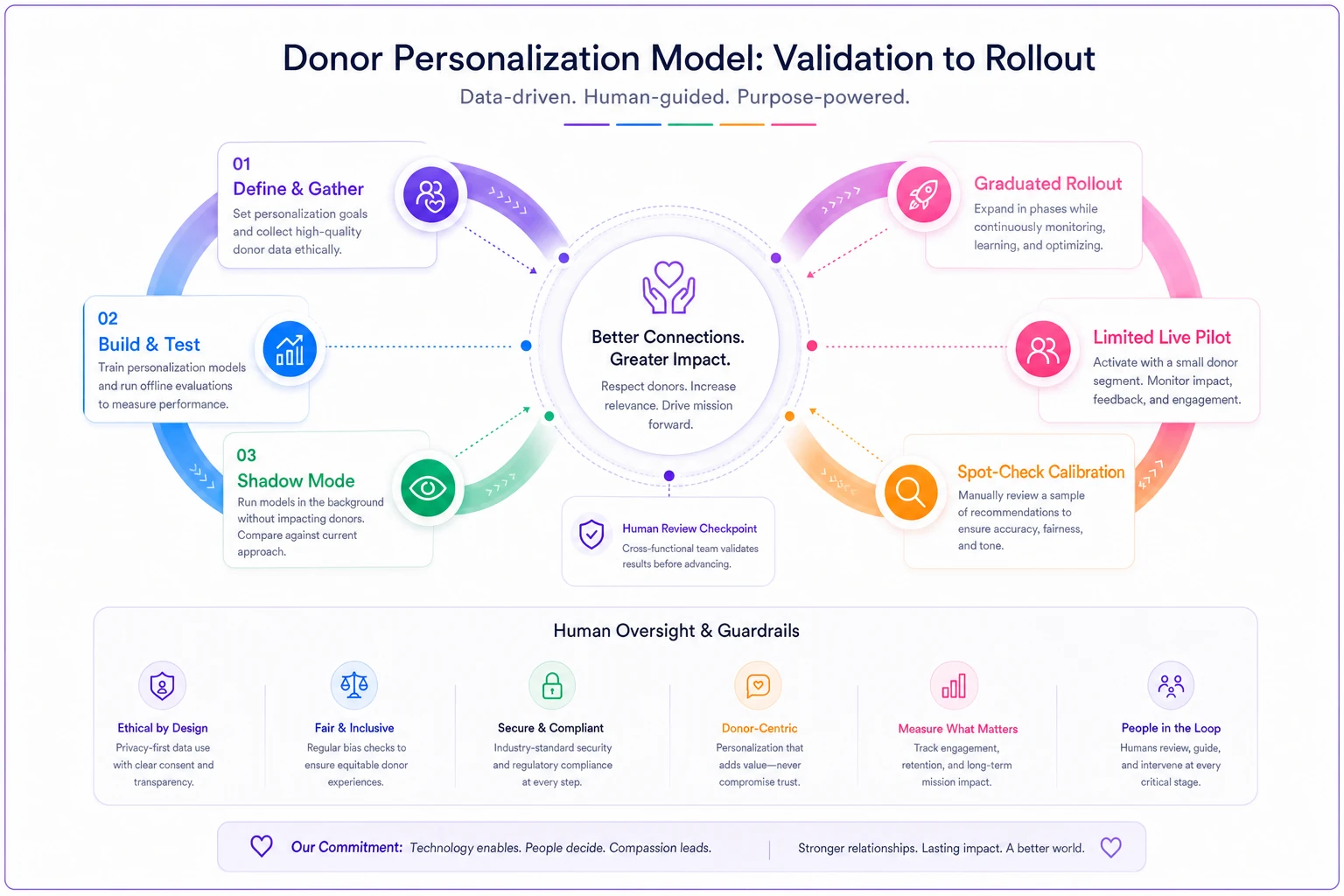
This illustrates the validation-to-rollout workflow and where human review should be inserted.
During shadow mode the useful signal isn't model accuracy in the abstract — it's where experienced humans disagree with the model. Those disagreement clusters usually reveal either a data problem (the model is reacting to a field it shouldn't trust) or a values problem (the model is optimizing for revenue in a way your staff instinctively knows will damage a relationship).
Rollback playbooks: what you do when it goes wrong
Eventually a model will produce a harmful output that slips past your checks. The question isn't whether, it's how fast you can stop it and how cleanly you can reverse the damage.
A rollback playbook should answer, in writing, before anything breaks:
-
Who has authority to disable a model immediately? One named person, reachable, with the access to actually flip the switch.
-
What is the kill switch? A documented way to stop model-driven actions without taking down the whole CRM.
-
What happens to in-flight communications? Queued sends pause, scheduled solicitations hold, and the affected segment is identified within hours, not days.
-
How do you reach affected donors? A pre-drafted correction/apology template that doesn't require legal review from scratch during a crisis.
-
What's the post-incident review? A fixed window — 48 to 72 hours — to document root cause, consent-map gaps, and the fix.
The organizations that recover gracefully from a personalization misfire are the ones that treated rollback as a core feature, not an afterthought. The ones that handle it badly are usually scrambling to figure out who even can turn the thing off.
Monitoring dashboards tied to donor-trust KPIs
Most personalization dashboards track the wrong things. They report model accuracy, lift, and revenue attribution — all useful for fundraising, none of which tell you whether donors trust you less because of it.
Trust-oriented monitoring tracks leading indicators of donor harm:
| KPI | What it signals | Watch for |
|---|---|---|
| Opt-out rate by model-touched segment | Donors fleeing personalized contact | Spike vs. non-personalized control |
| Complaint / "how did you know" rate | Perceived surveillance | Any upward trend |
| Gift-officer override rate | Staff distrust of outputs | Sustained high override % |
| Suppression-rule catch rate | Safety nets working | Drops near zero = rule may be broken |
| Re-consent / preference-update rate | Donors reasserting control | Clustering after a campaign |
| Lapse rate among high-score donors | Model pushing too hard | Rising lapse in "ready" segment |
Keeping a non-personalized control group is the single most useful monitoring habit here. Without it, you can't tell whether a rise in opt-outs came from your model or from something else entirely. The control group is your baseline for honesty.
This kind of measurement connects naturally to broader operational impact measurement — donor trust is an outcome you measure deliberately, not a vibe you hope for.
Sample consent language
Consent language should be specific enough that a donor understands what personalization means without being so dense they stop reading. Something in this range tends to work:
> "To make our communications more relevant, we may analyze your giving history and how you engage with our emails and events to tailor what we send you. We do not use purchased financial or demographic data to make automated solicitation decisions. You can ask us to stop personalizing your experience at any time, and you can request a summary of the information used to personalize your communications."
The two commitments that matter most in that language: naming what you don't do with inferred data, and giving the donor a right to both stop personalization and see what drove it. Those two lines convert a vague privacy gesture into something auditable.
When model-driven personalization actually makes sense
It makes sense when you have clean first-party data, enough volume that manual segmentation genuinely can't keep up, and the governance maturity to monitor and roll back. Mid-to-large shops sending hundreds of thousands of touches a year get real value here.
It's a bad idea when your consent records are messy, your CRM is full of duplicates, or you don't yet have reliable suppression rules for deceased and bereaved donors. Personalizing on broken data just industrializes your mistakes.
Who should not do this yet: small teams whose data is still in flux, or any organization that can't name a single owner accountable for model behavior. If no one owns it, no one can fix it, and the model will eventually do something no one will admit to deciding.
A short real scenario
A regional health nonprofit — roughly 90,000 active donors, a four-person development team — rolled out vendor propensity scoring and wired it straight into automated upgrade asks. No shadow period, no suppression override, inferred wealth data feeding the score.
Within about two months they saw their opt-out rate on upgrade-eligible donors climb from a normal low single-digit range to noticeably higher, and they fielded a handful of upsetting "how did you know my income" messages — including one solicitation sent to a recently widowed longtime donor.
They paused the automation, stripped the model back to a minimal first-party feature set, added hard suppression rules, and ran a four-week shadow validation before relaunching. Opt-outs settled back toward baseline over the following quarter, and gift-officer override rates dropped from constant to occasional once staff trusted the outputs again. Revenue from personalization came in slightly lower than the aggressive version had briefly produced — and far more durable, because they weren't burning relationships to get it.
Where this leaves you
Ethical AI nonprofit donor personalization isn't a compliance checkbox or a philosophical stance — it's an operating system. Consent maps keep inputs honest. Minimal feature sets keep the chain short. Audit steps, validation protocols, and rollback playbooks keep humans in control of what the machine suggests. And trust-oriented monitoring tells you, in near-real-time, whether your donors are actually comfortable with what you're doing on their behalf.
Organizations that get this right don't treat governance as the thing slowing their personalization down. They treat it as the thing that lets them run personalization at all — confidently, defensibly, and without the quiet dread of wondering what the model will do next.
Ready to elevate your nonprofit impact?
Join 2,000+ nonprofits using Almosly to boost fundraising efficiency, deepen donor relationships, and scale philanthropic impact.