

Most nonprofits don't find out their continuity plan is fiction until the worst possible moment — a year-end appeal is live, the donation page returns a 500 error, and nobody can say who's actually in charge of fixing it.
The usual failure isn't the outage itself. Outages happen. Stripe has incidents. Your CRM provider pushes a bad release. A gateway flags your account for a fraud review during a viral moment. The real damage comes from the twenty minutes of confusion afterward — the Slack messages flying with no owner, the gift officer refreshing the page hoping it'll fix itself, the executive director asking "are we losing money right now?" and nobody having a clean answer.
This is a playbook for that twenty minutes, and the hours after it. Not continuity-of-operations theory. Not a binder that lives on a shared drive and gets opened once during an audit. Actual tiering, actual owners, actual runbooks your team can execute at 9pm during a flash campaign when the person who "normally handles this" is unreachable.
Why generic COOP plans fail nonprofits specifically
Corporate continuity planning assumes a few things that don't hold for fundraising teams. It assumes dedicated IT staff. It assumes systems you control. It assumes revenue that isn't time-boxed to a specific emotional moment.
Fundraising breaks all three. Your payment stack is a chain of vendors you don't own — a page builder, a gateway, a processor, a CRM sync, an email platform — and a failure in any link looks identical to the donor: the gift didn't go through. Worse, a huge share of annual revenue is compressed into a handful of hours. A Giving Tuesday outage from 1pm to 3pm isn't "two hours of downtime." It's potentially a double-digit percentage of the day's total, gone, because donors who bounce during a surge mostly don't come back.
What you see across a lot of small development shops is that the plan, if one exists, is built around the wrong risk. Teams document the big dramatic scenario — the office burns down — and completely skip the boring, frequent one: the processor holds funds pending review, or the recurring-gift webhook silently stops firing for six days before anyone notices the deposits are short.
A good continuity plan is built around what actually happens. And what actually happens is payment and vendor failure, over and over, in small and medium doses.
Start with incident tiering, because "it's broken" is not a status
The single most useful thing you can do before any incident is agree on severity tiers. Without them, every problem feels like a five-alarm fire or gets dismissed as "probably fine," and neither reaction is right.
Stop missing fundraising opportunities.
Almosly helps you plan, track, and optimize every campaign with ease.
- Centralized donor and volunteer management
- Automated engagement workflows
- Impact and fundraising analytics
No credit card required
Here's a tiering model that works for fundraising teams of roughly 3 to 40 people. Adjust the thresholds to your giving volume.
| Tier | What it looks like | Response time | Who's involved |
|---|---|---|---|
| SEV-1 | Donations page down or failing during an active campaign; processor freeze; data/payment breach suspected | Immediate, drop everything | Incident lead + exec + comms + tech owner |
| SEV-2 | Degraded giving (some payment methods failing, slow page, broken receipt emails); recurring-gift sync down | Within 30 min | Incident lead + tech owner |
| SEV-3 | Non-urgent vendor outage with workaround; reporting or dashboard broken; delayed-but-not-lost data | Same business day | Tech owner, async |
| SEV-4 | Cosmetic or low-impact issue; single donor affected | Next business day | Whoever's on rotation |
The important move here isn't the table — it's deciding the trigger in advance. During a live campaign, any payment failure defaults to SEV-1 until proven otherwise. You downgrade, you don't upgrade. Teams that start low and escalate always react too slowly, because nobody wants to be the person who "overreacted."
One pattern worth flagging: SEV-2s are the silent killers. A SEV-1 gets attention because the page is obviously dead. A SEV-2 — where Apple Pay works but regular cards fail, or receipts stop sending — can bleed revenue and trust for days because everything looks fine from the inside. Build a monitoring habit around the quiet failures, not just the loud ones.
The owner matrix: who actually does what
Every incident needs named humans, not departments. "Development owns donor comms" means nothing at 9pm. "Priya sends the donor holding statement, and if Priya is unreachable, Marcus does" means something.
-
Incident Lead (Responsible) Runs the response, makes the call on tier, keeps the timeline. This is not automatically the most senior person — it's whoever is calmest and closest to the systems.
-
Executive (Accountable) Owns the final decision on anything involving money movement, legal exposure, or public statements. Available by phone, not necessarily in the room.
-
Tech/Systems Owner (Responsible) Works the technical runbook — checks vendor status pages, flips fallback flows, contacts processor support.
-
Donor Comms (Responsible) Drafts and sends donor-facing messages using pre-approved templates. Does not improvise during SEV-1.
-
Finance (Consulted) Confirms what's actually settled vs. pending, watches for duplicate charges, manages the short-term cash picture.
-
Everyone else (Informed) Gets status updates on a schedule, stays off the main incident channel unless pulled in.
The mistake small teams make is collapsing all of this into one or two people, which works fine until those people are the ones unavailable. The second mistake is the opposite — looping in the whole staff on every message, so the incident channel becomes noise and the actual responders can't think.
One detail that matters more than it should: write down phone numbers. Not Slack handles. When your auth provider is the thing that's down, Slack might be down too. A printed or offline-accessible contact sheet with cell numbers for the core five roles has saved more campaigns than any monitoring tool.
Payment-processor failure runbooks
This is the core of the whole playbook, because payment failure is the most common revenue-killing incident and the one with the most moving parts. A processor problem can mean a dozen different things, and your response depends entirely on which thing.
Diagnose before you act
-
Is it the page or the payment? Load the donation form yourself in an incognito window. If the page won't load, it's your page builder or host. If it loads but submission fails, it's deeper.
-
Is it one payment method or all? Try a test gift with a card, then a digital wallet. If cards fail but wallets work, you can route donors to the working method immediately.
-
Is it you or the vendor? Check the processor's and gateway's status pages first. A platform-wide Stripe or Authorize.net incident is handled completely differently from an account-specific freeze.
-
Is money moving but not recording? The nastiest case — charges succeed, but the CRM sync or webhook has died. Donors are being charged and getting nothing, or finance sees deposits that don't match records.
Then run the matching runbook
If it's a platform-wide processor outage: You can't fix it, so stop trying. Flip to a fallback payment flow (covered below), post a holding message, and track the start time precisely so you can estimate lost revenue later. Don't let a gift officer email twelve major donors apologizing — that creates panic over something that'll resolve in 40 minutes.
If it's an account-specific freeze or fraud review: This is urgent and relationship-based. Get Finance and the Exec on the processor's priority support line immediately. Freezes during viral fundraising moments are common — an unexpected surge looks like fraud to risk algorithms. Having your processor rep's direct contact (negotiated before you ever need it) is the difference between a two-hour and a two-day resolution. This is exactly why vendor governance and the contract terms you sign up front matter so much — your leverage during an incident was mostly decided at signing.
If it's a broken sync or webhook: Payments are succeeding, so do not take the page down. The revenue is fine. The problem is data integrity. Switch the CRM to manual/batch reconciliation mode, flag the start time, and plan to backfill once the sync recovers. The risk here is donors not getting receipts — queue a delayed receipt send rather than letting them think the gift vanished.
If it's a single payment method failing: Route around it. Hide or de-prioritize the broken method on the form, surface the working one, and note it as a SEV-2 to fix properly after the surge.
The diagram below shows the recommended diagnosis-to-action workflow.
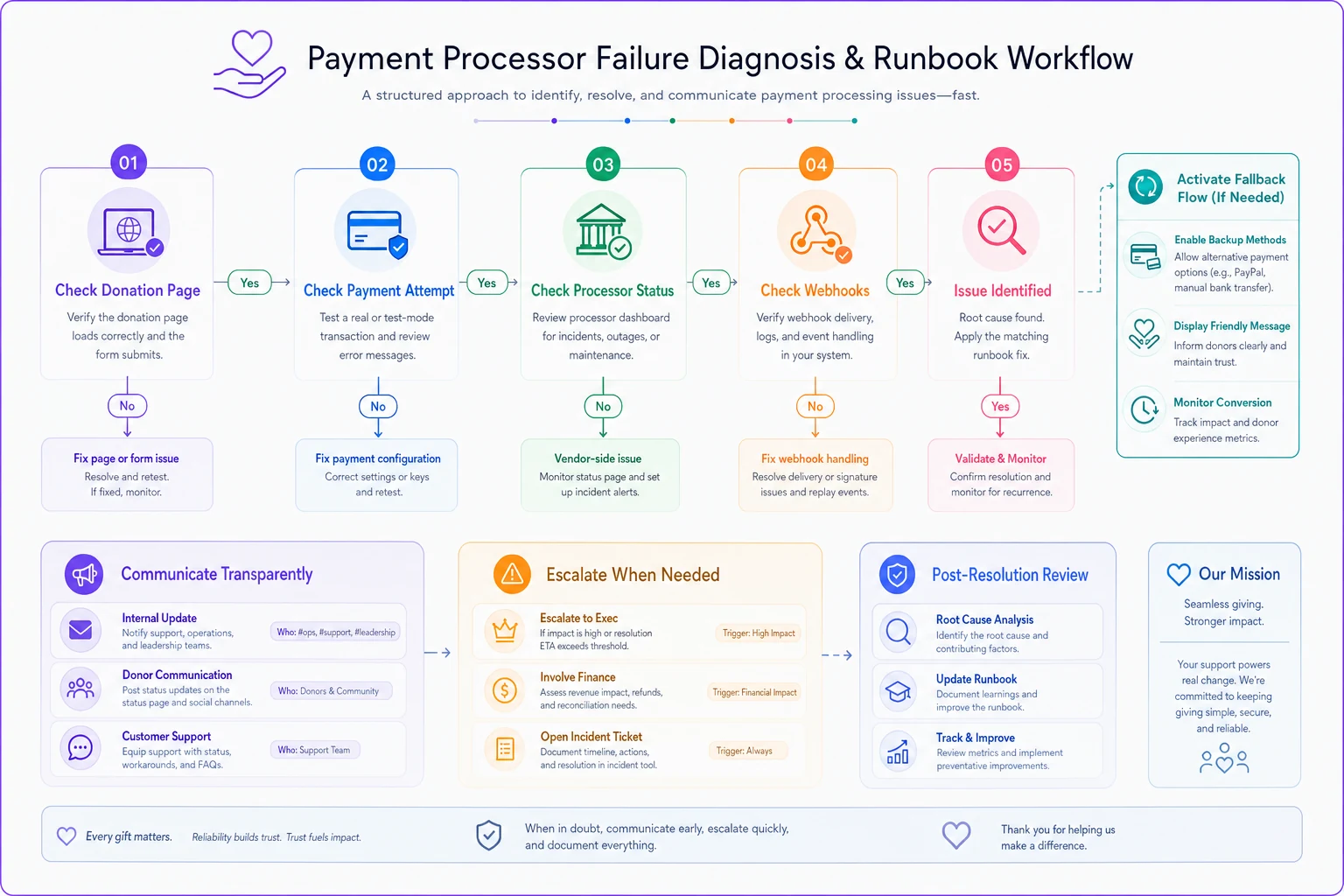
Don't skip the diagnosis step — the wrong fix wastes the window.
Temporary acceptance and fallback flows
The teams that survive outages are the ones who set up a plan B before the outage. You can't build a fallback payment path while your primary one is on fire.
-
A secondary payment processor on a pre-built, unlisted donation page. If your primary is Stripe, have a parallel page ready on a different processor. It doesn't need to be pretty. It needs to work and deposit money.
-
A text-to-give or mobile wallet path that runs on infrastructure independent of your main form.
-
A manually monitored "pledge now, charge later" form that captures intent and contact info during a total outage, so you can follow up. Lower-conversion, but it recovers gifts that would otherwise vanish entirely.
-
Phone/offline acceptance for major donors — a named staffer who can take a gift directly. For a six-figure year-end gift, a phone call beats any page.
The routing logic matters here, and it connects directly to how you've already set up your payment routing and fee controls. If you already understand your processor costs and routing, flipping to a fallback is a decision you can make in seconds instead of a scramble.
Put the fallback page URL in the one-page owner matrix so it's discoverable quickly.
One honest caution: fallback flows create reconciliation headaches. Money coming in through three paths during a two-hour window will need careful matching afterward, and some donors will accidentally give twice. Budget time for cleanup, and warn Finance in advance that duplicate-charge refunds are coming.
Short-term cash playbooks
A short-term cash playbook isn't about fundraising harder. It's about buying time without panic decisions.
-
Know your runway number before you need it. How many days of operating expenses can you cover from cash on hand right now? If you can't answer in under a minute, that's your first fix.
-
Pre-identify your levers. Which expenses can pause within 48 hours? Which vendors will accept a delayed payment with a phone call? Is there a line of credit, a board-designated reserve, or a bridge-loan relationship you can tap? Decide the order you'd pull these before the crisis.
-
Separate the real shortfall from the timing gap. Most "cash emergencies" are timing — the money is coming, just not yet. Treat a timing gap as a bridge problem, not a budget crisis. Panicked program cuts to cover a two-week gap do lasting damage.
-
Protect recurring revenue first. In any cash crunch, the instinct is to chase big one-time gifts. But recurring donors are your most durable asset, and an outage that quietly breaks recurring billing is worse long-term than a one-day campaign dip.
Protect recurring revenue first. In any cash crunch, the instinct is to chase big one-time gifts. But recurring donors are your most durable asset, and an outage that quietly breaks recurring billing is worse long-term than a one-day campaign dip.
Donor communication templates
What you say — and how fast — determines whether an outage becomes a trust problem. The goal is to sound calm, specific, and in control, without over-promising or over-apologizing.
Keep these drafted and pre-approved so nobody is writing copy during a SEV-1.
Holding message (on the donation page, during an active outage):
> We're experiencing a temporary issue processing gifts and are working on it right now. Your support matters enormously — please try again in a few minutes, or [use this alternate link]. Thank you for your patience.
Payment failed but donor isn't sure (follow-up email):
> We noticed your recent gift may not have completed due to a technical issue on our end — not anything you did. If you'd still like to give, here's a secure link. If you believe you were charged, please reply and we'll confirm right away.
Possible duplicate charge:
> During a brief technical issue, a small number of gifts may have been processed twice. We're reviewing all transactions now. If you were charged more than once, we will refund the duplicate automatically within [X] business days — no action needed on your part.
Recurring billing interruption:
> A temporary issue affected some recurring gifts this month. Your ongoing support means the world to us, and we've resolved the issue. Your next gift will process normally on [date]. Thank you for sticking with us.
The pattern across all of these: own the problem plainly ("on our end"), remove donor anxiety ("not anything you did"), and give a clear next step. What destroys trust isn't the outage — it's silence, or a message that sounds like it's dodging. For breach-adjacent incidents especially, the communication bar is much higher, and it's worth aligning this with your broader data governance and breach response framework so a payment incident doesn't accidentally become a privacy incident.
Tabletop exercises: practice before it's real
A playbook nobody has rehearsed is a document, not a capability. Tabletop exercises — talking through a simulated incident, step by step — are how you find the gaps while the stakes are zero.
You don't need a whole day. A focused 45-minute tabletop twice a year does more good than an elaborate annual drill that never actually happens. Here are two scripts to run.
Tabletop A — The Giving Tuesday freeze (SEV-1)
> It's 12:40pm on Giving Tuesday. Your donation page loads, but every card submission returns an error. Digital wallets also fail. Your processor's status page shows "investigating an issue." You've done roughly $40k so far today and your afternoon is usually your biggest window.
Walk the room through: Who declares the tier? Who checks the status pages? When do we flip to the fallback page? What goes on the donation page in the next five minutes? Who's calling the processor, and do we have their direct line? What do we tell the board, and when?
The gaps that usually surface: nobody knows the fallback page URL, the processor contact is a generic support email, and two people both think they're the incident lead.
Tabletop B — The silent sync failure (SEV-2)
> Finance notices Monday that last week's deposits are about $6k higher than what the CRM recorded. Gifts are processing fine, but something stopped syncing roughly six days ago. Some donors never got receipts.
Walk through: How did this go unnoticed for six days? Who owns catching it? How do we backfill without creating duplicates? What do we send donors who never got a receipt? How do we make sure this triggers an alert next time?
After each tabletop, write down every gap and assign an owner and a date. The exercise is worthless if the findings don't turn into fixes.
Where tooling genuinely helps — and where it doesn't
Continuity is mostly about preparation and clear ownership, not software. But a few things are much easier when your operations are centralized rather than scattered across inboxes and spreadsheets.
Having donor records, payment status, and communication history in one place means that during an incident you can actually see what's happening — which gifts are pending, who got a receipt, who was affected by the sync gap — instead of reconstructing it across five tools. Automated monitoring that flags quiet failures (receipts not sending, recurring volume dropping unexpectedly, sync lag) catches the SEV-2s that otherwise bleed for days. And queued, templated donor messages mean you can send the right holding statement to the right affected segment without hand-building a list at 9pm.
This is where an AI-assisted operational platform earns its place — not by "handling the incident for you," but by surfacing the anomaly early, keeping the affected-donor list current, and drafting the first version of the holding message so a human can approve and send it in two minutes instead of twenty. The judgment stays with your team. The grunt work and the reconciliation don't have to.
What tooling won't do is replace the owner matrix or the rehearsal. No dashboard decides who's incident lead. No automation calls your processor rep. Use tools to reduce manual work and catch things early — not as a substitute for the human plan.
A real scenario
A mid-sized arts nonprofit — roughly a seven-person development team, around $2.1M in annual contributed revenue — ran their spring gala appeal online. About 40 minutes into the peak of the matching-gift hour, card payments started failing. Digital wallets still worked, but nobody realized that for almost half an hour because there was no diagnosis step. Staff assumed the whole system was down.
With no playbook, they went dark for close to 50 minutes, posted nothing on the page, and a gift officer sent an apologetic email to a dozen major donors that caused more alarm than the outage itself. Their rough estimate of lost and delayed revenue was somewhere in the $9k–$12k range, plus a week of cleanup chasing confused donors who thought they'd been double-charged.
They rebuilt around a tiered playbook before the next year-end push. The changes weren't fancy: a one-page owner matrix with cell numbers, a pre-built fallback page on a second processor, four pre-approved donor templates, and one 45-minute tabletop. When a partial card failure hit again during year-end, the incident lead ran the diagnosis in under ten minutes, flipped donors to digital wallets and the fallback page, and posted a holding message immediately. Estimated revenue loss that time was in the low hundreds, and donor complaints were close to zero — because the communication was fast and clear.
Same underlying vendor problem. Completely different outcome, driven entirely by preparation.
Who should prioritize this — and who can keep it light
If you run time-compressed campaigns — year-end, Giving Tuesday, a gala, an emergency appeal — this is non-negotiable. The concentration of revenue into a few hours means an outage during the wrong window is existential, and you should have the full tiering, owner matrix, fallback flows, and rehearsed templates ready.
If your giving is steady and spread across the year with no big surge moments, you can run a lighter version: the owner matrix, the diagnosis runbook, and basic donor templates are enough. You probably don't need a fully staffed fallback processor if no single hour ever represents a large chunk of revenue.
Where this becomes a bad use of time is when a team builds an elaborate plan and never rehearses it, or writes continuity documents while their actual payment setup has no fallback path at all. Fix the fallback and run one tabletop before you polish the binder. A rough plan that's been practiced beats a perfect plan nobody has read.
Bringing it together
Fundraising continuity isn't really about disasters. It's about the ordinary, recurring ways your payment and vendor stack fails — and whether your team can respond in the first twenty minutes without confusion. The nonprofits that protect both revenue and trust during an incident aren't the ones with the biggest tech budgets. They're the ones who decided, in advance, who's in charge, what "broken" means at each severity, how donors get moved to a working payment path, and exactly what to say.
Treat this as part of your broader approach to protecting donor trust, not a standalone IT task. Write the one-page owner matrix this week. Build one fallback payment path this month. Run one 45-minute tabletop this quarter. That's a continuity plan that holds up when the page goes dark during your biggest hour — which, eventually, it will.
Write the one-page owner matrix this week. Build one fallback payment path this month. Run one 45-minute tabletop this quarter. That's a continuity plan that holds up when the page goes dark during your biggest hour — which, eventually, it will.
Ready to elevate your nonprofit impact?
Join 2,000+ nonprofits using Almosly to boost fundraising efficiency, deepen donor relationships, and scale philanthropic impact.