


Most of the painful vendor stories in fundraising don't start with a bad vendor. They start with a good vendor and a bad contract. The tool worked fine for three years, the account manager was great, and then renewal came around with a 40% price increase, your data was trapped in a format nobody could read, and the "migration help" they offered cost more than a full year of subscription fees.
That's the pattern worth understanding before you sign anything. Vendor governance isn't really about picking the right software once. It's about the system you build around every vendor relationship so that when things go sideways — pricing, performance, acquisition, sunset — you're not negotiating from a position of total weakness. And for nonprofits, where you're often storing donor PII, payment tokens, and years of giving history inside someone else's platform, the stakes are higher than a typical small business.
This is written for the person who signs or approves these contracts but doesn't write code. You don't need to understand API architecture. You need to understand leverage, exit, and accountability — those three things decide whether a vendor relationship stays healthy or turns into a hostage situation.
Why nonprofits get burned worse than most
The core problem is that fundraising teams evaluate vendors on the demo, not the divorce. The sales process is designed to show you the honeymoon — the clean dashboard, the fast import, the friendly onboarding specialist. Nobody walks you through what happens when you want to leave, what the data looks like on the way out, or who's liable when there's a breach.
-
Thin staff. Nobody owns vendor management as a real job. It gets bolted onto a development director who's already running three campaigns. Contracts get skimmed, not scrutinized.
-
Mission-driven trust. Nonprofit buyers tend to assume good intentions. When a vendor says "we're mission-aligned," the scorecard goes out the window.
-
Board turnover and institutional amnesia. The person who signed the original contract left two years ago. Nobody knows why you're on this plan or what was promised.
-
Data sensitivity without data expertise. You're holding exactly the kind of information that creates legal and reputational exposure, often without a single person on staff who can read a data processing agreement.
What breaks as you grow is coordination. When you have two vendors, you can keep the details in your head. When you have a CRM, an email platform, a payment processor, a wealth-screening tool, an event system, a matching-gifts service, and a direct-mail vendor — all passing donor data between each other — the contracts stop being isolated documents. They become an interlocking web where a weak clause in one agreement undermines the protection you negotiated in another.
The clauses that actually matter (and the ones that are theater)
Procurement checklists online tend to list thirty clauses as if they're equally important. They're not. For fundraising systems, a handful carry almost all the risk, and most teams under-negotiate exactly those.
Stop missing fundraising opportunities.
Almosly helps you plan, track, and optimize every campaign with ease.
- Centralized donor and volunteer management
- Automated engagement workflows
- Impact and fundraising analytics
No credit card required
| Clause | Why it matters for fundraising | Negotiate hard or accept standard? |
|---|---|---|
| Data portability / export | Your donor history is your organization's memory. If you can't get it out in a usable format, you're trapped. | Negotiate hard |
| Exit / termination terms | Defines notice periods, offboarding support, and data deletion. This is where surprise fees live. | Negotiate hard |
| Data ownership | Some contracts quietly imply the vendor has rights to aggregate or use your data. | Negotiate hard |
| Breach notification | How fast must they tell you if donor data leaks? "Without undue delay" is useless. Demand a number. | Negotiate hard |
| SLA / uptime commitments | Matters most during year-end giving when downtime costs real donations. | Negotiate, with teeth |
| Price increase caps | Prevents the renewal shock. Often the single highest-ROI clause to add. | Negotiate hard |
| Subprocessor disclosure | Who else touches your data downstream? | Request, review |
| Liability / indemnification | Caps on what they owe you if they cause harm. Usually heavily vendor-favored. | Push, but expect limits |
| Governing law / jurisdiction | Rarely worth a fight for most nonprofits. | Accept standard |
The two most neglected items on that list are data portability and exit terms — which is ironic, because they're the ones that determine whether you ever have any leverage again.
Data portability: get specific or get stuck
"You can export your data at any time" means nothing. Export it how? A CSV dump of your donor table is not the same as a structured export that preserves relationships between donors, gifts, pledges, soft credits, campaign codes, and interaction history.
In practice, the trap looks like this: you decide to migrate, you request your data, and you receive forty disconnected spreadsheets with internal ID numbers that only map to each other inside the old system. Technically they gave you your data. Practically, reconstructing your donor relationships from it costs weeks and real money. If you're even considering a system change down the road, the groundwork for a clean exit starts at the contract — not at the moment you want to leave. That's the same discipline we walk through in this donor-focused CRM migration checklist — the organizations that migrate smoothly are the ones who protected portability years earlier.
What to actually require in the clause:
-
Export available in a documented, standard format (CSV plus a data dictionary at minimum; JSON or SQL export preferred).
-
Export must preserve relationships — gifts linked to donors, soft credits intact, campaign and appeal codes retained.
-
No fee for standard export, or a capped, pre-disclosed fee.
-
Export available on demand, not "upon request with 30 business days' processing."
-
A commitment that the data dictionary (field definitions) is provided so another vendor can actually read it.
Exit terms: write the breakup before the honeymoon
The exit clause is where vendors bury the cost of leaving. Watch for auto-renewal windows that require 90-day cancellation notice, offboarding "support packages" sold separately, and vague data-deletion language that leaves your donor data sitting on their servers indefinitely after you leave.
A solid exit section covers four things: notice period for cancellation (30 days is reasonable), what offboarding help is included at no extra charge, a guaranteed data return window, and certified deletion of your data within a defined period after termination. That last one matters enormously given donor privacy and retention obligations — if a former vendor still holds donor records you no longer control, their breach becomes your problem.
SLA templates that fit a nonprofit's reality
Most SLA templates are copied from enterprise software contracts and promise things no small nonprofit will ever actually enforce. You're not going to sue your email vendor over a 20-minute outage. So the question isn't "what's the maximum SLA I can demand" — it's "what commitments actually protect me during the moments that matter."
For fundraising, those moments are concentrated: year-end giving (that final week of December can represent 20–30% of annual online revenue), Giving Tuesday, major campaign launches, and event registration periods. An SLA that guarantees 99.9% uptime averaged across a full year is useless if the 0.1% of downtime lands on December 31st.
A practical SLA for a fundraising system should specify:
-
Uptime target with a measurement window — monthly, not annual, so outages can't get averaged away.
-
Peak-period protection — explicit language that scheduled maintenance won't occur during defined blackout dates (late November through early January, for example).
-
Response time tiers — critical issues like payment processing going down get a response within an hour; minor issues within a business day.
-
Remedies that mean something — service credits are standard but weak. For critical systems, negotiate credits that scale and, for repeated failures, a termination right without penalty.
-
Status transparency — a public status page and proactive outage notifications, not you discovering the outage from an angry donor.
The mistake is accepting the vendor's standard SLA because it "looks reasonable." Reasonable for a general SaaS customer and reasonable for an organization whose entire fiscal health depends on a two-week window are very different things.
Building a vendor scorecard you'll actually use
A scorecard only works if it's simple enough that a busy team fills it out consistently. Ten-category weighted matrices look impressive and get abandoned by the second vendor. Keep it to the dimensions that predict real pain.
Score each vendor 1–5 across these areas, weighting the ones tied to donor risk more heavily:
-
Data security and compliance — SOC 2 or equivalent, encryption, breach history. (Weight: high)
-
Data portability and exit — can you leave cleanly? (Weight
high)
-
Reliability during peak periods — track record, SLA strength. (Weight: high)
-
Total cost over three years — not year one; model the renewal increases. (Weight: medium)
-
Support quality and responsiveness — real humans, reasonable hours. (Weight: medium)
-
Integration fit — does it play well with your existing stack, or create data silos? (Weight: medium)
-
Vendor stability — funding, ownership, acquisition risk. A tool that gets acquired and sunset is a slow-motion emergency. (Weight: medium)
-
Roadmap alignment — are they building toward where you're going? (Weight: low)
The thing most teams miss: vendor stability is a donor-data risk, not just a convenience risk. When a small fundraising tool gets acquired, the new owner often raises prices, degrades support, or announces a sunset with eighteen months' notice. Now you're migrating donor data under time pressure — exactly the conditions where mistakes happen. Scoring stability upfront isn't paranoia; it's just reading the probable future.
Renewal decision rules: stop auto-renewing on autopilot
The single most expensive habit in nonprofit vendor management is letting renewals happen by default. The auto-renew clause fires, the price bumps, and nobody questioned whether the tool still earns its place.
Set renewal decision rules in advance so the decision isn't emotional or rushed:
-
90 days before renewal, pull the vendor's scorecard and actual usage data. Are you using what you're paying for?
-
Re-score against current needs, not the needs you had when you signed.
-
Apply a simple decision gate
-
Score dropped two or more points in any high-weight category → put it out for competitive review.
-
Price increase above your negotiated cap (or above roughly 7–10% if uncapped) → open a renegotiation.
-
Tool underused (fewer than half the licensed seats or features in active use) → downgrade or cut.
-
Vendor acquired or restructured since last renewal → trigger a full re-evaluation regardless of score.
-
Document the decision and the reasoning, so the next person understands why you stayed or left.
The organizations that handle this well treat renewal as a scheduled operational event with an owner and a checklist — not a surprise email they react to with three days left before auto-renew.
A quick real scenario
A mid-sized arts nonprofit — roughly a $2.8M annual budget, around 9,000 active donor records — ran its email, event registration, and payment processing through a small all-in-one platform they'd loved for years. The original contract, signed by a development director who'd since left, had no price-increase cap, a 90-day cancellation notice, and vague data-export language.
The platform got acquired. Within one renewal cycle, the price jumped from around $9k to roughly $15k a year, support response times stretched to days, and the new owner announced the event module would be sunset in twelve months. When the team requested a data export to evaluate alternatives, they got a mess of CSVs with no documentation mapping registrants to gifts to campaigns.
They ended up spending close to $6k and about six weeks of staff time reconstructing relationships during the migration — in the middle of their spring gala season. The painful part wasn't the acquisition itself. That happens. The painful part was that nothing in the contract gave them a fast, clean exit. After rebuilding, they rewrote their procurement standard: price caps on every renewal, documented export clauses, a scorecard applied before signing, and a scheduled 90-day renewal review. The next vendor transition, two years later, took about ten days instead of six weeks.
When heavy governance makes sense — and when it's overkill
Not every vendor needs the full treatment. A $40/month scheduling tool that never touches donor PII doesn't warrant a negotiated SLA and a three-year cost model. Match the rigor to the risk.
Full governance makes sense when:
-
The vendor stores donor PII, payment data, or giving history.
-
The tool is central to revenue (CRM, payment processor, email).
-
Switching would be disruptive or expensive.
-
The contract value is meaningful relative to your budget.
Light-touch is fine when:
-
No sensitive data is involved.
-
The tool is easily replaceable.
-
The spend is trivial and the switching cost is near zero.
Who should slow down before adding more process: very small shops with one or two critical vendors. If you have a two-person development team, don't build a procurement bureaucracy — focus the energy on the two or three contracts that actually hold donor data and could hurt you. Governance that nobody maintains is worse than a short checklist that gets used every single time.
Keeping it all coordinated as you grow
The reason vendor governance quietly fails isn't that teams don't know the right clauses. It's that the knowledge lives in one person's inbox and expires when they leave. A contract gets signed, the terms get forgotten, renewal dates scatter across different calendars, and three years later nobody can say what you agreed to or why.
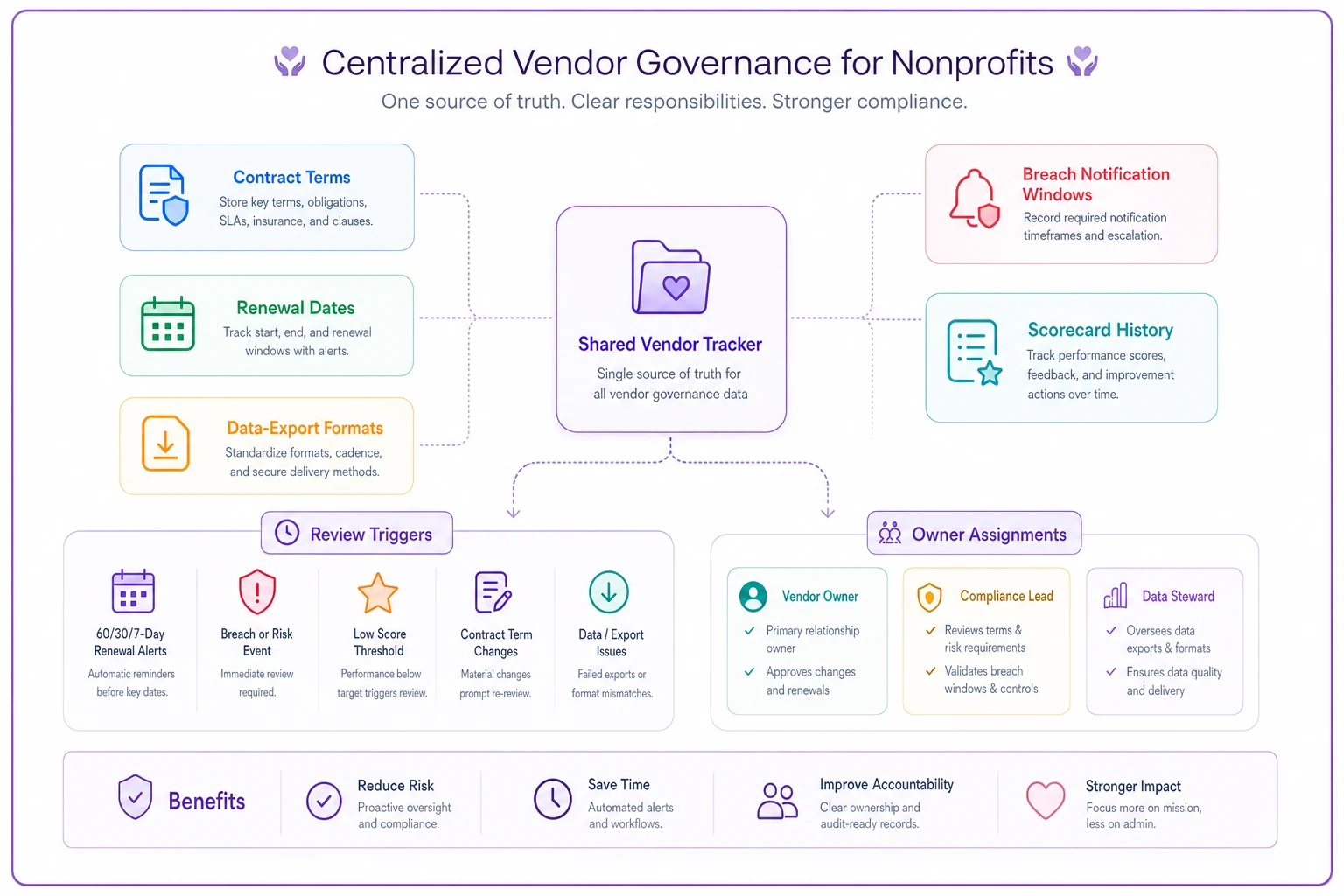
This shows the basic flow teams should aim for: a single source of truth that triggers renewal reviews and stores export specs so knowledge doesn't vanish with a staff change.
Keep a single shared tracker with contract expiry, export formats, and the vendor scorecard so renewal reviews are automatic, not memory-dependent.
What holds up over time is centralization — a single place where every vendor's contract terms, renewal date, data-export method, breach-notification window, and scorecard history live together. Some teams run this in a shared tracker; others build it into their broader operations platform so renewal reviews and vendor scorecards surface automatically instead of depending on someone remembering. The specific tool matters less than the principle: vendor governance has to outlive the staff member who set it up.
The goal of all of this isn't to turn your team into contract lawyers. It's to make sure that the next time a vendor raises prices, gets acquired, or has an outage during year-end, you're reacting from a position where you can actually walk away — with your donor data intact and on your terms. That leverage is built quietly, one clause at a time, long before you ever need it.
Ready to elevate your nonprofit impact?
Join 2,000+ nonprofits using Almosly to boost fundraising efficiency, deepen donor relationships, and scale philanthropic impact.