

Last month, a mid-sized education nonprofit in Chicago discovered they'd been storing credit card numbers in plain text inside donor notes fields for three years. Not intentionally — their development coordinator had been copying payment confirmations from processor emails as "backup documentation." About 1,400 records exposed, spanning major donors to monthly sustainers.
The breach cost them roughly $47,000 in notification requirements, legal fees, and credit monitoring. But the real damage came afterward: their spring gala lost 30% attendance, monthly giving dropped by 22%, and their development director spent four months doing damage control instead of fundraising.
Most nonprofits treat data governance like insurance — something you grudgingly buy but hope never to use. Your nonprofit data governance framework isn't just about avoiding disasters though. It's the operational backbone that determines whether your donor relationships scale or fall apart as you grow.
The consent problem hiding in every donation form
Pull up your online donation form right now. Does it say what happens to donor data after they give? How long you keep it? Who sees it? Whether you share it with partner organizations?
Most nonprofits operate with what I'd call "assumption consent" — assuming donors are fine with whatever you do because they gave you money. That works at 50 donations a month. At 500, it becomes a real problem.
Here's what typically breaks: Your major gifts officer adds personal notes about a donor's divorce to help with sensitive outreach timing. Your events team shares attendee lists with corporate sponsors for "partnership development." Your volunteer coordinator exports the entire database to their personal laptop to work on segmentation from home. Your direct mail vendor keeps copies of your donor file "for reprinting purposes."
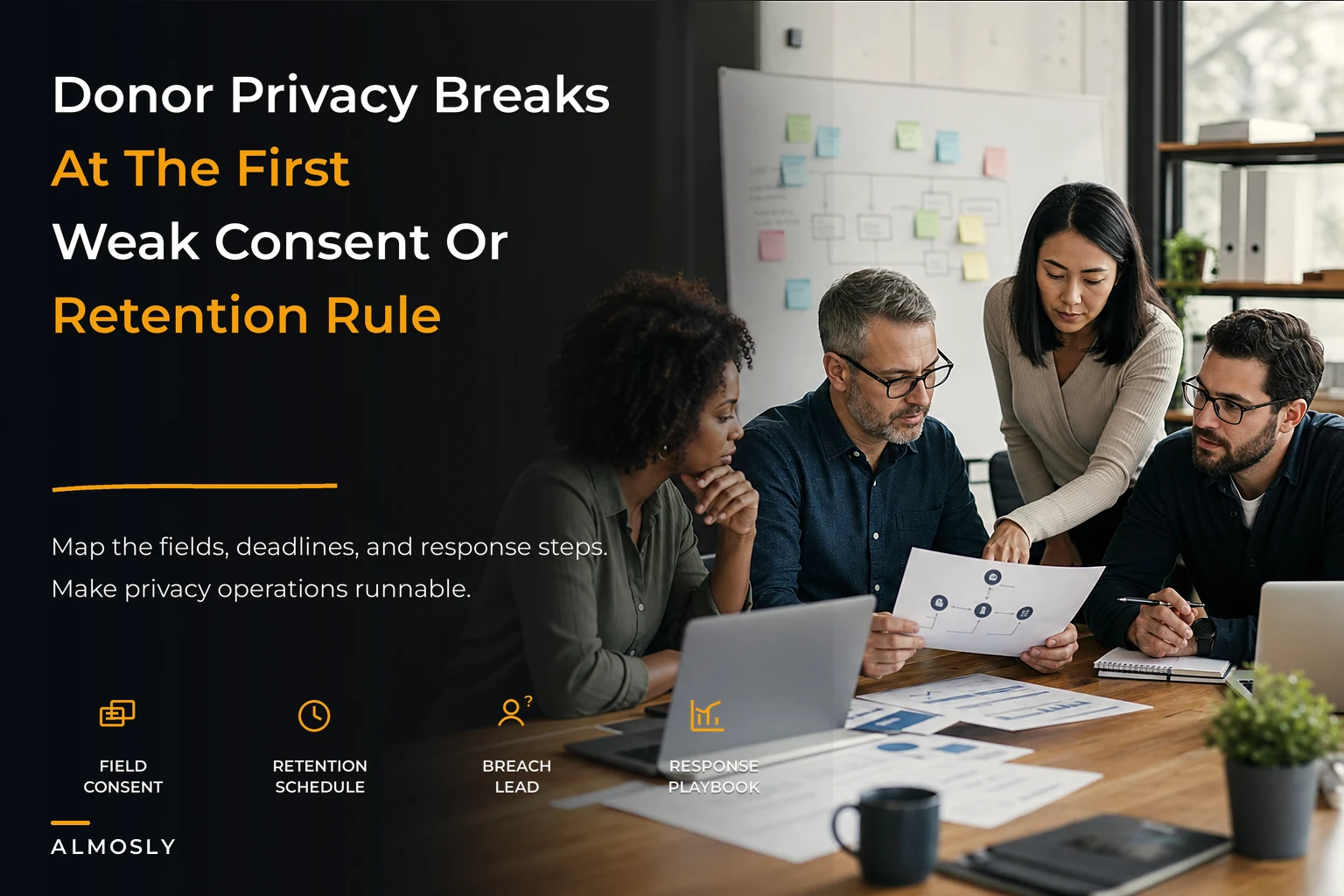
A field-level consent framework starts with understanding that different data types need different rules. A donor's email address for tax receipts has different consent requirements than that same address for fundraising appeals. Their giving history for internal analysis is different from handing that history to a wealth screening service.
Building a consent architecture that scales
Instead of treating consent as a yes/no checkbox, map it to specific operational uses:
Stop missing fundraising opportunities.
Almosly helps you plan, track, and optimize every campaign with ease.
- Centralized donor and volunteer management
- Automated engagement workflows
- Impact and fundraising analytics
No credit card required
Essential Operations Consent (required for donation processing):
-
Tax receipt delivery
-
Payment processing
-
Legal compliance reporting
-
Financial reconciliation
Engagement Consent (optional but valuable):
-
Fundraising communications
-
Event invitations
-
Impact reporting
-
Volunteer opportunities
Extended Use Consent (higher risk, higher bar):
-
Wealth screening services
-
Data appends and enrichment
-
Partner organization sharing
-
Research and analysis
The practical value here is connecting these consent levels to actual database fields. Your CRM should know that phone numbers marked "emergency contact only" never go into calling campaigns. Email addresses flagged as "tax only" stay out of marketing automation. This isn't just compliance — it prevents the awkward situation where a donor who explicitly opted out still gets your year-end appeal.
Retention schedules that balance compliance with operational reality
Every nonprofit keeps data forever by default. Old spreadsheets from 2014 capital campaigns. Volunteer applications from people who never showed up. Event attendance lists from galas that predate your current staff.
-
Security risk multiplies with every old file
-
Data quality degrades as outdated records pollute analysis
-
Staff can't tell what's current, so they trust nothing
Your retention schedule needs to map data types to operational lifecycles:
| Data Type | Retention Period | Trigger Point | Exception Cases |
|---|---|---|---|
| Donation records | 7 years | From transaction date | Pledges retain until fulfilled + 7 years |
| Donor communications | 3 years | From last interaction | Major gift documentation: permanent |
| Event registrations | 2 years | From event date | Attendee incidents: 7 years |
| Volunteer applications | 1 year | From submission | Accepted volunteers: active + 2 years |
| Prospect research | 6 months | From creation | Converted prospects: follow donor schedule |
| Payment methods | Delete immediately | After processing | Recurring gifts: until canceled |
Creating the schedule is the easy part. Making it operational — automated deletion workflows, quarterly audits, clear ownership for each category — that's where most organizations stall.
The vendor management blind spot
Count how many third parties touch your donor data: payment processors, email platforms, event registration tools, wealth screening services, direct mail houses, telefunding agencies. Each one expands your risk surface.
A performing arts nonprofit in Seattle found this out when their ticketing vendor's breach exposed around 8,000 patron records — including donors who'd bought gala tables. The nonprofit spent six weeks figuring out which records overlapped with their donor base, who needed notification, and whether their privacy policy even covered third-party ticketing data.
Your vendor checklist needs actual teeth:
Before Contract Signing:
-
Data handling addendum specifying encryption, access controls, deletion rights
-
Breach notification timeline (24-48 hours maximum)
-
Cyber insurance verification with your nonprofit as additional insured
-
Right to audit clause with 30-day notice
-
Data localization requirements (no offshore processing without consent)
During Operations:
-
Quarterly access reviews — which vendor staff can see your data?
-
Annual security attestation updates
-
Data minimization audits — are you sharing more than necessary?
-
Deletion confirmation when contracts end
Red Flags Worth Killing Deals Over:
-
"We'll figure out security details later"
-
No dedicated data protection contact
-
Subcontracting without notification rights
-
Retention beyond your specified schedule
-
Mixing your data with other clients' for "benchmarking"
The vendors pushing back hardest on these requirements are usually the ones you should worry about most. An email platform that can't explain their encryption approach probably doesn't have one.
Your breach response playbook (before you need it)
Most breach response plans read like insurance policies — technically complete, operationally useless when panic sets in. You need a playbook that assumes everyone's stressed, nobody remembers their role, and the clock's already ticking on notification requirements.
The first four hours matter most:
Hour 1: Containment
-
IT lead isolates affected systems
-
Password resets for any compromised accounts
-
Document everything — screenshots, logs, timeline
-
Don't delete anything that might be evidence
Hour 2: Assessment
-
What data was accessed or exposed?
-
How many records affected?
-
Do we have current contact info for affected donors?
-
Is the breach ongoing or contained?
Hour 3: Legal/Insurance
-
Contact cyber insurance carrier (claim number documented in playbook)
-
Engage breach counsel (pre-negotiated rates, contact info in playbook)
-
Determine notification requirements by state
-
Preserve evidence per legal guidance
Hour 4: Communication Prep
-
Draft donor notification (templates pre-approved by legal)
-
Prepare board alert
-
Create internal FAQ for staff
-
Designate single spokesperson
The playbook should include actual names, personal cell numbers, and backup contacts for every role. "Contact IT" doesn't help when your IT person is on vacation. "Call the insurance carrier" fails if nobody knows the policy number.
Here's a quick visual workflow of the first four-hour response.
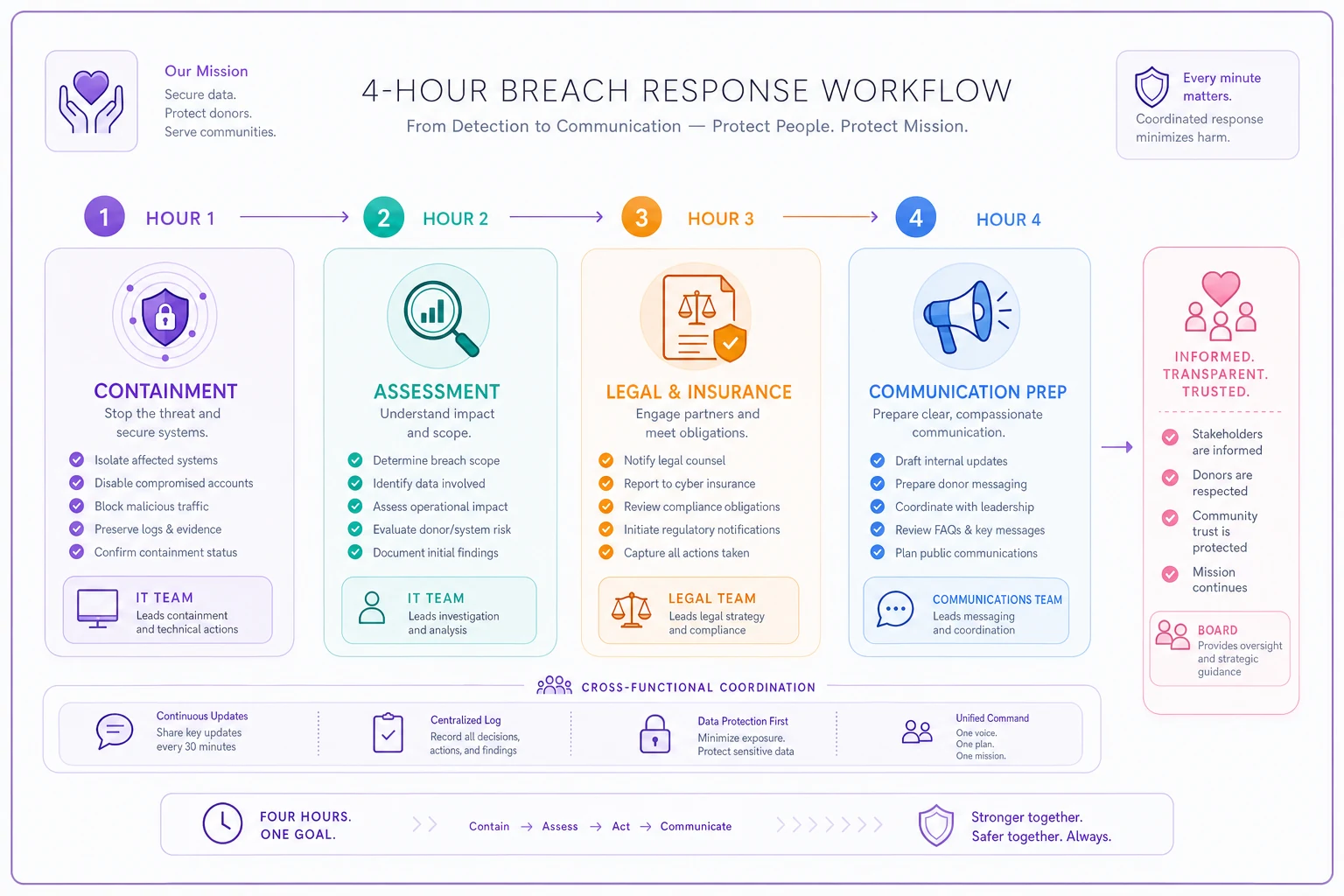
Your notification matrix maps breach types to requirements:
-
Financial data (credit cards, bank accounts) Immediate notification, offer credit monitoring
-
Social Security Numbers State-specific timelines, identity protection services
-
Basic contact info only May not require notification, document decision rationale
-
Passwords/credentials Immediate forced reset, notification within 24 hours
Pre-draft three versions of your donor notification: financial data breach, contact info only, and unknown scope. Getting templates reviewed by legal before you need them saves hours during an actual incident.
The owner cadence that keeps governance running
Data governance dies without clear ownership and consistent rhythm. Not the "we'll review this annually" kind that never happens — operational cadence built into workflows that already exist.
Monthly Development Team Check (15 minutes):
-
Any new data collection points this month?
-
Any new vendor relationships?
-
Any consent questions from donors?
-
Any old campaigns to archive or delete?
Quarterly Cross-Functional Review (1 hour):
-
Marketing
email suppression list updates
-
Finance
payment data handling audit
-
Programs
participant data retention check
-
IT
access review and security patches
Semi-Annual Vendor Audit (2 hours):
-
Contract review for all data-touching vendors
-
Security attestation updates
-
Data minimization assessment
-
Deletion confirmation for ended relationships
Annual Governance Refresh (half day):
-
Full retention schedule review
-
Consent language updates
-
Breach playbook tabletop exercise
-
Policy updates for new regulations
Embed these into existing meetings rather than creating new ones. Your monthly development meeting already happens — add a 15-minute governance check at the end. Your quarterly planning session exists — include the data review.
Add a 15-minute governance check to the end of your monthly development meeting so it actually happens.
Your monthly development meeting already happens — add a 15-minute governance check at the end. Your quarterly planning session exists — include the data review.
Where AI-powered operational software changes the game
The framework above works, but running it manually creates serious overhead. A development coordinator spending three hours per month managing consent preferences. An operations manager manually running retention audits. A CFO personally reviewing vendor contracts for data clauses.
Operational software enhanced with AI automation turns data governance from an active burden into a background process. Instead of manual consent tracking, the system flags when donors update preferences and pushes those changes across every touchpoint. Rather than quarterly retention audits done by hand, automation continuously identifies and queues data for deletion based on your retention rules.
The impact measurement processes you've built need clean, compliant data to function. Modern platforms handle consent inheritance — when a donor opts out of email, that preference automatically applies to email appends, campaign segmentation, and partner sharing. When preparing for CRM migrations, automation surfaces data governance issues before they become migration blockers.
Breach response is where it gets particularly useful. While your team is making phone calls, the system is already pulling affected records, compiling contact information, and populating notification templates. What normally takes 6-8 hours of manual data analysis can happen in a fraction of that time.
The governance dividend nobody talks about
Organizations that implement a real nonprofit data governance framework usually expect compliance overhead. What they get instead often surprises them.
Clean data with clear consent drives better segmentation. Defined retention schedules mean reports reflect current information instead of polluted datasets. Vendor management discipline prevents the shadowy tool sprawl that fragments your donor view.
A youth services nonprofit in Denver implemented this framework about 18 months ago after a close call with a vendor breach. Email engagement rates increased 34% (better consent means more engaged lists), major gift officers saved several hours weekly from cleaner research, and their donor lifecycle architecture actually started functioning as designed.
The framework also simplifies scaling. When you know exactly what data you have, where it lives, how long you keep it, and who can access it, adding new fundraising channels becomes much less chaotic. Launching peer-to-peer campaigns? Your consent architecture already handles it. Adding telefunding? Your vendor checklist ensures security requirements from day one. Expanding into planned giving? Your retention schedule already accounts for the longer documentation needs.
Making it real for your organization
Start with the highest-risk gap in your current operations. For most nonprofits, that's either the vendor inventory (you probably have more vendors touching data than you realize) or the retention schedule (you're almost certainly keeping too much). Pick one, fix it completely, then move to the next.
Don't try to cover everything at once. A functioning framework that handles 80% of your data beats a perfect plan that never gets implemented. Donor data first, volunteer data second, everything else third.
Build for the organization you're becoming, not the one you are today. If you're processing 200 donations monthly now but expect 500 within two years, design for 500. Rebuilding frameworks mid-growth is painful.
And make it someone's job. Not their only job, but explicitly part of their role with time allocated and success metrics attached. Data governance without an owner is just good intentions that quietly decay into liability.
Donors trust nonprofits with more than money — their identity, communication preferences, giving history, personal information. A nonprofit data governance framework isn't about checking boxes or avoiding fines. It's about honoring that trust at scale, systematically, every single day.
Ready to elevate your nonprofit impact?
Join 2,000+ nonprofits using Almosly to boost fundraising efficiency, deepen donor relationships, and scale philanthropic impact.