

Most nonprofits treat risk as a compliance chore. You fill out a spreadsheet before the audit, list "cybersecurity" and "reputational damage," assign an owner who nods, and never look at it again until next year. The problem is that donor trust doesn't fail in the categories your compliance template uses. It fails in the gaps between people, process, and technology—the exact places a generic risk register never looks.
The failures that actually cost you donors are almost never dramatic. Rarely a single breach or scandal. Instead, trust bleeds out through a slow accumulation of small operational cracks. A receipt goes out with the wrong amount. A widow keeps getting appeals for her late husband. A pledge gets recorded twice, and the follow-up call assumes she never gave. Each one, on its own, is survivable. Together they teach your best donors that you're not paying attention—and donors who feel unseen leave quietly, without complaint, which is why leadership usually finds out too late.
A real fundraising risk framework nonprofit teams can actually run has to map these failures back to the operational layer where they happen. Not "reputational risk" in the abstract, but "gift acknowledgment accuracy," "consent state integrity," "reconciliation timing." This article walks through how to build that—the risk register specific to fundraising, control mapping across people/process/tech, incident playbooks for when something breaks anyway, and the trustee reporting items that actually track donor trust instead of vanity metrics.
Why generic risk registers miss the failures that matter
Board-level risk registers are usually inherited from the finance or governance side of the house. They're built to satisfy auditors and insurers, so they think in terms of large, discrete events: fraud, data breach, litigation, funding collapse. Those matter. But they're low-frequency, high-visibility events, and most organizations already have some plan for them.
Trust failures are the opposite. High-frequency, low-visibility. They live inside daily fundraising operations, and they don't show up in a governance register because nobody categorizes "we sent a duplicate appeal to 400 lapsed donors" as an enterprise risk. It just gets fixed quietly, or not noticed at all.
-
Data state drift — consent flags, deceased flags, do-not-contact status, and address accuracy slowly falling out of sync with reality.
-
Handoff gaps — a gift comes in, and the acknowledgment, the tax receipt, the stewardship touch, and the CRM update are owned by four different people (or four different systems) with no shared definition of "done."
-
Timing failures — reconciliation that lags, receipts that go out late, recurring-gift failures that sit unnoticed for a full cycle.
-
Segmentation errors — the wrong message to the wrong person because the query logic quietly broke.
None of those fit neatly into "fraud" or "cyber." That's the whole point. A fundraising-specific register has to be organized around donor experience, not insurance categories.
Building the fundraising-specific risk register
Start by rejecting the idea that one register serves everyone. The board needs a rolled-up view. Your operations team needs a granular one. The mistake is trying to make a single document do both jobs—it ends up too vague for operators and too detailed for trustees.
Stop missing fundraising opportunities.
Almosly helps you plan, track, and optimize every campaign with ease.
- Centralized donor and volunteer management
- Automated engagement workflows
- Impact and fundraising analytics
No credit card required
The operational register should list risks the way they actually occur, tied to a specific workflow. Here's a structure that holds up in practice:
| Risk (donor-facing) | Where it originates | Likelihood | Trust impact | Primary control layer |
|---|---|---|---|---|
| Deceased donor still receiving appeals | Data state / flag not set | Medium | Severe | Process + Tech |
| Duplicate or double-counted gift | Reconciliation lag | High | Moderate | Process |
| Wrong consent state used in send | Segmentation logic | Medium | Severe | Tech + People |
| Late or inaccurate tax receipt | Handoff gap | High | Moderate | Process |
| Recurring gift fails silently | No failure monitoring | High | Moderate | Tech |
| Appeal sent to suppressed donor | Suppression list drift | Medium | Severe | Tech + Process |
| Pledge miscommunicated on call | CRM data not current | Medium | Moderate | People + Tech |
Two columns do the heavy lifting here. Trust impact forces you to separate "annoying" from "relationship-ending." A late receipt annoys people; contacting a grieving family after a death signals you don't see them as human. Those cannot carry the same priority just because both are "moderate likelihood."
The primary control layer column is what most registers skip, and it's the bridge to actually fixing anything. Which brings us to the part that makes this framework usable rather than decorative.
Control mapping across people, process, and technology
Every risk on your register is controlled—or not controlled—by some combination of three things: a person doing something, a process defining how it's done, and technology enforcing or automating it. When an incident happens, it's almost always because the org relied on only one of those layers and it broke.
A typical example: a shop relies entirely on people to catch deceased-donor flags—someone reads the obituaries, someone hears from a family member, someone just remembers. That works until the person who "just knows" goes on leave, or the volume gets too high to track manually. There's no process defining who checks and when, and no technology holding a hard suppression once the flag is set. So the appeal goes out. The failure wasn't the person; it was that the person was the only control.
-
People controls handle judgment
deciding whether a situation is sensitive, choosing tone, escalating something unusual. Humans are good at nuance and bad at consistency.
-
Process controls handle definition and accountability
who owns each step, what "done" means, what the sequence is when a gift arrives. Process turns "someone should" into "this person, by this time."
-
Technology controls handle enforcement and volume
hard suppressions that can't be overridden by accident, validation rules that reject bad data at entry, monitoring that flags a failed recurring gift the same day instead of a month later.
The strongest setups layer all three on the highest-impact risks. Deceased-donor contact, for instance, deserves a process (a defined flagging SOP), a technology enforcement (a hard suppression the CRM honors across every channel), and a people control (a human review before any re-activation). One control for the severe stuff is a gamble you'll eventually lose.
This is also where solid data governance underneath everything pays off. If your consent states, retention rules, and field-level permissions are already defined—the kind of foundation covered in this runnable nonprofit data governance framework—then your technology controls actually have something reliable to enforce. Control mapping falls apart when the underlying data model is mushy, because you can't automate a rule against a field nobody agrees on.
When adding more controls is actually a bad idea
More controls is not automatically better. Piling process on top of low-impact risks is how you end up with a fundraising team that spends more time documenting than fundraising. If a risk is low-likelihood and low-trust-impact, a single lightweight control—or accepting the risk explicitly—is the right call. Reserve the three-layer treatment for the handful of risks that can genuinely end relationships. A register where everything is "critical" is a register nobody uses.
Incident playbooks: what you do in the first 48 hours
Controls reduce incidents. They don't eliminate them. So the second half of the framework assumes something breaks and asks: how fast can you detect it, contain it, and repair the relationship?
Organizations that recover well from donor-facing incidents aren't the ones with the fewest incidents. They're the ones with a rehearsed response. When a bad send goes out, the difference between a shrug and a lost major donor is usually the first day.
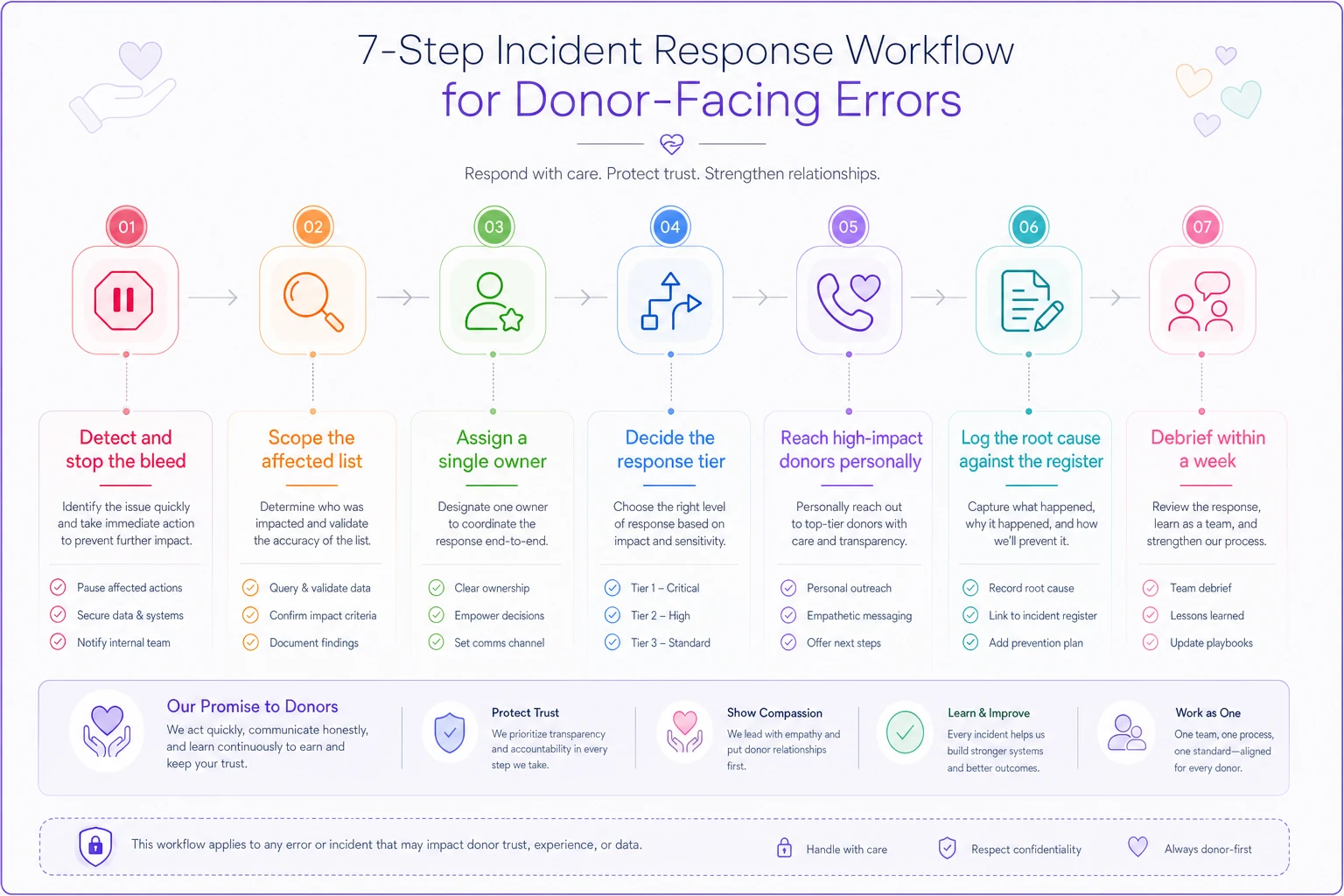
Here's a workable sequence for a "wrong message reached the wrong donors" event—the most common serious incident most shops will face:
-
Detect and stop the bleed. The moment an error is spotted, pause any related sends, automations, or follow-ups. Don't debate first. Stop, then investigate. Most damage in these events comes from the second and third wave that goes out while people are arguing about the first.
-
Scope it honestly. Pull the exact list affected. How many donors, which segments, and—critically—were any high-trust-impact donors caught in it (major donors, recently bereaved, previously complained)? Scope determines response tier.
-
Assign a single owner. One person coordinates the response. Committee-driven incident response is slow, and slow is what loses donors.
-
Decide the response tier. Not every incident warrants a mass apology. Sometimes a quiet correction to the affected segment is better than broadcasting a mistake to people who never noticed. Over-apologizing can create the crisis you were trying to avoid.
-
Reach the high-impact donors personally. If a major donor or a sensitive contact was affected, that's a phone call from a named human, not a form email. This is where the relationship is actually saved or lost.
-
Log the root cause against the register. Which control failed, and at which layer? This closes the loop back into your control mapping so the same gap doesn't reopen.
-
Debrief within a week. Not to assign blame—to fix the control. If the debrief turns into a search for who to punish, people will hide the next incident, and hidden incidents are how small problems become board-level ones.
Notice how much of this is about restraint. The instinct in a fundraising incident is to do more—more apologies, more messages, more meetings. Usually the right move is to stop fast, scope precisely, and respond proportionally.
What trustees should actually see: trust metrics that mean something
Trustees typically get fundraising numbers: total raised, cost to raise a dollar, donor count. Useful, but none of them tell you whether donor trust is intact. You can hit your revenue target for two straight years while quietly training your best donors to leave.
-
Retention by tenure and value tier. Blended retention hides the story. New-donor retention and multi-year major-donor retention behave completely differently, and a drop in the latter is a five-alarm signal that revenue won't show for months.
-
Complaint and correction volume. How many donors contacted you about an error, a wrong receipt, an unwanted contact? Rising correction volume is trust erosion you can see early.
-
Incident count by trust-impact tier. Not raw incidents—weighted by severity. Ten late receipts and one deceased-donor contact are not the same month.
-
Time-to-resolution on donor issues. How long between a donor flagging a problem and it being fixed. Speed here is a direct proxy for how much the org respects the donor's time.
-
Consent and suppression integrity. The percentage of contactable records with clean, current consent states. This is the health of the data your entire program stands on.
-
Recurring-gift involuntary churn. Donors lost to failed payments or expired cards rather than genuine decisions to stop. High involuntary churn means a fixable operational leak, not a giving problem.
The point of surfacing these to trustees isn't to add reporting burden. It's to shift the board conversation from "did we hit the number" to "is the relationship healthy." Boards that only see revenue react to trust failures after they've already cost money. Boards that see leading indicators can ask about a retention dip while there's still time to do something about it.
Several of these metrics depend on measuring donor behavior cleanly—turning data into actual signal rather than noise. That's a discipline in itself, and it's worth building deliberately, as outlined in this piece on running an impact-measurement process that doesn't waste donor data. Trust metrics are only as good as the measurement habits underneath them.
What changes as you grow
The whole framework shifts weight depending on your size, and getting this wrong is a common source of pain.
Small shops—under a few thousand active donors—run mostly on people controls, and honestly that's fine for a while. When one or two people touch every gift, tribal knowledge covers a lot. The deceased flag gets caught because the person opening the mail knew the family. The risk register can be lean. The danger is complacency: the org assumes this works forever and never writes anything down, so the day a key person leaves, every people-based control leaves with them.
The inflection point usually hits somewhere in the mid-sized range, when donor volume outgrows anyone's ability to "just know." This is where process controls have to get written down and technology controls have to start enforcing things automatically. Orgs that don't make this transition experience a specific, recognizable failure mode: incidents that used to be caught by memory start slipping through, and nobody can explain why "we never used to have this problem." The answer is that you grew past the volume your people-only controls could handle.
At the larger end, the register itself needs governance—a defined owner, a review cadence, a link between operational incidents and board reporting. The failure here is a register that exists but is stale, listing risks from three tech stacks ago while the real exposures go untracked.
A real scenario: how a mid-sized shop closed the gaps
A regional environmental nonprofit—roughly 8,000 active donors, small development team of six—kept hitting the same class of embarrassing errors. Over about a year they'd contacted two deceased donors' families, double-receipted a handful of major gifts, and, in the worst case, sent a lapsed-donor win-back appeal to a segment that included several donors who'd explicitly asked to be left alone.
Revenue was fine. That was the trap—leadership assumed things were healthy because the number was healthy. But when they finally looked, major-donor retention had slipped from the low 90s into the mid-80s over two years, and complaint volume had roughly doubled.
They rebuilt around control layering. Deceased-donor handling got all three: a written flagging SOP, a hard suppression the CRM honored across every channel, and a mandatory human review before any reactivation. Suppression and consent states got moved from "someone remembers" to enforced technology controls. And they added exactly five trust metrics to the board packet.
The results weren't a fireworks show, and that's the honest part. Donor-facing incidents dropped to near zero over the following year. Major-donor retention recovered a few points—back into the low 90s—which sounds small until you price out what a handful of retained major donors is actually worth. The bigger shift was cultural: the board started asking about retention and correction volume instead of only asking about the total, which meant problems got caught as questions rather than as crises.
The takeaway for leadership
Donor trust doesn't fail in the categories your compliance template uses, and it rarely fails all at once. It fails in the gaps between the person who was supposed to catch it, the process that never defined who owns it, and the technology that could have enforced it but wasn't set up to.
A fundraising risk framework earns its keep by mapping those gaps specifically—naming the donor-facing risks, assigning them across people, process, and technology, rehearsing what happens when one fails anyway, and giving trustees the leading indicators that reveal trouble while it's still fixable. Build the register around donor experience, layer controls on the risks that can actually end relationships, keep the response playbooks short enough to run under pressure, and report the metrics that move before revenue does. Do that, and you stop being surprised by trust failures—which, for the donors who matter most, is exactly the difference between staying and quietly leaving.
A fundraising risk framework earns its keep by mapping those gaps specifically—naming the donor-facing risks, assigning them across people, process, and technology, rehearsing what happens when one fails anyway, and giving trustees the leading indicators that reveal trouble while it's still fixable. Build the register around donor experience, layer controls on the risks that can actually end relationships, keep the response playbooks short enough to run under pressure, and report the metrics that move before revenue does. Do that, and you stop being surprised by trust failures—which, for the donors who matter most, is exactly the difference between staying and quietly leaving.
Ready to elevate your nonprofit impact?
Join 2,000+ nonprofits using Almosly to boost fundraising efficiency, deepen donor relationships, and scale philanthropic impact.