

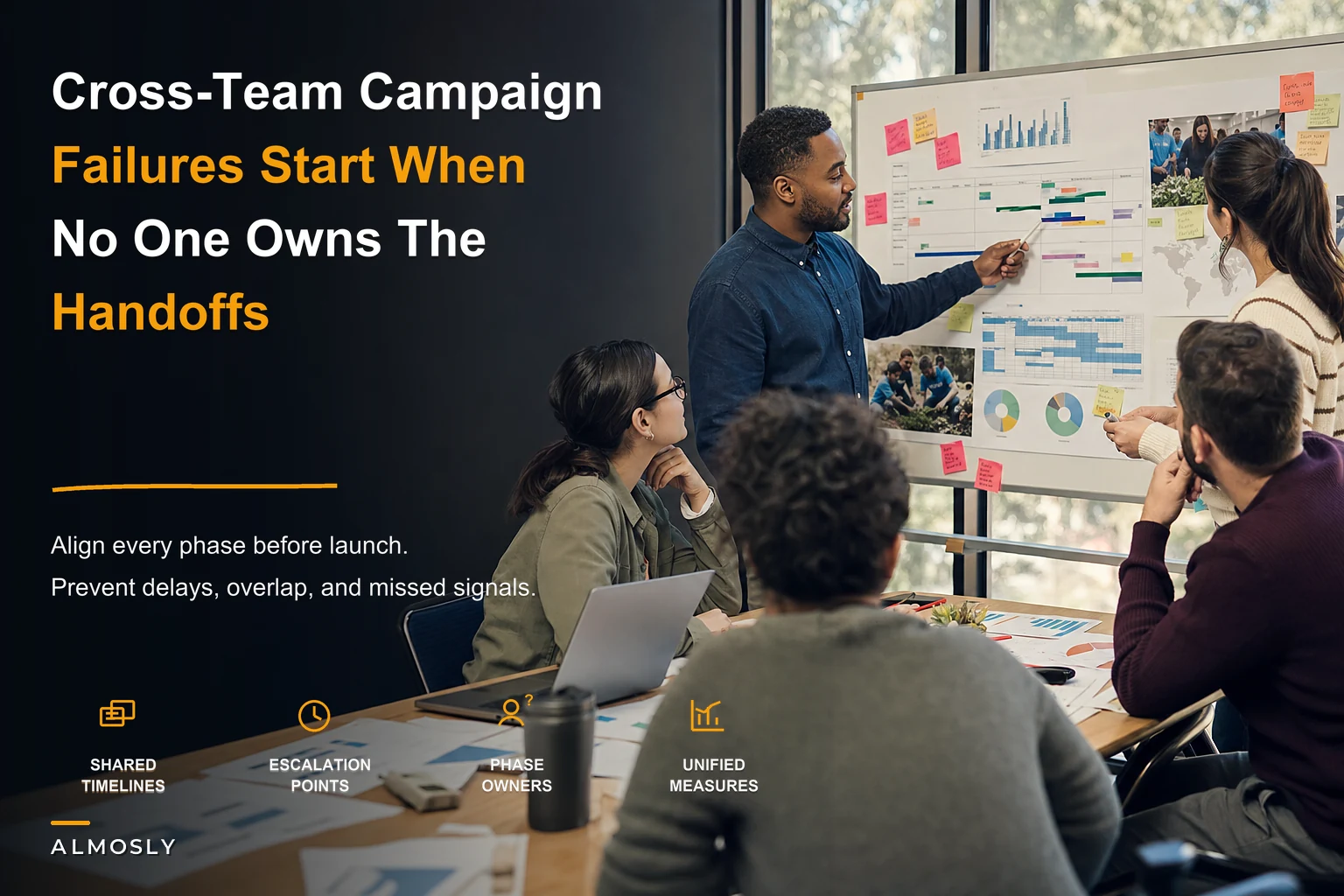

Last month, a mid-sized environmental nonprofit discovered they had three different Earth Day campaigns running simultaneously. The fundraising team launched a major donor push, communications rolled out a social awareness campaign, and the volunteer coordinator started recruiting for cleanup events. Each campaign had its own messaging, its own asks, its own timeline. Donors got conflicting emails. Volunteers couldn't find the donation link. Social posts contradicted the fundraising narrative.
The executive director called it "organizational chaos." The development director called it "Tuesday."
This happens constantly in nonprofits. Not because teams don't care about coordination, but because integrated campaign orchestration requires more than weekly check-ins and shared calendars. After building operational systems for dozens of nonprofits, I've watched this pattern destroy momentum during critical fundraising periods. The solution isn't more meetings - it's building an actual orchestration framework that makes cross-functional coordination automatic rather than heroic.
The real cost of campaign fragmentation
Most nonprofits think campaign failures come from bad messaging or poor timing. They don't. They come from structural coordination problems that compound as organizations grow.
A food bank in Phoenix ran their annual hunger awareness month with three separate workstreams. Fundraising planned a $250,000 corporate sponsorship push. Communications scheduled daily social posts highlighting client stories. The volunteer team organized meal-packing events at partner locations. Sounds comprehensive, right?
Corporate sponsors got invited to events that were already at capacity because volunteer recruitment exceeded expectations. The social media stories featured families who hadn't consented to fundraising use of their images. Volunteers shared unofficial messaging that contradicted the carefully crafted sponsor packets. They raised $147,000 instead of $250,000. Not from lack of effort - from lack of orchestration.
The bigger problem shows up in the data. When campaigns run in silos, you can't answer basic questions like "Did volunteer participation drive donations?" or "Which communication touchpoint triggered action?" You end up with three different success metrics that tell three different stories. The board sees confusion. Major donors see dysfunction. Staff sees overtime.
Understanding campaign orchestration beyond project management
Campaign orchestration isn't project management with extra meetings. Project management tracks tasks and deadlines. Orchestration manages dependencies, conflicts, and amplification opportunities across teams with different objectives and workflows.
Stop missing fundraising opportunities.
Almosly helps you plan, track, and optimize every campaign with ease.
- Centralized donor and volunteer management
- Automated engagement workflows
- Impact and fundraising analytics
No credit card required
Consider what happens during a typical year-end giving campaign. Development needs two weeks of donor cultivation before the ask. Communications wants to build momentum with escalating story content. Volunteers need advance notice for phone banking shifts. These aren't just different timelines - they're different operational rhythms that clash without proper orchestration.
A youth services nonprofit in Denver learned this lesson during their back-to-school campaign. Development sent appeals on schedule. Marketing posted content daily. Programs recruited mentors successfully. But the mentor recruitment push peaked the same week as the major gift solicitation, splitting attention and diluting both messages. Donors who might have given $10,000 gave $1,000. Volunteer applications dropped 40% because the donation appeals overshadowed the recruitment posts.
Traditional project management would call this campaign successful - all tasks completed on time. But from an orchestration perspective, it failed. The teams worked against each other instead of amplifying each other's efforts.
Building your RACI matrix for campaign phases
The RACI matrix (Responsible, Accountable, Consulted, Informed) sounds like corporate bureaucracy, but for nonprofits running integrated campaigns, it prevents the territorial disasters that kill momentum.
| Phase | Communications | Development | Programs | Volunteers |
|---|---|---|---|---|
| Discovery Phase (Weeks 1-2): | Accountable for audience research | Consulted on donor capacity | Responsible for impact data | Informed only |
| Planning Phase (Weeks 3-4): | Responsible for message framework | Accountable for revenue targets | Consulted on story selection | Consulted on capacity |
| Launch Phase (Week 5): | Accountable for first touch | Informed but not active | Responsible for story amplification | Informed only |
| Cultivation Phase (Weeks 6-7): | Responsible for supporting content | Accountable for donor engagement | Consulted on additional stories | Responsible for peer outreach |
| Ask Phase (Week 8): | Responsible for urgency messaging | Accountable for solicitation | Informed only | Responsible for phone banking |
Notice how accountability shifts? That's intentional. A homeless services organization in Portland restructured their winter campaign this way. Previous years saw development and communications fighting over email send times. With phased RACI, communications owned early warming-center awareness emails, then handed email control to development for the funding appeal. No conflicts. No confusion. They exceeded goal by 31%.
Creating shared timelines that actually work
Shared calendars aren't shared timelines. A calendar shows when things happen. A timeline shows how things connect.
Most nonprofits build campaign timelines backwards - starting from the launch date and working backward. This guarantees collision. Instead, map interdependencies first, then build the timeline around natural handoffs.
-
Story collection must complete before creative development - Programs needed 3 weeks to gather student success stories. Communications needed those stories 2 weeks before design started. That's a 5-week minimum runway, non-negotiable.
-
Volunteer recruitment must align with ask schedule - Phone banking volunteers needed 10 days training before calls started. Major gift asks happened week 1. Mass appeals happened week 3. Volunteer recruitment had to split into two cohorts.
-
Donor segmentation drives message testing - Development identified 6 donor segments. Communications could only test 2 messages per week. That meant 3 weeks of testing before the campaign could launch. Moving the launch date would break the testing sequence.
-
Board engagement precedes public launch - Board members needed talking points 2 weeks before public launch to prepare for peer conversations. But talking points required final messaging. So message lock happened earlier than communications wanted, but later than development preferred.
The actual timeline looked nothing like a traditional campaign schedule. Some teams started work 8 weeks early. Others stayed dormant until week 4. But every handoff happened smoothly because the timeline reflected actual dependencies, not arbitrary milestones.
Map interdependencies before assigning dates so handoffs drive the schedule, not milestones.
Some teams started work 8 weeks early. Others stayed dormant until week 4. But every handoff happened smoothly because the timeline reflected actual dependencies, not arbitrary milestones.
Escalation points and suppression rules
Campaigns fail because teams don't know when NOT to act. A disability advocacy nonprofit watched their spring campaign implode when all three teams responded to the same viral moment. Development sent an emergency appeal. Communications posted reactive content. Volunteers organized an impromptu rally. The mixed messages confused supporters so thoroughly that engagement dropped 60% for the next month.
Escalation Triggers:
-
Donation pace falls below 70% of projection for 3 consecutive days
-
Social engagement drops below baseline for 48 hours
-
Volunteer signups miss weekly target by 25%
-
Media opportunity emerges with 24-hour window
-
Major donor signals increased interest
-
Competitor launches similar campaign
Suppression Rules:
-
No donor emails within 48 hours of major news events (unless directly related)
-
Volunteer recruitment pauses during solicitation week
-
Social posting reduces 50% during peer-to-peer fundraising pushes
-
Communications holds all "wins" announcements until development clears donor recognition
-
Programs limits client story sharing during matching gift periods
-
All teams pause activity if crisis communications engages
An animal welfare organization documented their suppression rules after three campaigns where volunteer recruitment emails undermined major gift cultivation. Now, when development marks a donor in "active cultivation," that contact automatically suppresses from all other campaigns for 14 days. Their major gifts increased 43% because donors stopped getting mixed messages during critical decision periods.
The unified measurement plan nobody wants to build
Every team measures what matters to them. Development tracks dollars. Communications counts engagement. Volunteers monitor hours. These metrics tell you if individual teams succeeded. They don't tell you if the campaign succeeded.
Integrated measurement starts with shared outcomes, not combined reports. A mental health nonprofit shifted from department metrics to campaign outcomes:
Traditional Metrics:
-
Development
$500,000 raised
-
Communications
2 million impressions
-
Volunteers
1,000 hours logged
Integrated Outcomes:
-
340 new monthly donors acquired at $67 average (Development + Communications)
-
89% of volunteers made a personal donation (Volunteers + Development)
-
34 media stories mentioned both programs and giving options (Communications + Programs)
-
Corporate sponsors increased 4.2x after attending volunteer events (All teams)
See the difference? The integrated outcomes show how teams amplified each other. More importantly, they reveal optimization opportunities. If volunteers who attend events donate at 89% but general volunteers donate at 12%, guess where you focus next campaign?
Building this measurement plan requires uncomfortable conversations. Communications might need to accept that impressions don't matter if they don't drive donations or volunteer signups. Development might discover that their expensive direct mail performs worse than volunteer peer-to-peer outreach. Volunteers might learn their feel-good events don't actually advance mission.
Operational coordination beyond the campaign
The best nonprofits don't orchestrate campaigns. They orchestrate operations. The campaign just reveals whether the orchestration works.
-
Weekly pulse checks - 15-minute standing meetings where each team shares one priority, one concern, one handoff need
-
Monthly conflict reviews - Examining where teams stepped on each other, without blame, with process adjustments
-
Quarterly capacity planning - Mapping when each team faces peak workload, adjusting campaigns to spread pressure
-
Annual orchestration audit - Full review of handoffs, dependencies, and friction points
Their spring job fair campaign ran like clockwork. Development secured sponsors 6 weeks early because communications provided compelling impact stories from programs. Volunteers recruited precisely the right number of mentors because they knew exact attendance projections. Communications could guarantee media coverage because they knew sponsor announcements timing. The campaign raised $180,000 against a $125,000 goal.
Their everyday operations improved too. Random donor complaints dropped because communications and development aligned on messaging. Volunteer retention increased because programs gave them meaningful work aligned with campaigns. Board meetings became strategic instead of tactical because staff handled coordination without escalation.
Technology and systems for sustainable orchestration
Spreadsheets and emails don't scale. Neither do heroic program directors who personally coordinate everything through force of will. Real orchestration requires systems that make coordination automatic.
-
Centralized campaign briefs - One document with phases, RACI, timelines, escalation rules. Everyone works from the same source.
-
Automated handoff notifications - When development marks segmentation complete, communications automatically gets notified to start message testing
-
Suppression management - Donors in active cultivation automatically remove from mass communications without manual review
-
Integrated dashboards - Single view showing fundraising pace, communication engagement, and volunteer capacity
You're building operational infrastructure that reduces coordination burden. When teams know exactly when they own the timeline, what triggers require response, and how their work affects others, orchestration happens naturally. The campaign becomes an expression of existing operational rhythm rather than a disruption to it.
AI-powered platforms can help by automatically surfacing conflicts before they happen - flagging when volunteer recruitment emails might interfere with major gift solicitation, or identifying when multiple teams target the same audience segment. But the technology just enables what good orchestration design creates: systematic coordination that doesn't require constant management.
Implementation: From chaos to coordination
Moving from scattered campaigns to orchestrated operations doesn't happen overnight. Start with one campaign. Document everything. Build from what works.
A veterans service organization took 18 months to fully implement orchestration. They started with their smallest campaign - a spring golf tournament raising about $40,000. Simple scope, clear timeline, perfect for testing orchestration concepts. They mapped dependencies, built their first RACI, created basic suppression rules.
The tournament raised $47,000 (17% increase) but more importantly, it ran smoothly. No conflicting emails. No overwhelmed volunteers. No missed sponsor recognitions. They applied lessons to their summer campaign (doubled complexity, similar success). By year-end giving, they ran full orchestration across 5 teams, 12 workstreams, and 400 volunteers. They exceeded goal by $240,000.
A simple implementation workflow looks like this.
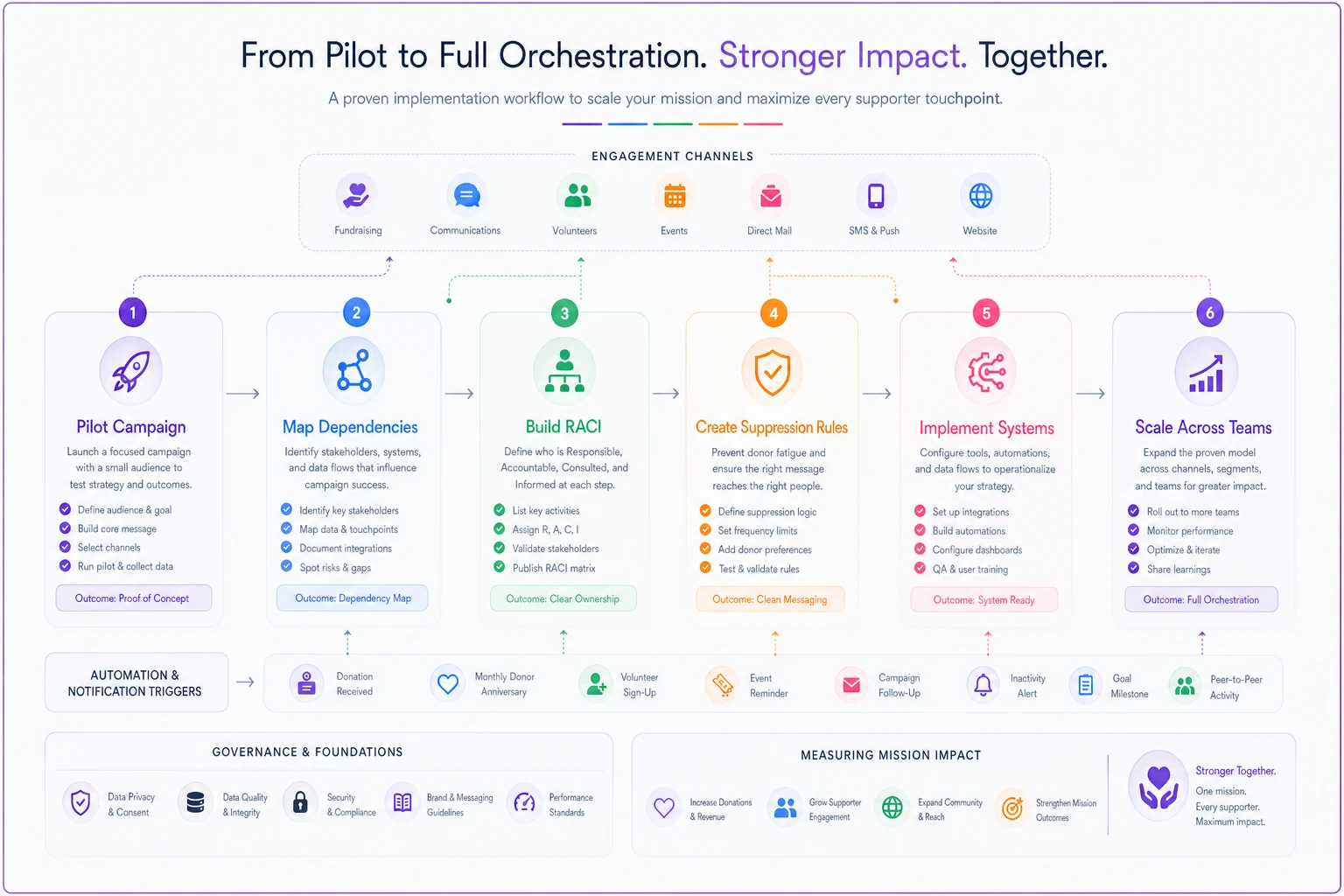
The transformation required changing how teams think about campaigns. Instead of owning pieces, they share outcomes. Instead of protecting territory, they actively hand off leadership. Instead of measuring individual success, they track collective impact.
Making orchestration sustainable
The best orchestration framework means nothing if teams abandon it under pressure. And pressure always comes - urgent grant deadlines, emergency appeals, unexpected media opportunities.
Sustainability comes from embedding orchestration into operational DNA rather than treating it as campaign overlay.
Regular orchestration reviews outside campaign periods. Teams should practice handoffs and test escalation triggers when stakes are low. A housing nonprofit runs monthly "fire drills" where they simulate campaign conflicts and practice resolution protocols.
Building orchestration skills across the organization. Don't centralize coordination expertise in one person. Train every team lead to read RACI matrices, manage handoffs, and recognize escalation triggers. When your volunteer coordinator takes medical leave during a campaign, others can maintain orchestration rhythm.
Accept that perfect orchestration doesn't exist. You'll still have conflicts. Messages will still occasionally contradict. Teams will still sometimes work at cross-purposes. But with orchestration frameworks, these become minor adjustments rather than campaign-killing disasters.
The actual payoff
Good orchestration doesn't just prevent campaign failures. It amplifies success in ways that surprise even experienced nonprofit leaders.
A conservation nonprofit implemented full orchestration across their fall campaign. Expected outcome: fewer conflicts and cleaner execution. Actual outcome: 47% increase in campaign ROI. Why? Orchestration revealed hidden amplification opportunities. They discovered volunteer event attendees had 6x higher donation rates than email recipients. So they shifted budget from direct mail to volunteer events. Communications crafted stories specifically for volunteer sharing. Development timed asks to coincide with post-event enthusiasm.
The campaign didn't just run better. It performed at a level they didn't know was possible.
That's the real power of integrated campaign orchestration for nonprofits. Not just avoiding failure, but discovering what exceptional execution actually looks like. When fundraising, communications, and volunteers truly orchestrate - sharing timelines, following RACI protocols, respecting escalation triggers, measuring unified outcomes - campaigns stop being organizational stress tests and start being opportunities for breakthrough impact.
The frameworks in this playbook aren't theoretical. They come from watching dozens of nonprofits transform campaign chaos into operational excellence. Some took months to implement. Others revolutionized their approach in a single campaign cycle. All discovered the same truth: orchestration isn't about controlling every detail. It's about creating systems where coordination happens naturally, teams amplify each other's work, and campaigns achieve more than any single department could accomplish alone.
Your next campaign doesn't have to be chaos. With proper orchestration, it can be your best one yet.
Ready to elevate your nonprofit impact?
Join 2,000+ nonprofits using Almosly to boost fundraising efficiency, deepen donor relationships, and scale philanthropic impact.