


You know that feeling when your development director presents their segmentation strategy and it's basically just three buckets: major donors, regular donors, and lapsed donors? Then your campaigns underperform because you're sending the same year-end appeal to someone who gave $50 once and someone who's been giving $500 monthly for three years.
Last month I helped a regional food bank fix their segmentation mess. They had 14,000 donors in their CRM but could only tell me about maybe 200 of them—the major gift folks. Everyone else was just... everyone else. Their monthly giving program was hemorrhaging supporters because they kept sending acquisition-focused messages to people already giving monthly. Mid-level donors felt ignored because all the personal attention went to the $10k+ crowd.
The crazy part? They had all the data. Years of giving history, event attendance, volunteer hours, email engagement. Just sitting there. Unused. Because nobody had built actual query rules that operations staff could execute.
Why mid-sized nonprofits specifically need different segmentation architecture
Mid-sized nonprofits (think $2M-$15M annual budgets) are operationally different from both small community orgs and large institutions: you have enough donors that manual tracking breaks down, but not enough staff to have dedicated analysts building custom segments every week.
A children's hospital foundation I worked with had 8,000 active donors but only 1.5 FTE in development ops. They couldn't run the complex segmentation models their consultants recommended because executing them took 6 hours of SQL queries that only their part-time data contractor understood. When she went on maternity leave, they basically stopped segmenting for three months.
Your development coordinator needs to pull lists for campaigns weekly. Gift officers need to identify upgrade candidates monthly. Retention managers need to flag at-risk sustainers immediately. If your segmentation taxonomy requires a data science degree to implement, it's worthless.
Mid-sized orgs also face this dynamic where major donors expect the personal touch of a small nonprofit, while your broader base expects the professionalism of a large institution. You can't hand-manage 8,000 relationships, but you also can't just blast generic appeals and hope for the best.
The exact query logic that actually works in production
Here's the segmentation taxonomy we've refined across about forty implementations. These rules work in any decent CRM because they rely on basic transaction data, not fancy predictive models.
Stop missing fundraising opportunities.
Almosly helps you plan, track, and optimize every campaign with ease.
- Centralized donor and volunteer management
- Automated engagement workflows
- Impact and fundraising analytics
No credit card required
Sustainer Segments
New Sustainers (0-3 months):
-
Query
recurringgiftstartdate >= TODAY - 90 AND recurringgift_status = 'Active' -
Campaign focus
Welcome series, impact confirmation
-
Touch frequency
Weekly for first month, then monthly
Stable Sustainers (4-12 months):
-
Query
recurringgiftstartdate BETWEEN TODAY - 365 AND TODAY - 91 AND recurringgiftstatus = 'Active' AND failedpayment_count < 2 -
Campaign focus
Upgrade asks, exclusive updates
-
Touch frequency
Monthly plus quarterly upgrade ask
At-Risk Sustainers:
-
Query
recurringgiftstatus = 'Active' AND (failedpaymentcount >= 2 OR creditcardexpiry < TODAY + 60) -
Campaign focus
Payment update campaigns, retention offers
-
Touch frequency
Immediate intervention, then weekly until resolved
Value-Based Segments
The key insight: segment by cumulative lifetime value, not just last gift amount. Someone who gave $100 monthly for two years then lapsed is fundamentally different from someone who gave a one-time $2,400 gift.
High-Value Active (top 10% by LTV):
-
Query
lifetimegiving >= [90th percentile value] AND lastgift_date >= TODAY - 365 -
Campaign focus
Major gift pipeline, exclusive cultivation
-
Touch frequency
Monthly personal touchpoint plus quarterly impact report
Mid-Value Active (next 30% by LTV):
-
Query
lifetimegiving BETWEEN [60th percentile] AND [89th percentile] AND lastgift_date >= TODAY - 365 -
Campaign focus
Upgrade cultivation, planned giving introduction
-
Touch frequency
Bi-monthly targeted appeals plus monthly newsletter
Engagement-Based Segments
Engagement trumps giving history for predicting future behavior. Someone who hasn't given in 18 months but opens every email is more likely to convert than someone who gave last month but never engages.
Highly Engaged Non-Donors:
-
Query
lifetimegiving = 0 AND emailopenrate >= 40% AND emailhistory_months >= 6 -
Campaign focus
First gift acquisition with social proof
-
Touch frequency
Bi-weekly cultivation until conversion
Engaged Lapsed (the golden segment):
-
Query
lastgiftdate BETWEEN TODAY - 730 AND TODAY - 366 AND emailopenrate >= 25% AND lifetime_giving > 0 -
Campaign focus
Win-back campaigns with specific impact updates
-
Touch frequency
Monthly targeted reactivation series
These rules work in any decent CRM because they rely on basic transaction data, not fancy predictive models.
Building segments that operations teams can actually maintain
A performing arts center in Minneapolis had beautiful segmentation logic their consultant designed. Thirty-seven segments with nested criteria considering giving patterns, event attendance, demographic modeling, and wealth screening data. Looked great in the PowerPoint.
Problem was, their development associate spent four hours every Monday just updating the segments. Half the queries would error out because of data quality issues. By Thursday, the segments were already stale because gifts from Tuesday weren't reflected.
The segmentation taxonomy you implement needs to be maintainable by whoever's actually running campaigns.
Query rules that auto-update
Don't build segments based on static lists. Every rule should be a query that pulls fresh data automatically. When someone makes a gift, they should move segments immediately, not wait for a weekly manual update.
Clear ownership and documentation
Each segment needs an owner who understands why it exists and what campaigns it feeds. We built a simple tracking table for a youth development org:
| Segment Name | Owner | Update Frequency | Primary Campaign Use | Query Location |
|---|---|---|---|---|
| Monthly Sustainers - New | Retention Manager | Real-time | Welcome series | CRM View #234 |
| Lapsed Major ($1k+) | Major Gifts Officer | Daily | Personal reactivation | CRM View #567 |
| Event Attendee Non-Donors | Events Coordinator | After each event | Conversion campaign | CRM View #890 |
| Upgrade Candidates | Development Ops | Weekly | Quarterly upgrade ask | CRM View #123 |
Failsafe criteria
(lastgiftdate >= TODAY - 365 OR recurringgiftstatus = 'Active') AND lifetimegiving > 0 AND (emailstatus != 'Bounced' OR emailstatus IS NULL) AND deceasedflag != 'Y'
Assign a clear owner for each segment and store the query in the CRM so updates run automatically.
Notice how we handle nulls and provide alternative conditions? That's what keeps segments running when your data isn't perfect.
Specific segment definitions for common mid-sized org campaigns
Here are the exact segments that drive the most revenue for organizations with 5,000-15,000 donors:
Year-End Campaign Segments
November Warm-Up Segment:
-
Query
lastgiftdate BETWEEN TODAY - 730 AND TODAY - 366 AND lastgiftcampaign_type = 'Year-End' -
Logic
These donors give annually at year-end but haven't given yet this year
-
Message focus
Early bird appreciation discount or matching gift opportunity
-
Expected response
18-22% with average gift 15% higher than previous year
December Sprint Segment:
-
Query
lastgiftdate >= TODAY - 365 AND lastgiftamount < 500 AND gift_count >= 3 -
Logic
Regular supporters who could handle an additional year-end ask
-
Message focus
Specific project funding with urgency
-
Expected response
8-12% response rate for additional gift
Monthly Giving Conversion Segments
Prime Converter Segment (hidden gold):
-
Query
giftcount >= 4 AND averagegiftfrequency <= 95 AND lastgiftdate >= TODAY - 180 AND recurringgift_status != 'Active' -
Logic
People already giving quarterly or more frequently, just not on autopay
-
Message focus
Convenience and impact multiplication
-
Expected response
12-15% conversion to monthly
Small But Mighty Segment:
-
Query
averagegiftamount <= 50 AND giftcount >= 3 AND emailopen_rate >= 30% -
Logic
Engaged small donors perfect for $10-25 monthly asks
-
Message focus
Collective impact and insider benefits
-
Expected response
8-10% conversion with average $19 monthly
Retention Emergency Segments
Payment Failure Recovery:
-
Query
recurringgiftstatus = 'Failed' AND failed_date >= TODAY - 30 -
Logic
Immediate intervention prevents 70% of sustainer churn
-
Message focus
Multiple channel outreach (email, text, phone)
-
Expected result
60-65% recovery rate within 30 days
The Silent Departees:
-
Query
giftcount >= 10 AND lastgift_date BETWEEN TODAY - 455 AND TODAY - 425 -
Logic
Loyal donors who just passed the crucial 14-month mark
-
Message focus
Personal check-in, not an ask
-
Expected result
25-30% reactivation within 90 days
The Silent Departees: Query: giftcount >= 10 AND lastgift_date BETWEEN TODAY - 455 AND TODAY - 425 Logic: Loyal donors who just passed the crucial 14-month mark Message focus: Personal check-in, not an ask Expected result: 25-30% reactivation within 90 days
When automation prevents segment decay
That food bank I mentioned? They were spending 15 hours a week just managing segments. Running queries, updating lists, checking for errors, fixing duplicates.
We helped them implement an automated segmentation system where query rules run continuously in the background. When someone's giving pattern changes, they automatically move segments. When a credit card fails, the system immediately triggers the retention protocol. When someone hits the upgrade threshold, they're flagged for personal outreach.
Here's how automation fits into daily ops.
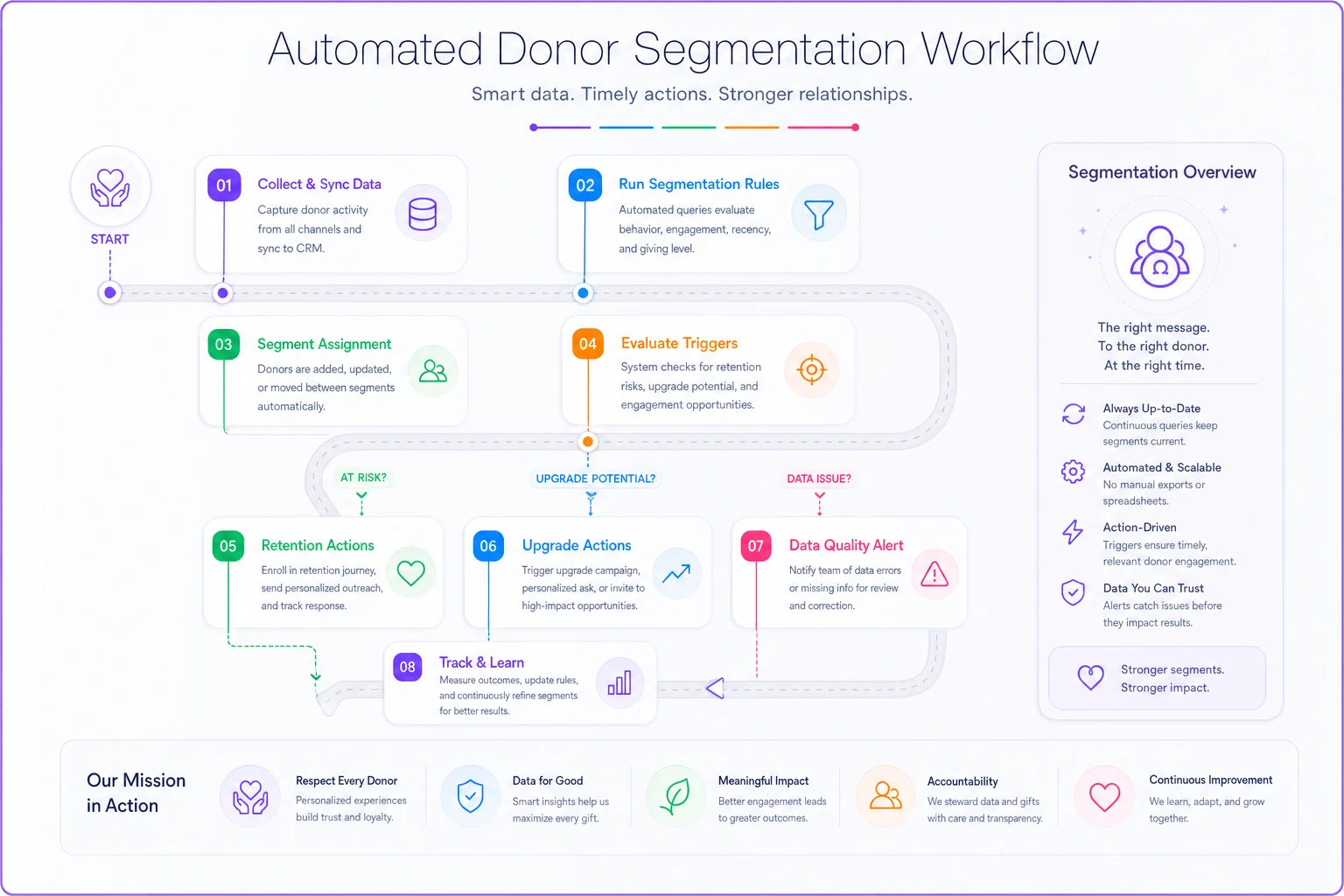
The development coordinator went from spending Monday mornings pulling lists to spending that time actually crafting compelling campaign messages. The retention rate on monthly donors jumped from around 68% to 84% in six months—not because they discovered some magical message, but because at-risk donors got contacted within 24 hours instead of whenever someone noticed.
AI automation particularly helps with edge cases and segment hygiene. It catches when someone appears in conflicting segments (like both "lapsed donor" and "new sustainer"). It identifies when query logic would exclude valuable donors due to data quirks. It suggests new segment opportunities based on actual giving patterns rather than theoretical models.
Campaign pairing strategies that compound results
The real power comes from coordinating campaigns across segments. An environmental nonprofit in Portland was running 47 different campaigns a year, completely uncoordinated. Major donors would get three asks in a week while monthly givers went months without meaningful contact.
Map your segments to campaign calendars:
High-Touch Sequence (Top 10% by LTV)
-
January
Impact report with handwritten note
-
March
Exclusive briefing invitation
-
May
Personal ask from ED/Board member
-
September
Site visit or program tour
-
November
Year-end insider preview
-
Monthly
Personal acknowledgment for gifts
Sustainer Journey (All monthly donors)
-
Month 1-3
Welcome series with impact stories
-
Month 4
First upgrade ask (if appropriate)
-
Month 6
Exclusive sustainer event/webinar
-
Month 9
Second upgrade opportunity
-
Month 11
Appreciation focus
-
Month 12
Anniversary celebration and soft upgrade
Reactivation Ladder (Lapsed by timeframe)
-
Lapsed 12-18 months
Full reactivation series (6 touches)
-
Lapsed 19-24 months
Condensed win-back (3 touches)
-
Lapsed 25-36 months
Annual "we miss you" with major update
-
Lapsed 37+ months
Move to acquisition messaging
The trick is building these campaigns to reference each other. Your year-end appeal to engaged lapsed donors should reference the program update they opened in September. Your upgrade ask should build on the impact story they engaged with last month.
Fixing broken segmentation without starting over
A refugee resettlement org came to me with 8 years of donor data in complete chaos. Different staff had created segments over time with zero documentation. They had donors in seven segments simultaneously. Some segments hadn't updated in two years.
You don't need to burn it all down.
First, audit what you have. Export all your segments with member counts. Look for:
-
Segments with zero members (delete these)
-
Segments that overlap 80%+ (consolidate)
-
Segments nobody can explain (document or delete)
-
Segments tied to old campaigns (archive)
Second, pick five segments that drive immediate revenue:
-
New sustainers needing welcome series
-
At-risk sustainers needing intervention
-
High-value donors ready for upgrade
-
Engaged non-donors ready for conversion
-
Recently lapsed donors open to winning back
Get these five working with clear query rules. Run them for a month. Measure response rates. Once they're stable, add the next five.
Third, document everything in a place operations staff can access. Not in some strategy document. In the CRM itself, or in a simple spreadsheet that lives next to the campaign calendar. Include the actual query logic, not just descriptions.
The compound effect of clean segmentation
That food bank's results after six months of disciplined segmentation:
-
Monthly donor retention up from 68% to 84%
-
Average gift increased from roughly $76 to $94
-
Campaign response rates increased 40% overall
-
Staff time on list management down 75%
-
Donor complaints about irrelevant messaging down 90%
But what really mattered: their development team stopped dreading Monday mornings. They trusted their segments. They knew exactly who would receive each message. They could focus on crafting compelling stories instead of fighting with spreadsheets.
When your segmentation taxonomy actually works—when the queries run clean, when the segments update automatically, when the campaigns align properly—fundraising becomes strategic instead of chaotic. You stop spraying and praying. You start building meaningful donor journeys that compound over time.
Start with the five segments that matter most. Write query rules that account for messy data. Document everything so your successor doesn't have to reverse-engineer your logic. Automate what you can so segments stay fresh. Measure what works and kill what doesn't.
Most importantly, remember that donors aren't segments—they're people who care about your mission. Good segmentation just helps you talk to them like you actually know who they are. Because with the right taxonomy and query logic, you finally do.
Ready to elevate your nonprofit impact?
Join 2,000+ nonprofits using Almosly to boost fundraising efficiency, deepen donor relationships, and scale philanthropic impact.