


You know that sinking feeling when a major donor asks for impact metrics and your development director starts scrambling through spreadsheets from six different programs? That's not an impact measurement problem. That's an operational breakdown that kills roughly 40% of major donor renewals.
Nonprofits aren't failing at measuring impact because they don't care. They're failing because they measure everything except what donors actually care about, capture it in seventeen different places, and then wonder why their program officers spend three days building a single impact report.
The measurement trap that breaks at 50+ donors
A nonprofit starts tracking outcomes because a foundation requires it. They build a spreadsheet. Then another foundation wants different metrics, so they build another tracking system. By year three, they're running four parallel measurement processes that don't talk to each other.
I watched a youth development nonprofit in Atlanta completely implode their measurement process this way. They had 127 active donors, each supposedly getting quarterly impact updates. Their program team was tracking attendance, test scores, graduation rates, college acceptance, employment outcomes, and parent satisfaction across three sites. The development team had a completely different set of "donor metrics" they'd pull monthly. The finance team ran their own cost-per-outcome calculations that nobody else understood.
The executive director would spend two full days before every board meeting trying to reconcile these numbers into something coherent. Meanwhile, their largest donor—contributing about $400K annually—hadn't received a meaningful impact update in eight months because nobody could agree on which metrics actually mattered.
When organizations hit this point, they usually try to fix it by adding more tracking. Wrong move. The solution isn't more data. It's less data, better organized, with clear ownership at every step.
Why standard KPI frameworks fail nonprofits
Corporate KPI frameworks assume you have dedicated analysts and consistent data streams. Nonprofits have program coordinators juggling direct service with data entry, usually on systems held together with Excel and prayer.
Stop missing fundraising opportunities.
Almosly helps you plan, track, and optimize every campaign with ease.
- Centralized donor and volunteer management
- Automated engagement workflows
- Impact and fundraising analytics
No credit card required
The standard advice—"track everything, analyze quarterly, report comprehensively"—sounds great until you realize your programs director is also running after-school programs, writing grants, and managing volunteers. One homeless services organization tried implementing a "comprehensive dashboard" with 47 metrics. Six months later, they'd updated it exactly twice.
The measurement system that actually works in nonprofits looks nothing like what consultants recommend. It's built on three principles most measurement experts would hate: minimal data points, good-enough accuracy, and automated narratives.
Building a measurement process that survives reality
The nonprofits that nail impact measurement don't track more—they track smarter. The framework that actually scales from 10 donors to 1,000 without breaking your team:
Phase 1: Pick five KPIs and abandon everything else
Not five per program. Five total. Period.
Start with these three questions:
-
What single change proves our intervention worked?
-
What number would make a skeptical donor believe us?
-
What can frontline staff capture without special training?
A mentorship program might land on: youth served, mentor matches sustained 6+ months, and program completion rate. That's it. Everything else is noise.
Phase 2: Design capture for failure
Your data capture system needs to work when your best program manager quits, your database crashes, and your volunteers forget their training. If it requires more than 30 seconds per entry, it will break.
Organizations that maintain accurate data long-term use stupidly simple capture methods. One literacy nonprofit uses a Google Form with exactly four fields. Takes 15 seconds per student interaction. They've maintained 94% data completeness for three years running.
Phase 3: Build validation into workflow
Most nonprofits validate data never, or during a panicked audit when something looks wrong. The ones that work validate continuously through their existing workflow.
Validation workflow:
-
Program coordinator enters attendance numbers
-
Automated flag if it varies more than 20% from previous week
-
Supervisor gets a quick check notification
-
Verified or corrected within 24 hours
No special validation meetings. No quarterly data audits. Just small checks built into what people already do.
Here's a quick visual of that validation-to-narrative workflow.
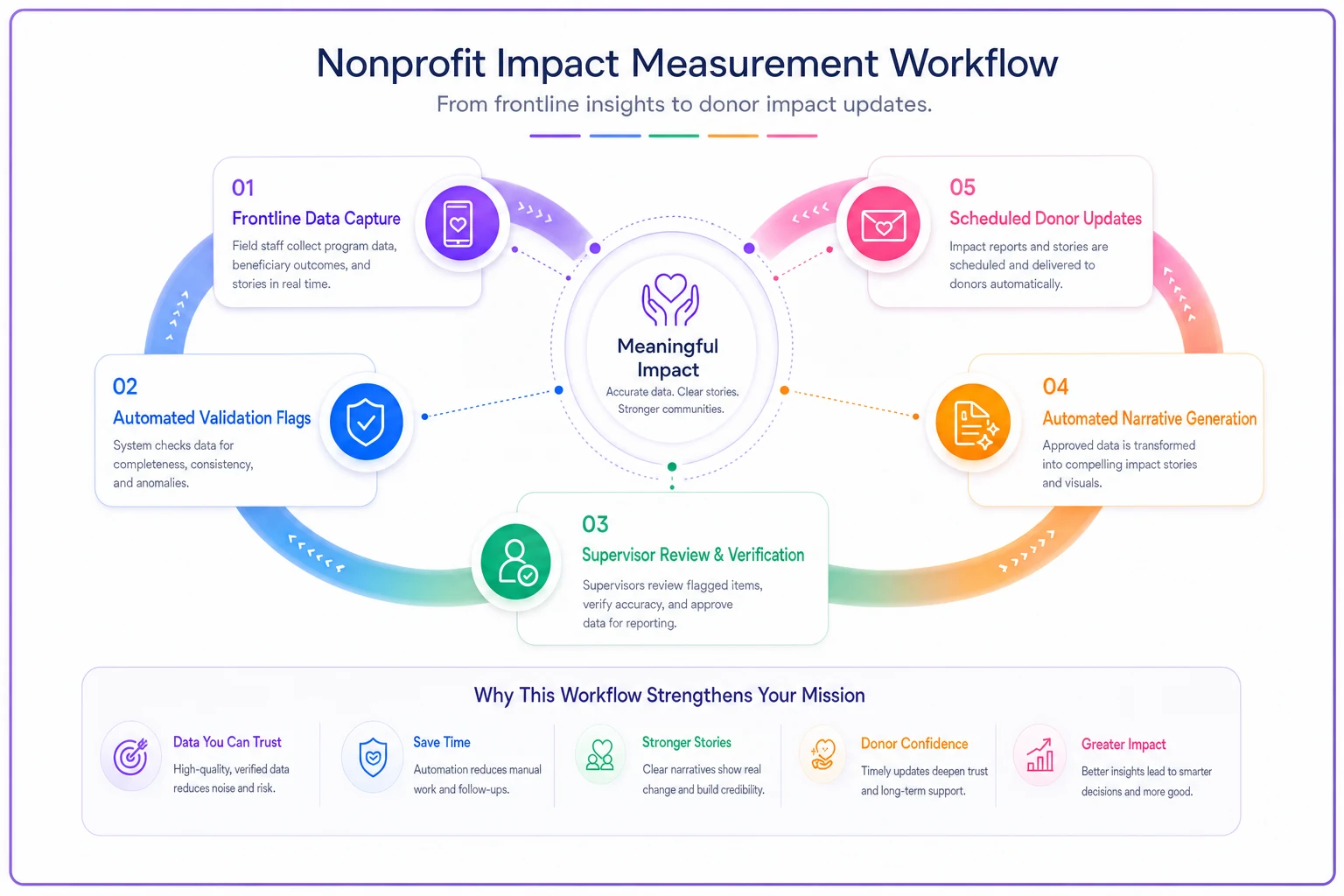
This keeps validation lightweight and continuous.
The donor narrative timeline that prevents scrambles
Every nonprofit knows that moment—major donor wants an update tomorrow, and suddenly everyone's running around trying to piece together a story from fragments of data.
Organizations that avoid this run on a pre-built narrative calendar.
Monthly (5 minutes):
-
Auto-pull your five KPIs
-
Flag any significant changes
-
Note one program highlight
Quarterly (30 minutes):
-
Combine three monthly snapshots
-
Add one participant story
-
Include one challenge and response
Annually (2 hours):
-
Aggregate quarterly narratives
-
Add cost-per-outcome calculation
-
Include one systems improvement
A housing nonprofit in Denver runs exactly this system. Their development associate spends about 45 minutes per month maintaining donor-ready narratives for 200+ funders. When a donor calls asking for impact data, they can respond within hours, not weeks.
Role clarity: who owns what (and when they can ignore it)
The fastest way to break impact measurement is to make it everyone's job. That means it's nobody's job. You need crystal clear ownership with reasonable boundaries.
| Role | Time Investment | Responsibilities |
|---|---|---|
| Program Staff | 2 minutes per participant interaction | Enter basic service delivery data, flag unusual situations, ignore everything else |
| Program Director | 1 hour weekly | Review flagged entries, approve/correct data, pull one story or highlight |
| Development Team | 2 hours monthly | Compile approved data into narratives, match narratives to donor interests, distribute to donor portfolios |
| Executive Director | 30 minutes monthly | Review aggregate trends, approve external narratives, flag strategic concerns |
Notice what's missing? Nobody's spending days building reports. Nobody's reconciling multiple systems. Nobody's panic-creating narratives from scratch.
The templates that actually get used
Complex templates die in nonprofit operations. The ones that survive look embarrassingly simple.
Weekly Data Capture (Google Form or simple database entry):
-
Date
-
Participant ID or count
-
Service delivered (dropdown)
-
Outcome if applicable (dropdown)
-
Flag for review (checkbox)
Monthly Program Summary (one page):
-
Five KPI numbers with trend arrows
-
One highlight (2-3 sentences)
-
Issues flagged for attention
-
Sign-off checkbox
Donor Impact Update (half page):
-
Your support this quarter achieved
[specific number]
-
Participant spotlight
[brief story]
-
Looking ahead
[one sentence]
-
Thank you message
[personalized closer]
An environmental education nonprofit in Oregon has used essentially these same three templates for four years. They've retained 78% of their major donors through that period, well above the sector average of around 45%.
When automated systems transform impact tracking
Operational software actually changes the game for nonprofits. Not by adding complexity, but by removing it.
The manual process—where someone pulls data from multiple sources, formats it, validates it, creates narratives, and distributes them—typically takes 15-20 hours per month for a mid-sized nonprofit. AI-powered platforms can reduce that to about 2 hours of review and personalization.
The transformation happens in three places:
Data automatically flows from service delivery to impact metrics without manual entry. When a case manager logs a client interaction, it feeds directly into outcome tracking. No duplicate entry, no spreadsheet updating, no monthly reconciliation.
Narratives generate themselves based on your data patterns. The system learns your organization's voice, understands your donor segments, and creates first drafts of impact updates that actually sound like you wrote them. Program staff review and personalize rather than starting from blank pages.
Donors get consistent updates without anyone managing the process. Set your cadence once, and the system maintains it. Major donors get monthly touches, foundation funders get quarterly reports, annual donors get campaign updates—all without someone manually tracking who needs what when.
A workforce development nonprofit recently implemented this kind of integrated system. They went from one development coordinator spending 60% of her time on impact reporting to spending maybe 10% on review and refinement. Their donor retention increased by 23% in the first year, largely because donors were actually getting regular, meaningful updates instead of sporadic scrambles.
The measurement mistakes that kill donor trust
Even with good systems, three mistakes consistently destroy donor confidence:
Claiming false precision: Your outcome data is not accurate to the decimal point. Stop pretending it is. "Approximately 340 youth served" is more honest than "341.7 youth reached"—and donors know it.
Burying problems: If a program struggled, say so. Explain what you learned and how you adjusted. Donors trust organizations that can acknowledge and address challenges.
Switching metrics: Pick your five KPIs and stick with them for at least two years. Nothing erodes trust faster than constantly changing what you measure to make numbers look better.
Building your implementation timeline
Don't try to revolutionize your impact measurement overnight. Organizations that successfully transform their measurement systems follow this progression:
Month 1-2: Audit and eliminate
-
List every metric you currently track
-
Identify your five core KPIs
-
Stop tracking everything else (seriously)
Month 3-4: Simplify capture
-
Create one simple entry method
-
Train frontline staff (15 minutes max)
-
Run parallel with old system briefly
Month 5-6: Automate workflows
-
Set up basic validation rules
-
Create template narratives
-
Assign clear owners
Month 7-12: Refine and scale
-
Adjust based on actual usage
-
Add automation where helpful
-
Expand donor communications
Start with radical simplification. Most nonprofits try to fix their measurement by adding sophistication. The ones that succeed strip everything down to the bare essentials, then build back only what proves necessary.
Your measurement system will never be perfect, and that's okay. Better to have five metrics you track religiously than fifty you track sporadically.
The bottom line on nonprofit impact measurement
Your impact measurement process is failing because it's designed for a nonprofit with unlimited time and perfect data. That nonprofit doesn't exist.
The system that actually works assumes chaos, embraces "good enough," and prioritizes donor communication over analytical perfection. It tracks five things instead of fifty. It validates through normal workflow instead of special audits. It generates narratives automatically instead of through heroic individual effort.
Most importantly, it recognizes that impact measurement in nonprofits isn't about data management—it's about relationship maintenance. Every number you track should directly support a story you'll tell a donor. Every process you create should assume your most overwhelmed staff member is running it. Every template should be simple enough that a brand-new volunteer can use it correctly.
Nonprofits that get this right don't have more sophisticated systems. They have simpler ones, with clearer ownership, that actually match their operational reality. They measure less but communicate more. They prioritize consistency over comprehensiveness.
Your donors don't need perfect data. They need regular, honest updates about how their investment creates change. Build your measurement process around that truth, and you'll find it suddenly becomes manageable—even at scale.
Ready to elevate your nonprofit impact?
Join 2,000+ nonprofits using Almosly to boost fundraising efficiency, deepen donor relationships, and scale philanthropic impact.