

The first time most development directors think seriously about their Charity Navigator score is the day a major donor mentions it on a call. By then, the profile has already been sitting there for months — sometimes with a two-year-old Form 990, a missing board list, or a "governance" checkbox that quietly knocked them from four stars to three.
That's what makes it frustrating. Charity ratings rarely go wrong because a nonprofit is badly run. They go wrong because nobody owns the profile. It falls into the gap between finance (who files the 990), the ED (who assumes marketing handles it), and the development team (who assumes finance does). Meanwhile the rating agencies keep pulling data on their own schedule, and your public score updates whether or not anyone on your team is paying attention.
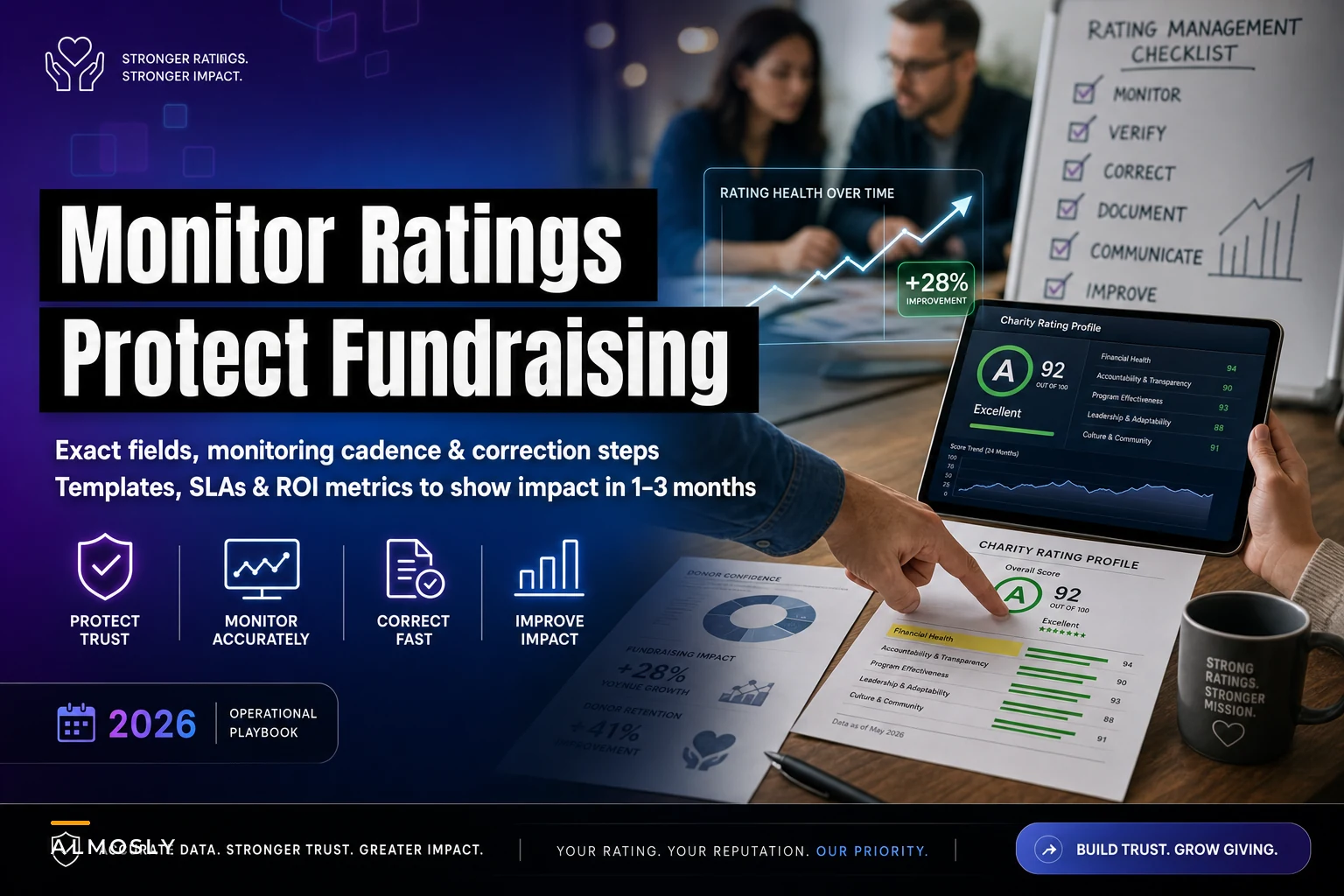
This playbook is about closing that gap — not a lecture on why ratings matter, because you already know a three-star profile costs you gifts. This is the operational side: how scores are actually built, which data points move them, how often to check, and what to do when something's wrong.
How the major ratings are actually assembled
You can't monitor what you don't understand, and most teams have a pretty fuzzy mental model of where these numbers come from. Here's the practical version.
| Rating source | Primary data source | What it actually scores | How you influence it |
|---|---|---|---|
| Charity Navigator | Your IRS Form 990 (auto-pulled) + self-reported beacon data | Finances, accountability & transparency, and increasingly "impact" and "culture/community" beacons | Filing a clean 990, completing optional beacons, adding governance/policy documents |
| Candid (GuideStar) | Almost entirely self-reported through your Candid profile | Transparency "Seals" — Bronze through Platinum — based on how much you disclose | Logging in and completing profile fields; Platinum requires quantified metrics |
| BBB Wise Giving Alliance | Direct questionnaire + document review against 20 standards | Governance, finances, truthful solicitations, donor privacy | Responding to their evaluation request and meeting all 20 standards |
The biggest misconception is that all of these run on the same fresh data. They don't. Charity Navigator's financial beacon lags because it's tied to your most recently processed 990 — which can be 12 to 18 months behind reality if you file on extension. Candid updates the moment you save your profile. BBB only re-evaluates on their own cycle or when you request it.
That timing mismatch is why a nonprofit can hold a Platinum Seal on Candid and a stale three-star score on Charity Navigator simultaneously. Same organization, two very different stories, depending on which door the donor walks through.
The data points that quietly move your score
Not all fields carry equal weight, and the ones that hurt small teams most are usually the boring administrative ones — not program spending.
Stop missing fundraising opportunities.
Almosly helps you plan, track, and optimize every campaign with ease.
- Centralized donor and volunteer management
- Automated engagement workflows
- Impact and fundraising analytics
No credit card required
-
The 990 filing gap. Charity Navigator can't score current financials off a document you haven't filed. Extensions are normal, but if your beacon still reflects fiscal 2022 numbers in late 2024, donors doing due diligence see an organization that looks frozen in time.
-
Missing governance policies. Whistleblower policy, conflict-of-interest policy, document retention policy, independent board majority. These are yes/no checkboxes on the 990 and in beacons. Each missing "yes" is a straight deduction, and they're almost always missing because of a paperwork lapse — not because the policy doesn't actually exist.
-
Board list and leadership fields. An outdated board roster or a blank "highest-paid staff" section reads as opacity even when it's just neglect.
-
Program vs. administrative expense ratio. Still watched, though less mechanically weighted than it used to be. The problem is usually coding, not spending — shared costs allocated entirely to "administrative" that should be split.
-
Unfinished Candid profile sections. The jump from Silver to Gold to Platinum is mostly about disclosure depth: strategy, metrics, results. Teams stall at Gold because Platinum requires actual quantified outcomes, and nobody has been assigned to produce them.
The pattern underneath all of this is the same: scores drop for accuracy and completeness reasons far more often than for performance reasons. That's genuinely good news, because accuracy problems are fixable in an afternoon once someone owns them.
A monitoring cadence that doesn't eat your week
You don't need to check ratings daily. You need a rhythm that catches changes before a donor does.
Weekly (about 10 minutes):
-
Quick visual check of your Charity Navigator and Candid public profiles. You're looking for one thing: did the star rating or seal level change since last week?
-
Scan for any new donor reviews or comments on your profiles.
Monthly (about 45 minutes):
-
Log into each platform's admin portal and confirm the underlying data matches your current reality — board list, leadership, contact info, mission statement.
-
Cross-check your latest filed 990 against what Charity Navigator is displaying. Note any lag.
-
Review which Candid seal fields are still incomplete and assign one to close before next month.
Quarterly (about 2 hours):
-
Full profile audit against the canonical checklist below.
-
Confirm all governance policy checkboxes are current.
-
Check for any BBB inquiry or re-evaluation request sitting unanswered in a shared inbox. This happens more than you'd think.
The mistake most teams make is treating this as a project instead of a cadence. A once-a-year "let's fix our Charity Navigator profile" push means you're blind for eleven months. The weekly ten-minute glance is what actually protects you, because rating changes are silent — nobody emails you when your score drops.
The canonical data checklist to keep profiles accurate
Keep this in one shared document, with an owner's name next to each item. That single act — assigning ownership — prevents most of the failures described in this article.
-
[ ] Most recent Form 990 filed and reflected on Charity Navigator
-
[ ] Legal name, EIN, and DBA consistent across all three platforms
-
[ ] Mission statement identical (or intentionally tailored) across profiles
-
[ ] Current board of directors list with roles
-
[ ] Key staff and highest-compensated employees listed
-
[ ] Conflict-of-interest policy — on file and checkbox marked
-
[ ] Whistleblower policy — on file and checkbox marked
-
[ ] Document retention/destruction policy — on file
-
[ ] Independent audit or financial review posted where applicable
-
[ ] Program, admin, and fundraising expenses correctly allocated
-
[ ] Current physical address, website, and phone
-
[ ] Candid seal fields completed to target level (set a target
Gold or Platinum)
-
[ ] Impact/outcome metrics with actual numbers for Candid Platinum and Charity Navigator impact beacon
-
[ ] Donor privacy policy published and linked (BBB standard)
-
[ ] Contact email that a real human monitors for BBB/rating inquiries
The reason a checklist beats memory here is that these fields drift independently. You update your board on the website, forget the 990 schedule, change your address on Candid but not Charity Navigator. Six months later you've got three slightly different versions of your organization living online.
This is also where a shared operational system earns its keep. If your CRM or profile-tracking tool already holds your canonical board list, policy documents, and expense allocations, keeping ratings accurate becomes a matter of pushing existing data outward rather than re-hunting it every quarter. AI-assisted operational platforms can flag when a source field changes — say, a new board member gets added to your records — and prompt whoever owns the profiles to update the public listing too. The point isn't automation for its own sake; it's that consistency across platforms is fundamentally a coordination problem, and coordination is exactly what quietly breaks on small teams.
When something's wrong: escalation and correction workflows
A rating drop or a factual error needs a defined path, not a scramble.
> Profile Correction Workflow
> [GRAPH: linear workflow — Confirm Change → Diagnose Cause → Assign Owner + Deadline → Fix at Source → Update Platform → Log Fix + Expected Refresh Date → Verify on Refresh]
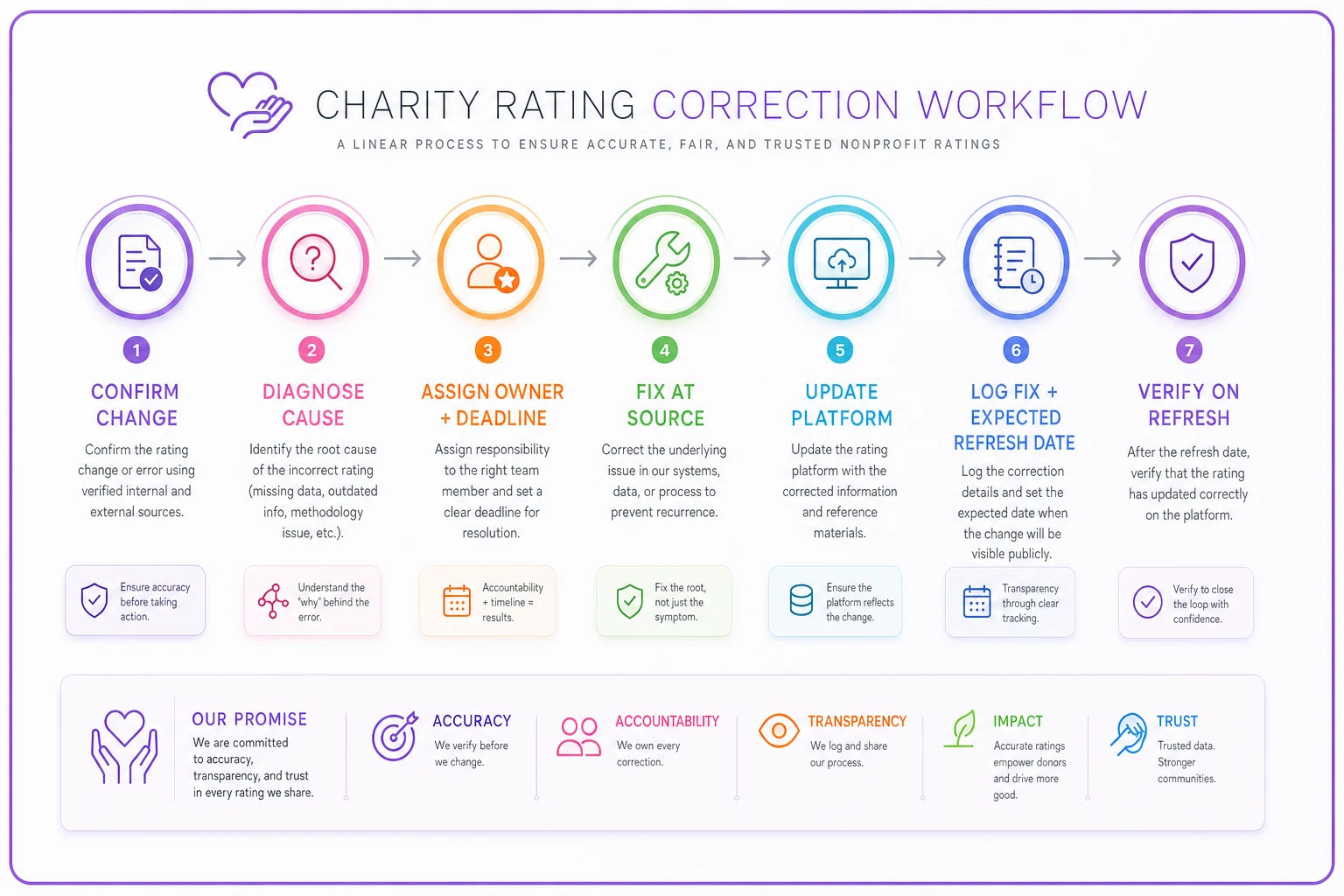
Follow this linear correction workflow when a profile error appears.
-
Confirm the change is real. Screenshot the current score/seal and the specific field. Rating pages occasionally show cached or partial data during their own update cycles.
-
Diagnose the cause. Trace it to a category
stale 990, missing policy, incomplete beacon, expense allocation, or an outright factual error. This tells you which fix path you're on.
-
Assign one owner and a deadline. For a stale 990, that's finance. For governance checkboxes, that's whoever holds board documents. Ambiguity is what kills correction — "someone should look at this" means no one does.
-
Correct at the source, then the platform. If the underlying document was wrong or missing, fix that first (file the amended 990, adopt the missing policy), then update the public field. Fixing only the display creates a mismatch that resurfaces at the next data pull.
-
Use the platform's correction channel. Charity Navigator and Candid both have nonprofit admin portals and dispute/correction request forms. For 990-driven errors, understand the timing — corrections tied to a new filing won't appear until they reprocess.
-
Log the fix and the expected refresh date. Note when you submitted and when the change should show. This is the step teams skip, then panic two weeks later thinking the fix didn't work when it's just in the processing queue.
-
Verify on refresh. Check back on the expected date and confirm the corrected data is live.
A quick example of how this plays out: a youth-services nonprofit with roughly a $2.4M budget noticed their Charity Navigator score had slid to three stars. Diagnosis took about ten minutes — two governance policy checkboxes showed "no" because the policies existed but had never been reported on the 990. Finance adopted the reporting on the next filing, development updated the accountability beacon fields immediately, and within one cycle they were back to four stars. Total staff time was maybe three hours spread across a few weeks, for a score that was actively costing them credibility on grant applications.
A rating drop or factual error is a process problem, not always a governance problem. Defined workflows and logging stop the panic and make the fix durable.
Donor-facing messaging templates
Two situations need ready language: when your rating is strong and you want to leverage it, and when it dipped and a donor asks.
> "We're proud to hold a [four-star Charity Navigator rating / Platinum Transparency Seal from Candid], reflecting our commitment to using your gift responsibly. Every dollar is tracked, reported, and put to work where it's needed most."
> "Thanks for looking closely — that means a lot. The recent change on our profile reflects a reporting gap in how we disclosed our governance policies, not a change in how we operate. We've already corrected it, and the updated rating should appear within the next reporting cycle. Happy to walk you through our financials directly if that's helpful."
> "A quick heads-up in case you check our public ratings: we recently identified an outdated data point on our profile and have submitted the correction. Nothing about our finances or operations has changed — we just want you to have the accurate picture."
The instinct when a rating dips is to stay quiet and hope no one notices. That's backwards. The donors who check ratings are exactly the ones who value transparency, and a calm, specific explanation often builds trust more than an uninterrupted perfect score would have. Vague reassurance ("we're a responsible organization!") does the opposite — it reads as dodging.
KPIs that connect ratings to actual fundraising
If you can't tie rating work to money, it stays a low priority forever. Track these to make the case internally and to know whether the effort actually pays off.
-
Acquisition conversion by rating badge exposure. If you display a rating badge on donation pages, A/B test it or at minimum compare conversion on pages with and without it.
-
Average first gift from rating-referred donors. Track donors who arrive via a Charity Navigator or Candid profile link. They often give more per gift because they've already done their diligence before clicking.
-
Grant application success rate. Many foundations check ratings during review. Note your win rate before and after a rating improvement.
-
Recurring conversion rate among rating-aware donors. Donors who cite transparency tend to convert to monthly giving at higher rates and stick longer.
-
Major-gift objection frequency. How often does a rating question come up in cultivation, and how often does it stall a gift?
A realistic pattern: nonprofits that move from three to four stars and complete a Candid Gold or Platinum seal often see a modest but real lift in profile-referred giving and a noticeable easing of major-donor due-diligence friction. It's rarely a dramatic revenue jump — it's more that a category of quiet objections disappears and grant reviewers stop flagging you. That compounds over a year in a way that's hard to see in any single gift.
Rating health also ties directly into retention economics. The same donors who care about ratings are the ones you least want to lose to preventable churn, which is why rating maintenance sits alongside things like a solid pre-expiry card update workflow in the broader work of protecting recurring revenue.
When this work is worth it — and when it isn't
When it clearly makes sense: You rely on individual major gifts, foundation grants, or online acquisition where donors research before giving. If a meaningful share of your revenue comes from people who check, rating accuracy is non-negotiable maintenance, not marketing polish.
When to keep it lightweight: If you're almost entirely funded by a handful of committed local donors who know your leadership personally, or by contracts and government funding, ratings matter far less. Do the annual accuracy check so nothing embarrassing sits online, but don't chase Platinum.
Who should not sink time into chasing a higher score: Very early-stage organizations without a filed 990 history yet. You literally can't be scored on data that doesn't exist. Build clean financial and governance records first — the ratings follow the operations, not the other way around.
Bringing it together
The organizations that never get blindsided by a rating aren't the ones with the fanciest tools. They're the ones where a specific person checks the profile every week, where the canonical data lives in one place, and where a dropped checkbox triggers a defined fix instead of a fire drill.
If you're standing up this discipline for the first time, treat it like any other new operational process: assign ownership, build the cadence into someone's actual calendar, and don't let it collapse back into "everyone assumes someone else handles it." The same change-management fundamentals that make CRM adoption stick apply here, and the stakes are highest in the run-up to your heaviest year-end and fall giving season, when a stale profile does the most damage.
Ratings reward the boring stuff: filing on time, keeping policies current, disclosing honestly, updating consistently across platforms. None of it is hard. It just needs an owner and a rhythm — and once you have both, your public profile finally starts telling the truth about how well your organization already runs.
Ratings reward the boring stuff: filing on time, keeping policies current, disclosing honestly, updating consistently across platforms. None of it is hard. It just needs an owner and a rhythm — and once you have both, your public profile finally starts telling the truth about how well your organization already runs.
Ready to elevate your nonprofit impact?
Join 2,000+ nonprofits using Almosly to boost fundraising efficiency, deepen donor relationships, and scale philanthropic impact.