



The Conference Board's August 2026 read landed at an awkward time for anyone running fall fundraising. As Reuters reported, consumer confidence slipped again in August, with the expectations component doing most of the sliding. The Conference Board's own release framed it as a modest decline, not a collapse. But "modest" is a misleading word for nonprofits, because recurring giving doesn't respond to confidence the way retail spending does. It responds later, quieter, and in ways that don't show up on your dashboard until the damage is already booked.
So this isn't a piece about the economy. It's about what a confidence dip does to the mechanics of your recurring base — the failed cards, the silent downgrades, the "I'll re-add it next month" that never happens — and what you can actually do about it in the six to eight weeks before year-end giving picks up.
Why recurring giving reacts differently than everyone assumes
Most fundraising plans treat a confidence drop as a revenue problem, so they respond with revenue tactics — bigger appeals, more emails, a matching push. That works fine for one-time gifts. But your recurring base doesn't churn because donors decided to stop caring. It churns because of friction that a nervous household stops absorbing.
-
They stop proactively updating an expired card because they're reviewing subscriptions more carefully
-
Bank fraud filters get more aggressive, and recurring charges get flagged more often
-
Households quietly trim "optional" auto-payments during a card replacement, and a $25/month gift is an easy one to skip re-adding
In real operations, this shows up as a rise in involuntary churn — payments that fail for technical reasons — not a spike in cancellation requests. That distinction matters a lot, because involuntary churn is recoverable and voluntary churn mostly isn't. If your team responds to a confidence downdraft by pouring energy into new acquisition, you're spending in the most expensive channel while a cheaper, more loyal cohort leaks out the back.
The signal you should be watching (and probably aren't)
Most nonprofits track recurring revenue as a single monthly number. That number hides the two things you actually need during a downturn: your decline rate and your recovery rate.
Stop missing fundraising opportunities.
Almosly helps you plan, track, and optimize every campaign with ease.
- Centralized donor and volunteer management
- Automated engagement workflows
- Impact and fundraising analytics
No credit card required
Decline rate is the percentage of recurring charges that fail on first attempt in a given month. In steady conditions, a healthy monthly-giving program running on modern card processing sits somewhere around 5–9% first-attempt failure, most of which recovers automatically. When confidence softens, that first-attempt number can drift up a point or two — and more importantly, the recovery rate on those failures drops, because donors are slower to fix expired cards and quicker to let a lapse ride.
A typical example looks like this. A mid-sized org with about 1,400 monthly donors averaging $22/gift is running roughly $30k–$31k a month in recurring revenue. Their first-attempt decline rate creeps from 7% to about 9% over a quarter. That alone isn't scary. But their recovery rate on failed gifts slips from around 80% down to the low 60s because donors aren't responding to update requests as fast. Net effect: they quietly lose somewhere around 30–40 monthly donors a month who would have stayed if the recovery had held. Nobody canceled. The program just bled.
That's the operational trap. The board sees a revenue number that's "down a little." The reality is a retention engine that stopped working.
Reforecast on failures, not just totals
Before you touch a single appeal, rebuild your Q4 recurring forecast around two variables you can actually influence:
-
Expected first-attempt decline rate for October through December
-
Expected recovery rate on those declines
Model a mild-stress scenario (decline rate up roughly 1.5 points, recovery down about 10 points) and a moderate one (decline up around 3 points, recovery down 20 points). You're not trying to predict the economy. You're trying to see how sensitive your revenue is to recovery performance — because recovery is the lever you control almost entirely in-house.
| Scenario | First-attempt decline | Recovery rate | Net monthly donors lost | Approx. annualized revenue at risk |
|---|---|---|---|---|
| Baseline (steady) | ~7% | ~80% | ~15 | — |
| Mild stress | ~8.5% | ~70% | ~28 | roughly $7k–$9k |
| Moderate stress | ~10% | ~62% | ~45 | roughly $12k–$15k |
(Numbers based on a ~1,400-donor, ~$22-average program. Scale to your own base.)
The point of the table isn't the exact figures — it's that the gap between "mild" and "moderate" is almost entirely a recovery-workflow problem, not a donor-generosity problem. That's genuinely good news, because it means your fall protection plan is mostly operational, not persuasive.
Where recurring programs actually break under stress
The retry logic nobody configured. Many nonprofits inherited their recurring setup years ago and never touched the dunning settings. Default retry schedules often hit a failed card three times in 72 hours, which is exactly the wrong pattern — bank replacement cycles take a week or more. Retries clustered too early just burn attempts before the new card exists.
The update request that reads like a threat. A "Your payment failed — action required" subject line performs terribly when people feel financially watched. It reads as a demand at the exact moment a donor is most sensitive to demands.
The handoff gap. When an automated recovery attempt fails, most orgs have no defined human follow-up. The gift just lapses into a report nobody reads. During normal times you lose a handful. During a confidence dip, that gap is where a third of your recoverable donors disappear.
The silent downgrade. Almost nobody tracks donors who reduce their monthly amount rather than cancel. A wave of $30→$15 downgrades looks fine on a headcount report and terrible on a revenue report — and it usually precedes cancellations by a month or two.
The recovery workflow that holds up when donors are nervous
The mechanics of not losing supporters to failed payments are well-established, and the full donor-first version is covered in this walkthrough on recovering failed recurring donations. For a confidence-downdraft context specifically, here's the tightened version worth running through before October:
-
Re-time your retries to match bank behavior. Space attempts across 10–14 days (e.g., day 1, day 4, day 8, day 12) instead of front-loading them. You catch more replacement cards without exhausting attempts.
-
Rewrite the first touch as a courtesy, not an alarm. "Looks like your card needs a quick update — here's the link" outperforms urgency framing, especially right now. Lead with the relationship, not the failure.
-
Add a human handoff at attempt three. A short personal note or call from a real staff member or trained volunteer, tied to the donor's actual impact, recovers gifts that automation can't. This is the single highest-leverage step during stress.
-
Track downgrades as a separate signal. Flag any monthly reduction and route those donors into a light stewardship touch, not a recovery flow. They didn't fail — they got cautious, and they need reassurance, not a payment link.
-
Reconcile recovery weekly, not monthly. During a downdraft, a monthly cadence lets three or four weeks of recoverable donors slip past their bank's re-add window. Weekly is often the difference between catching a card and losing a donor.
Here's a quick visual of the recovery workflow.
Pro-tip: prioritize attempt-three human handoffs for higher-value monthly donors — that's where ROI on staff time is clearest.
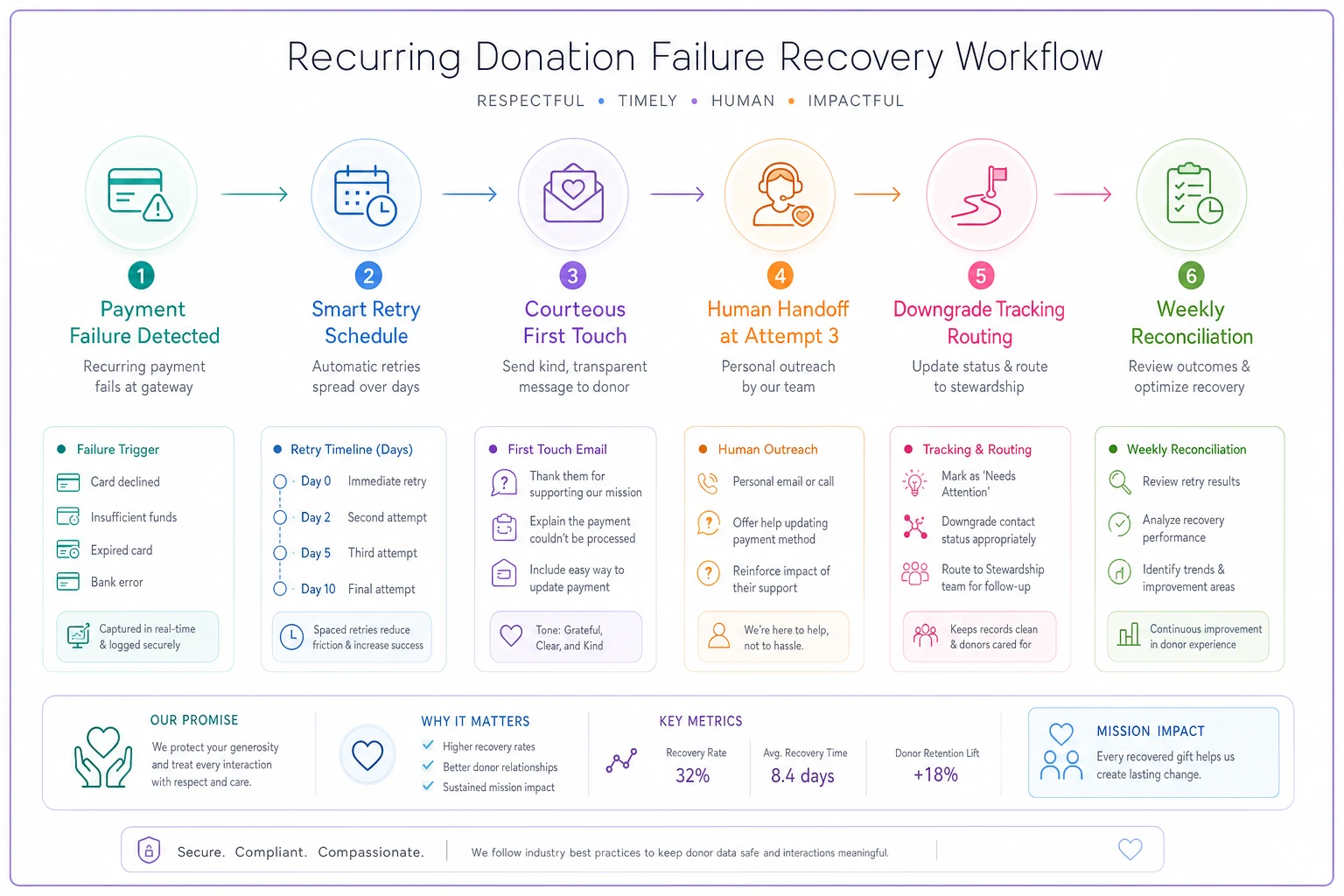
The reason a documented workflow matters more during a downturn is timing. When failures rise, ad-hoc handling collapses under volume — staff triage the loudest problems and let the quiet lapses ride. A defined sequence with clear owners keeps the recoverable gifts from becoming an afterthought exactly when there are more of them.
A quick pre-fall checklist
Run this before your first major fall appeal goes out:
-
[ ] Pull your last three months of first-attempt decline rate and recovery rate — separately
-
[ ] Confirm your retry schedule spans at least 10 days, not 72 hours
-
[ ] Rewrite failed-payment messaging to remove urgency/threat framing
-
[ ] Assign a named owner for the attempt-three human handoff
-
[ ] Build a report that isolates downgrades from cancellations
-
[ ] Set a standing weekly recovery reconciliation for October–December
-
[ ] Identify 2–3 volunteers who can make warm recovery calls to higher-value monthly donors
-
[ ] Set a "watch threshold" — a decline rate that triggers escalation to leadership
If you can only do two of these before fall, do the retry re-timing and the attempt-three human handoff. Those two move recovery more than anything else on the list.
Where lightweight automation helps — and where it doesn't
There's a natural temptation to solve all of this with more automation, and that's half right. Retry scheduling, expired-card detection, weekly reconciliation reports, flagging downgrades — this is exactly the kind of repetitive, rules-based work that operational software with AI-assisted automation handles well. It frees your team from manually chasing every failed charge and lets the recoverable gifts surface automatically instead of hiding in a spreadsheet.
But the part that actually saves donors during a confidence dip is the human touch at the right moment. Automation should get recoverable gifts in front of a person faster and keep busywork from swallowing staff time — not replace the personal follow-up that rebuilds a nervous donor's confidence in your organization. The orgs that come through downturns with their base intact use automation to create room for human contact, not remove it.
When to hold your ask cadence — and when to pull back
Hold or increase stewardship touches. Downturns are when donors most want to feel their money matters. Impact-forward messages to your recurring base are almost never a mistake.
Be cautious with upgrade asks. Pushing $20 monthly donors to $30 during a period of financial anxiety often backfires into a cancellation. Segment carefully — upgrade asks work best with donors already showing engagement signals, not your whole base.
Don't over-correct into silence. Some teams get skittish and go quiet, which is worse. A donor who hears nothing from you during a tense economic moment is a donor who forgets why they're giving. Fewer asks, steady relationship — that's the balance.
The distinction that separates programs that hold from programs that slide isn't how aggressively they fundraise during a downdraft. It's how carefully they protect the base they already have. Fall acquisition matters, but a monthly donor you keep through a nervous Q4 is worth several you'll spend to replace in January. Watch the decline rate, fix the recovery workflow, and put a human at the moment of friction. The confidence numbers will do what they do — your retention is the part you actually get to decide.
Ready to elevate your nonprofit impact?
Join 2,000+ nonprofits using Almosly to boost fundraising efficiency, deepen donor relationships, and scale philanthropic impact.