


Most nonprofits don't make an integration decision once. They make it three times: when they sign, then quietly over the next two or three years as the integration drifts, and finally when they try to leave. That third decision usually happens under pressure, like a price increase, an acquisition, or a platform sunset.
Governance tends to show up only at the first moment, during procurement, and only as contract language. The middle years run on trust and on whoever remembers how the sync works. The exit gets planned after someone has already decided to exit. That's backwards. The middle is where most of the damage happens, and the exit is where you find out whether any of your governance was real.
This piece goes through the whole lifecycle in order: before you shop, procurement, build, steady-state operations, change, and exit. A few things hold it together: a canonical gift and donor schema you own, data contracts with real error handling, an API checklist procurement can actually use, SLAs measured with reconciliation keys instead of vendor dashboards, and a portability checklist you can test before you need it. That's what fundraising data governance means here. It's less about policy documents and more about whether a gift that starts on a donation form ends up correct in the general ledger, every time, no matter which vendor sits in between.
Why integrations rot in the middle
Integrations rarely fail on launch day. Launch gets attention: testing, a consultant, someone checking the first hundred gifts by hand. The failure shows up eight or fourteen months later, when nobody's watching and something small changes.
-
The form vendor adds a new payment method (say, a bank transfer option). Your middleware has no mapping for it, so those gifts land with a blank payment type and finance can't match them to deposits.
-
Someone in development creates a new fund code in the CRM but not in the form tool. Gifts to the new fund come through as unrestricted.
-
The peer-to-peer platform changes how it handles team-page soft credits. Fundraiser credit quietly stops flowing, and nobody notices until stewardship season, when the top fundraiser asks why her thank-you note says she raised zero.
-
A webhook times out, the vendor retries, and nothing on your side recognizes the retry, so the donor ends up with two gift records.
None of these is a dramatic outage, and none trips an "integration down" alert. Data keeps flowing. It's just slightly wrong, and the wrongness compounds.
Underneath this is a structural problem. Most nonprofits let each vendor's data model become their data model. The CRM's idea of a gift becomes "what a gift is," and every other system gets bent to fit. Then you change CRMs, or a vendor changes its API, and there's no stable reference point. Nobody can say what the correct shape of a gift is independent of the tools, because it was never written down.
Ownership is the other half. If nobody has settled who owns which part of the stack, these problems fall between development ops, finance, and whoever set up the integration. We went deep on that in our piece on fundraising tech-stack architecture and ownership, and it's worth reading first if you don't have named owners yet. Everything below assumes someone is accountable for each integration.
Stage 0: Before you shop, write down what a gift is
This step gets skipped because it feels academic. It isn't. A canonical schema is a short, version-controlled document that defines what a gift and a donor look like in your organization, independent of any vendor. Every integration maps to it, and every vendor gets evaluated against it.
Stop missing fundraising opportunities.
Almosly helps you plan, track, and optimize every campaign with ease.
- Centralized donor and volunteer management
- Automated engagement workflows
- Impact and fundraising analytics
No credit card required
It doesn't need to be exhaustive. For a mid-sized nonprofit, a canonical gift record might be 20–30 fields. What matters is getting the hard parts right, and the hard parts are rarely the obvious fields.
The three-dates problem
If you only do one thing in a gift schema, stop collapsing dates. A gift has at least three:
-
gift_date
when the donor intended to give. This drives receipting, tax-year attribution, and the December 31st question.
-
received_at
when your system first recorded it.
-
settled_at
when the money actually landed, tied to a payout.
Most CRMs have one "gift date" field, and different integrations fill it with different meanings. The online form sends the transaction timestamp. The lockbox import sends the deposit date. The DAF platform sends the grant approval date, which can be weeks after the donor recommended the grant. Then fundraising and finance argue every month about why their totals don't match, when they're really just counting different dates under the same label. Separating the dates in your canonical schema ends a surprising number of those arguments.
Amounts, status, and history
Store amounts as integer minor units (cents) with an explicit currency code. Floating-point amounts cause penny-off mismatches that make reconciliation look worse than it is, and they train staff to ignore small variances, which eventually hides a real one.
Carry gross, fee, and net separately when the source provides them. If a vendor only sends net, record that as a known limitation of that integration, not as "the amount."
Treat status changes as events, not overwrites. When a gift is refunded, the usual pattern is that the vendor's sync updates the original gift's amount to zero or flips a status field, and now your history is gone. You can't tell whether a $250 gift was refunded or entered wrong. A refund should be its own linked record pointing at the original gift_id. Same for chargebacks and voids.
Your IDs, not theirs
Every canonical gift gets a giftid that you generate, plus a list of external references: source system, source transaction ID, processor transaction ID, payout ID. Every donor gets a partyid you own, with a crosswalk to each vendor's donor ID.
This decision makes everything later possible. If your only identifier is the CRM's record ID, changing CRMs means re-keying your entire history, and every reconciliation report breaks. If your only donor key is the form vendor's supporter ID, you can't leave without losing the link between donors and their recurring plans. The mechanics of resolving donors across systems (matching, merging, householding) are covered in our guide to master donor identity strategy and householding. The point here is narrower: whatever identity approach you use, the canonical ID has to belong to you and survive any single vendor.
Put a version on it
Stamp the schema with a version from day one, even if it's just "1.0." Every payload that moves between systems should carry the schema version it was built against. It feels pointless until the first time you change something, and then it's the only way to know which records came in under which rules.
Stage 1: Procurement, or asking the questions vendors hope you skip
Once you have a canonical schema, procurement changes. You stop asking "does it integrate with our CRM?" (every vendor says yes) and start asking whether this vendor can produce and accept data in your shape, with your keys, and tell you clearly when something goes wrong.
We covered contract risk broadly in don't sign risky vendor contracts: auto-renewals, liability caps, data ownership clauses. This checklist is narrower. It's the API and data-contract layer, written so someone in procurement or finance, not just a technical person, can run it and get yes/no answers.
API and integration procurement checklist
-
Does every transaction carry a stable, unique ID that never changes and is never reused? Ask what happens to the ID on refund, edit, and re-sync.
-
Does the vendor pass through the payment processor's transaction ID and payout/batch ID, unmodified? (This is the one that matters most for reconciliation later.)
-
Does the API or webhook support idempotency keys, so a retried message doesn't create a second gift?
-
Are webhooks retried on failure? On what schedule, for how long, and is there a way to replay missed events for a date range?
-
Can you pull records by "modified since" timestamp, so you can catch changes the webhooks missed?
-
Is the API versioned? How much notice do they give before breaking changes, and is that notice period in the contract or just on a blog page?
-
How do they communicate deprecations? A changelog URL is fine. "Our account manager will let you know" is not.
-
Does the API return partial-success responses explicitly? Or can a 200 response hide a failed sub-record?
-
Are error responses structured (codes, field names) or free text?
-
Are refunds, chargebacks, and voids exposed as separate events, or does the original record just get mutated?
-
Can you configure custom fields to carry your fund, campaign, and appeal codes, and are those fields included in exports and webhooks?
-
Who owns the merchant account, and where do recurring payment tokens live? (More on this in the exit section. Ask now.)
-
Is there a sandbox that mirrors production API behavior, including errors?
-
What rate limits apply, and what happens to your data during year-end peak if you hit them?
The sales team will say yes to most of these, and the actual API documentation often tells a different story. Have someone read the docs, not the brochure. If the documentation doesn't mention idempotency, assume there isn't any.
Also, don't use vendor size as a shortcut. Smaller vendors often have better answers than you'd expect, and enterprise vendors sometimes worse. A small, well-run donation form company with a tight, versioned API can be much easier to govern than a big suite where the "integration" is a nightly CSV someone built years ago.
Stage 2: Build, where the data contract gets written
A data contract is the agreement between a system that produces data (the form tool, the P2P platform, the event app) and a system that consumes it (CRM, finance, the warehouse). It covers which fields come through, what's required, what values are valid, and, most importantly, what happens when the rules are broken.
That last part is where most nonprofit integrations are weakest. The field list usually exists in some form. Error handling almost never does.
Error semantics, the part everyone skips
When a record arrives that doesn't fit, there are only a few sensible things to do with it. The contract should say which one applies to each kind of problem.
-
Reject
no record is created. The sender gets a clear, structured error and has to fix and resend. Use this when the data is unusable, like a missing amount or an invalid currency.
-
Quarantine
the record is held, not posted to the CRM or ledger, and routed to a human for review. Use this when the data is probably fine but something needs a decision, like an unknown fund code or a gift over a threshold from a new donor.
-
Accept with warning
the record posts, but gets flagged for cleanup. Use this when the problem doesn't affect money or donor communication, like an unparseable address line or a missing employer.
-
Duplicate / idempotent replay
not an error. The system recognizes it has already processed this message and returns the original gift_id. Nothing new is created.
Most integrations have only two outcomes, success and crash. So anything slightly off either crashes the sync (and someone "fixes" it by loosening validation) or gets accepted silently with wrong data. The quarantine lane is usually the missing piece, and it's the most valuable one, because it lets you be strict about money without blocking everything else.
For the gift feed from an online donation form, the field section of a contract might look like this:
| Field | Rule | On violation | Retryable? |
|---|---|---|---|
| sourcetxnid | Required, unique per source | Reject | No, sender must fix |
| idempotency_key | Required | Reject | No |
| processortxnid | Required for card/ACH gifts | Quarantine | Yes, may arrive after settlement |
| amount_minor | Integer > 0 | Reject | No |
| currency | ISO 4217, in allowed list | Reject | No |
| gift_date | Valid date, not in future, not > 400 days past | Quarantine | No |
| fund_code | Must exist in active fund list | Quarantine | Yes, once code is added |
| campaign_code | Must exist, may be inactive | Accept with warning | n/a |
| payment_method | Must be in mapped enum | Quarantine | Yes, once mapped |
| donor email | Valid format | Accept with warning | n/a |
| recurringscheduleid | Required if is_recurring = true | Quarantine | Yes |
| schema_version | Must be supported version | Reject | No |
Look at how the fund code is handled. An unknown fund doesn't get defaulted to unrestricted, which is what most integrations do and how restricted money ends up in the wrong bucket. It gets held until someone decides. That one rule prevents a whole category of year-end audit findings.
The contract also needs a header that isn't about fields at all: who owns it, which systems produce and consume, expected freshness, expected volume, and who gets notified when it's violated. Something this simple, kept in a shared folder or repo, is enough:
contract: onlinegiftstocrm schemaversion: 2.1 producer: donationformvendor consumer: crm, financeexport owner: developmentopsmanager freshness: gifts visible in CRM within 2 hours of processor capture expectedvolume: 40–400/day; 2,000+/day Dec 26–31 quarantine_review: daily by 11am, max age 3 business days alerts: quarantine count > 25, zero gifts received for 6+ hours (Mon–Fri)
The volume line looks like a throwaway, but it's how you catch silent failures. An integration that's "up" but delivers zero gifts on a Tuesday afternoon is broken, and no error log will tell you.
How a gift actually travels, and where the keys get stamped
Trace one gift end to end, because reconciliation only works if each key is created at a specific point and carried forward without being dropped or rewritten.
A donor gives $75 on your donation page at 9:40 on a Sunday night. The form vendor creates a submission and assigns its own sourcetxnid, along with an idempotency key for that submission. It sends the charge to the payment processor, which returns a processortxnid. The form vendor then fires a webhook to your middleware (or the CRM's connector) containing both IDs.
Your integration layer maps the payload to canonical schema 2.1, runs the contract checks, and resolves the donor: existing partyid or a new one? Then it creates the gift with your giftid, storing the source and processor IDs as external references. If the webhook gets retried because the first attempt timed out, the idempotency key matches and the second attempt returns the existing gift_id instead of creating a new one.
Here's a simple workflow diagram of how a gift travels and where keys are stamped.
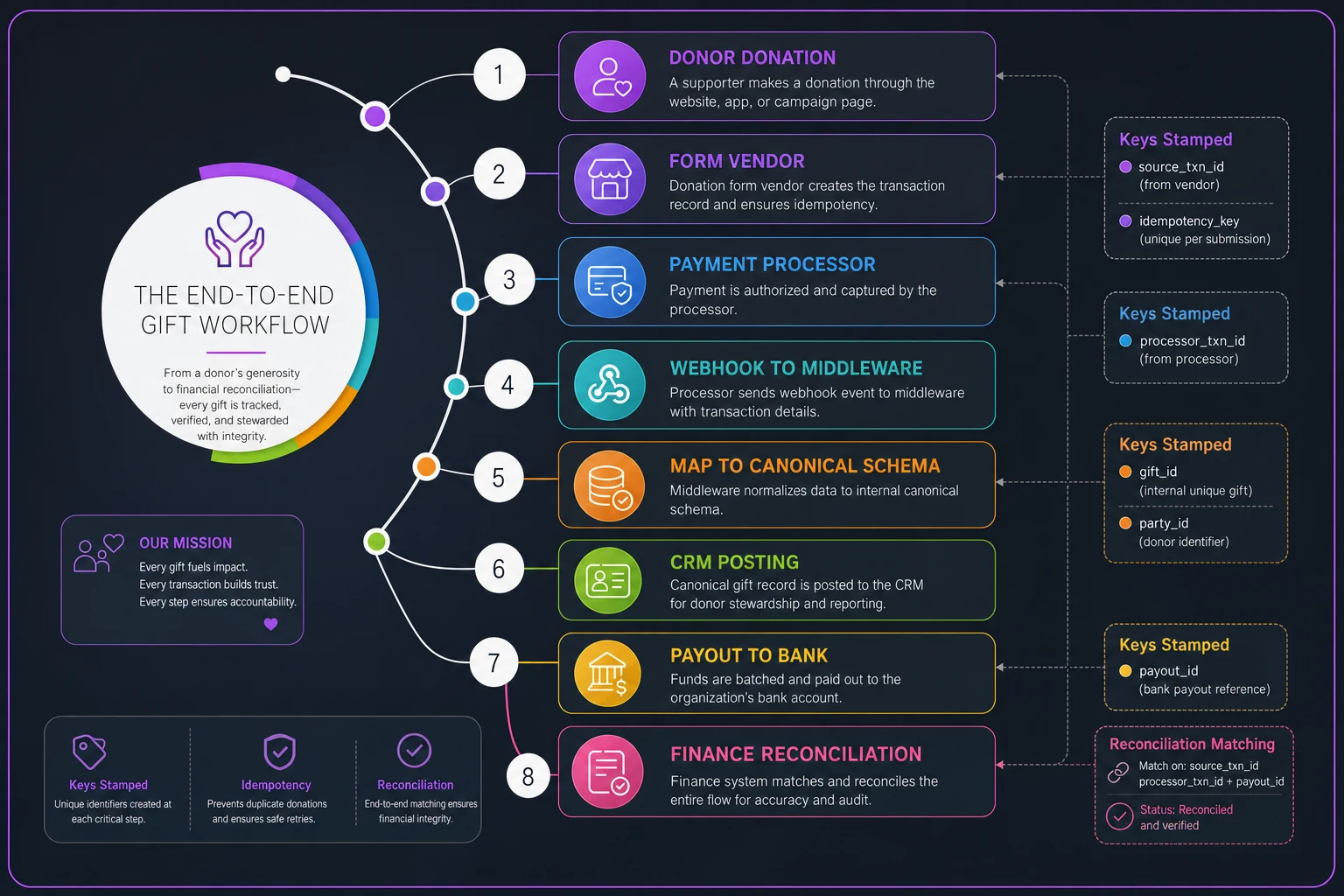
Tuesday morning, the processor pays out a batch of transactions to your bank account under a payoutid. Finance matches that payoutid to the bank deposit, then uses the processor's payout report (which lists every processortxnid in the batch) to tie each deposit back to individual CRM gifts. Fees net out at that step.
It usually breaks in one of three places:
-
The vendor drops the processortxnid, or only sends its own ID. Finance can't tie deposits to gifts except by amount and date, which falls apart on busy days when twelve people give $50.
-
Donor resolution creates a new party because the email has a typo or different capitalization. The gift is "correct," but it's attached to a ghost donor, and the real donor's giving history looks like it stopped.
-
The payout report isn't pulled at all. Finance reconciles at the deposit total level, so as long as totals match, individual mismatches never surface.
Once you've mapped this path for each integration, you know exactly which keys your SLAs can be measured on.
Stage 3: Run, with SLAs that are measured on your side
Most vendor SLAs in this space promise platform uptime: 99.9% availability, credits if they miss it. For fundraising that's nearly useless. A platform can be up 100% of the time while dropping a couple percent of your soft credits or mislabeling a fund for six weeks.
The SLAs that matter are about data, and they need to be measured with keys the vendor doesn't control.
What to measure
Five measures cover most of it:
-
Completeness. Of all transactions the processor settled in the period, what percentage exist as gifts in your CRM? The processor's settlement report is the independent source of truth, and processortxnid is the match key. A reasonable target is something like 99.5% within 24 hours and 100% within 72 hours, with every exception explainable.
-
Correctness. Of matched gifts, what percentage agree on amount, currency, date (the right date), and fund? Mismatches on amount or fund are the serious ones.
-
Latency. Time from processor capture to gift visible in the CRM. This matters more than people expect. If it's slow, your automated thank-you emails go out late or not at all.
-
Error handling. How long do records sit in quarantine or error queues on the vendor's side before they're resolved? A vendor-side failure queue that nobody looks at is a black hole.
-
Refund and chargeback propagation. When the processor records a refund, how long until it shows up in the CRM as a linked event?
The core idea is that the vendor can't grade its own homework. If the only evidence of SLA compliance is the vendor's status page or sync log, you don't have an enforceable SLA. You need to produce the evidence yourself, from the processor's data and your own CRM, matched on keys both sides agreed to carry.
Use the processor's settlement report and processortxnid as your independent match key for completeness checks.
The monthly reconciliation run
This process turns SLA language into something you can enforce. Once it's set up, a part-time ops person can run it in a few hours a month, and most of it can be automated.
-
Pull the processor's settlement export for the month, grouped by payoutid, with every processortxn_id, gross, fee, and net.
-
Pull every CRM gift with a processortxnid whose settled_at falls in the period, plus refunds and chargebacks.
-
Match the two sets on processortxnid.
-
Sort exceptions into buckets
missing in CRM, in CRM but not settled (orphans), duplicates, amount mismatches, fund or date mismatches.
-
For each exception, note whether the cause sits on the vendor side, your side (mapping, quarantine not reviewed), or the processor.
-
Calculate the completeness, correctness, and latency numbers against the contract thresholds.
-
If vendor-caused exceptions breach thresholds, send formal notice with the exception file attached. A spreadsheet of processortxnids, not a vague complaint.
-
Track the cure period written into the contract (often 15–30 days) and re-run the match for those exceptions once the vendor says they're fixed.
-
Log the result. Three consecutive breaches, or one serious one, should trigger whatever escalation or termination right the contract gives you.
Step 7 is where this gets real. Vendors respond very differently to "we think some gifts are missing" than to "here are 60-some processor transaction IDs from October that settled but never reached our CRM, per section 4.2 of our agreement."
On remedies
-
Vendor-funded remediation
they pay for, or do, the cleanup.
-
A guaranteed replay of events for any affected date range.
-
Termination for repeated breach without early-exit penalties.
-
Exit assistance triggered by breach, not just by contract end.
Some vendors won't agree to all of it. Even getting the measurement method into the contract ("compliance will be assessed by matching processor transaction IDs against customer CRM records") changes the conversation, because nobody can argue about whose numbers count.
Stage 4: Change, where versioning earns its keep
At some point the schema has to change. You add a field for tribute gifts, split a fund, or a vendor changes its API. Integrations without versioning rules quietly break here.
The basic rule has two parts:
-
Additive changes (a new optional field) are minor versions. Consumers that don't care can ignore them.
-
Breaking changes (renaming a field, changing a type, removing something) are major versions. Both versions run in parallel for a deprecation window, usually 60–90 days, before the old one is retired.
People get two things wrong.
First, tightening validation is a breaking change. Making a previously optional field required, or narrowing a list of allowed values, will start rejecting records that used to pass. Treat it as a major version even though the field list didn't change.
Second, adding an enum value is more dangerous than it looks. When a vendor adds a new payment method or gift type, it's technically additive. But downstream, finance has a mapping table that says "card goes to account 4010, ACH goes to 4015," and the new value maps to nothing. That's exactly how the "new bank transfer option" story from earlier happens. Treat new enum values as "minor with required notice": no parallel run, but every consumer has to confirm a mapping before the value goes live. Your contract's quarantine rule on unmapped payment methods is the safety net if someone forgets.
Keep a short changelog: date, version, what changed, who approved it, which consumers confirmed it. It doesn't need tooling, a shared doc works. What matters is that when someone asks in March why gifts from November look different, there's an answer.
Vendor-initiated changes are harder because you don't control the timing. That's why the procurement checklist asks about notice periods in the contract. When a vendor announces a breaking change, the response should be routine: map the new version to your canonical schema, test in the sandbox, run both versions where possible, and confirm reconciliation numbers hold for at least one full payout cycle before calling it done.
Stage 5: Exit, the test of whether any of this was real
Every vendor relationship ends. The only question is whether you planned for it while you still had leverage, or whether you're negotiating exports after you've already given notice.
Exits fail in a few predictable places, and recurring donors are the big one.
If your donation form vendor is also the merchant of record, or holds the payment tokens in its own vault, your monthly donors' card details may not be portable. Some processors support token migration between platforms, usually through a PCI-compliant transfer that takes weeks and needs cooperation from both sides. Some vendors simply don't allow it. If you find that out at exit, the only option might be asking every recurring donor to re-enter their payment info, and a lot of them won't. Losing a third or more of a recurring file in a forced re-signup isn't unusual.
So the exit checklist belongs in procurement, and it should be tested once a year while the relationship is still healthy.
Vendor-exit portability checklist
-
Full data export available on demand, not just at contract end, in a documented format (CSV/JSON with a field dictionary).
-
Export includes all historical records, not only active ones
refunds, voids, failed transactions, and edits.
-
Export includes every external ID
vendor's IDs, processor transaction IDs, payout IDs, and your canonical IDs if stored.
-
Recurring plan details exported
schedule, amount, next charge date, status, start date, linked donor.
-
Written confirmation of where payment tokens live and the documented process (and timeline) for migrating them to another processor or platform.
-
Custom field definitions and option lists exported, not just values.
-
Audit logs and consent records exported with timestamps.
-
Attachments and documents (tribute notes, pledge forms) included or separately retrievable.
-
Webhook and API access continues during a defined overlap period after termination notice, so you can run old and new systems in parallel.
-
Exit assistance hours specified in the contract, with rates if beyond the included amount.
-
Donation page URLs
can you redirect them, or do old links in emails and print die?
-
Data deletion certificate after migration, within a set timeframe.
-
A dry-run export completed in the last 12 months, loaded into a test environment, and reconciled against the vendor's own totals.
Almost nobody does that last one, and it's the only item that proves the others. An export that looks complete in a sales demo often turns out to be missing refund history, or has recurring plans with no link to donor IDs, or caps at some row count. You want to find that out in a calm year.
If your canonical schema and your own IDs were in place from the start, exit becomes mostly a mapping exercise. The new vendor maps to the same canonical schema, giftid and partyid stay stable, and your reconciliation reports keep working because they key on IDs you own and the processor's IDs, not the old vendor's.
Real scenario: a food bank, three intake channels, and a renamed field
A regional food bank with an operating budget around $6M and roughly 14,000 active donors was taking gifts through three channels: an online donation form vendor, a peer-to-peer platform for its hunger walk, and an event ticketing tool for its annual gala. Each connected directly to the CRM through the vendor's native connector. Nobody had written down a canonical schema. Different people had set up the integrations at different times.
The problem. The donation form vendor released an API update that renamed the designation field. The CRM connector didn't fail. It just stopped populating fund codes, and every gift defaulted to General Operating. That ran for about nine weeks. Around 1,900 gifts were affected, including somewhere in the range of $170k–$190k that donors had designated to specific programs, mostly a capital campaign for a new warehouse. Finance caught it at quarter close because the restricted fund balance looked oddly flat.
Cleanup took most of a month across two staff members, since the only way to recover the original designations was cross-referencing form submission exports one by one. Meanwhile, reconciliation on the P2P platform was showing roughly 3–4% exceptions every month, mostly duplicates from retried webhooks and soft credits that went missing. Monthly close was taking around 11 business days.
What they changed. Over roughly four months, they did the following:
-
Wrote a canonical gift schema (about 26 fields) and donor schema, with their own gift and party IDs.
-
Put a lightweight integration layer between the vendors and the CRM, so every source mapped to the canonical schema rather than pushing straight in.
-
Wrote data contracts for each feed, with an explicit quarantine rule
unknown or missing fund codes get held, never defaulted.
-
Started a monthly reconciliation run against processor settlement reports, matched on processor transaction ID.
-
Renegotiated the P2P contract at renewal to include completeness measured by processor transaction ID, a 30-day cure period, and exit assistance.
What happened after. About seven months later, the form vendor shipped another field change. This time the first affected gifts landed in quarantine the same morning. Staff mapped the new field and released the held gifts in under a day. Total affected: about 40 gifts, all correctly designated.
P2P exceptions dropped to well under 1% within two months, mainly because idempotency handling killed the duplicates. When the remaining soft credit issues breached the new SLA threshold twice in a row, the formal notice (with a file of specific transaction IDs) got a fix inside the cure period. The same issue had previously sat in a support ticket for months.
Monthly close came down to around six or seven business days. And when they later decided to replace the event ticketing tool, the migration took about seven weeks, largely because historical event gifts already carried canonical IDs and nothing in the CRM had to be re-keyed.
The schema work wasn't free. It took real staff time and some outside help on the integration layer. But next to a month of manual cleanup on restricted funds, plus an audit conversation nobody wanted, it paid back fairly fast.
What changes as you add integrations
With two integrations you can get away with a lot. Someone knows both, the volume is manageable, and mistakes surface quickly because the total number of gifts is small enough to eyeball.
Somewhere around four or five integrations (online forms, P2P, events, a DAF platform, a lockbox import, maybe a text-to-give tool), the direct point-to-point model starts to crack. Every system talks to the CRM in its own dialect. Every new field has to be added in several places. Every CRM change risks breaking several feeds at once, and nobody has the full picture of which feed depends on what.
This is where the canonical schema stops being nice to have and becomes the thing holding the stack together. Each source maps once, to your schema. The CRM consumes the canonical shape, and so does finance. When you replace a source vendor, you write one new mapping and nothing downstream changes.
Scale also changes who does the work. At small scale, the reconciliation run is one person with spreadsheets. At larger scale it has to be automated, with humans only handling exceptions. Otherwise reconciliation quietly stops happening in busy months, which are exactly the months it matters most. December is the classic case: highest volume, highest error rate, and the least staff time to check anything.
This is where AI-assisted operational tooling earns its place. It doesn't make governance decisions, but it handles the repetitive parts people stop doing once they get busy: running the nightly match between processor settlements and CRM gifts, sorting exceptions into likely causes, flagging schema drift when a payload suddenly has a field it didn't have yesterday, and drafting the exception file for a vendor notice. The rules, thresholds, and contract terms still come from your team. Automation just keeps them enforced at 11pm on December 30th, when nobody is checking by hand.
When this actually makes sense
The full lifecycle approach is worth the effort when:
-
You have three or more systems sending gift data into your CRM or finance system.
-
You take restricted gifts, where a wrong fund code is a compliance problem and not just a reporting annoyance.
-
You have a meaningful recurring program, because recurring tokens are the hardest thing to move during an exit.
-
You've already had at least one "the numbers don't match" quarter close you couldn't fully explain.
-
You expect to change at least one major system in the next two to three years. Most organizations do, whether they plan to or not.
It also makes sense right before a major procurement. Writing the canonical schema and the API checklist before you issue an RFP makes vendor responses much easier to compare, because you're measuring them against your requirements instead of against each other's feature lists.
When this is a bad idea, or at least premature
If you have one donation form and one CRM from the same vendor suite, a full contract-and-schema setup is probably overkill. The native integration is likely fine, and a simple monthly match against processor payouts gets you most of the value.
It's also a bad idea to start with versioning and contracts if your basic data hygiene is a mess, like duplicate donors everywhere and fund codes nobody understands. Contracts enforce rules, and if the underlying rules aren't settled you'll just quarantine half your gifts and everyone will hate the process. Fix the fund code list and the donor identity basics first.
And don't build an elaborate integration layer if nobody on staff can maintain it. A custom middleware setup that one contractor understands is a new single point of failure, not governance.
Who should NOT do this (yet)
A few kinds of organizations should hold off, at least for now:
-
Very small organizations, roughly under a few hundred gifts a month, with one or two systems. A good vendor contract and a quarterly reconciliation are enough for now.
-
Organizations in the middle of a CRM migration. Finish the migration, using some of these ideas for the cutover, then formalize contracts once the target system is stable.
-
Teams with no named owner for integrations. Without an owner, contracts become documents nobody reads and quarantine queues fill up with nobody clearing them. Sort out ownership first.
"Not yet" is the point. Each of these is a timing problem, and most of these organizations end up needing the full approach later.
Where to start if this feels like a lot
You don't need all five stages at once. A practical order:
Start with the reconciliation run against processor settlements, matched on transaction ID, for your highest-volume channel. It needs no vendor cooperation and no new tools, and within a month or two it'll show you where the real problems are. Those findings tell you which data contract to write first.
Then write the canonical gift schema, even a rough first version, before your next vendor renewal or purchase, so procurement has something to evaluate against. Add the exit checklist to that same procurement and actually run a test export.
Versioning rules and formal SLA language can wait for each vendor's next renewal. Contracts turn over on their own timeline, and each renewal is a chance to tighten one more.
The organizations that handle this well usually aren't the ones with the biggest budgets or the most technical staff. They're the ones that decided, at some point, that the shape of their gift data belonged to them and not to whichever vendor they happened to be using that year. Everything else in this playbook follows from that decision. It's just the work of making that ownership hold up across years of vendor changes, staff turnover, and very busy Decembers.
The organizations that handle this well usually aren't the ones with the biggest budgets or the most technical staff. They're the ones that decided, at some point, that the shape of their gift data belonged to them and not to whichever vendor they happened to be using that year. Everything else in this playbook follows from that decision. It's just the work of making that ownership hold up across years of vendor changes, staff turnover, and very busy Decembers.
Ready to elevate your nonprofit impact?
Join 2,000+ nonprofits using Almosly to boost fundraising efficiency, deepen donor relationships, and scale philanthropic impact.