


Most nonprofits track donor retention wrong. They measure it annually, miss the early warning signs, and by the time they notice someone's gone quiet, that donor has already mentally checked out.
The real problem runs deeper than metrics though. Organizations focus so hard on acquiring new donors that they completely neglect the operational infrastructure needed to keep existing ones engaged. They treat donor management like a series of disconnected touchpoints instead of building an actual donor lifecycle architecture.
The invisible operational breakdown
Here's what typically happens inside a nonprofit that loses 60% of first-time donors within twelve months:
Someone makes their first gift. Development logs it in the CRM. Finance processes the payment. Communications sends a thank you email three days later. Then... nothing systematic happens for months. Maybe they get added to the general newsletter list. Maybe someone remembers to invite them to the gala. Maybe not.
The donor, meanwhile, wonders if their gift actually made a difference. They get generic updates mixed with constant appeals for more money. Six months later when the annual campaign rolls around, they've already started supporting a different cause that made them feel more connected.
This isn't a people problem or even a technology problem. It's an architectural problem. The nonprofit never built the operational scaffolding to systematically move donors through defined lifecycle stages.
Why traditional donor pyramids fail modern nonprofits
The classic donor pyramid model treats progression like it's automatic—acquire at the bottom, donors naturally float upward toward major gifts. That passive approach breaks down completely when you're managing hundreds or thousands of relationships.
Stop missing fundraising opportunities.
Almosly helps you plan, track, and optimize every campaign with ease.
- Centralized donor and volunteer management
- Automated engagement workflows
- Impact and fundraising analytics
No credit card required
Small donors stay small because nobody systematically cultivates them. Mid-level donors plateau because there's no clear pathway to deeper engagement. Major donors get attention only during campaign season. Monthly givers—often the most valuable segment long-term—receive almost no specialized stewardship.
The architecture problem shows up in the handoffs. Or more accurately, the lack of handoffs. Development owns acquisition. Marketing owns communications. Finance owns processing. Programs own impact reporting. But nobody owns the donor journey itself.
A $3M education nonprofit I encountered had completely different engagement strategies running simultaneously across three departments. Development was pushing major gifts, marketing was focused on monthly giving, and programs kept soliciting volunteer hours. Same donors, three conflicting messages, zero coordination.
Mapping the lifecycle architecture that actually works
The nonprofits that maintain 70%+ retention rates structure their donor lifecycle into five distinct operational stages, each with clear ownership, metrics, and transition triggers:
Activation (Days 0-90) The activation stage starts the moment someone completes their first gift and runs for 90 days. Development operations owns this stage, with a singular focus: get the second gift.
The RACI breakdown looks like this: Development leads execution, Marketing consulted on messaging, Programs informed for impact stories, Finance just needs notification of new recurring gifts.
| Role | Responsibility |
|---|---|
| Development | leads execution |
| Marketing | consulted on messaging |
| Programs | informed for impact stories |
| Finance | just needs notification of new recurring gifts |
The key metric isn't gift size—it's second gift conversion rate within 90 days.
Most nonprofits blow this stage by sending a generic thank you and adding the donor to their standard communication flow. Organizations with strong architectures run a completely different playbook: personalized thank you within 24 hours, impact update at day 7, personal touchpoint at day 30, targeted ask for second gift between days 60-75.
Establishment (Months 3-12) Once someone makes that second gift, they enter establishment. Marketing operations takes the lead here, focused on building giving rhythm and connection to mission. The success metric shifts to giving frequency.
This stage requires the most sophisticated coordination. Marketing runs the communication cadence, Development provides giving history context, Programs delivers fresh impact content monthly, and Events includes donors in appropriate cultivation activities.
The playbook changes based on donor behavior. Monthly donors get lighter touch stewardship since they're already committed. One-time givers receive more frequent engagement aimed at converting to recurring. The key is systematizing these variations instead of hoping someone remembers to segment correctly.
Growth (Year 1-3) Donors who give three or more times in their first year enter the growth stage. Development takes back primary ownership, but with heavy marketing partnership. The focus shifts to increasing annual giving value and deepening program engagement.
This is where most architectures fall apart, because it requires sophisticated behavioral tracking. You need to monitor: giving capacity indicators, engagement depth across channels, program interest signals, and peer network connections. Then you need clear triggers for upgrade conversations.
A children's hospital built an elegant system: any donor who gives $500+ annually, opens 70%+ of emails, and attends one event gets flagged for personal cultivation. Simple rule, consistently applied, doubled their pipeline for leadership gifts.
Leadership (Years 3+) The leadership stage encompasses your most committed supporters—not just major donors, but anyone demonstrating sustained engagement over multiple years. This requires true shared ownership between Development and Executive leadership.
The metrics here go beyond money: board/committee participation, volunteer hours, referral generation, and advocacy actions all matter. The playbook becomes highly personalized, but certain elements stay consistent: quarterly personal touchpoints, exclusive program briefings, direct access to leadership, and involvement in strategic planning.
Legacy (Ongoing) Legacy runs parallel to all other stages—any donor at any level might be ready for a planned giving conversation. Development and Finance co-own this, with success measured by documented commitments rather than immediate revenue.
Below is a visual of the lifecycle workflow and handoffs.
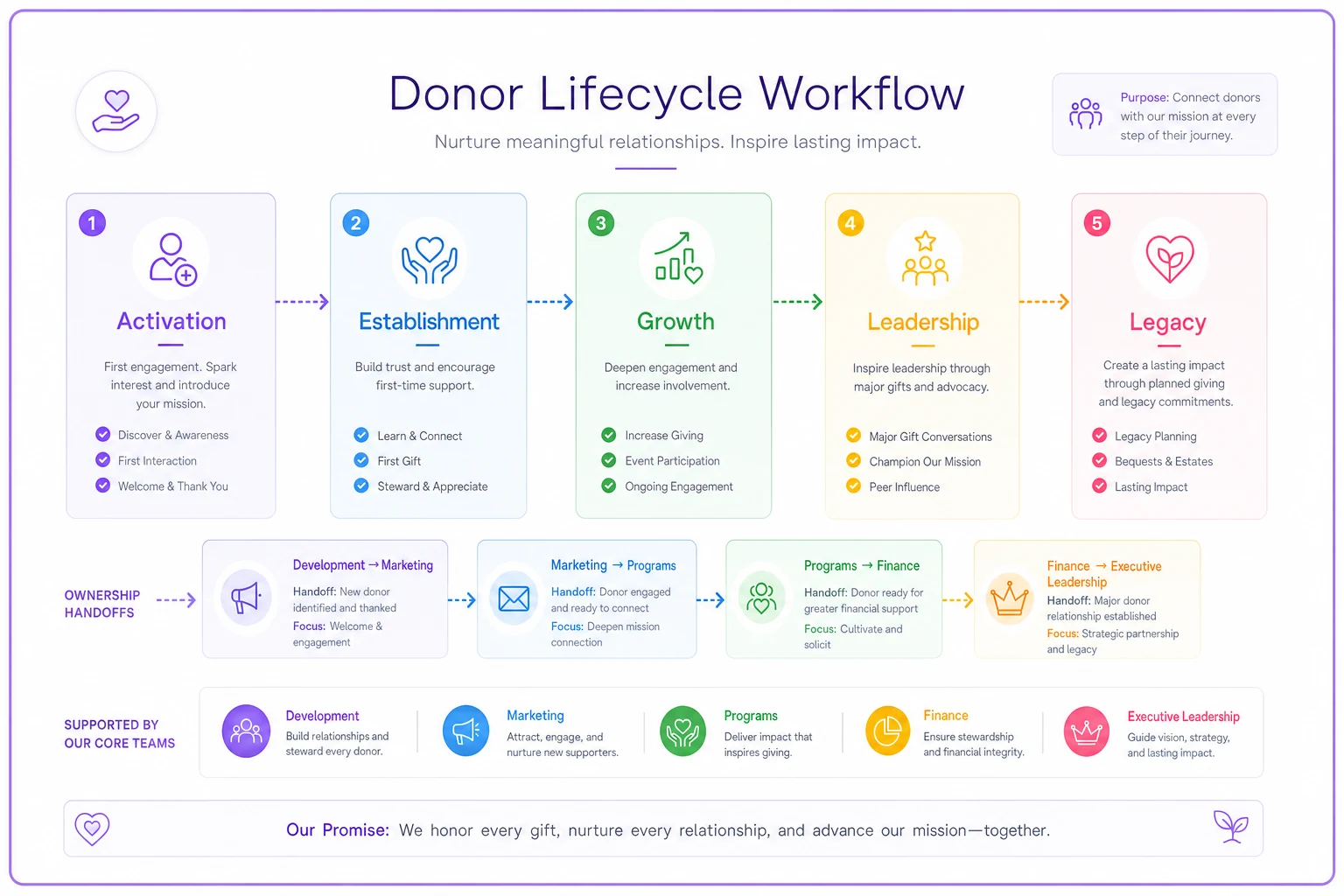
Use this workflow image to align teams on who owns each transition and what triggers movement between stages.
Building the operational connective tissue
Having defined stages means nothing without the operational infrastructure to support them. The architecture usually breaks at these points:
Information Architecture Every interaction needs to flow into a central system that all teams can access. Not just donation data—email opens, event attendance, volunteer hours, social media engagement, survey responses. If programs runs an impact survey and development doesn't know who responded enthusiastically, you've already failed.
Map your data flows before choosing a CRM to avoid costly mismatches.
Most nonprofits try to solve this with expensive CRM implementations that never quite work. The issue isn't the technology. It's that nobody mapped the actual data flows before choosing tools. Start with the architecture, then find technology that supports it.
Transition Protocols Clear handoff protocols prevent donors from falling through cracks during stage transitions. When someone makes their second gift, does development automatically notify marketing? When a donor's giving increases 50% year-over-year, who gets alerted? Who's responsible for reaching out?
A performing arts organization created a simple but effective protocol: every Monday, their system generates a transition report showing all donors who've hit stage milestones. The relevant team lead has 48 hours to acknowledge and 5 days to execute the transition playbook. Donor coverage gaps dropped by 85%.
Alerting Systems The best architectures include early warning systems for both opportunities and risks. Alerts for positive signals: increased giving frequency, higher email engagement, event registration. Alerts for concern: declined gifts, reduced engagement, lapsed communication.
But alerts without ownership create noise. Each alert type needs an assigned responder and required action. A major gift officer might own alerts for donors over $5k. Marketing might own re-engagement for donors showing decreased email activity. The key is someone always owns the response.
Where scale breaks everything
Small nonprofits can manage donor relationships through personal knowledge and informal coordination. Around 500 active donors though, that model collapses. The development director can't personally know everyone. The communication manager can't remember individual preferences. The executive director can't make every thank you call.
This is exactly where most nonprofits stall out—too big for purely relationship-based management, not sophisticated enough for true lifecycle architecture. They start dropping donors not because they don't care, but because their operational model can't scale.
The symptoms are predictable: Thank you letters go out late or not at all. Donors receive asks without proper cultivation. Different departments send conflicting messages. Impact reporting becomes generic instead of personalized. Phone calls and meetings happen only during campaigns.
The compound effect of systematic engagement
When you implement proper donor lifecycle architecture, instead of 40% first-year retention, you hit 65% or higher. Those retained donors give 3-4 times annually instead of 1-2. Average gift size increases 20-30% year-over-year through systematic cultivation. Monthly giving conversion jumps from 5% to 15%+ of active donors. Major gift pipeline stays consistently full instead of scrambling before campaigns.
More importantly, the operational burden actually decreases. When everyone knows their role, owns their metrics, and follows established playbooks, donor management becomes systematic instead of chaotic. Staff spend less time in coordination meetings and more time actually engaging donors.
A youth services nonprofit restructured their operations this way and saw immediate impact. First-year retention jumped from 42% to 68%. Average annual giving increased from roughly $180 to $340 per donor. The real win though: their development team reported feeling less overwhelmed despite managing 40% more donors.
The playbook implementation sequence
Rolling out donor lifecycle architecture requires careful sequencing. You can't transform everything simultaneously without creating chaos.
-
Start with mapping current state. Document how donors actually flow through your organization today, not how you think they do. Track a cohort of recent first-time donors for 90 days. Note every touchpoint, every handoff, every place they get stuck.
-
Next, define your stages and ownership. Keep it simple initially—even three stages beats none. Assign clear owners using the RACI model (Responsible, Accountable, Consulted, Informed). Development might be responsible for execution, but who's accountable for outcomes?
-
Build transition triggers before playbooks. It's tempting to create elaborate engagement sequences, but first nail down the basics: what moves someone between stages? What specific actions or thresholds trigger transitions? Who gets notified?
-
Implement measurement infrastructure early. Before launching new playbooks, ensure you can track stage progression, conversion rates, and time-in-stage. Otherwise you're flying blind and can't prove what's working.
-
Finally, pilot with one segment. Don't try to migrate all donors immediately. Pick your newest cohort or one donor segment and run them through the full architecture. Learn, adjust, then expand.
Start with mapping current state. Document how donors actually flow through your organization today, not how you think they do. Track a cohort of recent first-time donors for 90 days. Note every touchpoint, every handoff, every place they get stuck.
The technology question nobody wants to ask
Most nonprofits approach donor management technology backwards. They evaluate CRMs based on features, pick something that seems comprehensive, then try to force their operations to match the software's assumptions.
Donor lifecycle architecture should drive technology decisions, not follow them. The question isn't "what can this software do?" It's "what operational model do we need to support?"
Modern operational platforms handle this differently. Instead of rigid donor pyramids, they enable flexible lifecycle stages. Instead of siloed departmental tools, they create shared operational workspaces. AI automation handles routine tasks—thank you sequences, engagement scoring, alert generation—while humans focus on relationship building.
The real value isn't in the automation itself. It's in forcing organizations to define their architecture clearly enough that software can support it. Many nonprofits discover their biggest problems weren't technical but organizational. They never agreed on stages, owners, or handoffs in the first place.
Warning signs your architecture is failing
Some failures are obvious—donors leaving, retention dropping, revenue declining. But architectural problems usually surface earlier in operational symptoms:
Staff constantly ask "who owns this donor?" in meetings. Thank you letters pile up because nobody's clearly responsible. The same donors get multiple uncoordinated asks. Impact reporting happens sporadically instead of systematically. Donor complaints about communication increase.
Development complains marketing doesn't support cultivation. Marketing says development doesn't share donor intelligence. Programs feels disconnected from fundraising. Finance processes gifts without alerting anyone. Board members hear donor concerns that staff never knew about.
The most dangerous sign: heroic individual effort replacing systematic process. When donor retention depends on one amazing relationship manager remembering everything, you don't have architecture. You have a future crisis waiting to happen when that person leaves.
The math that makes this urgent
Run realistic numbers. Say you acquire 100 new donors monthly at an average acquisition cost of $75 each. With 40% first-year retention, you keep 40 donors. With 65% retention through better architecture, you keep 65 donors.
Those extra 25 retained donors, giving an average of $200 annually, generate $5,000 additional revenue per cohort. Multiply by 12 monthly cohorts and you're looking at $60,000 increased annual revenue just from better retention. That's before considering increased giving frequency, higher average gifts, or improved lifetime value.
The investment required? Mainly time to map processes, define ownership, and build playbooks. The ongoing operational cost is actually lower because systematic processes require less manual coordination than chaotic ones.
Making the architectural shift
The gap between nonprofits struggling with donor retention and those maintaining strong relationships isn't about caring more or working harder. It's about building operational architecture that scales relationship management beyond what any individual could handle manually.
This shift requires admitting that good intentions and personal relationships aren't enough anymore. Modern nonprofits need the same operational sophistication that successful businesses discovered decades ago. Not because donors are transactions, but because systematic engagement allows you to maintain meaningful relationships at scale.
The organizations succeeding with donor retention don't just track metrics or send more emails. They've built comprehensive lifecycle architectures with clear stages, defined ownership, measurable transitions, and systematic playbooks. They've moved beyond hoping someone remembers to follow up to ensuring everyone knows exactly what happens next.
Donor lifecycle architecture isn't a fundraising tactic—it's the operational foundation that determines whether your nonprofit creates lasting relationships or constantly churns through supporters. The question isn't whether you need this architecture. It's whether you'll build it before losing more donors to preventable operational failures.
Ready to elevate your nonprofit impact?
Join 2,000+ nonprofits using Almosly to boost fundraising efficiency, deepen donor relationships, and scale philanthropic impact.