
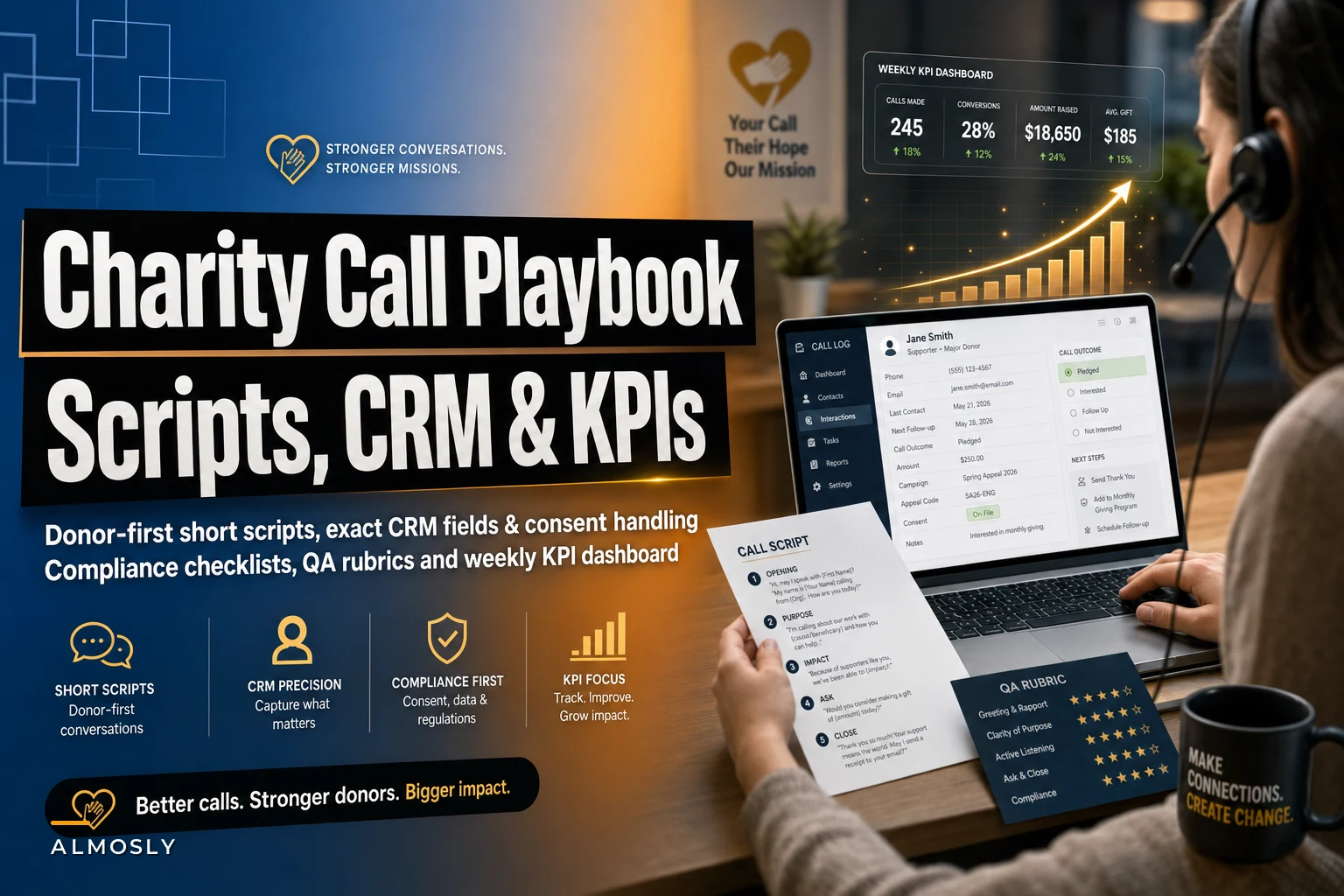

Phone calls are one of the few donor channels where a smaller organization can still outperform a giant. A real person, a real voice, a real conversation. But the gap between a call program that works and one that quietly damages your reputation comes down to boring operational stuff: who gets called, what gets said, what gets logged, and what happens when someone says "take me off your list."
Most small teams get the script half-right and the logging completely wrong. That's what this guide is about.
The three call types, and why mixing them up costs you money
The most common operational mistake is treating every call the same. A caller picks up the list, dials, and launches into "we'd love your support this year" regardless of whether the person on the other end gave last month or dropped off three years ago.
| Call type | Who it's for | Primary goal | What success looks like |
|---|---|---|---|
| Acquisition | Lapsed donors, warm leads, event attendees who never gave | Get a first or re-engaged gift | A gift, or a clear "not now but keep me informed" |
| Renewal | Donors whose last gift is 10–14 months old | Secure the next gift before they lapse | Renewal committed, ideally upgraded slightly |
| Stewardship | Recent or recurring donors | Say thank you, report impact, deepen the relationship | No ask at all — just connection |
What tends to happen in practice: teams run everything as a soft acquisition call because that's the only script they wrote. So a loyal monthly donor who's given for four years gets a call that treats them like a stranger, asking for money they already give automatically. That call does damage. It signals you don't know them.
Separate your lists before you separate your scripts. The scripts below assume you've already done that.
Donor-first scripts you can actually use
A good phone script isn't a word-for-word reading. It's a spine — an opening, a reason for calling, the ask or thank-you, and graceful exits. Callers should sound like humans, not telemarketers reading a card.
Stop missing fundraising opportunities.
Almosly helps you plan, track, and optimize every campaign with ease.
- Centralized donor and volunteer management
- Automated engagement workflows
- Impact and fundraising analytics
No credit card required
Acquisition / re-engagement script
> "Hi [Name], this is [Caller] calling from [Org]. Is now an okay time for a quick two minutes? …Great. I'm reaching out because you [came to our spring event / supported us a couple years back / signed up for our newsletter], and I wanted to tell you what that community helped make happen this year. [One specific, concrete result — not a mission statement.] We're trying to [specific current goal], and I'd love to invite you to be part of it with a gift of [suggested amount]. Would that be something you'd consider today?"
Two things most teams skip. First, one concrete result, not three. "We kept the night shelter open every single night through February" beats "we served the community in many ways." Second, a real suggested amount based on their history or the segment average. "A gift of any size" consistently produces smaller gifts than a specific, reasonable number.
If they hesitate: "No pressure at all — would it help if I sent you a short note by email and you decide when it's convenient?" That's a soft landing, not a lost call. Log it as a follow-up, not a rejection.
Renewal script
> "Hi [Name], it's [Caller] from [Org]. I'm calling with a genuine thank-you — your gift last [month/year] did [specific thing]. As we head into [season/campaign], I wanted to personally ask if you'd renew your support at [last gift amount or a modest step up]. Your steady giving is honestly what lets us plan ahead."
Renewal calls work best when the thank-you comes before the ask and is specific to their actual contribution. Donors who feel their last gift mattered renew at noticeably higher rates than donors who get a generic "it's that time of year again."
Stewardship script (no ask)
> "Hi [Name], this is [Caller] from [Org] — and before you wonder, I'm not calling to ask for anything. I just wanted to let you know that because of supporters like you, [specific outcome]. That's it. Thank you for being part of it."
The no-ask call feels counterintuitive to a team worried about revenue. But stewardship calls consistently lift the next gift and reduce lapse. People remember the organization that called just to say thanks. Keep a light tag on these so you don't accidentally ask the same person for money a week later — a coordination problem we'll come back to.
Consent and opt-out: the part that protects the whole program
This is where a program gets into actual trouble. Calling someone who's on a Do-Not-Call list or who previously opted out isn't just awkward — in GDPR jurisdictions and under national DNC regimes it carries real penalties, and it torches trust with the exact people most likely to complain publicly.
What goes wrong operationally is almost never malice. The opt-out lives in someone's inbox, or on a sticky note, or buried in a reply to a mass email that nobody logged. Three weeks later a different caller works a list that was pulled before the opt-out was recorded, and dials the person who explicitly asked to be left alone.
The fix is a hard rule: an opt-out is only real once it's in the CRM, and no list gets pulled without checking it.
-
Screen against suppression before every calling session. Not monthly — every session. A list pulled Monday can be stale by Thursday.
-
Record the consent basis. Did this person agree to phone contact? When, and how? For GDPR purposes you need to show lawful basis, not just assume it.
-
Capture opt-outs mid-call, immediately. The caller marks it during or right after the call, before the next dial. Never "I'll do it later."
-
Honor channel-specific requests. "Don't call me but email is fine" is a real and common instruction. Your data needs room to store that nuance, not a single on/off switch.
If you've already built field-level consent into your data governance, this is just the phone channel applying the same rules. If you haven't, the phone program is a good reason to start, because a call is the most intrusive channel you've got.
One more pattern worth naming: the "soft" opt-out. Someone sighs and says "ugh, you people call a lot." That's not a formal opt-out, but it's a signal. Smart teams log it as a frequency flag and quietly reduce contact before that person becomes a hard opt-out or a complaint.
The CRM logging template that makes the whole thing run
A call program lives or dies on what gets recorded. If logging is slow or vague, callers skip it, and within a month you have no idea who was contacted, what they said, or who needs follow-up.
Core fields:
-
Call outcome (picklist)
Pledged / Gift made / Declined / Call back / No answer / Voicemail / Wrong number / Opt-out / Deceased
-
Contact timestamp (auto)
-
Caller ID (auto — who made the call)
-
Segment / list name (so you can measure which lists perform)
-
Amount pledged or given (if any)
-
Follow-up required? (yes/no + date)
-
Consent / opt-out change (did this call change their contact preferences?)
-
Short note (free text — one or two sentences, the human detail)
Tags worth using: stewardship-touched, frequency-sensitive, wants-email-not-phone, major-gift-potential, callback-scheduled.
Automation triggers that earn their keep:
-
Outcome = Pledged → create a task to send a confirmation and track whether the pledge is fulfilled within X days.
-
Outcome = Opt-out → immediately flip the suppression flag so no future list can include them. This is the single most important automation in the whole program.
-
Tag = stewardship-touched → suppress this person from the next acquisition or renewal call list for a set window, so they don't get an ask right after a thank-you.
-
Outcome = Deceased → route to a sensitive-handling pause, never a generic follow-up.
-
Follow-up date reached → surface the task to the right caller.
The opt-out automation deserves emphasis because it's the one that prevents actual legal and reputational harm. Manual suppression always eventually fails — someone's out sick, a list gets pulled early, a note gets missed. When the opt-out flag flips the moment the outcome is logged, the human error point disappears.
Make the opt-out automation require manager review to re-enable a contact, so accidental reversals are avoided.
Getting a whole team to log consistently is its own project. If you're rolling this out alongside a new system, the same principles that make a CRM rollout succeed — stakeholder buy-in, short training sprints, and adoption tracking apply directly here.
A simple call-session workflow
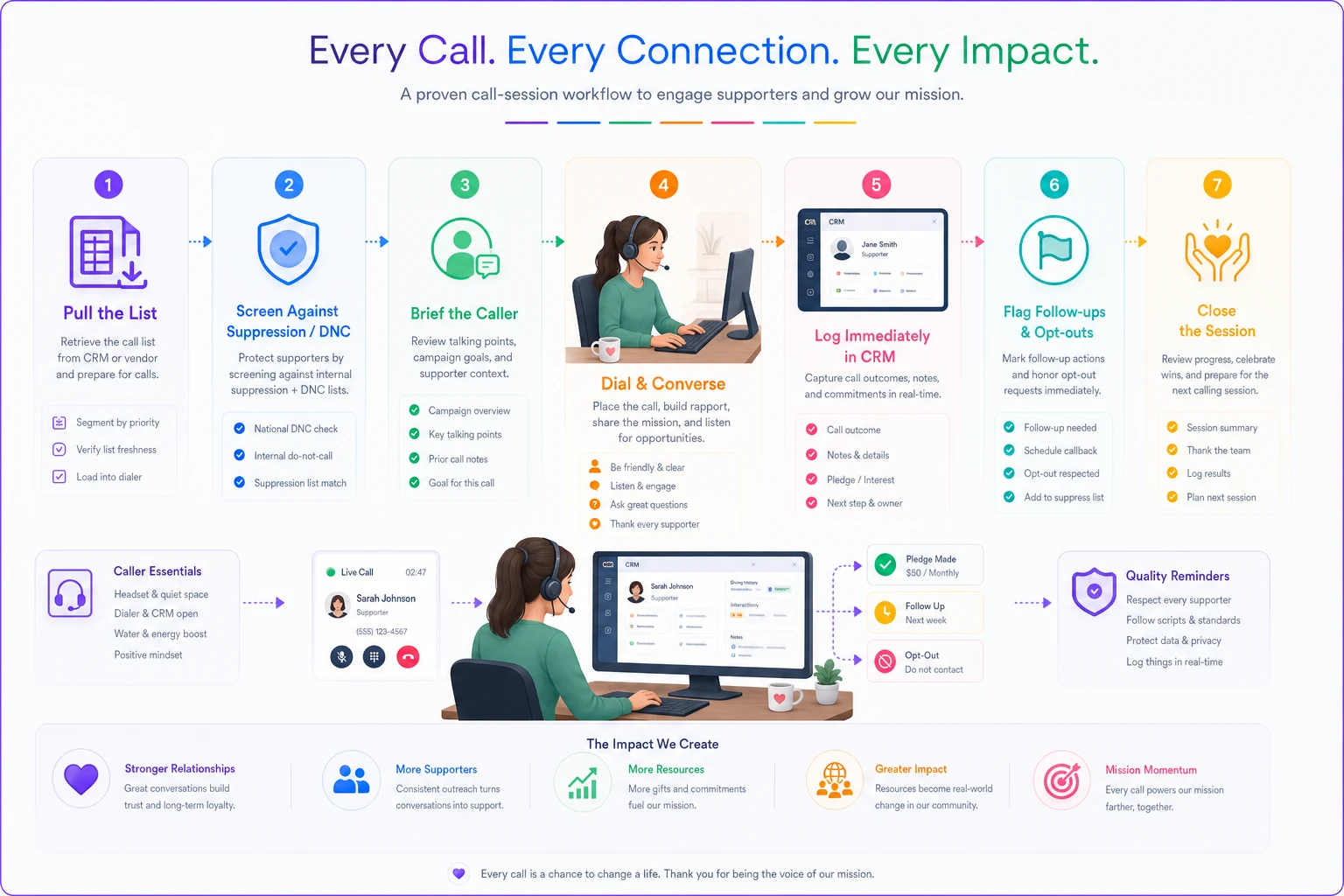
A clean calling session isn't complicated — it just needs a consistent order of operations. Teams that skip steps usually skip them under time pressure, and that's exactly when mistakes happen.
-
Pull the list from a defined segment (e.g., "lapsed 10–14 months, phone consent on file, not suppressed").
-
Screen against suppression and DNC one more time right before dialing.
-
Brief the caller — which script, what the current specific result is, what the suggested amounts are.
-
Dial and have the conversation, following the spine not the word-for-word.
-
Log immediately after each call using the template above.
-
Flag follow-ups and opt-outs before moving to the next number.
-
Close the session with a 5-minute review
how many dials, how many connects, how many gifts, anything odd to flag.
The step teams skip under time pressure is #5 and #6 — immediate logging. Batch logging at the end of a two-hour session produces garbage data because nobody accurately remembers call #11 by the time they finish call #40.
Here's a quick visual of the session steps.
The step teams skip under time pressure is #5 and #6 — immediate logging. Batch logging at the end of a two-hour session produces garbage data because nobody accurately remembers call #11 by the time they finish call #40.
QA and training checks that keep quality high
A small team doesn't need a formal call center QA department. It needs a handful of lightweight checks that catch drift before it becomes a habit.
-
Listen to or sit in on a few calls per caller per month. You're checking tone and accuracy, not policing word choice.
-
Spot-check logs against the template. Are outcomes being recorded? Are opt-outs captured? Pick five random logged calls per caller and review.
-
Run a "would I be annoyed?" test. Read a sample of notes. If the donor sounds pushed or the ask ignored their history, coach it.
-
Refresh the "specific result" every few weeks so callers aren't repeating a stale impact story that's now six months out of date.
-
New-caller shadowing a new caller listens to two sessions, then makes calls with someone listening, before going solo.
The most common quality failure isn't rudeness — it's callers who stop personalizing because they're tired, and slide into reading the same flat script to everyone. Rotating the specific result and keeping sessions short (90 minutes max) prevents most of that.
The KPIs fundraisers actually need weekly
Call programs drown in metrics they never use. For a team of 1–10, you need maybe five numbers, reviewed weekly.
| KPI | What it measures | What to watch for |
|---|---|---|
| Connect rate | Reaches ÷ dials | A collapsing rate usually means stale data, not bad callers |
| Conversion rate | Gifts or pledges ÷ connects | Tells you if the script and segment are aligned |
| Average gift by call type | Revenue quality per segment | Are renewals holding? Are acquisitions reasonable? |
| Pledge fulfillment rate | Pledges paid ÷ pledges made | A pledge isn't money until it clears |
| Opt-out rate | Opt-outs ÷ connects | Your early-warning light — rising rate means wrong people or too often |
Watch opt-out rate as carefully as conversion. A session that raised good money but spiked opt-outs isn't a win — it borrowed from future revenue. During periods when donors are financially stressed, that balance matters even more. The same caution behind protecting recurring gifts when consumer confidence drops applies to how hard you push on the phone.
Your weekly dashboard doesn't need to be fancy. A single view with those five numbers, this week versus last week, per caller and per list, is enough to run the whole program.
A real scenario: a small arts nonprofit
A regional arts organization with two part-time fundraisers was running phone renewals once a year from a spreadsheet. No suppression discipline, one script for everyone, logging done from memory at the end of the week.
The problems showed up as patterns. Their connect rate was sitting around 22% because a significant chunk of their numbers were years out of date. They had two donor complaints in a single season — both people who'd asked to stop being called but whose opt-outs lived in an old email thread. Pledge fulfillment was soft too, somewhere around 55%, because nobody was following up on commitments.
They changed three things, not ten. They split their list into renewal versus stewardship and wrote a proper no-ask thank-you call. They moved logging into the CRM with the opt-out automation flipping the suppression flag instantly. And they added a single follow-up task on every pledge.
Over the next two call cycles, connect rate improved once dead numbers were flagged and retired. Pledge fulfillment climbed into the low 70s because someone was actually chasing confirmations. And the complaints stopped — not because callers got nicer, but because the people who'd opted out simply never appeared on a list again. Revenue per calling hour went up noticeably, mostly from fulfillment and better targeting rather than more dials.
Nothing exotic. Just the operational basics done consistently.
When a phone program makes sense — and when it doesn't
When it's worth it:
-
You have warm relationships to deepen — lapsed donors, event attendees, recurring supporters.
-
Your average gift is high enough that a human conversation pays for itself.
-
You can commit to logging and suppression discipline, not just dialing.
When it's a bad idea:
-
Your list is mostly cold strangers with no prior relationship — that's expensive and the opt-out rate will punish you.
-
You can't reliably honor opt-outs. If you can't guarantee suppression, don't run outbound calls at all. The legal and reputational risk isn't worth it.
-
You're understaffed to the point that logging will be skipped. Unlogged calls are worse than no calls because you lose the data and keep making the same mistakes.
Phone calls also sit inside a bigger retention picture. If recurring donors are quietly lapsing from expired cards rather than lost interest, a call program won't fix that — a pre-expiry card update workflow does. Know which problem you're actually solving before you pick up the phone.
One-page implementation checklist
Run a call program like an operation, not a scramble, and the phone becomes the channel where your size is actually an advantage.
-
Segment lists into acquisition, renewal, and stewardship
-
Write one script per call type with a current, specific impact result
-
Set suggested ask amounts based on segment history
-
Confirm consent basis and screen against DNC before every session
-
Build the CRM logging template (8 core fields + tags)
-
Turn on the opt-out → auto-suppression trigger
-
Add the stewardship-touched suppression window
-
Set follow-up tasks on every pledge
-
Define your five weekly KPIs and build one dashboard
-
Set QA cadence
monthly call reviews + log spot-checks
-
Shadow every new caller before they go solo
-
Keep sessions to 90 minutes and refresh the impact story regularly
The scripts matter, but what really separates a program that raises money from one that generates complaints is everything that happens around the call — the segmentation before, the logging during, and the suppression that makes sure the person who asked to be left alone never gets dialed again.
Run a call program like an operation, not a scramble, and the phone becomes the channel where your size is actually an advantage.
The scripts matter, but what really separates a program that raises money from one that generates complaints is everything that happens around the call — the segmentation before, the logging during, and the suppression that makes sure the person who asked to be left alone never gets dialed again.
Ready to elevate your nonprofit impact?
Join 2,000+ nonprofits using Almosly to boost fundraising efficiency, deepen donor relationships, and scale philanthropic impact.