
Most nonprofits treat their volunteer program and their fundraising program like two separate buildings on the same campus. Volunteers get managed by one person (usually stretched thin), donors get managed by another, and the only time the two teams talk is when someone realizes a $25k donor has been stuffing envelopes every Thursday for six years and nobody flagged it.
That gap is expensive. Volunteers are, statistically, some of your warmest prospects — people who've already given time, understand the mission at a granular level, and have self-selected as believers. And yet the handoff from "committed volunteer" to "committed donor" is one of the most broken workflows in the entire sector.
This isn't a pitch for turning volunteers into ATMs. The opposite, actually. The nonprofits that convert volunteers well do it by respecting the difference between the two relationships and building a system that moves people forward at a pace that feels natural. Here's how that system works — and where it tends to fall apart.
Why the volunteer-to-donor bridge collapses
The core problem is structural, not attitudinal. Volunteer coordinators are rarely trained — or comfortable — with solicitation. Development officers rarely have visibility into volunteer engagement data. So even when someone is practically broadcasting readiness signals, nobody's watching the right dashboard.
In practice, this usually happens because volunteer data lives in a spreadsheet, a sign-in sheet, or a scheduling tool that never touches the CRM. The development team is looking at giving history. The volunteer team is looking at hours logged. Neither can see the full person.
A typical example: someone volunteers 120+ hours a year, brings friends to every event, and has been quietly telling the program director that "this place changed my life." That's a major-gift prospect hiding in plain sight. But because the program director doesn't think in terms of moves management, and the development team never got the memo, that person gets a generic year-end appeal — the same one that goes to lapsed $10 donors.
The other failure mode is the opposite: an over-eager development officer gets a volunteer list, sees names, and blasts an ask before any relationship groundwork exists. The volunteer feels used. They stop showing up. Now you've lost the time and the gift.
Both breakdowns come from the same root cause — there's no shared taxonomy and no agreed-upon rules for who moves whom, when, and how.
Start with a volunteer taxonomy that maps to fundraising intent
Before you can build conversion flows, you need to segment your volunteers by something more useful than "active" and "inactive." Most programs stop at frequency. That's not enough to make fundraising decisions.
Stop missing fundraising opportunities.
Almosly helps you plan, track, and optimize every campaign with ease.
- Centralized donor and volunteer management
- Automated engagement workflows
- Impact and fundraising analytics
No credit card required
A workable taxonomy separates volunteers along a few axes at once: engagement depth, capacity signals, and relationship warmth. Here's the rough structure that tends to hold up across organizations:
| Segment | What defines them | Fundraising posture |
|---|---|---|
| Transactional | One-off event help, minimal follow-up, low identity attachment | Keep engaged, no ask yet |
| Recurring / operational | Regular shifts, reliable, but relationship is task-based | Soft cultivation, small first ask possible |
| Mission-identified | Talks about the org as "we," recruits others, emotionally invested | Prime for cultivation → ask |
| Leadership / expertise | Serves on committees, brings professional skills, often networked | Major-gift and board pathway |
| Already-giving volunteers | Volunteer + donor overlap | Upgrade and deepen, not first ask |
The thing most people miss: capacity and warmth are independent variables. A retiree who volunteers 200 hours a year might have a modest ability to give. A busy executive who shows up twice a year might be your biggest prospect. Segmenting only by hours will systematically point you at the wrong people.
Tag both. Warmth tells you whether to ask. Capacity tells you how much to ask for and who should do the asking.
Tag both warmth and capacity in your CRM so your volunteer segmentation plugs into donor models instead of living in a parallel universe.
If you've already built out a real donor segmentation model, you don't start from zero — the same tagging discipline applies. The volunteer taxonomy should plug into it, not live in a parallel universe.
The conversion flow: segmentation → stewardship → ask readiness
Once you've segmented, the movement between stages is where the actual work happens. This is a flow, not an event. Rushing it is the number-one reason conversions fail.
-
1. Segmentation. Tag every volunteer against the taxonomy above. Do this quarterly at minimum, because people move. Someone who was transactional in January can become mission-identified by June after a powerful experience on-site.
-
2. Signal collection. This is the stage everyone skips. You need to be capturing soft signals that indicate deepening commitment — language shifts ("we" instead of "you"), unprompted recruiting of friends, requests to do more, emotional disclosures about why they're there. These aren't in your CRM by default. Someone has to log them.
-
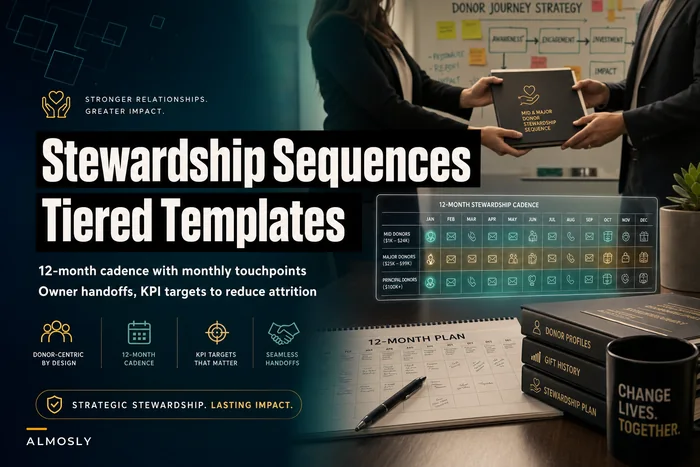
3. Stewardship before ask. Volunteers get thanked for time, then years later get asked for money with no bridge in between. The stewardship stage exists to acknowledge them as whole supporters — sharing impact tied to their specific work, inviting them into insider moments, treating them like insiders because they are. The stewardship sequences built for mid-level and major donors translate almost directly here, with cadence and owner handoffs adapted for a volunteer relationship.
-
4. Ask readiness scoring. Before anyone solicits, you score readiness. A simple three-question gate works: Has this person shown identity-level attachment? Have they been stewarded as a supporter — not just a helper — in the last 6–12 months? Do we have a capacity estimate? If all three aren't yes, they're not ready. Keep stewarding.
-
5. The ask itself. Made by the right person (more on RACI below), framed around the mission the volunteer already loves, not a generic campaign.
The workflow only holds together if steps 2 and 3 are actually staffed. When conversion pipelines stall, it's almost always because nobody owns signal collection and stewardship — those steps fall between the volunteer coordinator and the development officer and land on neither.
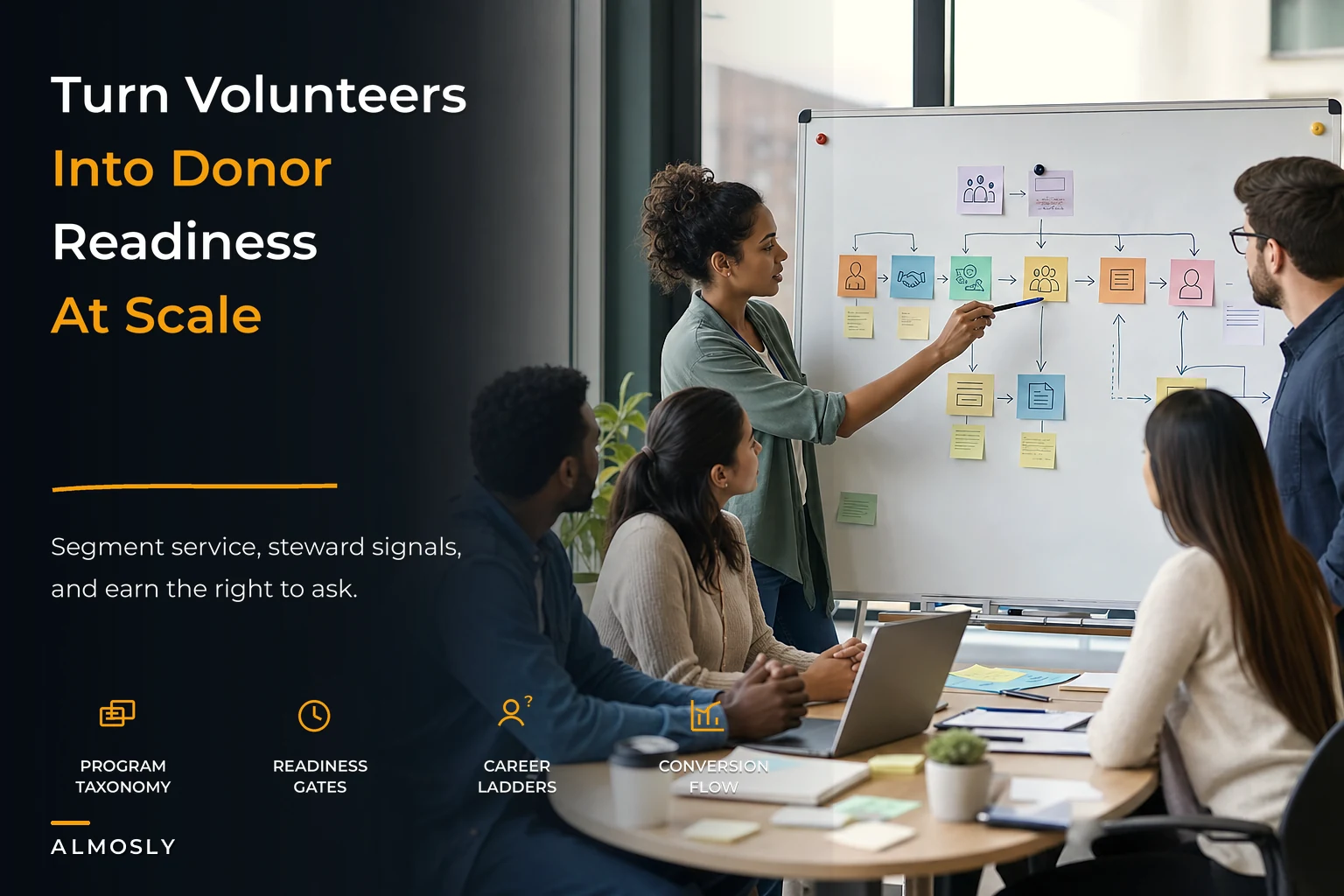
A quick visual of the flow can make roles and handoffs clearer.
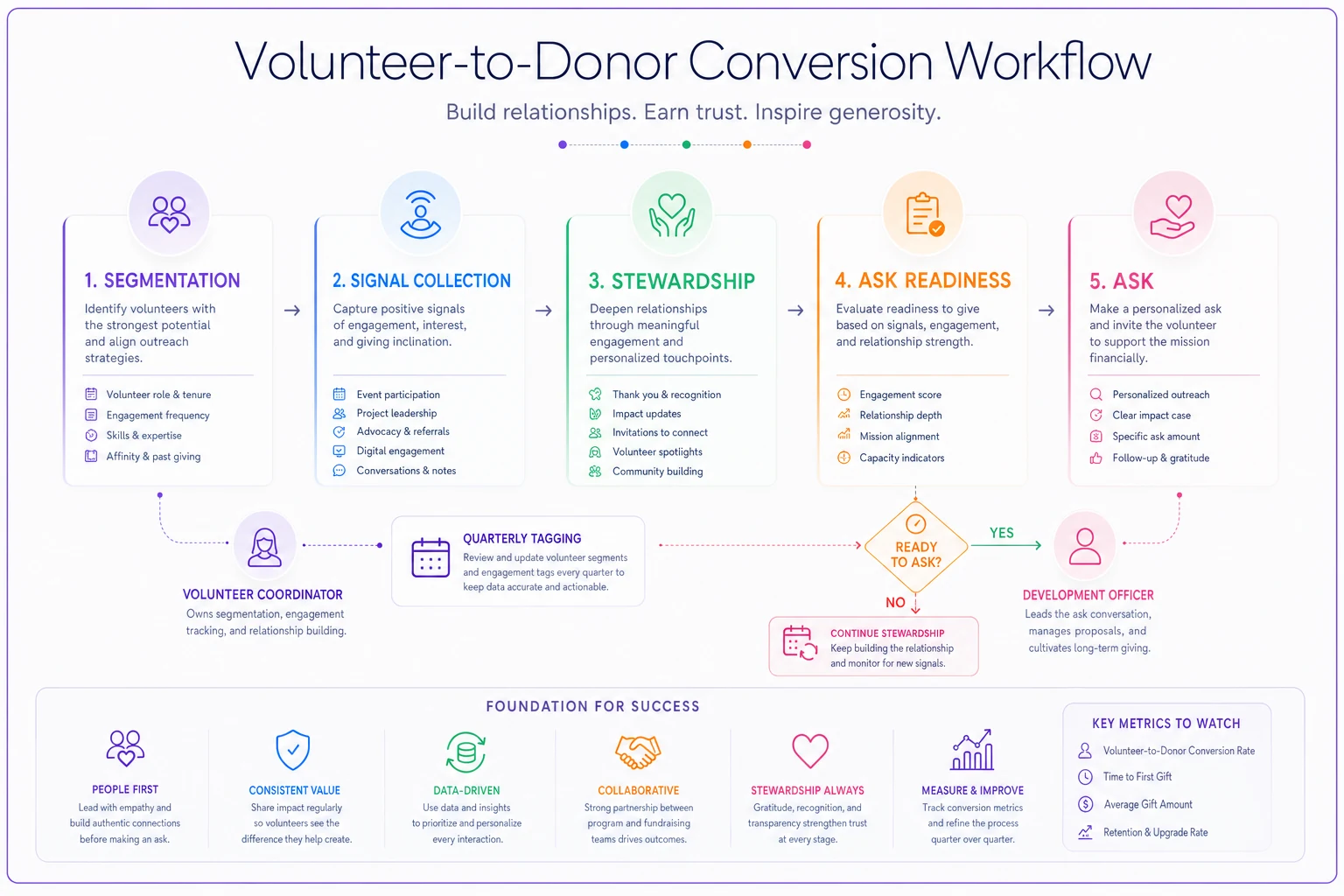
When the workflow stalls, it's usually because nobody owns signal collection and stewardship — those steps fall between the volunteer coordinator and the development officer and land on neither.
Volunteer career ladders: giving people somewhere to climb
People don't convert from volunteer to donor. They convert from shallow involvement to deep involvement, and money is just one expression of depth. If you build a ladder that lets people go deeper in multiple ways, giving becomes a natural rung rather than a jarring pivot.
A volunteer career ladder gives structure to that deepening:
-
Rung 1 — Episodic helper. Shows up for events. Low commitment, low friction.
-
Rung 2 — Committed volunteer. Regular shifts, has a "home" in the org.
-
Rung 3 — Team lead / mentor. Trains newer volunteers, owns a piece of a program.
-
Rung 4 — Committee / advisory role. Shapes decisions, brings expertise, starts thinking strategically about the org.
-
Rung 5 — Ambassador / board pathway. Represents the org externally, gives and gets, part of the leadership fabric.
Each rung should come with more access, more responsibility, and more insider connection — not just more work. And the ask conversation changes shape at each rung. You don't approach a Rung 1 helper about a major gift. But a Rung 4 committee member is already making resource decisions about the org; a giving conversation there is completely natural.
The mistake people make is building the ladder for the org's convenience — we need more shift coverage — instead of the volunteer's growth. If your ladder only offers "more of the same task," nobody climbs. People climb when the next rung offers meaning, recognition, or influence.
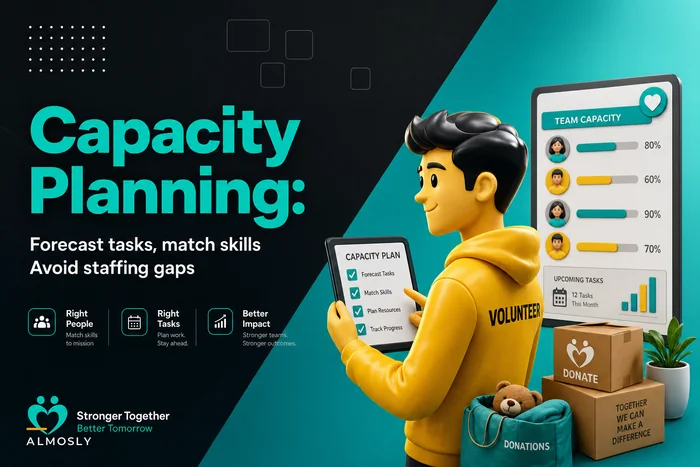
Capacity planning matters a lot here, because a career ladder without the staffing to support mentorship and committee structures just creates frustrated volunteers stuck on rung 2. Getting volunteer capacity forecasting and skills-matching right is what makes the upper rungs functional instead of theoretical.
RACI for the transition to solicitation
This is the part that saves relationships. The most damaging thing that happens in volunteer-to-donor conversion is role confusion at the moment of the ask — two people asking, nobody asking, or the wrong person asking.
RACI (Responsible, Accountable, Consulted, Informed) gives you a clean way to define who does what across the transition:
| Activity | Responsible | Accountable | Consulted | Informed |
|---|---|---|---|---|
| Logging engagement signals | Volunteer coordinator | Volunteer manager | — | Development |
| Ask-readiness scoring | Development officer | Development director | Volunteer coordinator | — |
| Deciding who makes the ask | Development director | Development director | Volunteer coordinator, ED | — |
| Making the solicitation | Assigned solicitor | Development director | — | Volunteer coordinator |
| Post-ask stewardship | Development officer | Development director | Volunteer coordinator | Volunteer team |
A few things this forces:
-
The volunteer coordinator is always consulted before an ask, never bypassed. They know the relationship. They can flag bad timing. This one rule prevents most damage.
-
Someone owns the decision of who asks. Sometimes it's the development officer. Sometimes the volunteer's mentor is the right voice. Sometimes it's a peer board member. That's a deliberate choice, not a default.
-
The volunteer team stays informed after the ask — win or lose — so the volunteer relationship doesn't get quietly dropped the moment a gift conversation happens.
When there's no RACI, trust breaks down at scale. A volunteer coordinator who finds out one of "their" people got solicited without warning will stop cooperating with development entirely. And volunteers feel the seams — when the org that thanked them warmly on Tuesday hits them with a cold ask on Thursday, they notice the disconnect.
A real scenario
A mid-sized community health nonprofit — roughly a $2.5M annual budget, one development officer, one part-time volunteer coordinator — had about 180 active volunteers and almost no crossover into their donor file. Maybe a dozen volunteers gave, mostly small event-driven gifts.
The problem wasn't a lack of prospects. Nobody had ever looked at the volunteer roster through a fundraising lens. When they finally ran the two lists side by side and added a lightweight taxonomy, they found roughly 20–25 volunteers sitting in the "mission-identified" and "leadership" tiers who had never been meaningfully cultivated as donors.
They didn't rush it. Over about nine months they built a stewardship track for those volunteers — impact updates tied to their actual work, a couple of small insider gatherings, the volunteer coordinator flagging readiness signals to the development officer. Asks only went out after the readiness gate cleared, and the coordinator was consulted on every one.
The result wasn't dramatic in raw dollar terms at first — somewhere in the $30k–$45k range in new committed gifts that first year, most from three or four leadership-tier volunteers. But the more important outcome was structural: they now had a repeatable pipeline instead of a one-time list-scrub. And volunteer retention actually went up, because the deepened relationships made people feel more seen, not more used.
When this makes sense — and when it doesn't
This makes sense when you have a stable volunteer base with real relationship depth, and at least some staff capacity to own signal collection and stewardship. It works best when your volunteer and development functions can actually talk to each other, even if they're the same overworked person wearing two hats.
This is a bad idea when your volunteer program is purely transactional and event-driven with no ongoing relationships. If people show up once for a beach cleanup and never come back, there's no depth to convert. Build engagement first, conversion second.
Who should NOT do this yet: organizations without the basic infrastructure to track volunteers and donors in a connected way. If your volunteer data is trapped in a sign-in binder and never touches your donor records, fixing that plumbing comes first. You can't run a conversion flow on data you can't see. This is also where connected operational software earns its keep — not because it makes the asks for you, but because it's the difference between a coordinator's gut feeling and a shared, actionable record that everyone can actually act on.
A short checklist to start
Run your volunteer list and donor list side by side. Find the overlap and the gaps.
-
Run your volunteer list and donor list side by side. Find the overlap and the gaps.
-
Tag every active volunteer against a real taxonomy — depth, warmth, capacity — not just hours.
-
Assign ownership of signal collection. Someone has to log the "we" language and the recruiting behavior.
-
Build a stewardship track for your top two tiers before anyone thinks about asking.
-
Write down your RACI so the volunteer coordinator is always consulted before a solicitation.
-
Score readiness with a simple three-question gate. No shortcuts to the ask.
-
Keep the volunteer relationship alive after the gift conversation, regardless of outcome.
Keep the volunteer relationship alive after the gift conversation, regardless of outcome.
The bigger picture
The organizations that win at this stop thinking of volunteers and donors as two separate audiences and start thinking of them as one community at different depths of involvement. The taxonomy, the career ladder, the stewardship flow, the RACI — they're all just mechanisms to move people deeper at a pace they choose.
The money follows the depth. It almost never works the other way around. When a volunteer program is built to grow people rather than just fill shifts, fundraising stops feeling like an intrusion and starts feeling like the obvious next step for someone who already believes. That shift — from extraction to progression — is the whole game.
The shift — from extraction to progression — is the whole game.
Ready to elevate your nonprofit impact?
Join 2,000+ nonprofits using Almosly to boost fundraising efficiency, deepen donor relationships, and scale philanthropic impact.