
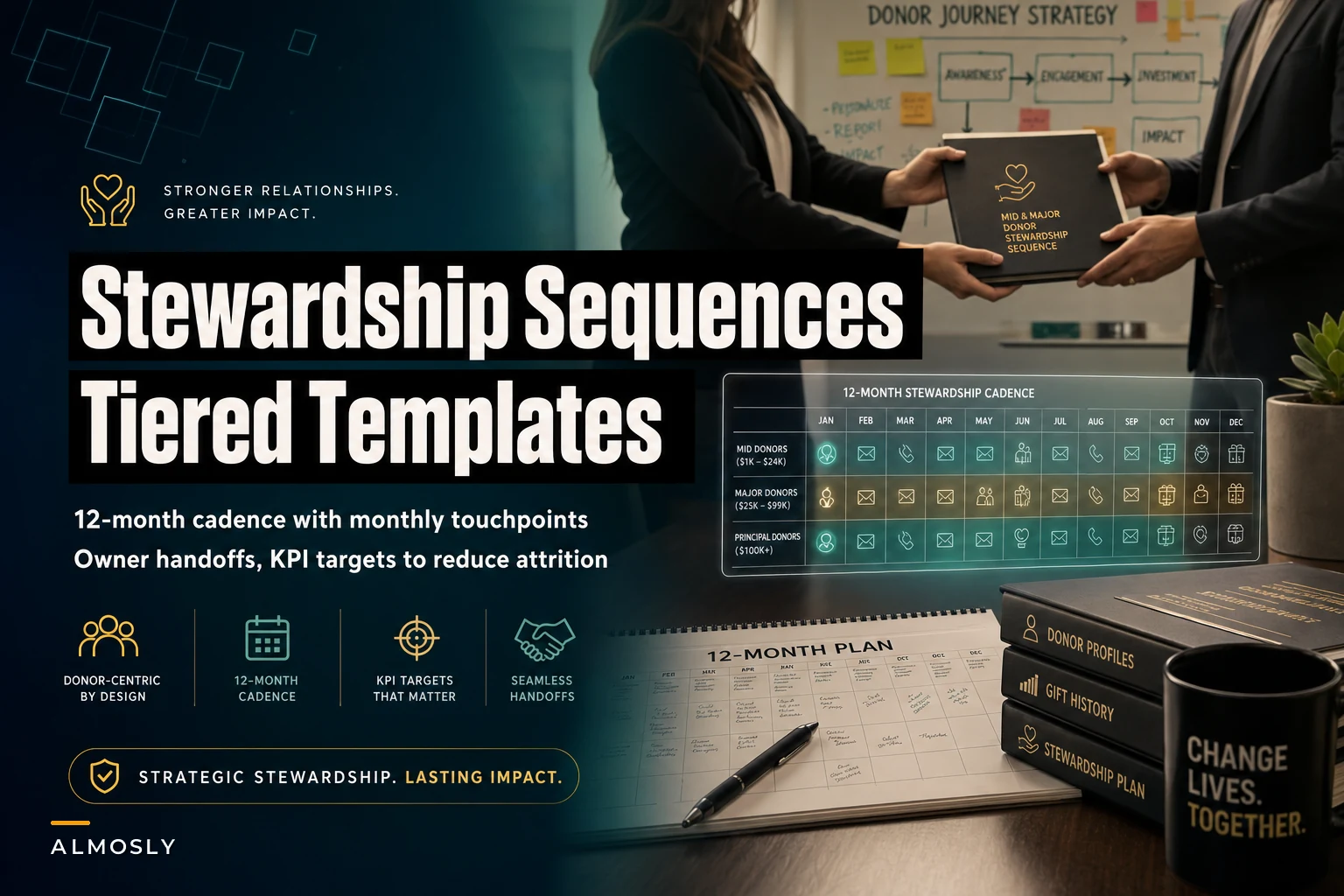

Most nonprofits lose major donors because their stewardship sequences are built backwards. They start with recognition ideas—naming opportunities, gala invites, thank-you videos—then wonder why retention drops after year two.
The real problem isn't lack of appreciation. It's operational chaos. Development owns the first touch, program staff handles the site visit, executive director jumps in for the ask, and nobody tracks who's supposed to do what when. Your major donor stewardship sequence becomes a series of forgotten handoffs and missed opportunities.
After building donor management systems for organizations ranging from small arts nonprofits to multi-site health clinics, the pattern is painfully consistent: stewardship fails when ownership is unclear, timing is vague, and outcomes aren't measured. Not because teams don't care, but because they're running everything through memory and spreadsheets.
The ownership problem that kills major donor relationships
A mid-sized education nonprofit I worked with had what looked like a solid stewardship plan. Quarterly touchpoints for anyone over $5,000. Monthly check-ins for $25,000+. Personal outreach from the ED for $50,000+.
What actually happened was messier.
The development associate sent the initial thank you. Three weeks later, the program director was supposed to share an impact update but didn't know the donor had just given. Six weeks after that, the ED was meant to call but had no context about previous touchpoints. By month four, nobody remembered who was supposed to send the quarterly report.
They lost four major donors that year. Not because donors felt unappreciated—they got plenty of generic thank yous—but because the experience felt disjointed and transactional.
This happens when stewardship lives in color-coded Excel sheets that only one person understands. Task lists scattered across three different project management tools. Calendar reminders that say "follow up with donor" with zero context. Email threads where critical handoff details get buried.
The fix isn't more touchpoints. It's clear operational ownership with exact timing and measurable outcomes at each tier.
Building tiered sequences that actually work
Forget the standard pyramid model where giving level determines attention. Real stewardship tiers should factor in three variables: giving capacity, engagement trajectory, and organizational priorities.
Stop missing fundraising opportunities.
Almosly helps you plan, track, and optimize every campaign with ease.
- Centralized donor and volunteer management
- Automated engagement workflows
- Impact and fundraising analytics
No credit card required
-
Tier 1
Emerging Major ($5K-$15K annually)
- Primary owner: Development Associate - Secondary owner: Program Manager - Cadence: 6 touchpoints annually - Handoff points: After gifts 2 and 4 -
Tier 2
Established Major ($15K-$50K annually)
- Primary owner: Development Director - Secondary owner: Executive Director - Cadence: 9 touchpoints annually - Handoff points: Quarterly between owners -
Tier 3
Leadership Circle ($50K+ annually)
- Primary owner: Executive Director - Secondary owner: Board Champion - Cadence: 12+ touchpoints annually - Handoff points: Monthly coordination required
But tiers mean nothing without exact sequences. Generic "quarterly check-ins" fail because nobody knows what happens in each check-in or who drives it.
The exact 12-month sequence for Tier 2 donors ($15K-$50K)
Month 0 (Gift received):
-
Month 0 (Gift received)
- Day 1: Auto-acknowledgment (Development) - Day 2: Personal call from Development Director - Day 7: Handwritten note from ED - Day 14: Impact packet mailed (Program)
-
Month 1
- Week 2: Program update email with specific allocation details (Program Manager) - Week 4: Coffee invitation from Development Director
-
Month 2
- Week 1: Behind-the-scenes program content (video/photos) from Program - Week 3: Development Director check-in call
-
Month 3
- Week 2: Quarterly impact report with their specific metrics (Development) - Week 4: ED personal update (handoff from Development Director with context)
-
Month 4
- Week 2: Exclusive program briefing invitation (Program) - Week 4: Development touchpoint based on briefing attendance
-
Month 5
- Week 2: Peer story featuring another donor (Development) - Week 4: Mid-year survey with 3 questions max (Development)
-
Month 6
- Week 1: Semi-annual comprehensive report (Development + Program jointly) - Week 3: ED call with specific talking points from Development
-
Month 7-8
- Cultivation for next gift based on engagement scores - Site visit or virtual deep-dive with Program team
-
Month 9
- Week 2: Pre-ask strategic update from ED - Week 4: Soft ask or increased engagement opportunity
-
Month 10-11
- Renewal ask with specific project options - Follow-up sequence based on response
-
Month 12
- Year-end appreciation regardless of renewal status - Transition planning for next tier up or down
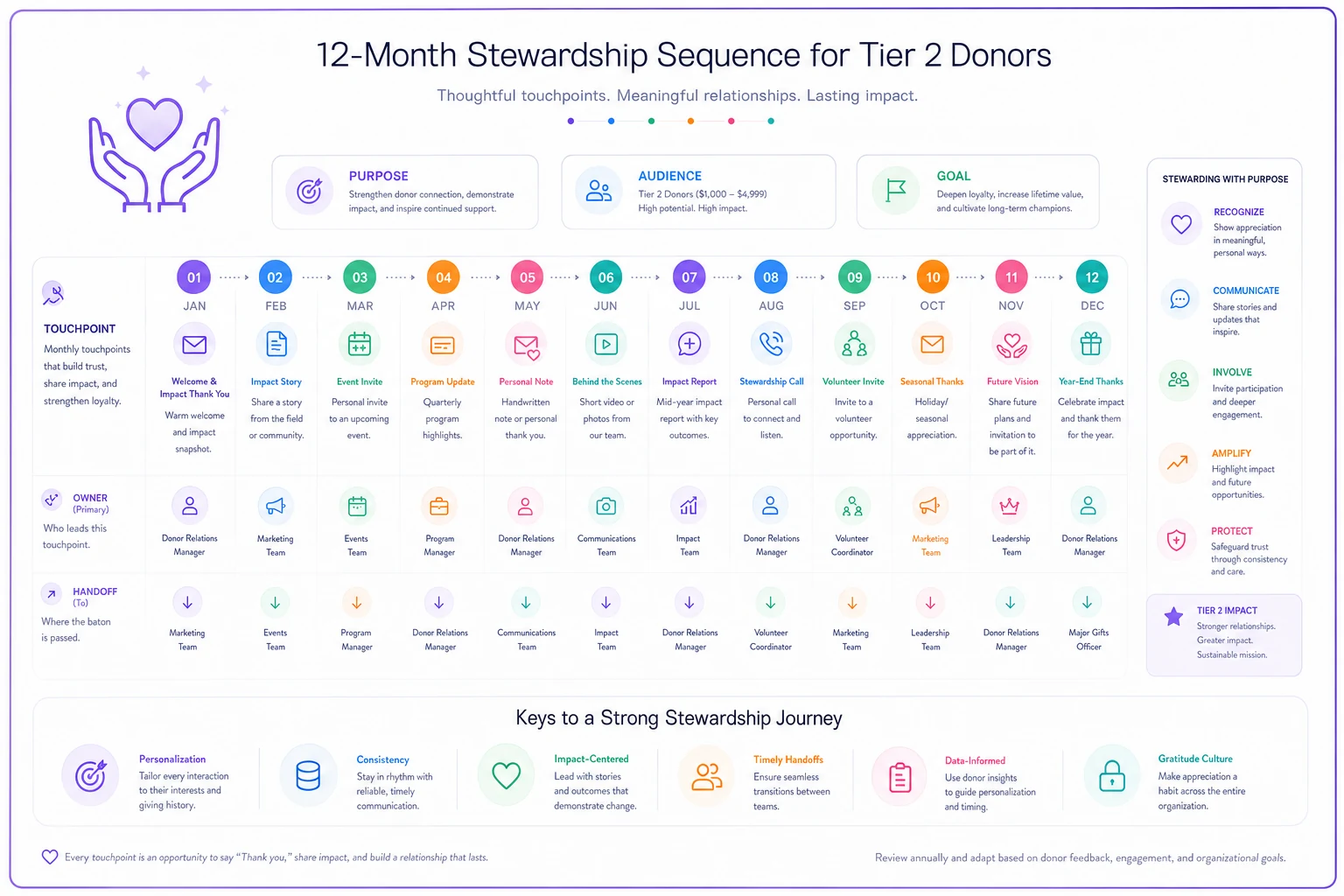
Here's a visual workflow for this 12-month sequence.
Each touchpoint has a specific owner, specific content requirement, and specific success metric.
Handoff protocols that prevent dropped donors
The technical handoff between Development and Program kills more donor relationships than anything else. The protocol:
-
Pre-handoff (48 hours before) Development sends Program
- Donor giving history (last 3 years) - Communication preferences - Key interests/restrictions - Last 3 touchpoints summary - Specific talking points needed - Expected outcomes from this touch
-
During handoff Program documents
- Actual conversation points covered - Donor questions or concerns - Next steps promised - New information learned - Engagement level (1-5 scale) - Recommended follow-up
-
Post-handoff (within 24 hours) Program sends back to Development: - Contact report in CRM - Any promises made requiring tracking - Updated donor interests/concerns - Next touchpoint recommendation - Flag if acceleration or intervention needed
Require a single CRM contact report template so every handoff captures the same fields consistently.
Without this protocol, Program has great conversations that Development never hears about, or Development makes promises that Program can't deliver on. Neither scenario ends well.
Measuring what matters: KPIs by tier and touchpoint
Stop measuring stewardship by activity metrics (calls made, emails sent) and start measuring outcomes. Each tier needs different KPIs, and each touchpoint type needs its own success metric.
| Touchpoint Type | Tier 1 KPI | Tier 2 KPI | Tier 3 KPI |
|---|---|---|---|
| Thank you (Month 0) | 95% within 48hr | 100% within 24hr | 100% within 12hr |
| Impact update | 70% open rate | 85% open rate | 95% open rate |
| Personal outreach | 50% response rate | 65% response rate | 80% response rate |
| Event invitation | 30% attendance | 50% attendance | 75% attendance |
| Renewal ask | 75% retention | 85% retention | 95% retention |
| Upgrade ask | 15% upgrade rate | 25% upgrade rate | 35% upgrade rate |
-
Response time to donor inquiries (target
under 4 hours for Tier 3)
-
Number of touchpoints before donor-initiated contact
-
Percentage of planned touchpoints actually executed
-
Average days between touchpoints vs. plan
-
Cross-team handoff completion rate
A performing arts center discovered their Tier 2 donors averaged 47 days between meaningful touchpoints instead of their planned 30. After tightening their sequence, retention jumped from 72% to 86% in one year.
Warning signs your sequence is failing
You know your major donor stewardship sequence needs work when:
-
Timing issues - Thank you calls happen 5+ days after gifts - Nobody knows when the last touchpoint occurred - Donors reach out asking for updates you should've sent - Renewal asks feel surprising to donors
-
Ownership confusion - Multiple staff contact the same donor accidentally - Donors get contradictory information from different team members - Program accomplishments never make it to Development - ED has no context for donor conversations
-
Content problems - Every donor gets identical updates regardless of interests - Impact reports are generic organizational overviews - No connection between donor's specific gift and specific outcomes - Recognition feels performative rather than genuine
Most organizations hit at least two of these regularly.
The automation opportunity nobody talks about
This is where operational software changes everything. Not by replacing personal touchpoints—that's not the point. But by handling the coordination complexity that makes sequences fail.
The handoff protocols I described above? They're perfect for workflow automation. The system tracks who owns each touchpoint, when it's due, what content is needed, and whether it happened. Program uploads their contact report, Development gets notified automatically. ED's quarterly call gets scheduled with full context loaded. Nothing falls through cracks because nothing relies on manual memory.
Organizations reduce donor touchpoint delays by roughly 80% just by automating the backend coordination. Not the donor communication itself—that stays highly personal. But all the internal orchestration that makes personalization possible at scale.
Think about your current recurring donation recovery process. The same operational discipline applies to major donor stewardship, just with different stakes and touchpoint complexity.
Capacity reality check: when to segment differently
Not every organization can run three-tier sequences with monthly touchpoints. If you're a two-person development shop, this framework might feel impossible.
-
For teams under 3 people - Collapse to two tiers maximum - Extend touchpoint intervals to 6-8 weeks - Focus on consistency over frequency - Automate all coordination and reminders
-
For organizations under 50 total major donors - Run quarterly cohort touchpoints instead of individual sequences - Batch similar activities (all thank you calls on Tuesdays) - Use templates more heavily but personalize key details - Share ownership between Development and ED only
-
For volunteer-driven development - Assign donor relationships not touchpoint tasks - Create simple 4-touchpoint annual sequences - Focus on retention over upgrade paths - Document everything for volunteer transitions
The point isn't perfection. It's having a clear, documented, measurable process that someone besides you can execute.
Starting Monday: your implementation checklist
Skip the six-month planning process:
-
Week 1
Audit current state
- List every donor touch from last quarter - Note who actually executed each one - Calculate average days between touches by tier - Identify your biggest gap (timing, ownership, or content) -
Week 2
Design one tier completely
- Pick your highest-value tier to start - Map all 12 months of touchpoints - Assign specific owners and backup owners - Set measurable outcomes for each touch type -
Week 3
Document handoff protocols
- Create templates for Development-to-Program handoffs - Build contact report requirements - Set up tracking for handoff completion - Train all touchpoint owners on the protocol -
Week 4
Launch with 5 donors
- Start with donors in months 1-3 of their cycle - Run the full sequence manually first - Document what breaks or feels awkward - Adjust before scaling
Organizations who succeed start small, document obsessively, and measure outcomes not activities. They also recognize that major donor stewardship is fundamentally an operations problem that happens to involve fundraising, not the other way around.
Just like converting one-time donors to monthly givers, the magic isn't in the strategy—it's in the systematic execution of clearly owned, properly timed, measurably successful touchpoints.
The sequence is the strategy
Your major donors don't need more recognition. They need coherent relationships. That means every touchpoint connects to the last one, every handoff preserves context, and every interaction drives toward a clear outcome.
Stop building wish lists of touchpoint ideas. Start building operational sequences with exact timing, clear ownership, and measurable results. The donors who matter most to your mission deserve more than good intentions and scattered Excel sheets.
They deserve a real system. And you deserve not to lose them because somebody forgot whose turn it was to call.
They deserve a real system. And you deserve not to lose them because somebody forgot whose turn it was to call.
Ready to elevate your nonprofit impact?
Join 2,000+ nonprofits using Almosly to boost fundraising efficiency, deepen donor relationships, and scale philanthropic impact.