


Three weeks before their annual food distribution event, a program coordinator at a mid-sized food bank discovered they had 47 volunteers signed up for setup roles but only 12 for the actual distribution shifts. The setup crew would arrive at 6 AM to arrange tables for nobody to staff four hours later.
Most nonprofits discover their volunteer gaps when it's already too late
This wasn't a recruitment problem. They had 280 active volunteers in their database. The issue was visibility—nobody could see the mismatch between volunteer skills, availability patterns, and actual task requirements until it was too late to fix.
Most nonprofits run volunteer programs through a combination of spreadsheets, email chains, and hope. A volunteer coordinator maintains one spreadsheet with contact info, another tracking skills and certifications, maybe a third showing who worked which events. When planning an upcoming program, they manually cross-reference these sheets against a task list, trying to remember who's available Tuesdays versus Thursdays, who needs a partner for heavy lifting, and whether Jennifer still has her food handling certification.
The manual matching process creates blind spots everywhere. You can't see that your Tuesday morning crew has eight people comfortable with data entry but nobody certified for client intake. You don't notice that your biggest fundraising push coincides with spring break when half your student volunteers disappear. These gaps only become visible when programs fail.
Why volunteer programs operate half-blind
Volunteer capacity planning breaks because nonprofits treat it as a scheduling problem when it's actually a forecasting and matching challenge. The difference matters operationally.
Stop missing fundraising opportunities.
Almosly helps you plan, track, and optimize every campaign with ease.
- Centralized donor and volunteer management
- Automated engagement workflows
- Impact and fundraising analytics
No credit card required
A scheduling problem assumes you know what resources you have and when they're available. You just need to slot people into time blocks. But volunteer programs deal with constantly shifting availability, varying skill levels, and tasks that require specific combinations of capabilities.
Consider what happens during grant application season at a youth mentorship nonprofit. They need volunteers who can gather program data, others who can write compelling narratives, and some who understand financial reporting. These aren't interchangeable roles. A volunteer great at tutoring kids might be terrible at spreadsheet work. The development director might know they need help with a grant due in six weeks, but without visibility into which volunteers have which skills and when they're available, they can't plan effectively.
The planning breakdown usually follows this pattern: Program staff identify tasks they need covered. They send these requests to the volunteer coordinator, often just days before the work needs doing. The coordinator scrambles through their mental database and scattered spreadsheets, texting volunteers they think might work. Half don't respond. Of those who do, several can't make the specific times needed. The coordinator fills what they can and tells program staff to make do with gaps.
This reactive scrambling means programs never build the operational rhythm they need to scale impact. Staff burn out covering volunteer gaps. Volunteers feel frustrated when they're asked to do tasks outside their comfort zone or when they show up to chaotic, understaffed shifts.
The hidden cost cascade
When volunteer capacity planning fails, the damage spreads through your entire operation in ways most nonprofits never calculate properly.
Start with direct program impact. A homeless services organization running a weekly meal program discovered their inconsistent volunteer staffing meant they could only serve 85 meals reliably, even though they had kitchen capacity for 120 and typically had 100-115 people show up. Those 15-30 people turned away each week represented 750-1500 missed meals annually—not because of funding or food availability, but because they couldn't predict whether they'd have enough trained volunteers to handle food prep and service safely.
Staff costs multiply when employees cover volunteer gaps. A literacy nonprofit tracked how much time their program managers spent filling in when volunteers didn't show or couldn't handle assigned tasks. It averaged 12 hours per week across three managers—essentially a half-time position worth of highly paid staff doing work volunteers could handle. At their salary levels, this represented roughly $42,000 annually in misdirected labor costs.
Volunteer retention suffers when people feel poorly utilized. Nobody wants to show up for a shift where they're either overwhelmed because half the team didn't materialize, or standing around because too many people were scheduled for too little work. Poor experiences drive volunteers away, creating a cycle where coordinators can't build a reliable roster because they keep losing experienced people.
When an animal shelter had to temporarily close intake because they didn't have enough trained volunteers to handle basic care tasks, the story spread through social media. Donations dropped 20% the following quarter. Major donors questioned operational competence. The development director spent months rebuilding confidence that could have been maintained with better capacity forecasting.
Building your volunteer capacity forecast
Real volunteer capacity planning starts with understanding your true resource pool, not your wish list. This means mapping three distinct layers that most nonprofits stuff into one messy spreadsheet.
Layer 1: Skills inventory with proficiency levels Don't just track that someone "can do" data entry. Break it down:
-
Basic data entry (copying from forms)
-
Spreadsheet management (formulas, pivot tables)
-
Database administration (query building, report generation)
-
Data analysis (trend identification, visualization)
A workforce development nonprofit learned this lesson after assigning "computer skilled" volunteers to help with outcomes tracking. Half could barely navigate Excel while program staff expected pivot table creation. Now they test and tier technical skills during onboarding, marking volunteers as beginner, intermediate, or advanced for each capability.
Layer 2: Availability patterns, not just preferences Instead of noting "Tuesday/Thursday available," map realistic patterns:
-
Tuesday mornings
9 AM-12 PM (except first Tuesday monthly)
-
Thursday full day
8 AM-5 PM (can stay until 6 PM if needed)
-
Cannot work school holidays (has children)
-
Prefers 2-week advance notice but can do 3-day notice for emergencies
This granular tracking seems excessive until you need to staff a special event that falls on a school holiday. Suddenly knowing which volunteers have childcare constraints versus those who are retired saves dozens of unsuccessful recruiting calls.
Layer 3: Task requirements with dependencies Most task lists say things like "event setup" or "client intake" without defining what these actually require. Detailed task mapping includes:
-
Minimum/maximum people needed
-
Required skills and certification levels
-
Physical requirements (lifting, standing, mobility)
-
Training prerequisites
-
Tools or systems access needed
-
Supervision requirements
A senior services nonprofit discovered their "friendly visitor" role actually required volunteers who could recognize signs of elder abuse, navigate mobility equipment, and complete health screening forms. Once they mapped these real requirements, they understood why so many volunteers struggled in the role despite seeming perfect on paper.
The shift planning matrix that actually works
Creating a functional shift planning system means moving beyond the basic calendar view most nonprofits use. You need a matrix that shows the intersection of tasks, skills, and availability in a way that reveals gaps before they become crises.
Update the matrix weekly and assign an owner to monitor the contingency triggers.
| Time Block | Task Category | Skills Required | Min Staff | Target Staff | Confirmed | Gap/Surplus |
|---|---|---|---|---|---|---|
| Mon 9-12 | Food prep | Food handler cert + knife skills | 3 | 5 | 4 | -1 |
| Mon 9-12 | Client intake | Bilingual + database access | 2 | 3 | 2 | 0 |
| Mon 12-3 | Food service | Food handler cert + customer service | 4 | 6 | 7 | +1 |
| Mon 12-3 | Data entry | Database access + attention to detail | 1 | 2 | 0 | -2 |
This matrix view immediately shows problems. Monday morning food prep is short one person but manageable. The afternoon data entry gap is critical—nobody's assigned to a required task. The surplus in food service means you might move someone with the right skills to cover data entry if they're cross-trained.
The power comes from updating this matrix weekly and looking ahead 6-8 weeks. A youth program nonprofit uses this approach to spot that their summer coding camps would clash with college volunteer availability. They recruited and trained high school volunteers three months in advance, avoiding what would have been a program cancellation.
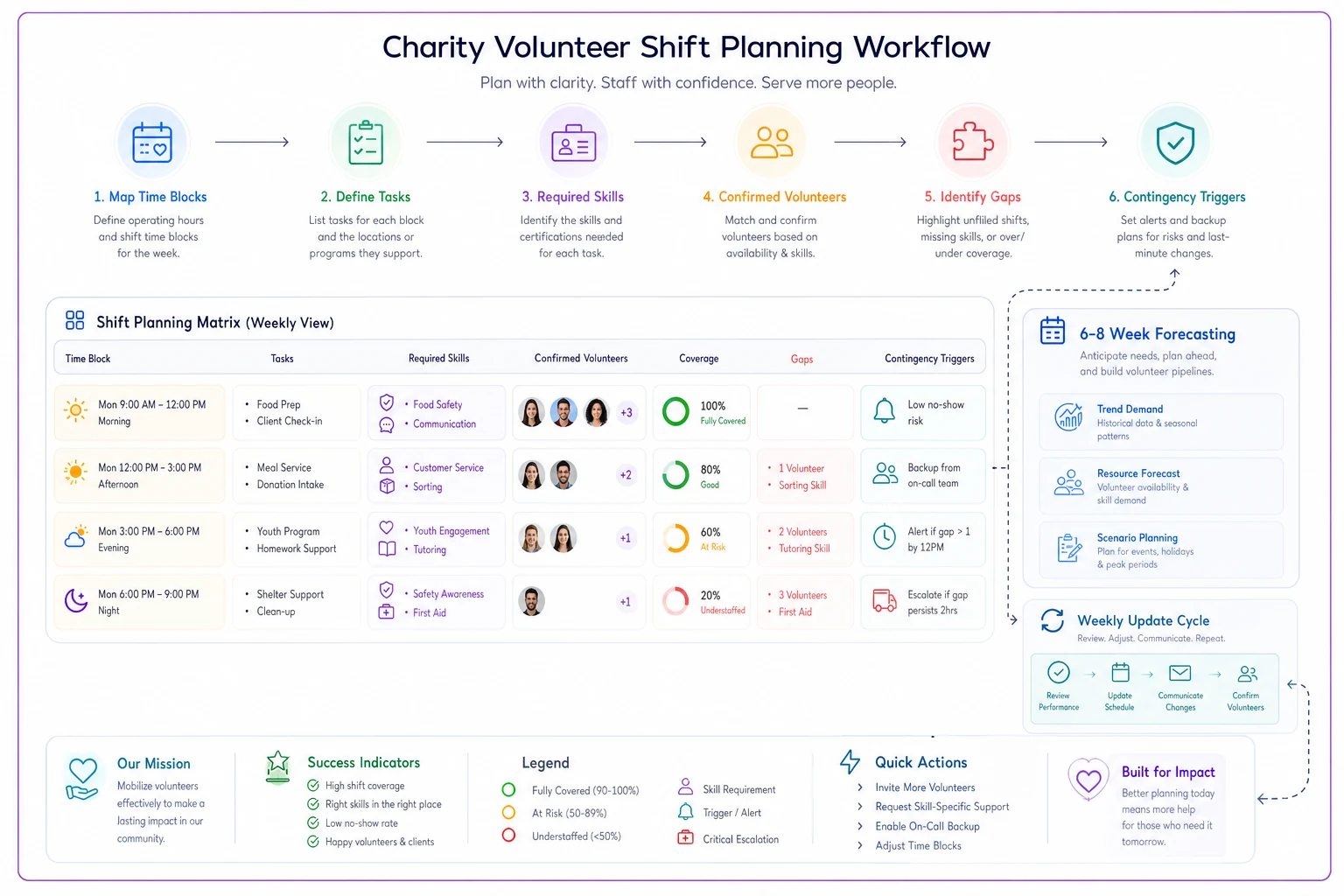
A quick visual of this workflow makes it easier for teams to act on gaps.
Track no-show rates by volunteer and factor these into planning. If Marcus has a 25% no-show rate for morning shifts, you need backup coverage when he's scheduled. If Sarah never misses Tuesday evenings, you can count her as solid coverage. This statistical reality checking prevents the optimistic scheduling that creates operational failures.
Build contingency triggers into your matrix. When confirmed coverage drops below 75% of target for any shift within two weeks, that triggers immediate outreach to backup volunteers. When critical skills coverage (like van drivers or certified counselors) drops below minimum, program managers get alerted to potentially cancel or modify activities.
Matching tasks to volunteer capacity
The most overlooked element of volunteer capacity planning is task-volunteer fit optimization. Most coordinators match based on availability first, skills second, and preference third. This hierarchy creates miserable experiences for everyone.
Reverse the priority order when possible. Start with preference and interest, filter by skills, then solve for availability. A volunteer passionate about education who has teaching credentials will rearrange their schedule to support tutoring programs. Someone available Tuesday mornings who gets assigned to filing because that's when office work needs doing will ghost after two sessions.
Create volunteer profiles that capture motivation alongside capability:
-
Why they volunteer (social connection, skill building, giving back, resume building)
-
What energizes them (working with people, solving problems, physical activity, quiet focus)
-
What drains them (repetition, ambiguity, confrontation, isolation)
-
Growth interests (leadership, new skills, deeper involvement, staying casual)
An environmental nonprofit transformed their volunteer retention by matching based on these profiles. Previously, they assigned whoever was available to trail maintenance, community education, or data collection. Now they match outdoors-loving volunteers to trails, teachers to education, and detail-oriented introverts to data collection. Retention jumped from about 6 months average to over 14 months.
Task bundling improves matches and coverage. Instead of recruiting for "Tuesday morning phone calls," create a "Community Outreach Volunteer" role that includes calls, email responses, and database updates. Volunteers get variety, you get flexibility in task assignment, and the role feels more substantial and engaging.
Watch for skill development opportunities that benefit both sides. A volunteer with basic Excel skills assigned to simple data entry might be willing to learn advanced functions if it means taking on more interesting analysis work. A retiree with management experience might mentor newer volunteers if you structure the opportunity. These growth paths create deeper engagement while expanding your capability pool.
Program cadence alignment
Most volunteer capacity crises stem from poor alignment between volunteer availability patterns and program scheduling. Organizations set program schedules based on staff preferences, facility availability, or tradition, then wonder why volunteer coverage is spotty.
Map your volunteer availability heat patterns first. A homeless services nonprofit analyzed six months of volunteer attendance data and discovered clear patterns:
-
Tuesday/Thursday mornings
Retiree peak (15-20 available)
-
Weekday afternoons
Student availability (3-4 PM to 6 PM)
-
Wednesday evenings
Working professional cluster (6-8 PM)
-
Saturday mornings
Family volunteer peak
-
Sunday afternoons
Dead zone (2-3 people maximum)
They'd been running their meal service Sunday afternoons for years because "that's when clients need it most." After switching to Saturday lunch, they went from scrambling for 4 volunteers to turning away extras from a pool of 12-15 regulars.
Seasonal patterns matter more than most nonprofits track. Universities provide huge volunteer surges September-November and February-April, then vanish during breaks. Parents become available when school starts and disappear in summer. Retirees leave for months during winter or summer depending on your climate. Building programs that ignore these patterns guarantees coverage gaps.
Create program scheduling templates that match your volunteer reality:
-
High-complexity programs during retiree-heavy morning slots
-
Physical activities during weekend family volunteer times
-
Skilled technical work during professional evening availability
-
Flexible, trainable tasks during student afternoon surges
Don't schedule critical programs during known gap periods. A mentorship nonprofit learned to avoid launching new cohorts in December or May when volunteer availability craters. They also stopped scheduling training sessions during spring break after multiple years of 60% no-show rates.
Consider program intensity curves when planning coverage. A job training nonprofit runs 12-week cycles with predictable intensity patterns:
-
Weeks 1-2
High touch orientation (need 150% standard coverage)
-
Weeks 3-8
Steady state operations (100% coverage)
-
Weeks 9-10
Mock interview prep (need skilled volunteers)
-
Weeks 11-12
Graduation prep and transitions (75% coverage)
They now recruit extra volunteers before each cycle starts, specifically for weeks 1-2 and 9-10, rather than maintaining consistent staffing that's either overstaffed or overwhelmed depending on the week.
The early warning system that prevents gaps
Catching coverage gaps before they become crises requires systematic early warning triggers, not just calendar reminders. The most effective system tracks multiple failure points simultaneously.
Set coverage thresholds that trigger action:
-
6 weeks out
Need 50% of positions confirmed
-
4 weeks out
75% confirmed or begin contingency planning
-
2 weeks out
90% confirmed or modify program scope
-
1 week out
100% confirmed with backup identified
A literacy nonprofit automated these triggers in their planning system. When confirmation percentages fall below thresholds, the system alerts both the volunteer coordinator and relevant program manager. This dual notification ensures someone takes action rather than assuming the other person is handling it.
Track leading indicators, not just confirmation counts:
-
Response rates to shift requests (below 40% signals volunteer engagement issues)
-
Time to confirm (taking longer means volunteers are less enthusiastic)
-
Repeat volunteer percentages (dropping below 60% indicates satisfaction problems)
-
Skills gap emergence (certain capabilities becoming scarce)
When these indicators trend negative, you have time to address root causes rather than just filling immediate gaps.
Build redundancy into critical roles. Every task requiring specialized skills or knowledge needs at least two qualified volunteers, ideally three. A crisis hotline learned this after their only Spanish-speaking overnight volunteer had a family emergency. They had to route Spanish calls to daytime staff for three weeks while recruiting and training replacements.
Create skill development pipelines before you need them. If you rely on volunteers with commercial driver's licenses, don't wait until your only van driver retires to recruit others. Identify volunteers interested in getting CDLs and support their training. If database management is critical, cross-train multiple volunteers before your expert moves away.
Monitor external factors that affect availability:
-
Major employer layoffs (suddenly available professionals)
-
School calendar changes (shifts student patterns)
-
Community events (compete for volunteer time)
-
Economic changes (affect retiree and working volunteer availability)
Monitoring these factors gives you lead time to adapt recruitment and scheduling strategies.
Making it operational with the right tools
Manual volunteer capacity planning through spreadsheets stops working around 30 active volunteers or 10 concurrent programs. Beyond that scale, the complexity overwhelms human tracking ability and critical patterns become invisible.
The operational breakdown happens in predictable ways. Updates lag because entering the same information across multiple spreadsheets takes too long. Version control fails when different staff work from different copies. Forecasting becomes guesswork because historical data sits in scattered files nobody can efficiently analyze.
AI-powered operational platforms solve these problems through centralized data and automated pattern recognition. Instead of manually checking who's available next Tuesday with the right certifications, the system instantly shows qualified, available volunteers ranked by reliability and fit.
These platforms identify patterns humans miss. They'll notice that volunteers who work three Monday shifts in a row need a break or they disappear entirely. They'll flag that your Thursday evening coverage is trending down and will hit critical levels in six weeks. They'll identify which skill combinations are becoming scarce and suggest targeted recruitment.
The best systems integrate volunteer management with program planning and outcomes tracking. When you schedule a program, the system automatically checks volunteer coverage, flags gaps, and suggests solutions. When volunteers work shifts, their hours automatically flow into grant reports. When new volunteers apply, the system identifies which programs need their skills most urgently.
AI automation handles the repetitive coordination tasks that burn out volunteer coordinators. Automated shift reminders, confirmation tracking, and waitlist management free up human time for relationship building and problem-solving. The system can even suggest optimal shift assignments based on volunteer preferences, past performance, and program needs.
The real operational value comes from predictive analytics. Knowing that you'll likely have a 20% no-show rate for early December shifts lets you overrecruit appropriately. Seeing that certain skill combinations predict 3x longer volunteer retention lets you prioritize those profiles in recruitment. Understanding which program schedules generate the highest volunteer satisfaction helps you design better services.
From reactive scrambling to strategic capacity building
The shift from reactive volunteer management to strategic capacity planning changes everything about how programs operate. Instead of wondering each week whether you'll have coverage, you know six weeks in advance where gaps will occur and have time to solve them properly.
A food rescue nonprofit made this transformation over eight months. Previously, they'd send mass texts 48 hours before each pickup route, hoping enough drivers would respond. They regularly had to cancel routes, leaving food to spoil and damaging partner relationships.
Now they forecast driver availability 8 weeks out, identifying gaps while there's time to recruit backup coverage or adjust routes. They track each volunteer's reliability percentage and schedule accordingly. They know that university breaks require route consolidation and plan for it. Their route completion rate went from around 75% to 96%, and they've expanded from 12 to 19 regular pickup locations.
The operational stability cascades through the organization. Program staff can commit to partners knowing they'll deliver. Development can promise funders specific outcome levels with confidence. Volunteers feel part of a professional operation rather than a chaotic scramble, improving retention and recruiting.
Strategic capacity planning reveals growth opportunities previously hidden by operational chaos. When you can see that Tuesday mornings have excess volunteer capacity while Wednesday afternoons are consistently short, you can design new programs for Tuesday mornings instead of trying to force-fit them into gap periods.
When you know certain skills are abundant in your volunteer pool, you can develop
Ready to elevate your nonprofit impact?
Join 2,000+ nonprofits using Almosly to boost fundraising efficiency, deepen donor relationships, and scale philanthropic impact.