


Most nonprofits treat their monthly donor file as one blob. Everyone gets the same year-end appeal, the same "thank you for your ongoing support" email, the same upgrade ask in March. And then leadership wonders why net recurring revenue crawls along at 4-6% growth while acquisition costs keep climbing.
The problem isn't that monthly donors don't want to give more. Plenty of them do. The problem is that a $10/month donor who's been giving for three years, a $25/month donor who joined last week, and a $15/month donor whose card just declined twice are three completely different situations — and blanket messaging serves none of them well.
This piece is about carving your recurring base into three working segments — new recurring, at-risk, and upgrade-ready — attaching real triggers to each, using small asks instead of big ones, and running a lightweight LTV calculation so you actually know whether to spend the next hour on saving a donor or growing one.
This builds on the 90-day onboarding workflow for converting one-time givers into monthly supporters. That post gets people into the recurring program. This one is about what happens after they're in — when the real LTV is won or lost.
Why one recurring list quietly caps your growth
A mid-sized org has around 1,400 active monthly donors. Development runs two upgrade campaigns a year to the whole file. Response rates sit around 2-3%, which feels normal, so nobody questions it.
But when you actually break the file apart, the averaged number hides two opposite realities. The donors who upgraded were almost all people who'd been giving for 18+ months and had opened the last five emails. The donors who churned that same quarter were disproportionately people in their first 90 days — and several of them churned because they got hit with an upgrade ask three weeks after signing up.
So the single-list approach did two damaging things at once: it under-asked the people ready to grow, and it over-asked the people who needed reassurance instead. The net effect looks fine on a spreadsheet. It's quietly capping your recurring giving growth.
The fix isn't more campaigns. It's routing. Each donor should be in exactly one of three operational states at any moment, and each state has its own job.
The three operational segments
Think of these as states a donor moves through, not permanent labels. A new recurring donor becomes upgrade-ready. An upgrade-ready donor can slip into at-risk after a failed payment. The point is to always know which bucket someone is in today.
Stop missing fundraising opportunities.
Almosly helps you plan, track, and optimize every campaign with ease.
- Centralized donor and volunteer management
- Automated engagement workflows
- Impact and fundraising analytics
No credit card required
| Segment | Primary goal | Core question you're answering | What you do NOT do |
|---|---|---|---|
| New recurring (0-90 days) | Confirm the decision, reduce early churn | "Did I make a good choice?" | No upgrade asks |
| At-risk | Retain before they lapse | "Should I keep giving?" | No upsell, no guilt |
| Upgrade-ready | Grow gift size or add channel | "Can I do a little more?" | Don't over-ask; small increments |
If you've already built a broader donor segmentation taxonomy with exact query rules, these three are a sub-layer that sits specifically inside your recurring program. You're not replacing your taxonomy — you're adding an operational overlay for monthly donors only.
New recurring: the first 90 days decide everything
Triggers that put someone here:
-
New recurring gift set up (day 0)
-
Still inside the 90-day window
-
No missed payments yet
What this segment gets: confirmation, a real thank-you with a specific outcome tied to their gift amount, and one small non-monetary micro-ask. The goal is participation, not more money.
A micro-ask here might be: "Reply and tell us why this cause matters to you," or "Take 30 seconds to tell us how you first heard about us." These feel trivial but they raise retention noticeably. A donor who's done something beyond paying feels like a participant, not a subscription.
The mistake orgs make constantly: they put new recurring donors straight into the general newsletter and nothing else. No distinct onboarding track. By month four these donors have no more attachment than they did on day one, and they churn at the first card expiration.
At-risk: retention is cheaper than reacquisition, so act early
Triggers that put someone here:
-
A failed or declined payment (immediate at-risk)
-
Card expiring within 30 days
-
No email opens in 90+ days despite consistent sends
-
Downgrade request or a support ticket about their gift
-
Anniversary of signup with zero engagement all year
What this segment gets: a retention touch, never an upgrade. This is the rule people break most. A donor whose card just failed does not want to hear about your capital campaign. They want a frictionless way to fix the card and a reminder that their gift is doing something real.
The thing most teams miss: at-risk donors respond to usefulness, not urgency. "Your card on file expires next month — here's the 20-second link to update it" outperforms any emotional appeal, because you're removing friction instead of adding pressure.
Upgrade-ready: small asks beat big ones almost every time
Triggers that put someone here:
-
12+ months of uninterrupted giving
-
Opened or clicked recent emails (engaged)
-
Responded to a survey or attended an event
-
Made an additional one-time gift on top of their monthly
-
No failed payments in the last six months
What this segment gets: a small, specific upgrade ask framed as incremental. Not "double your gift." Instead: "Would you consider going from $15 to $20 a month? That extra $5 covers [specific, concrete thing]."
The pattern that works: tie the increment to a unit of impact the donor already cares about, and keep the jump small enough that saying yes doesn't require a real decision. A $5 bump on a $15 gift is a 33% revenue increase per donor, and it converts far better than asking for a big leap.
Micro-asks: the operating principle across all three
The thread connecting these segments is that you almost never make a big ask. You make the next small one. Micro-asks reduce the cognitive weight of every request, which means higher completion rates and less list fatigue.
A few micro-asks that map cleanly to the segments:
-
New recurring "Tell us why you gave" / "Follow us on [channel]" / "Read this 2-minute impact story"
-
At-risk "Update your card (20 seconds)" / "Confirm you still want to hear from us" / "Tell us if the amount stopped working for you"
-
Upgrade-ready "Add $5/month to fund X" / "Switch your gift to annual and save us processing fees" / "Add a second cause to your monthly gift"
Notice that only one item in each list touches money. That ratio matters. If every message asks for a dollar, donors start ignoring you. Micro-asks keep the relationship active between the money moments.
A simple LTV model to decide where your hour goes
You don't need a data scientist for this. You need a number good enough to prioritize. The whole point of the LTV model is to answer one operational question: should I spend the next block of staff time retaining an at-risk donor or upgrading an upgrade-ready one?
Here's the lightweight version:
LTV = (average monthly gift × 12) × expected years of giving × gross margin
For recurring, gross margin is usually close to 1, so most orgs simplify to:
LTV ≈ average monthly gift × 12 × expected retention (in years)
Expected retention in years is just 1 ÷ annual churn rate. If your annual recurring churn is 25%, expected retention is 4 years. If it's 40%, it's 2.5 years.
Running the numbers
Take a $15/month donor at 25% annual churn:
-
Annual value
$15 × 12 = $180
-
Expected years
1 ÷ 0.25 = 4 years
-
LTV ≈ $720
Now compare two moves:
-
Retention win you save an at-risk $15/month donor who would've churned. You've preserved roughly $720 in LTV.
-
Upgrade win you move an upgrade-ready donor from $15 to $20/month. That's $5 × 12 × 4 = $240 in added LTV per donor.
At first glance retention looks more than four times as valuable per success. But here's the catch most people miss: conversion rates differ wildly between the two. Upgrade-ready donors say yes to a small ask maybe 8-12% of the time. At-risk saves — genuinely preventing a determined churner — often land closer to 20-30%, because many "at-risk" flags are just an expired card, not a decision to leave.
So the real prioritization math is LTV impact × probability of success. A card-update save at 30% conversion protecting $720 is worth about $216 in expected value. An upgrade at 10% conversion adding $240 is worth about $24 in expected value. On a per-contact basis, the at-risk fix usually wins — which is exactly why so many orgs are leaving money on the floor by chasing upgrades while their card-decline queue sits untouched.
That doesn't mean skip upgrades. It means at-risk gets your fastest, most reliable workflow, and upgrades get your volume. You can hit thousands of upgrade-ready donors cheaply with a scheduled ask; you can't afford to lose the retainable ones.
When each activity actually makes sense
Prioritize retention when:
-
You have a backlog of failed payments or expiring cards
-
Your recurring churn is above ~30% annually
-
Acquisition costs are high and your board is watching CAC
Prioritize upgrades when:
-
Your at-risk queue is genuinely small and current
-
You have a large, tenured, engaged upgrade-ready segment
-
You need incremental revenue without new acquisition spend
When to do neither (yet): if you haven't defined the triggers above, running either campaign blind will just repeat the single-list mistake. Get the segmentation working first, even manually, before you scale the asks.
When to do neither (yet): if you haven't defined the triggers above, running either campaign blind will just repeat the single-list mistake. Get the segmentation working first, even manually, before you scale the asks.
A real scenario
A regional food-security nonprofit had about 900 monthly donors and flat recurring revenue for two years. Annual recurring churn was sitting around 34%, mostly from failed payments nobody was chasing systematically, plus first-90-day drop-off.
They didn't add a single new campaign. They split the file into the three segments and changed the rules:
-
New recurring donors got a distinct 90-day track with two non-monetary micro-asks and zero upgrade requests.
-
At-risk donors — card declines and expiring cards — got an immediate, friction-free update flow and nothing else.
-
Upgrade-ready donors (12+ months, engaged) got one small "add $5" ask tied to a specific meal-count outcome.
Over roughly two quarters, churn dropped from about 34% to the mid-20s, mostly from catching card issues earlier. The upgrade ask converted around 9% of the upgrade-ready group at an average bump close to $6/month. Net recurring revenue growth went from basically flat to somewhere in the low double digits — not from finding new donors, but from stopping the leaks and asking the right people for a little more.
The uncomfortable takeaway: almost all of the gain came from work they could have been doing all along with the donors they already had.
Making the routing actually run
The hard part isn't the strategy — it's keeping every donor in the correct bucket as their status changes. Cards expire, payments fail, engagement drops, tenure ticks over 12 months. Doing this by hand in a spreadsheet falls apart above a few hundred donors, and stale segments are worse than no segments because you'll send an upgrade ask to someone who churned last month.
This is where operational software with rule-based routing earns its keep. Triggers fire automatically, a declined payment moves someone into at-risk the same day, a donor crossing 12 months of clean giving lands in upgrade-ready without anyone running a query. Staff time goes into the messages and the relationships, not into maintaining lists. You can start manual to prove the model works, but plan to automate the trigger logic before it becomes the bottleneck.
Start manual to prove the model works, but plan to automate the trigger logic before it becomes the bottleneck.
Here's a simple visual of how rule-based routing should flow for monthly donors.
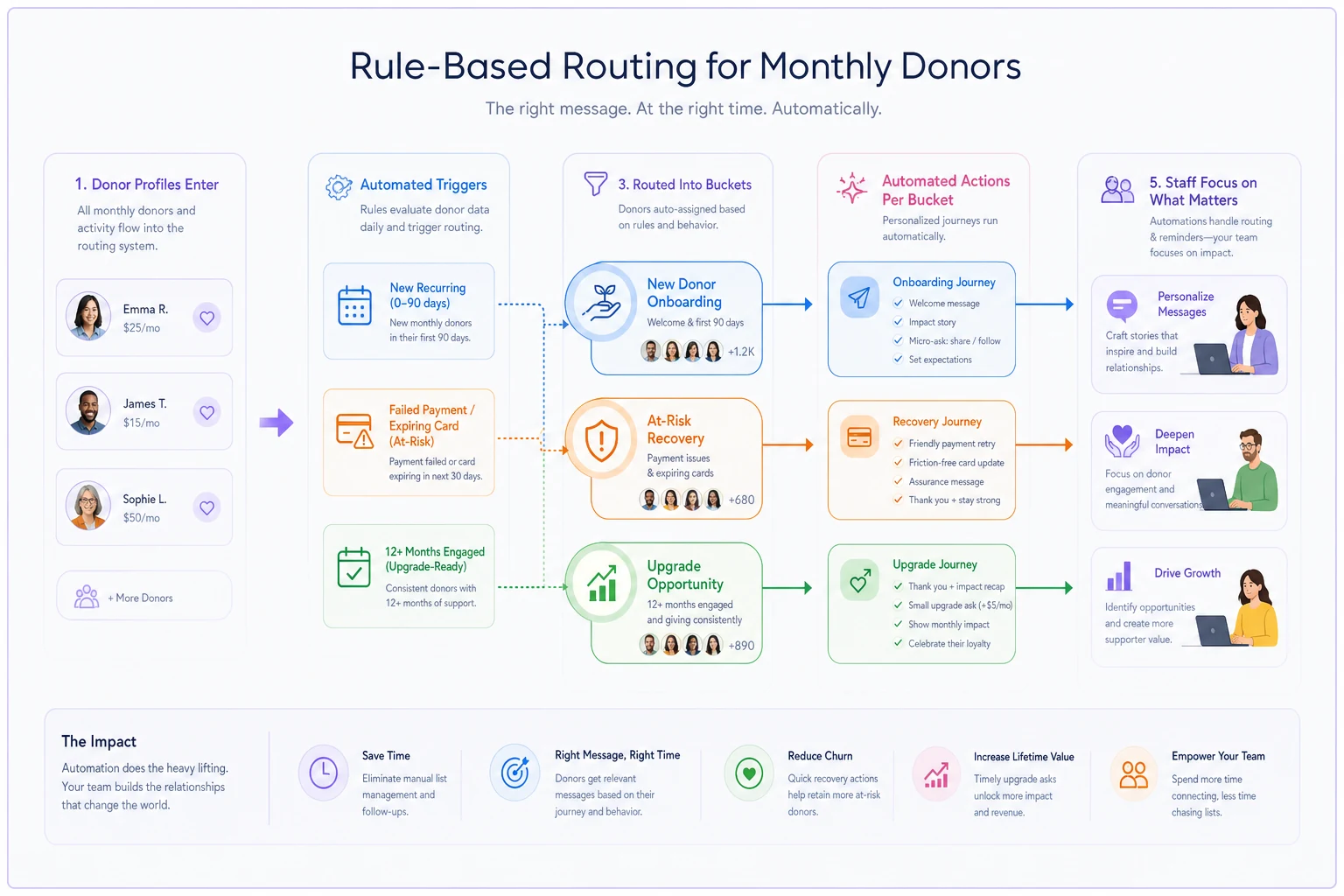
Triggers fire automatically, donors move buckets in real time, and staff focus on the right message for each state.
The short version
Your monthly donors aren't one audience — they're three, and each one needs a different job done. New recurring donors need reassurance and small participatory asks, not upgrade pressure. At-risk donors need friction removed, fast, because retention is usually the highest expected-value move you can make. Upgrade-ready donors need small, specific, incremental asks — never a big leap.
Run the simple LTV math not to produce a perfect number, but to decide where your next hour goes. Build the trigger rules so donors move between segments automatically. Most recurring giving growth isn't hiding in new acquisition. It's sitting in the base you already have, waiting for you to stop treating everyone the same.
Run the simple LTV math not to produce a perfect number, but to decide where your next hour goes. Build the trigger rules so donors move between segments automatically. Most recurring giving growth isn't hiding in new acquisition. It's sitting in the base you already have, waiting for you to stop treating everyone the same.
Ready to elevate your nonprofit impact?
Join 2,000+ nonprofits using Almosly to boost fundraising efficiency, deepen donor relationships, and scale philanthropic impact.