


Most nonprofits treat one-time donors like they'll magically convert themselves into monthly supporters. They won't. After watching dozens of organizations struggle with donor retention, the pattern is clear - the first 90 days after someone's initial gift determines whether they'll become a reliable monthly donor or disappear forever.
The difference between nonprofits that convert 2% of their one-time donors versus those converting 12-15% comes down to operational precision in those first three months. Not inspiration. Not mission alignment. Pure operational execution.
Day 0-3: The acknowledgment window that sets everything up
Your first 72 hours determine whether someone regrets their donation or feels excited about it. This isn't about sending a generic thank-you email. Most organizations blow this completely.
A food bank in Phoenix tested two acknowledgment sequences last year. Their standard approach sent an automated receipt immediately, then nothing for a week. Their test sequence sent three touchpoints within 72 hours: an instant personalized video message from a staff member (recorded in batches, not individually), a 24-hour follow-up showing exactly what their donation accomplished that day, and a 72-hour message from someone who directly benefited from services.
The test group showed 34% higher email engagement rates over the next 60 days. More importantly, when asked to convert to monthly giving at day 30, the test group converted at 8.3% versus 2.1% for the control group.
The operational challenge here involves coordinating multiple team members quickly. Your development coordinator needs to trigger the video selection, your program team needs current impact metrics ready, and someone needs to coordinate beneficiary stories. Without proper workflow automation, this falls apart by donation number 50.
Day 4-14: Building connection without asking for money
After the initial acknowledgment rush, most nonprofits go silent until they need money again. Organizations seeing higher conversion rates maintain momentum without being pushy.
Stop missing fundraising opportunities.
Almosly helps you plan, track, and optimize every campaign with ease.
- Centralized donor and volunteer management
- Automated engagement workflows
- Impact and fundraising analytics
No credit card required
You're establishing communication patterns between days 4-14. Not selling. Not asking. Just connecting.
Here's what works operationally:
Day 7: Send a "peek behind the curtain" message showing actual operational work. Not a polished success story - the Tuesday morning food sorting, the grant application your team is writing, the volunteer training happening that week. Make it feel like they're getting insider access.
Day 10: Share a specific challenge you're working through. Maybe you're figuring out how to serve 20% more families with the same refrigeration capacity. Maybe you're adapting programs for winter weather. Real organizations have real operational challenges. Donors who understand your challenges become partners, not just ATMs.
Day 14: Introduce them to someone specific on your team. Not the executive director - someone doing the actual work. Let that person explain what they do in their own words. This creates multiple connection points within your organization.
A youth mentorship program in Denver structured this exact sequence and tracked engagement rates. Their Day 7 "behind the scenes" emails got opened by 47% of new donors. Day 10 "current challenge" emails saw 43% open rates with 12% clicking through to read more. Day 14 team introductions generated actual replies from 8% of recipients - people writing back with questions, encouragement, or offers to help.
Day 15-30: The strategic pivot toward recurring support
Around day 15, you introduce the concept of monthly giving without directly asking for conversion. This requires careful messaging that feels natural, not manipulative.
Most nonprofits rush this. They send one email on day 30 asking people to become monthly donors. That's like proposing marriage on the third date.
Between days 15-30, you're planting seeds:
Day 18: Share a story about one of your monthly donors - why they give monthly, what it means to them, how it fits their budget. Make it relatable. "Mark gives $15 monthly - the cost of his Netflix subscription - because he wants consistent impact without thinking about it each month."
Day 22: Explain your monthly donor community benefits without selling them. Maybe monthly donors get a quarterly video call with program participants. Maybe they receive handwritten notes from volunteers. Maybe they get early access to volunteer opportunities. Present these as natural benefits, not sales incentives.
Day 26: Send impact math that favors recurring gifts. "$25 monthly provides weekend food bags for one child all school year" hits different than "$300 provides food bags for a year." The monthly framing feels more manageable even though the annual amount is identical.
Day 30: Make the actual ask with a specific campaign. Not just "become a monthly donor" but "Join our February monthly giving challenge where 50 new monthly donors will unlock a $5,000 matching grant." Create urgency without false pressure.
The conversion metrics tell the story. Organizations following this staged approach see day-30 conversion rates between 6-9% for first-time donors who gave $50 or more initially. Those who skip straight to the ask average under 2%.
Day 31-60: Recovery sequences and personalized nudges
Not everyone converts at day 30. Actually, most don't. Organizations seeing 12-15% total conversion rates have sophisticated recovery sequences for the next 30 days.
Your day 31-60 strategy splits into two tracks:
Track A: Those who opened but didn't convert
These donors engaged with your day 30 ask but didn't pull the trigger. They need different handling than complete non-responders.
Day 35: Send a "no pressure" message acknowledging they might not be ready for monthly giving. Include an alternative way to stay involved - maybe signing up for quarterly giving, volunteering, or joining an advocacy list. This removes the binary choice between monthly donor and nothing.
Day 42: Share what last month's monthly donors accomplished collectively. "Our 847 monthly donors provided 3,200 meals, 150 counseling sessions, and emergency shelter for 45 families last month." Make them feel the collective impact they're missing.
Day 50: Present a limited-time incentive that actually matters. A homeless services org in Portland offers new monthly donors a behind-the-scenes facility tour. A literacy program provides signed books from authors they've helped. Make it experiential, not transactional.
Day 58: Last soft touch before the 60-day mark. Share a specific upcoming need that monthly donors will address. "Next month we're launching evening tutoring sessions. Monthly donors make it possible to commit to programs like this knowing we have reliable funding."
Track B: Those who didn't engage at all
These donors ignored your day 30 campaign entirely. They need re-engagement before any conversion attempt.
Day 33: Send something completely different. A survey about their giving preferences. A volunteer opportunity. An event invitation. Break the donation-focused pattern.
Day 40: Share your most powerful impact story from the past month, tied directly to donor support. Make them feel what they're part of, even as one-time donors.
Day 47: Educational content about a problem you're solving. Not fundraising - genuine education about your issue area. Build expertise and trust.
Day 55: Soft monthly giving mention within broader content. "While updating our monthly donors this week, we realized..." Don't make it the focus, just plant the seed.
An environmental nonprofit tracked these parallel tracks for six months. Track A (engaged but didn't convert) showed 4.7% conversion between days 31-60. Track B (non-engaged) converted at 1.8%. Combined with the initial 6% conversion at day 30, they hit 12.5% total conversion within 60 days.
Day 61-90: The sustainer confirmation phase
Most organizations stop trying after 60 days. That's exactly when sophisticated nonprofits double down with a different approach.
Days 61-90 focus on confirming the relationship, whether or not someone became a monthly donor. You're either solidifying new monthly donors or setting up one-time donors for future conversion.
For new monthly donors (converted in first 60 days):
Day 65: Personal welcome from a long-time monthly donor explaining what to expect, tips for maximizing impact, and ways to get more involved beyond giving.
Day 70: First monthly donor exclusive update - something they wouldn't receive as one-time donors. Make the distinction immediately valuable.
Day 75: Surprise acknowledgment - an unexpected thank you that's not tied to processing their payment. Maybe a photo from a program they're supporting, a voice message from a beneficiary, or invitation to a virtual meet-and-greet.
Day 85: Ask for feedback on their experience so far. What motivated them to give monthly? What concerns did they have? What would make the experience better? This data shapes your future conversion strategies.
For remaining one-time donors:
Day 65: Shift to quarterly engagement rhythm announcement. "We'll be updating you quarterly about our work, with special opportunities to get involved between updates."
Day 72: Share your annual impact report or quarterly metrics. Show organizational competence and transparency.
Day 80: Invitation to non-donation engagement - advocacy action, volunteer opportunity, educational webinar. Keep connection without donation pressure.
Day 90: Final monthly giving opportunity with a specific hook - matching campaign, giving tuesday, fiscal year-end. Make it special, not desperate.
A/B testing strategies that actually generate insights
Testing different approaches reveals what resonates with your specific donor base. But most nonprofits test the wrong variables or interpret results incorrectly.
Tests that generated actionable insights for real organizations:
Test 1: Video vs. text gratitude messages (Days 0-3)
An animal shelter tested personal video messages versus well-crafted text emails for initial acknowledgment. Videos seemed like obvious winners, but results surprised them. Donors under 35 showed 3x higher engagement with videos. Donors over 55 actually preferred text emails with photos, showing 40% higher click-through rates. The operational lesson: segment by age for acknowledgment strategy.
Test 2: Problem-focused vs. solution-focused messaging (Day 30 ask)
A youth development org tested two monthly giving campaigns. Version A emphasized problems: "Every month, 50 teens in our community face homelessness." Version B emphasized solutions: "Every month, your support houses 3 teens facing homelessness." Solution-focused messaging converted at 7.8% versus 4.2% for problem-focused. Donors want agency, not guilt.
Test 3: Individual vs. collective impact framing (Day 42)
A food pantry tested how they described monthly giving impact. Individual framing: "Your $20 monthly provides groceries for one family." Collective framing: "Join 500+ monthly donors providing groceries for 500 families." Collective framing converted 5.9% versus 3.1% for individual. People want to be part of something bigger.
Test 4: Immediate vs. delayed benefits (Day 50)
A literacy program tested when monthly donor benefits start. Immediate benefits: "Get your welcome package and exclusive updates starting immediately." Delayed benefits: "After three months, receive your welcome package and exclusive updates." Surprisingly, delayed benefits converted better (6.2% vs 4.8%). Immediate benefits feel transactional, delayed benefits feel like earned membership.
Building the operational infrastructure
Running this 90-day sequence manually for every donor will destroy your team. A mid-sized nonprofit receiving 100 first-time donations monthly would need to manage 9,000 individual touchpoints over 90 days. That's impossible without proper systems.
The operational requirements:
-
Donation date and amount
-
Engagement metrics for each touchpoint
-
Response to monthly giving asks
-
Demographic information for segmentation
-
Communication preferences
Workflow triggers needed:
-
New donation received
-
Email opened/not opened
-
Link clicked/not clicked
-
Monthly giving page visited
-
Conversion completed
-
30/60/90 day markers
Team coordination points:
-
Development team creates content
-
Program team provides impact metrics
-
Database manager sets up segments
-
Communications team schedules sends
-
Director reviews conversion metrics
Most nonprofits cobble together spreadsheets, email platforms, and CRM systems that don't talk to each other. By donation 500, the system breaks. Messages get missed, timing gets blown, and conversion rates plummet.
Automate the 0-3 day acknowledgment sequence first so you secure early engagement without overloading staff.
Organizations consistently converting 12-15% of one-time donors have unified systems managing the entire process. They know exactly where each donor is in the journey, what message they're receiving next, and how they've engaged previously.
Here's a simple visual of the workflow that ties donation triggers to content sends and team responsibilities.
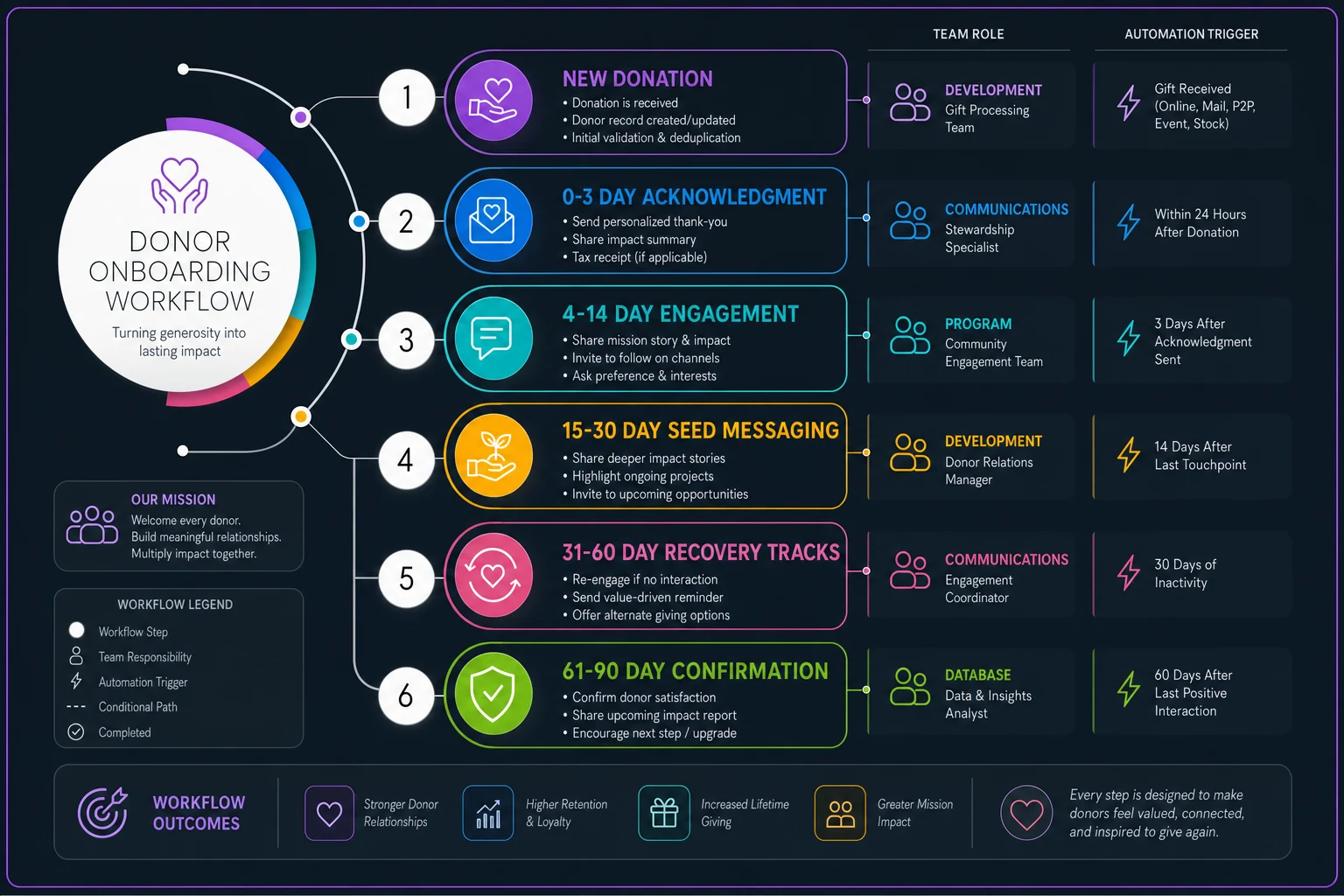
AI automation handles the complexity while staff focus on content creation and relationship building. The system tracks engagement, triggers next actions, and flags donors needing personal attention. It's the difference between hoping donors convert and systematically guiding them there.
The hidden impact of proper onboarding
A homeless services organization in Seattle implemented this exact 90-day sequence starting January last year. Their previous approach converted around 3% of one-time donors to monthly giving. They'd send a thank you email, add donors to their regular newsletter, and occasionally send monthly giving appeals.
After implementing the structured 90-day sequence:
| Month | Result |
|---|---|
| Month 1 | 8% conversion from January cohort |
| Month 2 | 11% conversion from February cohort |
| Month 3 | 14% conversion from March cohort |
By month 3, they'd refined their messaging, improved their timing, and identified their highest-converting segments. The March cohort that converted at 14% generated an additional $8,400 in annual recurring revenue from just 30 new monthly donors.
More importantly, those monthly donors showed 85% retention after six months, compared to 60% retention for monthly donors acquired through other methods. The 90-day onboarding process created stronger connections and clearer expectations.
Their development director said the biggest surprise wasn't the conversion rate - it was how the process changed their team's mindset. Instead of viewing one-time donors as complete transactions, they saw them as relationships beginning. That shift affected everything from how they wrote thank you notes to how they planned programs.
Beyond 90 days: setting the foundation for long-term relationships
The 90-day sequence doesn't exist in isolation. It sets patterns and expectations that shape donor relationships for years.
Organizations running successful 90-day sequences report several long-term benefits:
One-time donors who don't convert to monthly giving still show higher retention rates. They give more frequently, respond better to special campaigns, and engage more with non-donation activities. The relationship building in those first 90 days pays dividends even without monthly conversion.
Monthly donors converted through this process understand your organization better. They ask smarter questions, provide more useful feedback, and become authentic advocates. They're not just automatic payments - they're informed partners.
Your team develops systematic thinking about donor relationships. Instead of random touchpoints when you need money, you maintain intentional communication rhythms. This discipline extends beyond new donors to your entire supporter base.
The data you collect during these 90 days reveals patterns you'd never notice otherwise. Which message themes resonate with which donor segments? What timing works for your specific audience? What concerns prevent conversion? These insights shape your entire fundraising strategy.
Converting one-time donors to monthly supporters isn't about finding the perfect ask or the most heart-wrenching story. It's about building operational systems that consistently guide donors through a journey from transaction to partnership.
This 90-day framework isn't theoretical - it's based on what actually works for nonprofits converting 12-15% of their one-time donors versus the 2-3% sector average. Every touchpoint, timing decision, and message theme comes from tested experience.
The difference between nonprofits struggling with donor retention and those building sustainable revenue comes down to operational discipline. Not bigger marketing budgets or better stories - just consistent, thoughtful execution of proven processes.
Most nonprofits won't implement this. They'll keep sending sporadic appeals, hoping donors spontaneously decide to give monthly. They'll keep seeing 2% conversion rates and assume that's normal. Meanwhile, operationally sophisticated organizations will quietly build recurring revenue streams that fund their missions for years.
The question isn't whether this approach works - dozens of organizations have proven it does. The question is whether you'll build the operational infrastructure to execute it consistently, or keep hoping for different results from the same broken processes.
Ready to elevate your nonprofit impact?
Join 2,000+ nonprofits using Almosly to boost fundraising efficiency, deepen donor relationships, and scale philanthropic impact.