

Most major gifts programs don't stall because gift officers are lazy or the prospects aren't there. They stall because the program is really five separate mini-systems duct-taped together, and nobody owns the seams between them.
You've got prospect research doing one thing, gift officers doing another, the stewardship coordinator running her own sequences, and the ED getting pulled into meetings that were scheduled three steps too early. Each piece works okay in isolation. But the handoffs leak. Prospects get scored and then sit for four months. A donor gets a beautifully written thank-you letter while their gift officer has no idea the ask meeting even happened. The CEO shows up to a cultivation lunch cold because nobody briefed her.
That's the real problem with major gifts program architecture: it's usually not designed at all. It grew. And anything that grows without a design eventually hits a ceiling where adding another gift officer stops producing more revenue.
This piece is about treating the whole thing as one pipeline — scoring feeds enrichment, enrichment feeds the task queue, the task queue triggers stewardship, and executive engagement gets pulled in only at the moments where it actually moves a gift. Plus the reporting cadence that keeps the whole machine honest.
Why these five pieces have to be one system, not five
Most programs think of these as stages a donor passes through: identify → qualify → cultivate → solicit → steward. Linear. Tidy. Wrong, mostly.
In real operations, they're not sequential — they're concurrent and interdependent. Enrichment doesn't happen once during qualification; it happens continuously and it changes a prospect's score, which changes their place in the task queue, which changes whether the ED should be looped in. Stewardship isn't the last box; it feeds back into scoring because a well-stewarded donor becomes a warmer upgrade prospect than a cold new name with the same capacity.
When you draw it as a loop instead of a line, the failure points become obvious. A break anywhere breaks everything downstream:
| Component | What it produces | What it needs from upstream | What breaks if it's disconnected |
|---|---|---|---|
| Prospect scoring | Ranked, actionable prospect list | Clean data + enrichment | Officers work gut-feel favorites; capacity sits unworked |
| Enrichment cadence | Updated capacity/affinity signals | Trigger rules, data feeds | Scores go stale; portfolios full of dead names |
| Moves-management queue | Next-action tasks per prospect | Scores + last-touch data | Officers freelance; no consistency; no forecast |
| Stewardship sequences | Retention + upgrade readiness | Gift + touch history | Donors thanked generically or not at all; attrition |
| Executive engagement | High-leverage relationship moments | Briefings + timing signals | ED wasted on wrong meetings; big asks fumbled |
The point of that table isn't the categories — most people know these. It's the middle column. Every component depends on data from another one. That dependency is exactly where programs fall apart, because the data hand-off is almost always manual, informal, or living in one person's head.
The pattern behind stalled pipelines
Scoring that nobody trusts. A program scores prospects once — maybe during a wealth screening two years ago — and then the score just sits there as a static number. Capacity changes. Someone sells a business, someone loses a board seat, someone's kid starts at your program's beneficiary school. If the enrichment cadence isn't feeding the score, officers stop trusting it. And the moment officers stop trusting the score, they revert to working whoever they personally like. Now your portfolio allocation is based on comfort, not capacity.
Stop missing fundraising opportunities.
Almosly helps you plan, track, and optimize every campaign with ease.
- Centralized donor and volunteer management
- Automated engagement workflows
- Impact and fundraising analytics
No credit card required
A task queue that's really just a to-do list. Moves-management is supposed to enforce that every prospect has a defined next action with a date. What actually happens: officers have 150 names in a portfolio, maybe 30 get real attention, and the other 120 get a "touch base Q3" note that never fires. No forced ranking means the loudest or easiest prospects get the time. Capacity sits unworked not because officers are bad but because nothing in the system pushes the right name to the top of today's list.
Stewardship running on its own island. This is the sneaky one. Stewardship often reports to a different person than gift officers, so the sequences run on a calendar that has nothing to do with where a donor actually is in their giving journey. A donor who just made a stretch gift gets the standard quarterly newsletter treatment instead of the intensive, personal follow-up that would set up next year's upgrade. If you want stewardship to actually feed upgrades, the stewardship sequences need to be tiered with defined cadence and owner handoffs — and those handoffs have to be wired into the same queue the gift officers live in.
Executive time spent everywhere except where it matters. The ED or CEO is the single most expensive resource in the pipeline, and it's almost always allocated by whoever asks loudest. This happens when there's no rule for when executive engagement is actually worth it. So the CEO does a coffee with a $5k donor because a board member requested it, and misses the moment to close a $250k conversation because nobody flagged that it was ripe.
What breaks specifically at scale
A two-officer shop can run all of this on relationships and hallway conversations. The seams don't matter much when everyone's in the same room and there are 200 prospects total.
-
1. Portfolio overlap and orphans. Two officers both think they own a prospect, or nobody does. At small scale you catch this in a meeting. At scale, a $100k prospect goes uncontacted for a year because both officers assumed the other had it.
-
2. The reporting lag becomes a reporting fog. With three officers and a manual pipeline, your monthly numbers arrive two weeks late and half-wrong. You can't tell whether a soft month is a real slowdown or just officers behind on data entry. So you can't intervene.
-
3. Enrichment can't keep up manually. One researcher can hand-refresh maybe 40–60 profiles a month with any depth. Once your active pipeline hits 700+, manual enrichment means the average prospect's data ages out before it gets touched again. Scores rot.
-
4. Stewardship silently drops the ball on your best donors. As volume grows, the intensive personal stewardship that should follow major gifts gets diluted into the same batch process as mid-level. The exact donors most likely to upgrade get the least differentiated attention.
The through-line: everything that worked on trust and memory at small scale needs to be encoded into the workflow at larger scale. Not because people got worse — because human working memory doesn't scale past a few dozen relationships.
The connected pipeline, step by step
Here's how the pieces actually chain together when designed as one system. Think of it as a continuous loop with defined triggers between each stage.
1. Scoring produces a ranked, tiered list — and it's never static. Every prospect carries a live score built from capacity, affinity, and engagement recency. The score determines which tier they're in and, critically, which enrichment cadence they get. Your top tier might get deep enrichment quarterly; the broad base gets a lighter refresh annually or on trigger events.
2. Enrichment runs on a cadence tied to tier — plus event triggers. Two engines: the scheduled refresh (so nothing goes fully stale) and the event trigger (a prospect gives, attends an event, opens three emails in a week, or shows up in a news alert). Event triggers are the ones that actually change outcomes, because they catch the moment a prospect got warmer. When enrichment changes a score, that automatically kicks the next stage.
Here's a simple diagram of the loop.
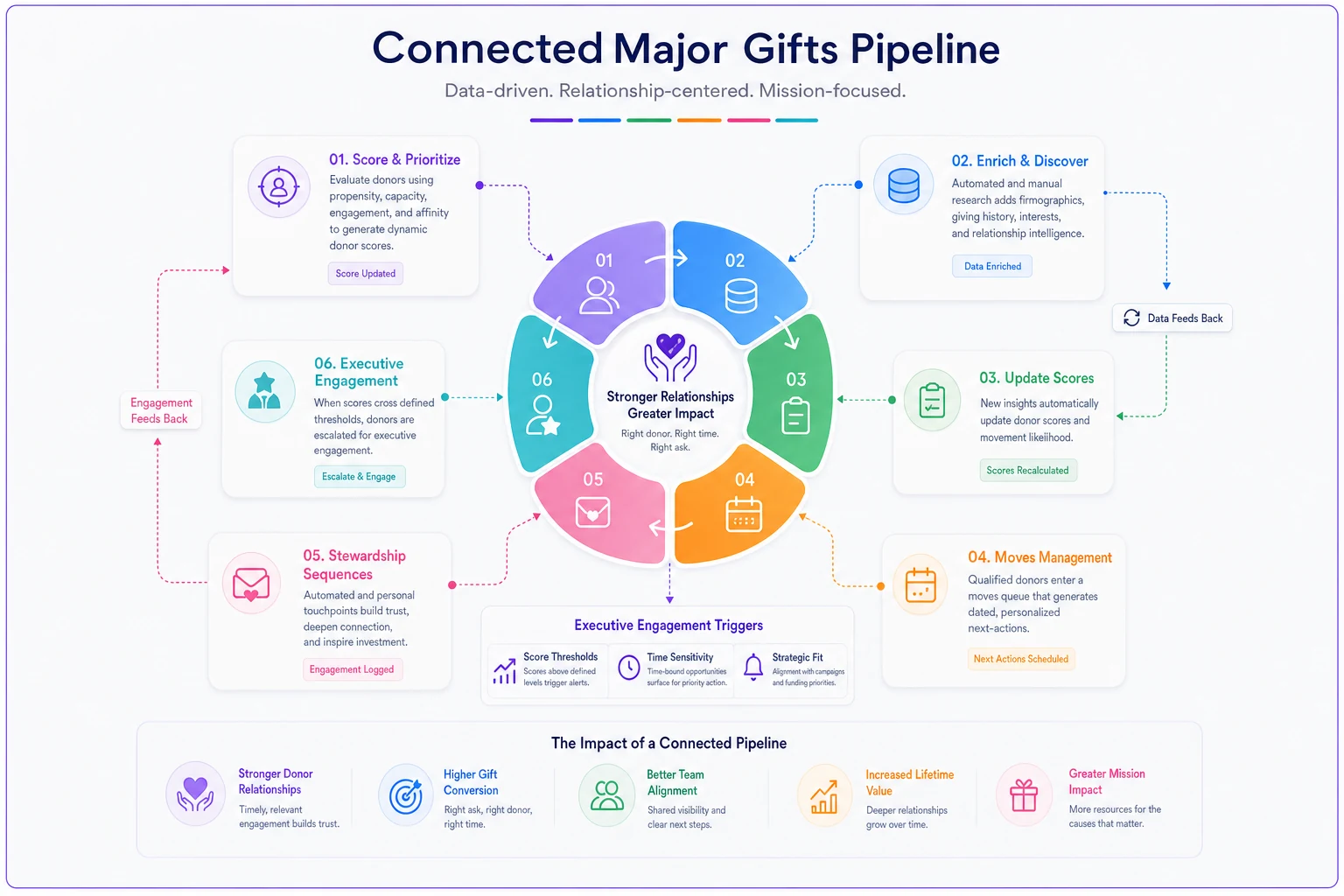
3. Score changes push next-actions into the moves-management queue. This is the seam that matters most. When a prospect's score jumps or they hit an event trigger, the system generates a dated next action assigned to the owning officer — not a vague "follow up," but "schedule discovery call, due within 10 days." The queue is force-ranked by score and readiness, so the officer opens their list each morning and the right names are already at the top.
4. The queue enforces move progression, not just contact. Each move has to advance the relationship a defined step: identification → qualification → cultivation → solicitation → stewardship. A "touch" that doesn't advance the stage gets flagged. This is what stops the "I emailed them, that counts" problem where officers rack up activity without progress.
5. Solicitation readiness triggers stewardship pre-planning AND the executive check. The moment a prospect crosses into solicitation-ready, two things fire simultaneously: the stewardship plan for that gift level gets pre-loaded (so the thank-you and follow-up are ready before the ask, not scrambled after), and the system checks whether this gift crosses the executive-engagement threshold.
6. Executive engagement is triggered by rule, not by request. Set a clear threshold — any solicitation above a defined dollar level, or any prospect where the relationship map shows an existing CEO connection. When those conditions hit, the ED gets a briefing packet and a recommended role (open the meeting, make the ask, or steward post-gift). No more executive time allocated by who lobbies hardest.
7. The gift closes, stewardship executes, and the loop feeds back. Post-gift, the tiered stewardship sequence runs. How the donor responds to stewardship updates their engagement score, which repositions them for the next upgrade cycle. The pipeline never ends; it loops.
A checklist for wiring the seams
If you want to audit whether your program is actually connected or just five islands, run through this:
-
- [ ] Does a change in a prospect's score automatically create or reprioritize a task in someone's queue?
-
- [ ] Does every prospect in an active portfolio have a dated next action right now?
-
- [ ] Is enrichment triggered by events (gifts, engagement spikes, news) — not just an annual calendar?
-
- [ ] Can you tell, today, which stage each major prospect is in without asking the officer?
-
- [ ] Does stewardship know when a major gift closed the day it closed, automatically?
-
- [ ] Is there a written dollar or relationship threshold that triggers executive involvement?
-
- [ ] When the ED gets pulled into a meeting, do they get a briefing packet without having to ask?
-
- [ ] Does stewardship response feed back into the prospect's score for the next cycle?
Start with the score-to-queue seam; it's the most common leak.
If you're checking "no" on more than three of these, your pipeline isn't stalling from bad prospects. It's stalling at the handoffs.
The reporting cadence that keeps it honest
A connected pipeline is only as good as your ability to see it. Most programs report on the wrong things — total dollars raised, which is a lagging number that tells you about work you did months ago. Useful for the board, useless for management.
A cadence built around leading indicators looks like this:
Weekly (officer + manager): Queue health. How many active prospects have a dated next action? How many moves advanced a stage vs. just "touched"? Any prospects gone dark past their cadence window? This is a 20-minute pipeline review, not a strategy meeting.
Monthly (program level): Movement between stages. How many prospects moved from cultivation to solicitation-ready? What's the enrichment coverage — what percent of the active pipeline has been refreshed within its cadence window? Where's capacity sitting unworked?
Quarterly (leadership + board-facing): Pipeline value and conversion by stage, upgrade rate on stewarded donors, and executive-engagement ROI — did the meetings the ED took actually correlate with closed or advanced gifts?
Each level catches problems before they become the quarterly miss. A stalled queue shows up weekly. A stage-conversion drop shows up monthly. By the time it would hit the dollar total, you've already intervened twice.
Where the right infrastructure earns its keep
You can run a version of this on spreadsheets and calendar reminders, and plenty of two-person shops do. But the manual version breaks exactly at the seams we've been talking about — because a human has to remember to move the data from scoring into the queue, from the queue into stewardship, from stewardship back into the score.
This is where an operational platform with AI-assisted automation actually changes the math. Not as a magic prospect-finder, but as the connective tissue between stages: recalculating scores as enrichment data lands, generating dated next-actions when a threshold is crossed, flagging orphaned prospects, pulling together a briefing packet when an executive-engagement rule fires. The value isn't in any single feature — it's in the workflow never dropping a handoff because a person got busy.
The honest test for any tool: does it reduce the number of manual data transfers between your five components? If it just gives you five better-looking dashboards that still require someone to move information between them, it hasn't fixed the actual problem.
A realistic scenario
Consider a mid-sized human-services nonprofit with three gift officers and roughly 750 active major and mid-level prospects. Their pipeline was technically documented but functionally disconnected — scoring done annually, moves-management living in each officer's own spreadsheet, stewardship running on a fixed newsletter calendar, and the ED pulled into meetings ad hoc.
The visible symptoms: their major-gift upgrade rate was stuck around 8–9%, roughly a third of prospects had no next action on the books at any given time, and the ED estimated more than half her cultivation meetings were with prospects who weren't close to ready.
They didn't add staff. They reconnected the seams: score recalculation on event triggers, an auto-populated force-ranked queue per officer, stewardship plans that pre-loaded when a prospect hit solicitation-ready, and a written $50k threshold for executive involvement with an automatic briefing.
Over about three quarters, orphaned prospects dropped to under 10%, the ED's cultivation meetings got noticeably more productive because she was walking into ripe conversations with a briefing in hand, and upgrade rate climbed into the low-to-mid teens. Nothing revolutionary happened on the prospect side — the same names were in the pipeline the whole time. The work just stopped falling through the cracks between stages.
When this level of architecture makes sense — and when it doesn't
When it's worth building: You've got three or more gift officers, an active pipeline north of roughly 500 names, and you can already feel that adding another officer isn't producing proportional revenue. That plateau is the signal that your bottleneck is coordination, not headcount.
When it's overkill: If you're a one- or two-person shop with a couple hundred prospects, don't over-engineer this. You'll spend more time maintaining the system than it saves. Get your donor segmentation taxonomy clean and consistent first, run a simple prioritized list, and revisit the full architecture when you hit the scaling wall.
Who should not do this yet: Programs with genuinely dirty underlying data. If your capacity ratings are guesses and your gift history has duplicates and gaps, automating the connections just moves bad data faster. Fix the foundation, then wire the pipeline.
The takeaway
The programs that produce predictable upgrades aren't the ones with the best gift officers or the biggest prospect pools. They're the ones where scoring, enrichment, the task queue, stewardship, and executive time operate as a single loop with the handoffs designed on purpose — and a reporting cadence that catches a stall while it's still a small problem in someone's weekly queue, not a number in the quarterly board deck.
Start by finding your leakiest seam. Usually it's the one between scoring and the task queue, or the one between gift closure and stewardship. Fix that connection first, then the next. You don't have to rebuild everything at once — you just have to stop letting prospects fall into the gaps.
The programs that produce predictable upgrades aren't the ones with the best gift officers or the biggest prospect pools. They're the ones where scoring, enrichment, the task queue, stewardship, and executive time operate as a single loop with the handoffs designed on purpose — and a reporting cadence that catches a stall while it's still a small problem in someone's weekly queue, not a number in the quarterly board deck.
Start by finding your leakiest seam. Usually it's the one between scoring and the task queue, or the one between gift closure and stewardship. Fix that connection first, then the next. You don't have to rebuild everything at once — you just have to stop letting prospects fall into the gaps.
Ready to elevate your nonprofit impact?
Join 2,000+ nonprofits using Almosly to boost fundraising efficiency, deepen donor relationships, and scale philanthropic impact.