


Last month, a development director at a mid-sized environmental nonprofit showed me their monthly recurring donation report. Out of 1,400 monthly donors averaging $47 per gift, they were losing around 180 donors every quarter purely from payment failures. Not donor choice. Not dissatisfaction. Just credit card declines, expired cards, and insufficient funds.
The kicker? Their recovery process was a single automated email that basically said "your payment failed, please update your card." Recovery rate: 11%.
That's roughly $32,000 in quarterly revenue walking away, not because donors wanted to stop giving, but because the nonprofit treated a payment failure like a transaction problem instead of a relationship moment.
The real cost of failed payment recovery (and why most nonprofits handle it backwards)
Most nonprofits approach failed payments completely backwards. They focus on the transaction ("fix your payment method") instead of the relationship ("we noticed an issue and want to make sure you can continue supporting the cause you care about"). This fundamental misunderstanding kills recovery rates and turns temporary payment hiccups into permanent donor losses.
After building payment recovery systems for dozens of nonprofits, the organizations that recover 60-70% of failed recurring payments all follow a similar multi-channel sequence that treats payment failures as donor care opportunities, not collection attempts.
Why traditional payment recovery destroys donor relationships
The standard nonprofit payment recovery workflow looks something like this: payment fails, system sends automated email, donor ignores it, nonprofit marks them as lapsed, relationship ends. Sometimes there's a follow-up email. Rarely anything more.
Stop missing fundraising opportunities.
Almosly helps you plan, track, and optimize every campaign with ease.
- Centralized donor and volunteer management
- Automated engagement workflows
- Impact and fundraising analytics
No credit card required
This approach fails because it misunderstands what's actually happening when a payment fails. In about 75% of cases, the donor has no idea their payment didn't go through. They're not checking their credit card statements thinking "oh, I wonder if my donation to the food bank processed this month."
-
Card expired (happens every 2-4 years)
-
Insufficient funds (temporary situation for many)
-
Bank flagged it as potential fraud
-
Card number changed after compromise
-
Processing error on the payment gateway side
None of these reasons mean the donor wants to stop supporting your mission. Yet most nonprofits treat payment failures exactly like intentional cancellations.
The psychological impact matters too. When donors get a cold, transactional "payment failed" email, it can feel embarrassing. Nobody likes being told their card was declined. If that's the only communication they receive, many donors will simply avoid dealing with it rather than face what feels like a financial shame moment.
The donor-first recovery sequence that actually works
Organizations recovering 60%+ of failed recurring donations use a specific multi-channel sequence that acknowledges the donor as a supporter first, payment method second. Here's the exact framework:
A quick visual of the donor-first, multi-channel sequence:
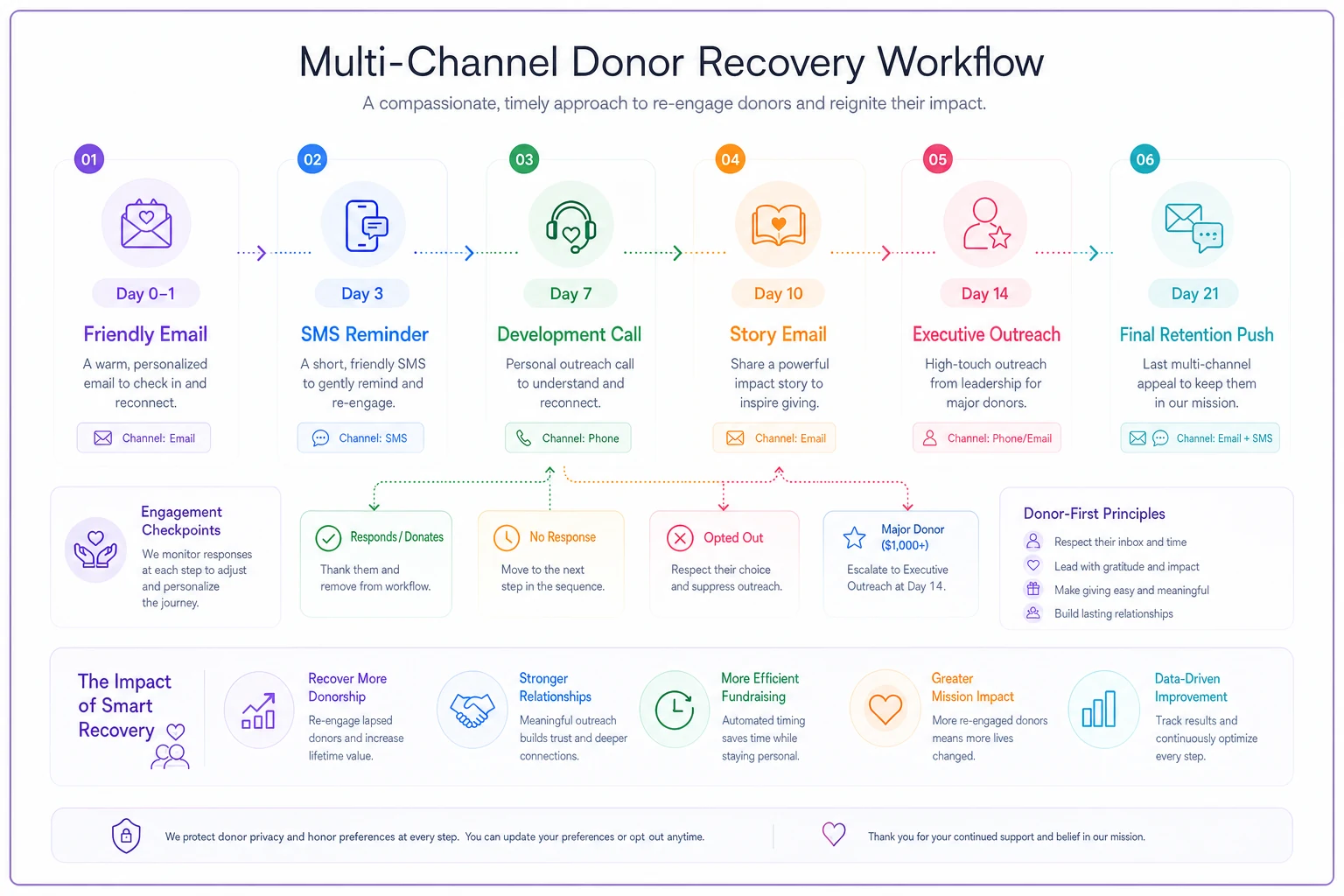
Day 0-1: Soft notification (Email)
Subject: "Quick heads up about your monthly support"
Not "PAYMENT FAILED" or "Action required." The initial email should feel like a courtesy notification from someone who knows them, not an automated collection notice.
-
Acknowledge their ongoing support first
-
Frame the issue as "we noticed a small hiccup"
-
Emphasize continuity ("so your support can continue without interruption")
-
Include a one-click update link
-
Add a PS about recent impact (remind them why they give)
Day 3: Gentle SMS follow-up
"Hi [Name], just wanted to make sure you saw our email about your monthly donation. There was a small processing hiccup - you can update your info in 30 seconds here: [link]. Thanks for your ongoing support of [specific program they support]!"
The SMS shouldn't feel like escalation. It should feel like a helpful reminder from a friend who knows you're busy.
Day 7: Personal call attempt #1
This is where most nonprofits completely drop the ball. They either skip calling entirely or have someone from finance call with a script about "updating payment information."
Instead, have someone from development call with this approach:
"Hi [Name], this is Sarah from [Organization]. I'm calling to thank you for being a monthly supporter of our [specific program]. I noticed there was a technical issue with your recent monthly gift processing, and I wanted to personally make sure you knew about it and see if I could help resolve it quickly."
Notice: Thank first, issue second. Personal responsibility ("I noticed"), not institutional ("our system detected").
Day 10: Story-based email
Subject: "What your support made possible this month"
This email should barely mention the payment issue. Lead with impact, include a specific story or outcome, then add one line: "PS - We're still having trouble processing your monthly gift. If you have 30 seconds to update your information, it would help us maintain the programs you're supporting: [link]"
Day 14: Executive outreach
For donors above a certain giving threshold (usually $50+ monthly), have someone senior reach out personally. Email from the ED or development director:
"I wanted to personally reach out about your monthly support. You've been supporting our [program] work for [duration], and your consistency has meant so much. We've had some trouble processing your recent gift, and I wanted to make sure everything is okay on your end and see if there's anything I can help with."
Day 21: Final retention attempt
One last multi-channel push: email in the morning, SMS in the afternoon, both with urgency but not panic:
"We'd hate to lose you as a monthly supporter. Can you take 30 seconds to update your payment info so your support can continue?"
Channel-specific scripts that maintain dignity
The language you use matters enormously. Here are tested scripts that maintain donor dignity while solving the payment problem:
Email scripts by failure type
Generic failure (when you don't know the specific reason): "We noticed a small technical hiccup when processing your monthly gift. This happens sometimes with online payments - nothing to worry about! To make sure your support continues without interruption, could you take a moment to update your information?"
Expired card: "It looks like the card you've been using for your monthly donation recently expired. Would you mind updating it when you have a chance? Your continuous support means so much to our programs."
Insufficient funds: "We noticed your recent monthly gift didn't process - this sometimes happens when banks process multiple transactions at once. If you'd like to update your payment method or adjust your giving amount, you can do so here: [link]. Any amount you're comfortable with makes a real difference."
Never use phrases like "your payment was declined" or "insufficient funds" directly. Keep it vague and dignified.
SMS templates that actually get responses
First SMS: "Hi [Name], quick note that your monthly donation had a processing hiccup. Update here: [link] Thanks for supporting [program]!"
Follow-up SMS: "Hey [Name], your monthly support of [program] couldn't process this month. Everything okay? Update here: [link] or reply CALL if you'd prefer we phone you."
Final SMS: "[Name], we'd hate to pause your monthly support. Can you update your payment info today? [link] Your gifts have helped [specific recent achievement]."
Call scripts that don't feel like collections
Opening: "Hi [Name], this is [Your name] calling from [Organization]. How are you today? [Pause for response] Great! I'm actually calling to thank you for being such a consistent supporter of our [specific program they support]. Your monthly gifts have been making a real difference."
Transition to issue: "I also wanted to let you know that we had a small technical issue processing your most recent monthly gift. This happens sometimes with online payments - nothing unusual! I just wanted to make sure you knew about it and see if I could help get it sorted out quickly."
If they want to update now: "Perfect! I can either help you update it right now over the phone, or I can send you a secure link to update it online - whatever's easier for you."
If they're not sure about continuing: "I completely understand. Would it help if we adjusted the amount or changed the giving date? We really value having you as part of our monthly giving community, and we're happy to work with whatever makes sense for your situation right now."
Escalation rules that prevent donor fatigue
Not every donor should get every message. Here's the escalation logic that prevents overwhelming supporters while maximizing recovery:
| Donor Tier | Monthly Amount | Communication Sequence | Special Handling |
|---|---|---|---|
| Tier 1 | Under $25 | Days 0, 3, 10 (email, SMS, email) | Skip phone calls unless high engagement history |
| Tier 2 | $25-$100 | Full sequence through day 21 | One call attempt, personalized subjects after day 7 |
| Tier 3 | $100+ | Full sequence plus additional outreach | Two call attempts, development director by day 10 |
Special handling rules:
New monthly donors (less than 3 months): Accelerate the timeline and increase personalization. These donors are still forming their giving habit. A failed payment in month 2 often means permanent loss if not handled immediately.
Long-term donors (12+ months): Start with a phone call, not email. They've earned the personal touch. Also, check if they've had previous failed payments - multiple failures might indicate financial strain, requiring a different conversation.
Recent major donors: If someone made a large one-time gift in the past year AND has monthly giving, route to major gifts officer immediately. Don't let an automated sequence handle it.
Case study: How timing gaps killed a hospital foundation's recovery rate
A hospital foundation in the midwest was losing about $18,000 monthly from failed recurring donations. Their process looked fine on paper: email on day 1, follow-up on day 7, final notice on day 30.
The problem? Those timing gaps were killing them. By waiting a week between the first and second contact, they were losing the moment when donors actually cared about fixing the issue. By day 30, donors had mentally moved on.
They also made a classic mistake: sending all communications from "noreply@[foundation].org". Even when donors wanted to respond with questions, they couldn't. The emails felt like utility bills, not relationship communications.
After restructuring to the tighter timeline above (more contacts in the first 14 days, nothing after 21 days except for major donors), their recovery jumped from 22% to 61%. The improvement wasn't more messages - it was better timing and making every message feel human.
Metrics that actually predict recovery success
Most nonprofits track the wrong metrics. They obsess over recovery rate percentage but ignore early indicators that predict whether their system is working.
24-hour response rate: What percentage of donors take ANY action (open, click, respond) within 24 hours of your first notification? This should be above 40%. If it's not, your initial message is wrong.
Channel breakthrough rate: What percentage of donors respond only after you switch channels (email to SMS, SMS to phone)? If more than 30% only respond to a secondary channel, you should reconsider your primary channel.
Time to recovery: Of successful recoveries, what percentage happen within 7 days? Should be above 70%. Recovery likelihood drops dramatically after week one.
Temporary vs permanent recovery: Track whether recovered donors stay recovered. If more than 20% fail again within 90 days, you're not addressing the root cause.
Recovery by failure reason: Break down your success rate by failure type. You might recover 80% of expired cards but only 30% of NSF failures. This tells you where to focus optimization.
Donor sentiment post-recovery: Survey recovered donors 30 days later. Did the process feel supportive or transactional? This predicts whether they'll stay long-term.
Integrating recovery into your broader retention workflow
Payment recovery shouldn't exist in isolation. It needs to integrate with your overall donor journey and retention strategy.
Pre-failure prevention
The best recovery is prevention. About 40% of payment failures are predictable:
Expiring cards: Your payment processor knows expiration dates. Start outreach 45 days before expiration with a "thanks for your consistent support" message that happens to mention updating payment info.
Seasonal NSF patterns: Many donors experience cash flow issues at predictable times (post-holidays, tax season, back-to-school). Consider offering to pause or reduce donations during known stress periods.
Declining engagement: If a monthly donor hasn't opened an email in 90 days, they're at high risk of not recovering from a payment failure. Re-engage them before a failure happens.
Start outreach 45 days before expiration with a "thanks for your consistent support" message that happens to mention updating payment info.
Post-recovery nurturing
Successfully recovering a payment doesn't end the process. These donors need special attention:
-
Immediate acknowledgment - Send a personal thank you within 24 hours of successful recovery. Not an automated receipt - a real thank you that acknowledges the effort they made to continue supporting.
-
30-day check-in - A month later, send an impact update specifically to recovered donors. Show them what their continued support is accomplishing.
-
Quarterly personal touch - For the next year, make sure recovered donors get quarterly personal outreach (call or handwritten note). They've shown commitment by taking action to continue giving - reward that.
These steps help convert a recovered payment into sustained long-term support rather than a one-time fix.
When operational software transforms recovery efficiency
The manual overhead of running a proper recovery sequence is overwhelming for most nonprofits. Someone has to track who's in which stage, personalize messages, coordinate between email/SMS/calling teams, and monitor responses across channels.
This is where AI-powered operational software becomes transformative. Not about automating the relationship, but handling the operational complexity so your team can focus on meaningful donor interactions.
Modern platforms can automatically detect failure types and route to appropriate sequences, personalize outreach based on donor history and preferences, coordinate timing across channels without human intervention, escalate to human team members at exactly the right moments, and track and optimize performance without manual reporting.
The development director I mentioned at the beginning? After implementing an AI-assisted recovery workflow, they went from 11% to 64% recovery rate. The improvement came from ensuring every donor got the right message at the right time through the right channel - something that was operationally impossible to manage manually at their scale.
Building your recovery sequence: start here
If you're looking to overhaul your payment recovery process and actually recover failed recurring payments from nonprofit supporters who want to continue giving, start with these specific steps:
-
Audit your current recovery rate by channel - know your baseline
-
Draft your day 0, 3, and 7 messages using the templates above
-
Set up call scripts and train whoever will be making calls
-
Build escalation rules based on donation amounts
-
Implement tracking for the metrics that matter
-
Test with a small cohort before rolling out fully
The biggest mistake nonprofits make is treating payment recovery like a technical problem instead of a relationship opportunity. Every failed payment is a chance to deepen donor connection - if you approach it with empathy, urgency, and respect.
Your monthly donors want to keep supporting you. Payment failures are just speed bumps. But if you treat them like abandonment, that's exactly what they'll become.
The organizations recovering 60-70% of failed payments aren't doing anything magical. They're just treating donors like humans who care about the cause but might need a friendly reminder and some help navigating a technical hiccup. That shift in perspective, combined with proper operational execution, makes all the difference.
Ready to elevate your nonprofit impact?
Join 2,000+ nonprofits using Almosly to boost fundraising efficiency, deepen donor relationships, and scale philanthropic impact.