


Most grants problems don't look like grants problems when they show up. They look like a program manager asking finance "wait, how much is left in the Johnson grant?" three weeks before a report is due. They look like two different spreadsheets with two different award amounts for the same funder. They look like a reimbursement request that gets kicked back because nobody tracked the budget line it was supposed to draw against.
The grant itself was fine. The system connecting intake, the signed award, program delivery, and finance was never really built. It got stitched together over a few years by whoever happened to be in the seat, and now it leaks at every handoff.
This is a blueprint for the whole chain — not a list of tips. The goal is to show how the pieces fit, where small teams quietly lose money and credibility, and what a workable record model looks like when you have maybe two to six people touching grants and no dedicated grants ops person.
The chain nobody draws out, but everyone runs
Almost no small nonprofit has written down the actual path a grant takes from "we're applying" to "we closed it out clean." Every org runs this path. Very few have mapped it, which is exactly why it breaks.
The path looks like this:
Intake form → canonical grant record → award master → program deliverable trackers → finance drawdown schedule → funder reports → closeout
Each arrow is a handoff. And handoffs are where data gets copied by hand, re-typed slightly wrong, or just dropped. When a funder's award letter says $148,500 and your tracking sheet says $150,000 because someone rounded during the application phase, that $1,500 difference will eventually surface during an audit or a final report — usually at the worst moment.
The core failure across small teams isn't incompetence. It's that the grant exists in four or five different places at once, with no single version anyone trusts. Development has the application copy. Finance has the budget in the accounting system. Programs have a deliverables doc. The ED has an email thread. None of them agree, and nobody owns reconciling them.
Why this breaks differently as you grow
At one or two active grants, the mess is survivable. One person holds the whole picture in their head. The spreadsheet works because there's exactly one spreadsheet and one person who understands it.
Stop missing fundraising opportunities.
Almosly helps you plan, track, and optimize every campaign with ease.
- Centralized donor and volunteer management
- Automated engagement workflows
- Impact and fundraising analytics
No credit card required
| Stage | Active grants | What usually breaks first |
|---|---|---|
| Solo-run | 1–3 | Nothing visible yet — but all knowledge lives in one person's head |
| Stretched | 4–8 | Report deadlines slip; finance and programs stop agreeing on spend |
| Fragmented | 9–15 | Multiple conflicting records; drawdowns lag; restricted funds get commingled |
| Overwhelmed | 16+ | Compliance risk becomes real; staff burn out; funders notice late/thin reports |
The dangerous stage is "stretched" — 4 to 8 grants — because that's where teams feel like they're still small enough to wing it, but the person-in-their-head model has already failed. The first serious audit finding, or the first funder who quietly doesn't renew, almost always traces back to this stage. The systems that worked at three grants were never rebuilt for eight.
A typical example: an org with roughly $1.2M in annual revenue was running six federal and foundation grants off a shared drive. Each program lead kept their own budget tracker. When a federal pass-through agency asked for a reconciliation of indirect cost allocation across all six, it took the finance manager close to three weeks of nights and weekends to assemble something defensible — because the "award amount" field existed in six slightly different forms. That three weeks is the real cost of not having a canonical record.
The canonical grant record: one version, owned
The fix starts with a single idea: one record per grant that everything else references. Not copies. References. When finance needs the award amount, they look at the canonical record. When programs build a deliverable tracker, it inherits the grant ID from the canonical record. When the ED wants status, they look at the same place.
If you've already built a minimal nonprofit CRM data model with canonical fields and validation rules for your donor side, this is the same discipline applied to grants. Define the fields once, validate them at entry, and never let a second "truth" spawn.
-
Grant ID (your internal unique key — this is the backbone of everything)
-
Funder name and funder type (federal, state, foundation, corporate)
-
Program name this grant funds
-
Status (prospecting / submitted / awarded / active / closing / closed / declined)
-
Requested amount vs awarded amount (keep both — the gap matters)
-
Grant period start and end dates
-
Restricted / unrestricted flag and any restriction notes
-
Indirect cost rate allowed
-
Report schedule (dates, types
narrative, financial, final)
-
Drawdown / payment type (advance, reimbursement, milestone)
-
Primary owner (one named human)
-
Link to award master (the signed-document source of truth)
When an award is signed, re-enter the awarded amount, final budget, and report schedule from the executed agreement rather than carrying them over from the proposal.
The mistake small teams make here is treating the application as the record. The application is a proposal. The canonical record only becomes real when the award is signed — and at that moment, the awarded amount, final budget, and report schedule must be re-entered from the executed agreement, not carried over from the proposal. That re-entry step catches the $148,500-vs-$150,000 problem before it poisons everything downstream.
The award master: your audit anchor
The canonical record is the index. The award master is the source document layer — the executed agreement, the approved budget, the reporting requirements spelled out exactly as the funder wrote them.
A simple award master, which you can keep as a structured CSV or a dedicated table, holds one row per budget line per grant:
grantid, budgetline, linedescription, awardedamount, spenttodate, encumbered, remaining, restrictionnotes, allowablecostcategory, lastreconciled_date
This is the single most valuable artifact in the whole system, and most small orgs don't have it. Without a budget-line-level award master, you literally cannot answer "how much is left in the personnel line of the Johnson grant" without opening three documents and doing mental math. With it, that's a lookup.
The pattern worth stealing: the award master's awarded_amount column must sum, per grant, to the canonical record's awarded amount. If they don't match, something's wrong — and you want to find that in a five-minute check, not in an audit.
Deliverable trackers: where programs and compliance meet
Funders don't just give money. They buy outcomes and expect proof. The deliverable tracker is where program reality gets logged against those promises — and it's usually the weakest link because program staff don't think of themselves as compliance people.
-
Deliverable description (exactly as the funder worded it)
-
Due date and type (activity, output, outcome, report)
-
Target number vs actual number
-
Status and owner
-
Evidence link (where the proof lives — attendance logs, photos, assessment data)
One thing that saves teams repeatedly: the deliverable tracker and the financial drawdown should be able to tell the same story. If you've drawn down 80% of a program budget but only logged 40% of the deliverables, that's a red flag you want to catch internally — before a program officer catches it. Spend and delivery drifting apart is the earliest warning sign of a grant in trouble.
Finance drawdown schedules: the part that gets money in the door
A grant you've been awarded but haven't drawn against is a grant you're financing out of your own cash. Small nonprofits with thin reserves feel this hard. Reimbursement grants especially — you spend first, then claim, then wait. If your drawdown process is sloppy, you're effectively giving the funder an interest-free loan while straining your own payroll.
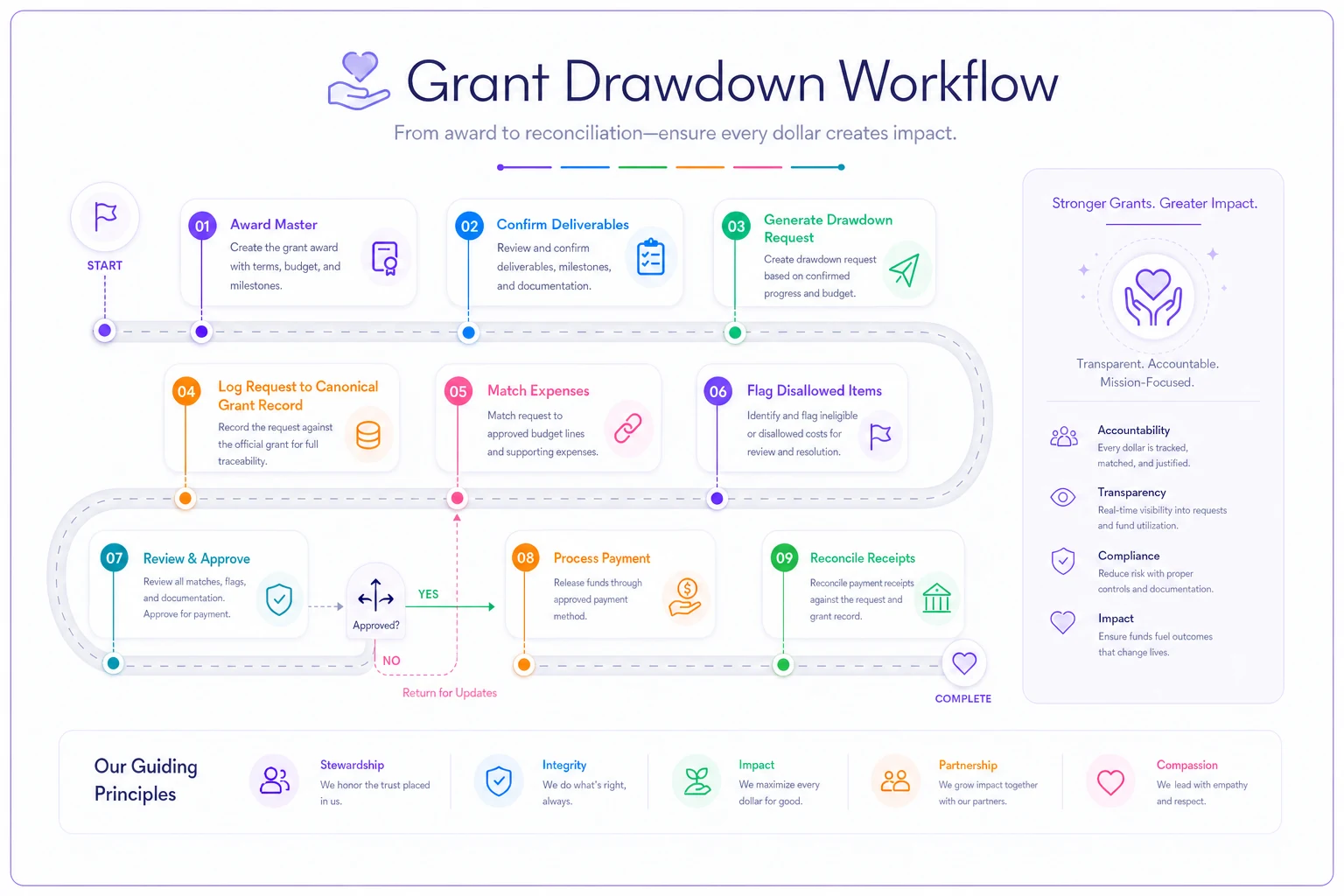
The drawdown schedule connects the award master (what's allowable) to actual spending (what happened) to the claim or request (what you're asking for). A clean drawdown workflow runs like this:
-
Pull allowable budget lines from the award master for the period
-
Match actual expenses from the accounting system to those lines
-
Flag anything outside allowable categories before it enters a claim
-
Confirm deliverable progress supports the spend (the cross-check above)
-
Generate the drawdown request with backup documentation attached
-
Log the request against the canonical record with date and amount
-
Reconcile the receipt when funds arrive, and update
spenttodateandremaining
This process shares DNA with donation reconciliation. If your team has built a solid stepwise reconciliation process for gifts and offline revenue, you already understand the muscle: match actuals to a source of truth on a fixed cadence, and never let unreconciled items pile up. Grant drawdowns are the same discipline applied to restricted funds.
Visualizing this process helps clarify the handoffs.
The common failure: teams draw down on gut feel or quarterly habit instead of against reconciled actuals. Then a budget modification gets approved mid-grant, nobody updates the award master, and the next drawdown requests against stale line amounts. Now you've over-claimed a line, and that's a finding.
Who owns what: a RACI that actually fits a small team
"Everyone's responsible" means nobody is. On small teams the RACI can't be aspirational — it has to assume people wear multiple hats, and it has to name one accountable person per stage so handoffs have a clear owner.
| Stage | Responsible | Accountable | Consulted | Informed |
|---|---|---|---|---|
| Intake / application | Development | Dev Director | Program Lead, Finance | ED |
| Award acceptance | Finance | ED | Dev, Program | Board (if large) |
| Canonical record setup | Dev / Grants coord | Dev Director | Finance | Program |
| Award master build | Finance | Finance Mgr | Program | ED |
| Deliverable tracking | Program Lead | Program Director | Dev | Finance |
| Drawdowns | Finance | Finance Mgr | Program | ED |
| Funder reporting | Dev + Program | Dev Director | Finance | ED |
| Closeout | Finance | Finance Mgr | Dev, Program | ED, Board |
The one rule that matters most: the person who sets up the canonical record should not be the only person who ever touches it. The most fragile arrangement is one grants coordinator who holds the entire chain. When they leave — and in this sector, they leave — the institutional memory walks out with them. Accountability should belong to a role, not a person.
A monthly audit checklist you can actually run
You don't need a quarterly fire drill if you run a light check every month. Thirty minutes per active grant, done consistently, prevents the three-week scramble. Here's a checklist that catches most problems early:
-
- [ ] Canonical awarded amount matches award master line-item total
-
- [ ]
spenttodatereconciles to the accounting system for each grant -
- [ ] Restricted funds are not commingled with unrestricted or other grants
-
- [ ] Spend-to-date percentage roughly tracks deliverable completion percentage
-
- [ ] All drawdowns submitted this period are logged and reconciled
-
- [ ] Upcoming report deadlines (next 60 days) are assigned to a named owner
-
- [ ] Any budget modifications are reflected in the award master
-
- [ ] Indirect costs applied at the correct, allowable rate
-
- [ ] Evidence/documentation exists for every deliverable marked complete
-
- [ ] No grant is within 90 days of end date without a closeout plan started
Run this the same day every month. The teams that catch problems early are the ones that made it boring and routine, not the ones that promised to "stay on top of it."
Funder reports: assembled, not written from scratch
If your records are clean, a funder report becomes assembly, not archaeology. A good narrative report for most foundations follows a predictable shape:
-
- Summary of progress (pull from deliverable actuals vs targets)
-
- Financial status (pull from award master
spent, remaining, on-track/variance)
-
- Outcomes and evidence (pull from deliverable evidence links)
-
- Challenges and adjustments (the honest part funders actually respect)
-
- Next period plan
Grant: Johnson Family Foundation (grant_id: JFF-2025-04) Award period: 01/15/2025 – 01/14/2026 Total awarded: $148,500 Spent to date: $94,200 (63%) Deliverables complete: 7 of 11 (64%) Variance notes: Personnel line underspent due to Q2 hiring delay; reallocation request pending funder approval.
Notice the spend percentage (63%) and the deliverable percentage (64%) sit close together. That alignment is what a good program officer looks for, consciously or not. When those two numbers diverge sharply, you want to be the one explaining why — in the narrative — rather than the one getting asked.
Where lightweight automation helps — and where it doesn't
Once the chain above exists, there are a few places where simple automation genuinely reduces risk and saves hours. Grant period end dates and report deadlines can trigger reminders to named owners automatically. When spenttodate crosses a threshold, a flag routes to finance. When a deliverable's due date passes without an evidence link, the owner gets nudged. An operational platform that keeps the canonical record, award master, and deliverable tracker linked — so updating one surfaces mismatches in the others — removes most of the manual reconciliation that eats a finance manager's month.
The tooling only helps after the record model is right, though. Automation applied to a broken four-copies-of-the-truth setup just produces wrong answers faster. Build the canonical structure first. Then let software handle the deadline tracking, the mismatch flags, and the report assembly — the repetitive, error-prone parts that don't need a human brain, just consistency.
When this full blueprint makes sense — and when it's overkill
When it makes sense: you're running four or more active grants, you have restricted funds, or any funder is federal or a government pass-through. At that point the compliance exposure alone justifies the structure. If you've had even one messy audit or one report scramble, you're already past the threshold.
When it's overkill: one or two small, unrestricted foundation grants with simple reporting. A clean shared spreadsheet and a calendar reminder genuinely work at that scale. Building a full award master with line-item reconciliation for a single $10k general-operating grant is effort you don't need yet.
Who should NOT try to run the whole thing at once: a team adopting this mid-year across all existing grants simultaneously. That's a recipe for a half-built system that's worse than what you had. Start with your next new award, build the canonical record and award master for that one properly, and migrate existing grants at their renewal points. Retrofitting everything in one push almost always stalls.
A short real scenario
A youth-services nonprofit, roughly $1.6M annual budget, was carrying nine active grants — four foundation, three state, two federal pass-through. Their finance manager was spending somewhere around 15–20 hours a month just reconciling what had been spent against what each funder's budget allowed, mostly because award amounts and budget lines lived in separate, slightly-disagreeing documents.
They rebuilt around a single canonical record plus a budget-line award master, migrated grant by grant over about two quarters, and set a fixed monthly check. The reconciliation time dropped to a few hours a month. More importantly, their next state monitoring visit — which previously meant a week of panic document-gathering — was handled by pulling existing reconciled records. The monitor's report came back clean. No dramatic revenue jump, no miracle. Just a month that stopped being a fire drill, and a funder relationship that got easier to maintain.
The takeaway
Grants management isn't a reporting problem or a compliance problem or a finance problem. It's a systems problem — a chain of handoffs where the same grant is supposed to mean the same thing to development, programs, and finance, and usually doesn't.
Build one canonical record, anchor it to an award master at the budget-line level, keep deliverables and drawdowns telling the same story, name one accountable owner per stage, and run a boring monthly check. That's the whole blueprint. The orgs that do this don't just pass audits more easily — they spend less time fighting their own records and more time doing the work the grants were meant to fund.
Ready to elevate your nonprofit impact?
Join 2,000+ nonprofits using Almosly to boost fundraising efficiency, deepen donor relationships, and scale philanthropic impact.