
Most maturity models fall apart the moment a board member asks the obvious question: "So what does this get us?" You show them a tidy grid of capability levels, and someone in a fleece vest asks whether "Level 3 data governance" translates into dollars. Fair question. If your maturity model can't tie back to forecasted yield, it's just an org chart wearing a costume.
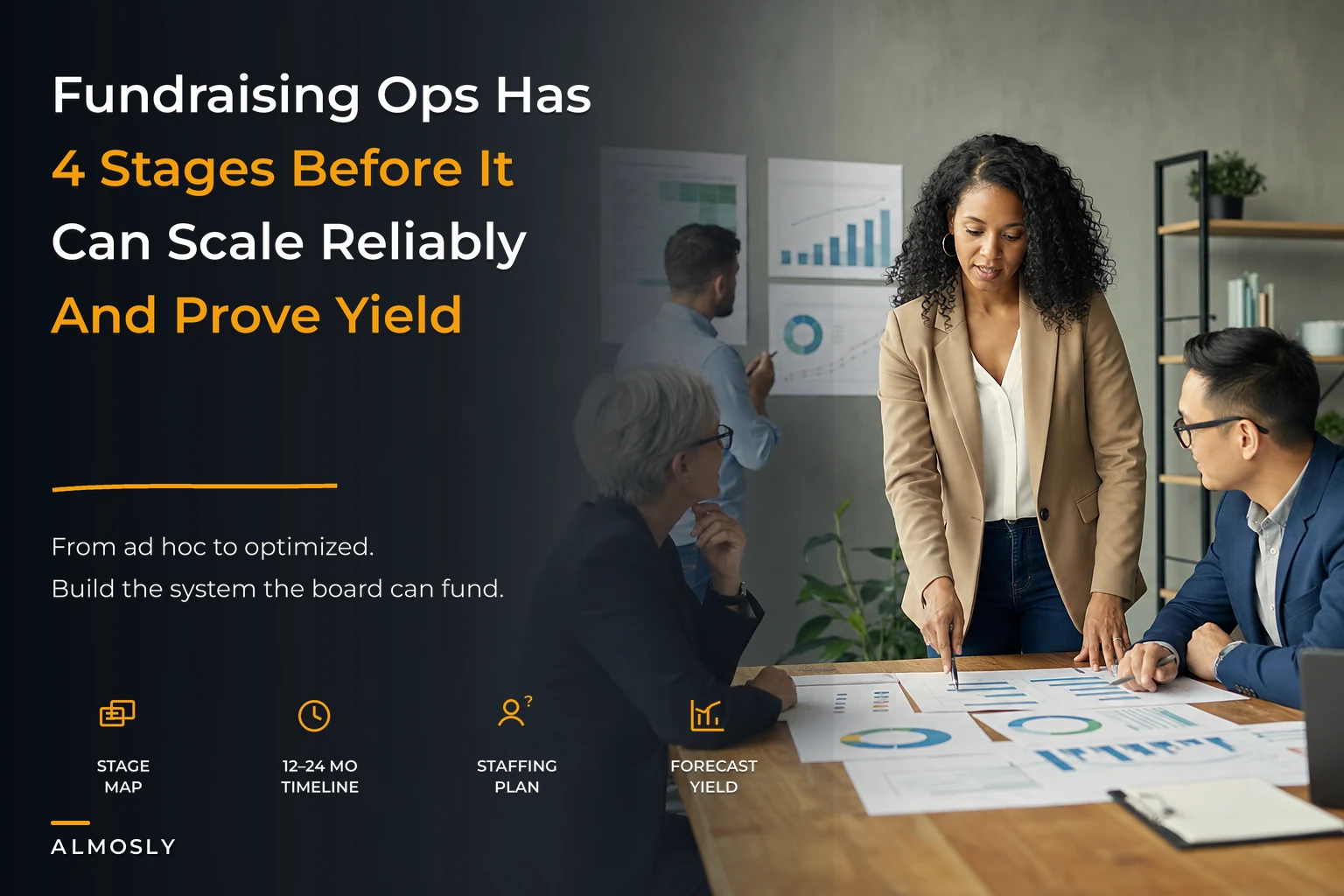
This one is built the other direction — from revenue backward. Four stages. Each maps to how your operation coordinates work, what it can reliably produce, and roughly what kind of yield behavior you should expect. The stages are Ad‑hoc → Defined → Integrated → Optimized, and the whole point is to know exactly which stage you're in, what breaks if you try to skip one, and what to promise the board over the next 12–24 months without setting yourself up to fail.
One thing worth saying upfront: almost every mid‑sized shop thinks they're a stage ahead of where they actually are. You have documented processes, sure — but if three people run them three different ways, you're not "Defined." You're Ad‑hoc with a wiki.
Why maturity stalls have almost nothing to do with effort
The stall is rarely a motivation problem. Development teams at stuck organizations are usually working harder than the ones that have moved on. The difference is that effort at a low maturity stage doesn't compound. You fix a broken export this week, and it breaks again next quarter because the underlying process was never actually defined — just tolerated.
The pattern plays out like this: a shop hits a revenue ceiling around $1.5M–$3M and assumes it needs more gift officers. They hire. Revenue barely moves. The constraint was never fundraising capacity — it was that intake, acknowledgment, data entry, and reporting were all held together by one overworked ops coordinator who happened to know where everything was. Add two gift officers to that and you've just added two more people generating work the system can't absorb.
Maturity is really about where the work lives. In immature operations, the work lives in people's heads. In mature ones, it lives in the system, and people supervise the system. That shift — from doing the work to running the machine that does the work — is the entire game.
The four stages, mapped to what actually changes
Read the "what breaks" column carefully. That's usually the truest description of which stage you're actually in.
Stop missing fundraising opportunities.
Almosly helps you plan, track, and optimize every campaign with ease.
- Centralized donor and volunteer management
- Automated engagement workflows
- Impact and fundraising analytics
No credit card required
| Stage | How work gets done | Yield behavior | What breaks at this stage |
|---|---|---|---|
| 1. Ad‑hoc | Individual heroics, tribal knowledge, spreadsheets per person | Unpredictable; a good year is luck or one big gift | Anything when a key person leaves or gets sick; reporting takes days |
| 2. Defined | Written processes, one owner per process, shared CRM | More stable but still slow; forecasting is a guess | Coordination between teams; handoffs drop; data drifts between systems |
| 3. Integrated | Processes connected across teams; data flows automatically between intake, stewardship, finance | Forecastable within a reasonable range; retention improves | Optimization ceiling — you can see the numbers but struggle to move them fast |
| 4. Optimized | Continuous measurement, segmented experiments, tuned cadences | Predictable and improving; yield per donor rises year over year | Complacency; over‑engineering; chasing marginal gains while missing big shifts |
Yield doesn't jump in a straight line. The biggest leap is usually from Defined to Integrated, because that's where coordination costs collapse. A gift entered once shows up correctly in stewardship queues, finance reconciliation, and board reporting without anyone re‑keying it. That single change frees up more hours than most new hires would.
Stage 1 — Ad‑hoc: everything works until one person is out
An Ad‑hoc shop can raise real money. That's what fools people. You'll see organizations pulling in a couple million a year running almost entirely on the memory and hustle of two or three staff. It feels productive because everyone's busy.
The tell is fragility. Ask what happens when the ops person takes two weeks off, and you'll get nervous laughter. Acknowledgment letters pile up. Nobody's sure which pledges are still open. The finance reconciliation slips, and now July's numbers are a mystery until August.
Capability map — Ad‑hoc:
-
Donor data
scattered across a CRM, several spreadsheets, and email inboxes
-
Gift processing
manual, single point of failure, no defined SLA
-
Stewardship
reactive, driven by whoever remembers
-
Reporting
assembled by hand, takes 1–3 days, not trusted enough to forecast from
-
Forecasting
essentially "last year plus hope"
Minimal staffing at this stage: you don't need more people yet — you need definition. A realistic Ad‑hoc team is 1 development director, 1 ops/gifts coordinator, and shared marketing help. Adding gift officers here is premature.
The mistake almost everyone makes at Stage 1 is buying a new, more expensive CRM thinking the tool will impose the discipline. It won't. A better system on top of undefined processes just gives you a more expensive place to be disorganized.
Stage 2 — Defined: you wrote it down, now the handoffs break
Defined is where most mid‑sized nonprofits actually live, even the ones that think they're further along. Documented processes. Every core function has an owner. Everyone works out of the same CRM, mostly.
The new failure mode is coordination. Processes are defined within teams but not between them. The classic breakdown: a major gift officer closes a five‑figure gift, but the stewardship team doesn't find out for three weeks because there's no automatic handoff. The donor gets a generic year‑end receipt instead of a personal thank‑you, and you've quietly damaged a relationship that took a year to build.
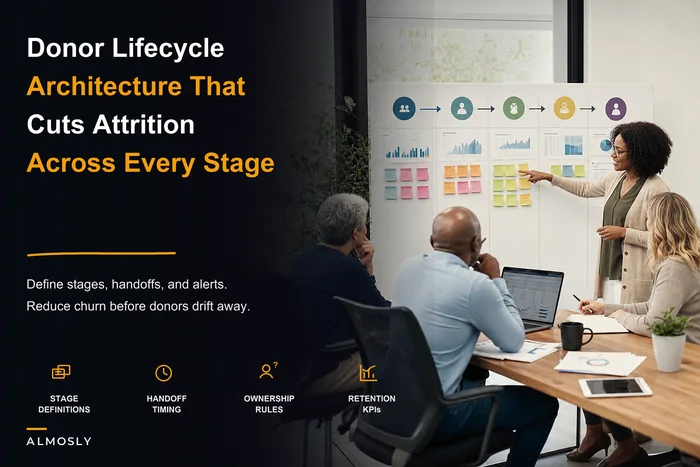
This is where a real understanding of the donor lifecycle architecture starts to matter, because Defined shops usually have decent individual stages but terrible transitions between them. The donor journey is a relay race being run by people who can't see each other.
Capability map — Defined:
-
Donor data
centralized in one CRM, but with drift (duplicate records, inconsistent fields)
-
Gift processing
documented SLA, still manual, still one primary owner
-
Stewardship
tiered and scheduled, but handoffs from fundraising are manual and unreliable
-
Reporting
standardized templates, still pulled manually, produced weekly or monthly
-
Forecasting
possible but wide error bars — you can be off by 20–30% and not know why
Minimal staffing at this stage: development director, dedicated ops/database manager (this becomes a real, protected role), 1–2 gift officers, and shared comms. The database manager is the single most important hire to stabilize here — not another fundraiser.
Defined shops tend to over‑document and under‑connect. You end up with a 40‑page ops manual nobody reads because the actual problem was never the steps — it was that the steps live in silos that don't talk.
Stage 3 — Integrated: the coordination tax finally drops
Integrated is the stage where the operation starts to feel calm even as volume grows. Data moves between functions without human re‑entry. A gift comes in and automatically triggers the acknowledgment, updates the donor's giving record, flags the stewardship team if it crosses a threshold, and feeds the reconciliation queue.
Yield becomes genuinely forecastable here, because your numbers are trustworthy and current. Instead of pulling a report and wondering if it's right, you're pulling a report and making a decision from it the same afternoon.
The workflow shift in plain terms: in a Defined shop, a $10,000 gift generates roughly this human chain — ops enters it, ops emails the gift officer, gift officer remembers to tell stewardship, someone drafts the personal thank‑you, finance re‑keys it for reconciliation, and someone updates the forecast spreadsheet. Six manual touches, several chances to drop the ball.
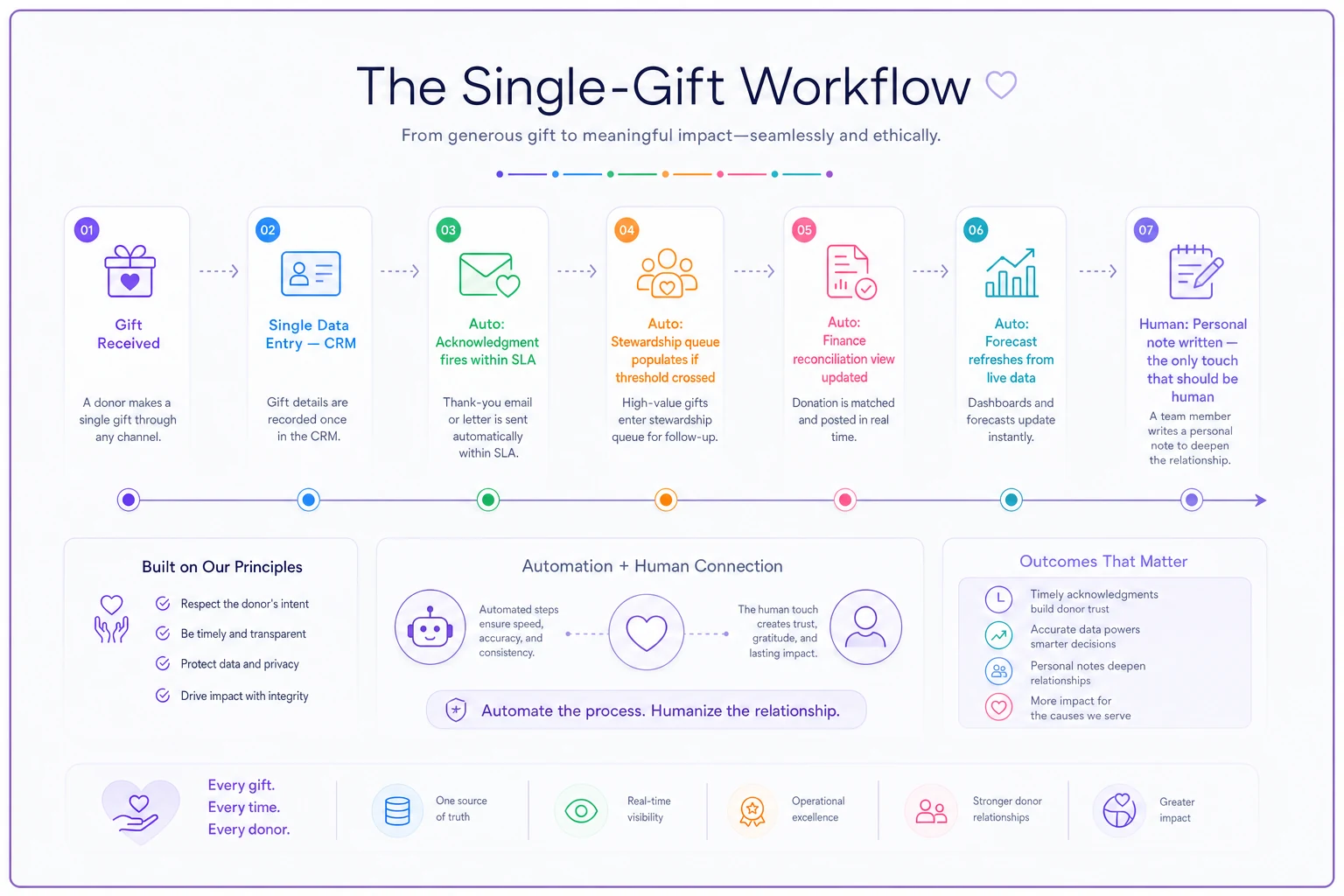
In an Integrated shop, that same gift is entered once. The acknowledgment fires from a template within the SLA. The stewardship queue populates automatically. Finance sees it in a reconciliation view already matched against the deposit. The forecast updates because it reads from live data, not a spreadsheet someone forgets to refresh. One human touch — the personal note — which is exactly the touch you want a human doing.
Capability map — Integrated:
-
Donor data
single source of truth, validation rules preventing drift, deduplication running continuously
-
Gift processing
automated acknowledgment and routing, exceptions flagged rather than everything handled manually
-
Stewardship
automatic triggers off gift events; owners get queues, not reminders they have to remember to set
-
Reporting
live dashboards; board reports assembled in hours, not days
-
Forecasting
reliable within a tighter band, tied to actual pipeline movement
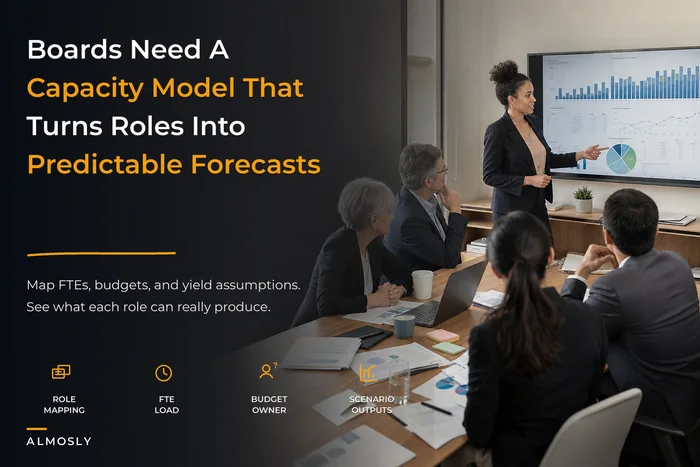
Minimal staffing at this stage: the striking thing is that headcount doesn't balloon. You might have the same 4–6 people from a struggling Defined shop, producing far more because the coordination tax has dropped. This is where the connection to your fundraising capacity model gets real — you can finally map roles to predictable outputs because the outputs are actually predictable.
Stage 4 — Optimized: you're tuning, not building
Optimized shops aren't building new machinery anymore. They're measuring and adjusting the machine they already have. Ask cadences get tested and refined. Segments get split when the data says they should. Recurring donor upgrade paths get tuned by measured LTV rather than instinct.
The failure mode flips entirely. At every earlier stage, the risk is that things break. At Optimized, the risk is chasing marginal gains — spending three months squeezing another 2% out of an email cadence — while missing a structural shift like a major economic pullback or a demographic change in your donor base. Optimized organizations can become weirdly conservative, optimizing the known while blind to the new.
Capability map — Optimized:
-
Donor data
clean, enriched, continuously monitored for quality
-
Gift processing
near‑fully automated with human oversight only on genuine exceptions
-
Stewardship
segmented, tested, measured against retention and upgrade KPIs
-
Reporting
real‑time, self‑serve for leadership, scenario modeling built in
-
Forecasting
predictive, updated continuously, trusted enough to make staffing and budget decisions from
Minimal staffing at this stage: roles specialize — you might see a dedicated analytics/ops person distinct from the database manager, plus gift officers who spend nearly all their time on relationships because the system absorbs the admin.
A real scenario: what moving one stage actually did
A regional environmental nonprofit, roughly $2.2M in annual revenue, sat firmly in Defined for years. Six staff. Everyone busy, forecasting basically fiction — they'd projected $2M the prior year and landed at $2.35M, which sounds like good news until you realize they had no idea why.
The bottleneck wasn't fundraising talent. Their database manager was spending something like 15–20 hours a week re‑keying gifts across their CRM, accounting system, and a board reporting spreadsheet, then chasing down mismatches. Every board meeting, two full days went into assembling numbers.
They spent about nine months moving toward Integrated — not by buying more software, but by connecting what they had: automated acknowledgments, event‑triggered stewardship handoffs, and a live reconciliation view. Nothing exotic.
Results after roughly a year weren't a fairy‑tale revenue explosion. Revenue rose to around $2.6M — solid but not miraculous. The bigger wins were operational: board reporting dropped from two days to a few hours, the database manager got back roughly 12–15 hours a week and redirected that time to donor research, and — this is the number that mattered to the board — their forecast for the following year came in within about 6% of actual, versus being off by 17% the year before. Predictability was the product.
How to sequence a 12–24 month board‑ready roadmap
Boards don't fund "maturity." They fund milestones tied to yield. Here's a realistic sequence for a shop moving from Defined toward Integrated, framed the way a board will actually approve it.
-
Months 0–3 — Stabilize the data foundation. Deduplicate, enforce validation rules, establish a single source of truth. Board milestone: "Reporting error rate down, one trusted donor record." No revenue promise yet — this is the runway.
-
Months 3–6 — Automate gift acknowledgment and routing. Board milestone: "Acknowledgment SLA hit 95%+, ops hours reclaimed." Tie it to retention: faster, reliable thank‑yous protect first‑year retention.
-
Months 6–12 — Connect fundraising‑to‑stewardship handoffs. Board milestone: "Major gift stewardship triggered automatically; measurable lift in second‑gift rate." This is where you can start forecasting yield improvement honestly.
-
Months 12–18 — Live dashboards and forecasting. Board milestone: "Forecast accuracy within ~10%; board reporting cut from days to hours."
-
Months 18–24 — First optimization cycles. Board milestone
"Two tested improvements to ask cadence or recurring upgrades, with measured yield impact."
The discipline here is refusing to promise revenue in months 0–6. If you tell the board the data cleanup will raise revenue next quarter, you'll miss, and you'll lose credibility for the parts of the roadmap that actually do move money.
A quick readiness checklist before you commit to the roadmap
Before you take any of this to a board, run through this:
-
[ ] Can you produce an accurate donor giving report in under an hour, without one specific person?
-
[ ] Does a closed gift automatically reach the stewardship team, or does someone have to remember?
-
[ ] Are gifts entered once, or re‑keyed into finance and reporting separately?
-
[ ] Do you know your current forecast error — how far off was last year's projection?
-
[ ] Is there a protected ops/database role, or is it bolted onto someone's "real" job?
-
[ ] When your ops person is out for two weeks, does anything critical stop?
If you checked fewer than four, you're earlier in the model than you think — and that's fine. Knowing the stage is most of the work.
When advancing stages is actually a bad idea
Not everyone should be pushing toward Optimized. A small shop under roughly $750k, running lean with a tight, loyal donor base, may be perfectly well-served at a solid Defined level. Jumping stages requires real operational overhead — someone to maintain the connected systems, discipline to keep data clean — and a tiny team can drown in that.
Skipping a stage is almost always a mistake. Shops that try to leap from Ad‑hoc straight to fancy dashboards end up with beautiful reports built on garbage data, which is arguably worse than no reports because now people trust the wrong numbers. You have to earn each stage. Integrated only works because Defined cleaned the data first.
And if your organization is in genuine crisis — funding cliff, leadership turnover — this is not the moment to launch a two‑year maturity initiative. Stabilize first. Maturity work assumes you have the bandwidth to build while operating.
The real point of a maturity model
The value of a fundraising operations maturity model isn't the grid or the stage labels. It forces an honest answer to "where does our work actually live, and what does that cost us?" Most stalled shops aren't under‑staffed or under‑motivated. They're carrying an invisible coordination tax — hours lost to re‑entry, handoffs that drop, reports nobody trusts — and that tax is what's capping their yield.
Move the work out of people's heads and into the system, one stage at a time, and two things happen: your team spends its time on relationships instead of re‑keying, and your forecasts start telling the truth. For a board, a truthful forecast is worth almost as much as the revenue itself — because it's what lets them plan, fund, and trust the next ask you bring them.
The value of a fundraising operations maturity model isn't the grid or the stage labels. It forces an honest answer to "where does our work actually live, and what does that cost us?" Most stalled shops aren't under‑staffed or under‑motivated. They're carrying an invisible coordination tax — hours lost to re‑entry, handoffs that drop, reports nobody trusts — and that tax is what's capping their yield.
Move the work out of people's heads and into the system, one stage at a time, and two things happen: your team spends its time on relationships instead of re‑keying, and your forecasts start telling the truth. For a board, a truthful forecast is worth almost as much as the revenue itself — because it's what lets them plan, fund, and trust the next ask you bring them.
Ready to elevate your nonprofit impact?
Join 2,000+ nonprofits using Almosly to boost fundraising efficiency, deepen donor relationships, and scale philanthropic impact.