



Most donor communication problems don't come from bad messages. They come from good messages arriving in the wrong order, from the wrong team, at the wrong frequency. A supporter gets a heartfelt thank-you email on Monday, an urgent appeal on Tuesday, a survey on Wednesday, and a direct mail piece the following week referencing a campaign they already gave to. Nothing is technically broken. But to the donor, it feels like nobody's paying attention.
That gap — between what each channel does individually and what the donor actually experiences — is the real subject of a cross-channel donor experience strategy. It's not about picking the "best" channel or sending fewer emails. It's about deciding what each channel is for, who controls it, and what rules stop them from colliding.
Organizations that get this right aren't sending less. They're sending with governance. And the ones that struggle usually have every piece in place except the one that matters most: a suppression system that actually gets enforced.
Why channel coordination breaks even at well-run nonprofits
The default failure isn't laziness. Channels grow independently, each with its own owner, calendar, and success metric.
Email is owned by digital. Direct mail sits with the annual fund team. Major gifts runs its own personal outreach. Events has its own list. Text messaging got added two years ago and nobody fully agreed who owns it. Each team optimizes for its own numbers — open rates, response rates, RSVP counts — and every one of those metrics rewards sending more.
The pattern that shows up again and again: no single team is over-contacting anyone, but the sum of all teams is hammering the most valuable donors hardest. Why the most valuable? Because your best supporters qualify for every segment. They're on the major gifts radar, they're recurring donors, they came to the gala, they opened the last three emails. Every team's targeting logic points at them. So the person you most want to retain gets the worst experience.
This creates a strange inverse relationship: contact frequency goes up with donor value, while satisfaction quietly goes down. The donor doesn't complain. They just stop opening. Then they stop giving. And because attrition is slow and diffuse, no single team gets blamed — which is exactly why the problem never gets fixed.
This is fundamentally a coordination problem, and it connects directly to how teams plan campaigns together in the first place. If your fundraising, comms, and volunteer teams aren't syncing calendars before launch, suppression rules can't save you downstream. The cross-functional orchestration playbook covers that upstream planning layer — this piece assumes those teams are already talking and focuses on the rules that govern messages once they're in motion.
Start with experience principles, not channels
Before you assign channels or build suppression logic, you need a short set of principles that describe what the donor experience should feel like. Skip this and every later decision becomes an argument between teams about who gets to send what.
Stop missing fundraising opportunities.
Almosly helps you plan, track, and optimize every campaign with ease.
- Centralized donor and volunteer management
- Automated engagement workflows
- Impact and fundraising analytics
No credit card required
-
A donor should never receive two solicitations in the same week from different teams.
-
Stewardship always outranks solicitation. If a thank-you and an ask are both scheduled, the thank-you wins the slot.
-
The most engaged donors get fewer, more personal touches — not more frequent ones.
-
Every channel must be able to see what the others sent in the last 30 days.
-
Recovery and service messages (failed payment, receipt, tax letter) are never suppressed by campaign rules.
Notice what these do. They're not aspirations — they're tiebreakers. When the events team and the annual fund team both want to email a major donor on the same Tuesday, "stewardship outranks solicitation" decides it without a meeting. That's the whole point. Principles exist to make thousands of small routing decisions automatically so humans don't have to litigate each one.
The mistake is writing principles that sound good but can't adjudicate a real conflict. If two teams can both read a principle and each conclude they're allowed to send, the principle failed.
Define channel roles so channels stop competing
Once you have principles, each channel needs a job. Not a vague purpose — an actual role in the donor's journey that other channels don't duplicate.
The failure mode is channels that all try to do everything. When email, mail, and text are all sending solicitations, stewardship, and updates, they compete for the same slots and the donor drowns. Assigning roles reduces overlap and makes suppression far easier to enforce, because you can say "this channel handles this, so the others stand down here."
| Channel | Primary role | Secondary role | What it should NOT do |
|---|---|---|---|
| Ongoing relationship + broad appeals | Event reminders, receipts | Carry the entire ask calendar alone | |
| Direct mail | Anchor solicitations (year-end, spring) | High-value stewardship | Compete with email in the same week |
| SMS/text | Time-sensitive & service (event day, payment failed) | Match-window nudges | Routine appeals or newsletters |
| Phone/personal | Major & mid-level relationship building | Recovery of lapsed high-value donors | Mass outreach |
| In-person/events | Deepening + upgrade conversations | Recognition | Being the only stewardship a donor gets |
The insight most teams miss: channel roles aren't fixed by donor — they shift by donor tier. For a $50 annual donor, email carries almost everything. For a $25k donor, email becomes a support channel and phone becomes primary. A good role map is really a grid of channel-by-tier, not a single flat list. When you flatten it into "email does X for everyone," you either over-contact your small donors or under-serve your major ones.
Suppression matrices: the part everyone skips
A suppression matrix is the rule set that says, given what a donor has already received, what they're now allowed to receive. This is where strategy becomes operational. Principles and channel roles are the intent; the suppression matrix is the enforcement.
The reason most nonprofits don't have one isn't ignorance — it's that building it forces uncomfortable prioritization. Someone has to decide that the year-end appeal loses to a major-donor stewardship call. Teams resist that because it caps their own volume. But without hard rules, "coordination" is just a shared calendar everyone ignores under deadline pressure.
| If donor received in last… | Then suppress from receiving… | Exceptions (always allowed) |
|---|---|---|
| Any solicitation in past 7 days | Any other solicitation (any channel) | Payment failure, receipt, tax letter |
| Direct mail appeal in past 14 days | Email appeal referencing same campaign | Event logistics they RSVP'd to |
| 3+ emails in past 30 days | Non-urgent email (newsletter, survey) | Personal note from their gift officer |
| Major-donor personal touch in past 30 days | Mass appeals of any kind | Time-sensitive match with hard deadline |
| Event invite in past 10 days | Second invite to different event | — |
Two things make a matrix like this actually work.
First, exceptions have to be explicit and narrow. The fastest way to gut a suppression system is a broad "urgent campaigns override suppression" clause, because every campaign feels urgent to the team running it. Define exceptions by message type — payment failure, tax document — not by importance, which is subjective.
Second, the matrix needs a clear precedence order when multiple rules apply. Read top to bottom, most protective first. If a major donor got a personal touch three days ago and an email appeal is queued, the personal-touch rule wins and the appeal is held.
Enforcement rules: where good matrices go to die
A suppression matrix on a shared doc is a suggestion. Enforcement is what makes it real, and this is the difference between organizations that talk about coordination and ones that actually have it.
The core problem: suppression can't be enforced by asking teams to check before they send. Under a Friday-afternoon deadline, nobody checks. Enforcement has to sit at the point of send, applied to the list itself, not to the humans making decisions.
-
A single contact ledger. Every send from every channel writes a record: donor ID, channel, message type, date. If a channel doesn't log to the ledger, its sends are invisible to suppression — and that channel will be the one that over-contacts. Text and phone are the usual blind spots because they often live outside the main system.
-
Suppression applied at list-pull, not at send-decide. When any team pulls a list for a campaign, suppression rules run against the ledger and strip out anyone currently protected. The team never sees suppressed contacts, so there's nothing to override in a hurry.
-
An override that requires a name and a reason. True exceptions exist. But an override should require a specific person to log why, and those overrides should be reviewed monthly. When overrides spike, it's usually a sign a suppression rule is wrong or a channel role is being ignored — the log tells you which.
This is exactly the kind of coordination that falls apart on spreadsheets and calendar invites once you pass a few thousand donors and more than two or three sending teams. A shared calendar tells you what's scheduled; it can't tell you what an individual donor actually received across five systems. Platforms that centralize the contact ledger and apply suppression at list-pull remove the need for humans to remember the rules — which matters, because the rules always break at the exact moment everyone's busiest.
Here's a simple visualization of how enforcement should flow through your systems.
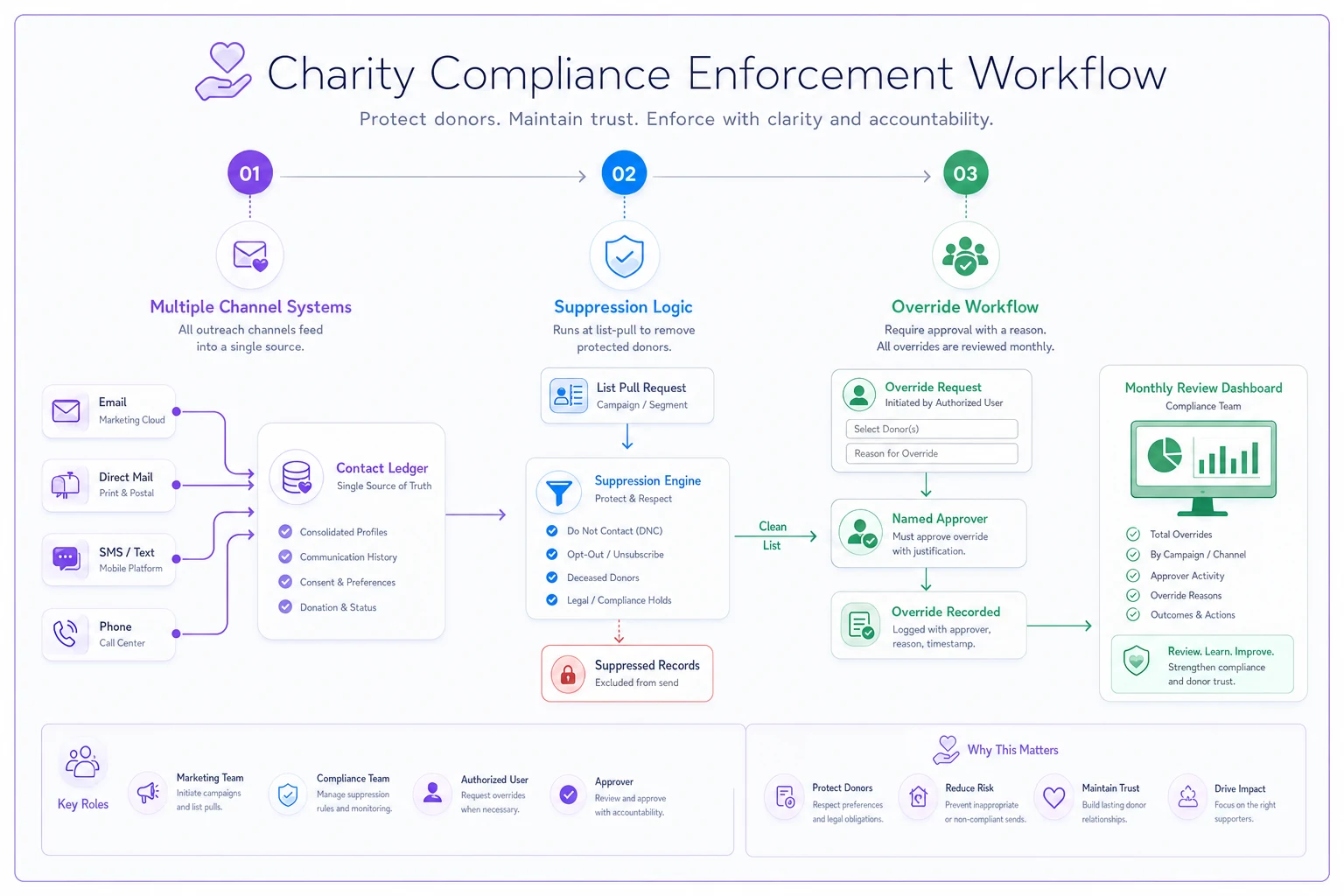
Require that every override include a business reason and the approver's name so monthly reviews surface systemic rule gaps quickly.
The value isn't the automation itself; it's that suppression stops depending on someone remembering to check.
A measurement plan that balances ask frequency and retention
More asks usually raise short-term revenue and lower long-term retention. If you only measure campaign response, you'll optimize yourself straight into higher attrition. The measurement plan has to hold both sides in view at once.
-
Contact frequency per donor per month, broken out by tier. Watch whether your top tier is quietly getting the highest frequency — it usually is.
-
Response rate and unsubscribe/opt-out rate on the same campaign. A campaign that "worked" on response but spiked opt-outs borrowed revenue from the future.
-
12-month retention by contact-frequency band. Group donors by how many contacts they received and compare retention across those bands. There's almost always a frequency point where retention starts dropping — that's your ceiling.
-
Suppression hit rate. How many contacts got stripped at list-pull? Near zero means your rules aren't firing. Very high means your channels are wildly overlapping.
-
Override frequency by team. Rising overrides mean the rules are being routed around.
The pattern worth hunting for: the frequency band where an extra monthly contact stops adding retained revenue and starts subtracting it. Once you can see that line, ask frequency becomes a decision instead of a guess. This also depends on knowing which channel actually drove a gift — otherwise you'll credit the wrong channel and misjudge which touches to protect. Clean campaign attribution is what keeps this measurement honest.
A real scenario
A regional health nonprofit, roughly 18,000 active donors, had five teams sending independently: email, direct mail, major gifts, events, and a texting program added the year prior. No shared ledger. Each team hit its own numbers, so on paper everything looked fine.
The problem surfaced in retention data. Their top 600 or so donors — the ones who qualified for nearly every segment — were receiving somewhere around 9 to 12 contacts a month during busy stretches. Retention in that group had slipped into the low 70s while their broad file held steady. The most valuable donors were leaving fastest, and nobody had connected it to contact volume because no single system could see the total.
They did three things. Built a single contact ledger every channel logged to — the texting program was the hardest to wire in. Wrote a suppression matrix with stewardship outranking solicitation and a hard 7-day gap between asks. Applied suppression at list-pull so teams physically couldn't send to protected donors.
Within about two quarters, monthly contacts for that top group dropped to roughly 4 to 6. Response rates on the appeals that did go out actually ticked up slightly — fewer, better-timed asks landed harder. Top-tier retention recovered into the low 80s over the following year. Total revenue didn't fall; the asks that survived suppression simply performed better. Sending less to their best donors made those donors worth more.
When this level of governance makes sense — and when it doesn't
When it's worth building: You have three or more teams sending independently, more than a few thousand donors, and at least one channel operating outside your main system (texting and phone are the usual culprits). If your best donors are leaving faster than your file average, you almost certainly have an uncoordinated frequency problem and need this now.
When it's overkill: A small shop with one or two people sending everything doesn't need a formal suppression matrix — they are the suppression system, because they hold the whole calendar in their heads. Building heavy governance for a two-person operation adds process without solving a real coordination gap.
Who should not start here: If your channels don't yet have clear roles, or your teams aren't coordinating campaign calendars at all, fix that first. Suppression rules assume there's a plan to enforce. Bolting enforcement onto chaos just produces confusing, contradictory rules that teams route around on day one.
Pulling it together
A cross-channel donor experience strategy isn't a messaging exercise — it's a governance system. Experience principles decide the tiebreakers. Channel roles stop teams from competing for the same slots. The suppression matrix turns intent into rules. Enforcement makes those rules real by applying them to the list instead of trusting busy people to remember. And the measurement plan keeps ask frequency and retention balanced against each other instead of letting short-term revenue quietly erode your best relationships.
The nonprofits that struggle usually have talented teams and genuinely good individual messages. What they lack is the layer that governs how those messages add up in a single donor's inbox. Build that layer, protect your highest-value donors from the contact frequency that comes because they're valuable, and the numbers tend to move in the direction everyone wanted — often by sending less, not more.
A cross-channel donor experience strategy isn't a messaging exercise — it's a governance system. Experience principles decide the tiebreakers. Channel roles stop teams from competing for the same slots. The suppression matrix turns intent into rules. Enforcement makes those rules real by applying them to the list instead of trusting busy people to remember. And the measurement plan keeps ask frequency and retention balanced against each other instead of letting short-term revenue quietly erode your best relationships.
The nonprofits that struggle usually have talented teams and genuinely good individual messages. What they lack is the layer that governs how those messages add up in a single donor's inbox. Build that layer, protect your highest-value donors from the contact frequency that comes because they're valuable, and the numbers tend to move in the direction everyone wanted — often by sending less, not more.
Ready to elevate your nonprofit impact?
Join 2,000+ nonprofits using Almosly to boost fundraising efficiency, deepen donor relationships, and scale philanthropic impact.