

The letter that lands on a family's kitchen table three weeks after a funeral, addressed to the person they just buried, cheerfully asking for a year-end gift — that's the failure most nonprofits never talk about. Nobody schedules it. Nobody wants it. But it happens because the systems generating mail, email, and recurring charges don't know the donor is gone, and the people who do know have no reliable way to stop the machine.
This is one of the few operational gaps where a single miss doesn't just cost money. It can permanently damage a family's relationship with your organization, and occasionally end up screenshotted on social media with a caption that starts, "Can you believe…"
So this is the actual SOP. Not a policy statement about "respecting our donors," but the mechanics: how the flag gets set, what stops sending the moment it's set, who owns the situation, what you say to the family, and how finance closes the record cleanly.
The three ways this goes wrong (and they're all preventable)
Before the fix, it helps to see exactly where the breakdown lives. Deceased-donor mistakes almost always trace back to one of three failure points.
The recurring charge that keeps hitting. A monthly donor passes away. Their card is still active for a few billing cycles, or the estate hasn't closed the account. Your processor keeps pulling $25 or $50 a month. The family notices on a statement, or the bank flags it, and now you're issuing refunds and apologizing. This is the most financially and emotionally expensive version.
The appeal that goes out anyway. Someone in your organization hears the news — maybe a program officer, maybe a board member who attended the service. They mention it in passing. But the mailing list was already exported to the print vendor two weeks ago, and there's no mechanism to pull one record from a batch already in production. The appeal ships.
The "we sort of knew" record. The information existed somewhere — a note in a call log, an email from a relative, a comment during a gift officer's visit — but it never became a structured, enforceable status in the database. It stayed as tribal knowledge. Three months later, a different staffer runs a segment and the deceased donor is right back in the pipeline.
What ties all three together: the knowledge that someone died and the systems that keep contacting them were never connected. Someone knew. The database didn't.
Start with the flag, because everything else depends on it
You cannot pause what you haven't marked. The foundation of a deceased-donor handling SOP is a single, unambiguous status field — not a note, not a tag buried in a description box, but a structured field that other processes can read and act on.
Stop missing fundraising opportunities.
Almosly helps you plan, track, and optimize every campaign with ease.
- Centralized donor and volunteer management
- Automated engagement workflows
- Impact and fundraising analytics
No credit card required
Here's the distinction that matters. A note says "spoke with daughter, John passed in October." A flag is a field called something like Deceased_Status with controlled values, a date, and a source. The difference is that automations, segment queries, and export filters can act on a flag. They cannot act on a sentence someone typed.
-
Deceased status — a hard field, not free text (values like
Confirmed,Reported – Unverified) -
Date reported — when you learned, not necessarily the date of death
-
Source of information — family member, obituary, returned mail, bank notice
-
Verification level — because "a returned envelope marked deceased" is not the same certainty as "the spouse called us"
That verification level matters more than people expect. You will occasionally get a false deceased report — a data-entry error, a confused vendor file, or two donors with the same name. Treating every report as instantly confirmed creates its own problem: suppressing a very-much-alive donor and going silent on them for months. So the SOP branches. A Reported – Unverified status stops outbound asks immediately but holds off on permanent record changes and condolence outreach until someone confirms.
Make verification levels explicit so automation can immediately suppress asks without permanently silencing a living donor.
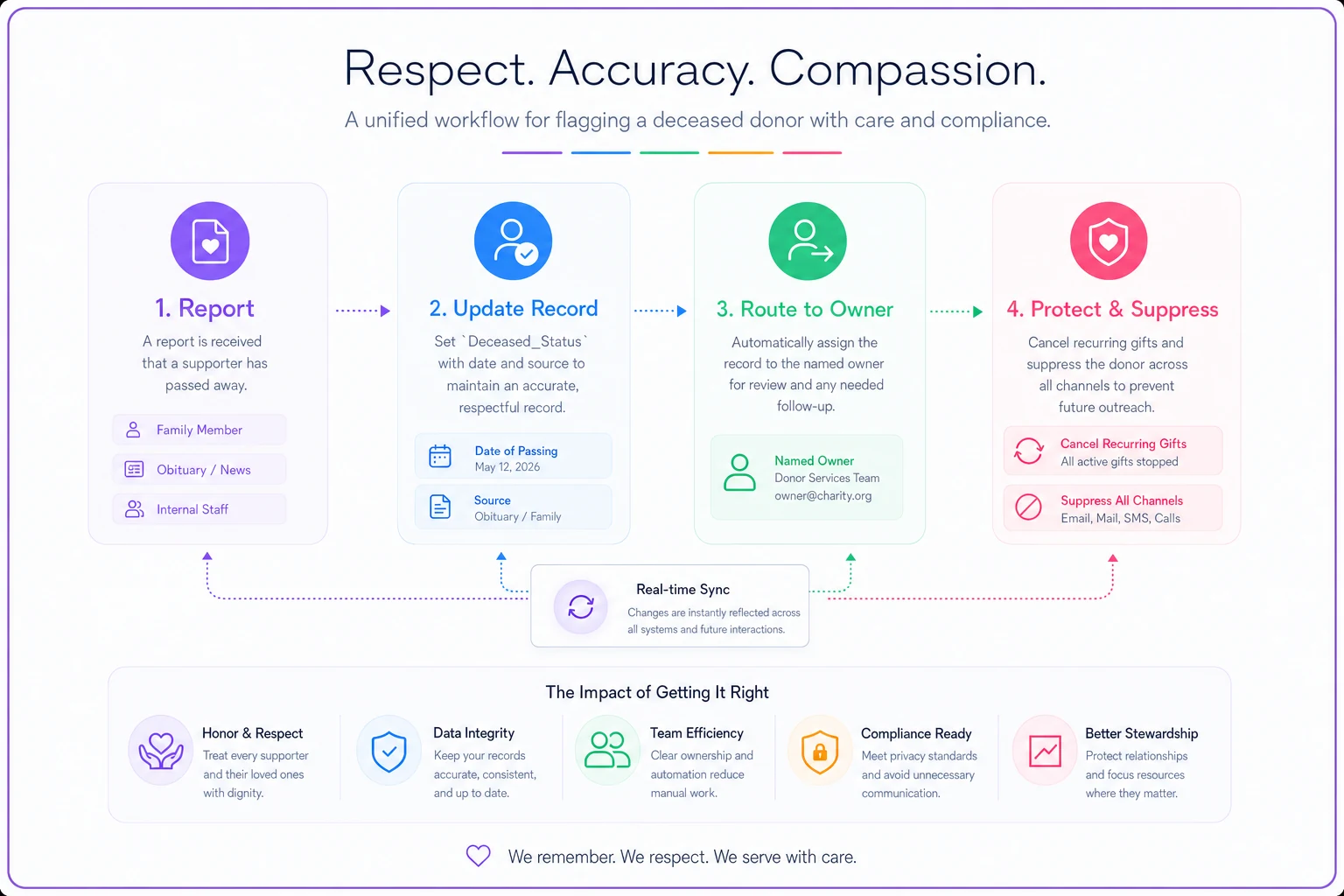
This diagram shows the handoff from report to action and the points where automation should intervene.
The stop-send rule: what has to halt the second the flag is set
Most organizations set the flag and assume the rest handles itself. It doesn't. Flags are passive. You need explicit stop-send rules that treat the deceased status as a hard suppression across every channel — and the word "every" is doing a lot of work here.
What should stop immediately when the flag flips to Confirmed or even Reported – Unverified:
| Channel / Process | Default behavior | Required action on flag |
|---|---|---|
| Recurring credit card / ACH | Keeps charging until canceled | Cancel the recurring gift immediately — this is the #1 priority |
| Email appeals & newsletters | Included in list pulls | Suppress across all automated journeys |
| Direct mail / print vendor exports | Pulled in batch, hard to reverse | Suppress at export; flag record before next batch |
| Phone / text campaigns | Included in call lists | Remove from active dialing and SMS |
| Event invitations | Included by segment | Exclude, including "spouse of" logic checks |
| Peer-to-peer / third-party lists | Often synced externally | Push suppression to synced platforms |
Two things people consistently miss on this.
First, the recurring charge has a clock on it. Every day it stays live is another potential charge against a deceased person's account. That cancellation should be the very first action — before condolence messaging, before record cleanup, before anything. The delay usually happens because the person who sets the flag (a gift officer, an admin) isn't the same person who can cancel a payment in the processor. That handoff gap is where the extra charges slip through. Close it by giving the flag-setter either the access or a same-day escalation path.
Second is the direct-mail batch problem. If your appeal file already went to the printer, suppressing the record in your CRM does nothing for that mailing. Your stop-send rule has to include a step to contact the vendor and pull the record from an in-progress job — and if it's too late to pull, flag it internally so that when the family calls upset, whoever answers the phone already knows and can respond with grace instead of confusion.
Escalation to a named owner (not "the team")
"The team will handle it" is how deceased-donor situations fall through the cracks. Diffused responsibility means nobody owns the follow-through — the flag gets set, and then everyone assumes someone else canceled the recurring gift or reached out to the family.
Every deceased-donor case needs one named owner. Not a role in the abstract, a person for that specific case. That owner is responsible for confirming the stop-send actions actually happened and for the human side of the response.
A workable escalation flow:
-
Anyone can report a death and set the initial
Reported – Unverifiedflag. Lowering the barrier to reporting is critical — you want people to log it the moment they hear, not wait until they're "sure." -
The flag automatically routes to a designated owner based on donor tier. A $30/month recurring donor might route to a stewardship coordinator; a major donor's case routes to their gift officer directly. This mirrors the ownership logic you'd already have in your stewardship sequences for mid-level and major donors, just applied to a much more sensitive moment.
-
The named owner verifies, moves the status to
Confirmed, and personally confirms three things: recurring gift canceled, all channels suppressed, condolence path decided. -
The owner decides on the relationship. A major donor's family often warrants a personal note or call. A lapsed one-time donor from six years ago probably warrants quiet suppression and nothing more. Judgment, not a blanket rule.
The reason to route by tier is that the right response varies enormously. Sending a formal tribute acknowledgment to the family of a small annual donor can feel oddly intense; going silent on a major donor's family whose matriarch left a bequest can feel cold and transactional. Naming the owner lets a human make that call.
Message templates: condolence and reconciliation
Templates here aren't about efficiency — they're about not making a grieving family do emotional labor because your organization was caught flat-footed. You want language ready so nobody is improvising a delicate message under pressure.
Two situations need pre-written language.
The condolence / acknowledgment — used when you've confirmed the passing and the relationship warrants a response:
> Dear [Name], > We were so sorry to learn of [Donor]'s passing. [He/She/They] was a valued part of our community, and [his/her/their] support helped make [specific program or outcome] possible. Please know that we've paused all communications and updated our records. If there's anything we can do to support you during this time, or any questions about [Donor]'s giving history, please reach out to me directly. > With sympathy, [Named Owner, direct contact]
Notice it does two jobs at once: it expresses genuine sympathy and quietly signals that the operational side — pausing communications, updating records — is already handled. That reassurance matters. Families worry about exactly the kind of mistaken appeal we're trying to prevent.
The reconciliation message — used when something already went wrong, like a charge went through or an appeal shipped after the death:
> Dear [Name], > I'm reaching out to sincerely apologize. A [donation of $X / appeal letter] was processed after [Donor]'s passing due to a delay in our records. We've refunded the charge in full / stopped all further communications, and I've personally reviewed [Donor]'s account to make sure nothing further will be sent. I'm truly sorry for the added distress this caused. Please contact me directly with any questions. > [Named Owner, direct contact]
The reconciliation template is the one you hope to rarely use, but when you need it, you really need it — and you don't want a stressed staffer writing it from scratch at 4:45 on a Friday. Keep the apology direct, name the specific error, state exactly what you did to fix it, and give a real person to contact.
Families almost always respond well to a straightforward apology and a fast fix. What damages the relationship is the second mistake — the second charge, the second appeal — which signals the organization still isn't paying attention.
Finance closure: the steps that actually close the record
Suppression and condolences are the visible half. The finance side is what protects you on audits and compliance, and it's where records tend to be left half-finished — flag set, accounting trail never cleaned up.
The closure sequence finance should run once a death is confirmed:
-
Cancel all recurring commitments in the payment processor and reconcile against the CRM so the two systems agree. A canceled gift in the CRM that's still live in the processor is the classic failure.
-
Review pledges. An open multi-year pledge doesn't just vanish. Depending on your policy and the estate, it may be written off or honored by the estate. Either way, someone has to make a decision and document it — don't leave the pledge sitting "open" indefinitely and skewing your forecasts.
-
Handle any post-death transactions. If a charge or gift processed after the date of death, decide on refund vs. retention. When a family requests a refund on a charge that hit after the passing, refund it. The goodwill is worth far more than the gift.
-
Check for pending matching gifts, tribute gifts, or memorial designations. Deaths often generate inbound memorial gifts from others. Make sure those are correctly attributed and acknowledged separately from the deceased's own record.
-
Document everything. Date of death, date reported, actions taken, who approved the pledge write-off, refund decisions. This is your audit trail and your compliance backstop.
-
Set the record to a final archived state — retained for reporting and history, but excluded from all active solicitation and analysis segments.
That last point connects to your broader data handling. How long you retain a deceased donor's record, and how you treat it, falls squarely under the thinking in a proper nonprofit data governance framework. Deceased-donor records aren't a special exception to your governance — they're a case that tests whether your governance actually works.
A real scenario
A mid-sized health nonprofit — roughly 4,000 active donors, a four-person development team — had a monthly donor giving $40 a month pass away in the spring. The family notified them by email through the general inbox. That email got read, someone replied kindly, and then nothing was entered into the CRM as a structured status.
The recurring gift kept charging. Over about four months, roughly $160 was pulled from an account the estate was trying to close. The family called, upset — not really about the money, but about the feeling that nobody was paying attention. On top of that, a spring appeal had gone out to the deceased donor's name during that same window.
The fix wasn't complicated. They added a hard deceased status field, wrote a rule that any deceased flag immediately routes to the stewardship coordinator as named owner, and made "cancel recurring gift in the processor" the mandatory first step — logged, not assumed. They wrote both message templates and stored them somewhere the team could reach them fast.
In the months after, they handled several deceased-donor cases with zero post-death charges and no misdirected appeals. The clearest signal it worked: one spouse actually wrote back to thank them for how gently the whole thing was handled. That's the outcome worth aiming for — not just avoiding harm, but turning a painful moment into evidence that your organization treats people as people.
When to keep this manual — and when it's worth automating
Not every organization needs heavy automation around this. If you're handling a handful of deceased-donor cases a year and your team is small and tightly coordinated, a well-documented manual SOP with a named owner is often better than automation, because these situations demand judgment. Over-automating condolence outreach is exactly how you send a templated sympathy email that feels cold.
Where lightweight automation earns its place is the suppression mechanics — making sure that the moment the flag is set, the record drops out of every list pull and journey without someone remembering to do it manually across six systems. The human decisions (does this family get a call? what do we say?) should stay human. The mechanical enforcement (this record must not receive an ask) is what you want your systems to handle reliably, because that's precisely the part humans forget under a batch deadline.
The line is simple: automate the stop, keep the response human.
The one thing to fix this week
Go check one thing: when someone on your team learns a donor has died, is there a single, structured place to record it that actually stops the recurring charge and pulls them from the next mailing? For most organizations, the honest answer is no — the knowledge lives in an inbox or someone's memory, and the systems keep running.
Building the flag, the stop-send rule, and the named owner isn't a big project. It's a couple of afternoons of setup that prevents the one category of mistake nobody in your organization ever wants to be responsible for. Donor dignity, in the end, is mostly an operations problem wearing a very human face — and it's one you can solve before it costs you a family's trust.
Building the flag, the stop-send rule, and the named owner isn't a big project. It's a couple of afternoons of setup that prevents the one category of mistake nobody in your organization ever wants to be responsible for. Donor dignity, in the end, is mostly an operations problem wearing a very human face — and it's one you can solve before it costs you a family's trust.
Ready to elevate your nonprofit impact?
Join 2,000+ nonprofits using Almosly to boost fundraising efficiency, deepen donor relationships, and scale philanthropic impact.