

Most event failures don't happen at the event. They happen three days later, when someone on the finance team is staring at a cash box with $4,217 in it and a gift log that says $3,890, and nobody can explain the gap. Or when a donor who pledged $2,500 at the gala never gets acknowledged because their pledge card ended up in a tote bag that lived in someone's trunk for a week.
The gala itself usually goes fine. People show up, the room looks good, the auctioneer does their thing. The breakdown is operational — it's in the handoffs, the capture, and the reconciliation. Event money arrives in the messiest possible forms: cash, cards, checks written on the spot, verbal pledges, text-to-give that may or may not have cleared, and sponsor commitments that live only in someone's inbox.
This is a working charity event operations checklist built around that reality. Not the event-planning side — the venue, the catering, the seating charts. The money-and-trust side. Below is the full sequence, from the week before through the seven days after, including the fields you actually need in your CRM and the escalation rules that keep a bad moment from becoming a bad headline.
Step 1: Lock your capture methods before you print anything
The single most common source of reconciliation pain is having more payment options than you have ways to track them. A team decides, two weeks out, to "also do Venmo" and "also take Zelle" and suddenly there are five payment rails and no owner for two of them.
Decide early exactly which capture methods are live for this event. A typical, manageable set looks like:
-
Card — through one reader/processor, one account
-
Cash — counted in pairs, logged by table or station
-
Check — logged at intake, photographed before it leaves the room
-
Pledge (card-on-file to be charged later, or invoice-to-follow)
-
Text-to-give — one short code, one landing page
Every method needs a named owner and a tracking artifact. If you can't name who reconciles Venmo on Monday morning, Venmo doesn't exist at this event. That's not being rigid — it's the difference between a $300 variance you can explain and a $3,000 one you can't.
One pattern worth flagging: pledges are where trust quietly erodes. A verbal "put me down for five thousand" at the podium feels like a win in the moment and turns into an awkward phone call three weeks later. More on pledge capture in Step 4.
Step 2: Build the event records in your CRM *before* the doors open
Walking into an event with a blank CRM and planning to "enter everything Monday" is how you lose gifts. The entry backlog after a 200-person gala is brutal, and anything entered from memory or a messy notecard is already compromised.
Stop missing fundraising opportunities.
Almosly helps you plan, track, and optimize every campaign with ease.
- Centralized donor and volunteer management
- Automated engagement workflows
- Impact and fundraising analytics
No credit card required
Set up the scaffolding in advance. At minimum, create the campaign/event record, a batch for each capture method, and a clean set of capture fields. Here's a sample field structure that holds up for most mid-sized events:
| Field | Type | Why it matters |
|---|---|---|
event_id | Lookup | Ties every gift to this specific event, not just "2026 Gala" generally |
capture_method | Picklist (cash/card/check/pledge/text) | Drives reconciliation routing |
stationortable | Text | Lets you trace a cash gap to a location |
captured_by | Lookup (volunteer/staff) | Accountability without blame |
gift_status | Picklist (collected/pledged/pending-charge/failed) | Separates money you have from money you're promised |
pledgeduedate | Date | Triggers follow-up so pledges don't rot |
receipt_sent | Checkbox + date | Prevents double-receipting and missed acknowledgments |
anonymous_flag | Checkbox | Avoids publishing a name someone asked you not to |
softcreditto | Lookup | Handles "my company is paying but credit me" cases |
The field that saves the most grief is gift_status. Collected and pledged money look identical on a tally sheet in a loud room. They are not the same thing, and conflating them is how boards get told you raised $90k when you've actually received $61k.
Step 3: Assign volunteer roles with real scripts, not vibes
Volunteers default to being helpful, which sounds good and is actually a problem. A helpful volunteer who doesn't know the script will take cash without logging it, promise a donor something you can't deliver, or "just hold onto" a check until the end of the night.
Intake/registration volunteer — "Welcome! Can I confirm the name on your registration? Great, you're at table six." If someone hands them a gift: "Thank you so much — let me walk you two steps over to our giving station so we get you a proper receipt."
Giving station volunteer — handles capture. Script for a verbal pledge: "That's wonderful. So I can make sure you're thanked properly, can I grab your name, email, and whether you'd like us to charge a card tonight or send you a reminder?" That one question — tonight or later — is worth thousands in collected pledges.
Cash runner — moves cash from stations to the count area in pairs, never alone, logging the amount and station on the handoff sheet.
Floor lead — the escalation point (Step 6). Not counting money, not working a station — free to move and solve problems.
The mistake is over-recruiting and under-briefing. Ten confused volunteers create more risk than four who know exactly what they're doing. Your volunteer-to-role ratio matters less than whether each person can repeat their script back to you at the pre-event huddle.
Step 4: Capture pledges like they're already slipping away
Offline pledges are the leakiest part of event fundraising. A pledge is a promise with no paper trail unless you build one on the spot. The collection rate on poorly-captured pledges can be ugly — it's not unusual to see 30–40% of verbal pledges never convert because nobody captured enough information to follow up.
The fix is straightforward: never let a pledge exist as only a verbal statement. Every pledge needs, at minimum:
-
Name and a way to reach them (email and phone, not one or the other)
-
Amount
-
Payment intent
charge tonight / card-on-file for [date] / invoice to follow
-
A
pledgeduedate -
The name of the person who captured it
If someone pledges from the stage or the auction floor and won't stop to give details, the floor lead's job is to quietly find them before they leave. One real pattern: the biggest verbal commitment of the night is also the most likely to walk out un-captured, because everyone assumed someone else got it.
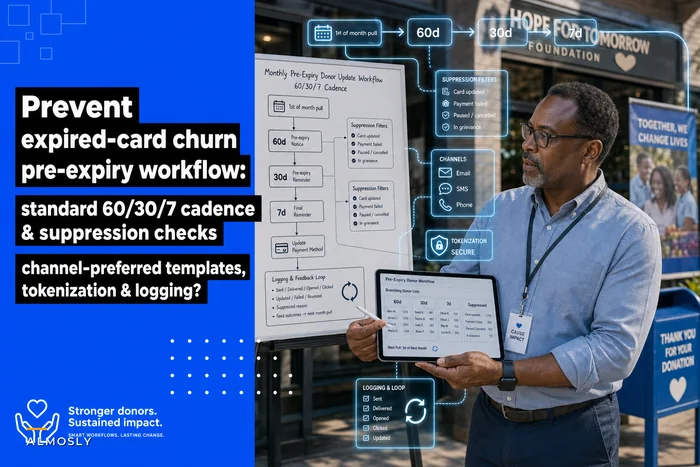
For pledges with a card on file to be charged later, build in the same care you'd use for any delayed charge. Cards expire, get replaced, and fail — and a failed pledge charge handled badly reads as a dunning notice to a generous donor. The thinking in this pre‑expiry donor update workflow applies directly: confirm the card is good before the charge date, and treat a failure as a service touch, not a collections event.
Step 5: Run cash with two sets of eyes, always
Cash is the only capture method with no automatic audit trail, which means it's the only one where a variance can look like either an honest mistake or something worse. Protect your volunteers and your organization by never letting one person handle cash alone, start to finish.
The rule is simple: cash is counted by pairs at every transition. Opening float counted by two, verified against the log. Station-to-count handoffs counted by two, signed by both. Final count done by two people who didn't run the stations.
-
Each giving station starts with a known float ($100–$200), logged
-
Cash runners move collections in pairs, logging station + amount at each pickup
-
Count area tallies in pairs against the running handoff sheet
-
End of night
float removed, event cash counted twice, reconciled to the station logs before anyone leaves
Use time-stamped handoff sheets so you can quickly trace where a discrepancy first appears.
The point isn't suspicion. A documented, two-person chain means a $40 discrepancy is a rounding conversation, not an accusation. Teams that skip this always regret it the first time a box comes up short.
Step 6: Define incident escalation before you need it
Events produce incidents — a donor gets belligerent, a payment reader goes down mid-auction, someone has a medical issue, a volunteer realizes a gift was logged wrong after the donor left. The failure isn't that incidents happen. It's that nobody knows who decides what, so a small problem stalls while three people look at each other.
-
Operational hiccup (reader down, missing supplies, confused volunteer) → giving station lead resolves or routes to floor lead
-
Donor-facing issue (complaint, dispute over a gift amount, someone upset) → floor lead, who can pull in a senior staff member
-
Safety/medical → floor lead + venue security/EMS, with a pre-identified staff member who makes the call
-
Money anomaly (short box, double charge, suspected error) → does not get "fixed" in the moment; it gets documented and handed to the reconciliation owner for Monday
That last rule matters. The instinct to quietly correct a cash discrepancy during the event destroys the audit trail. Document it, flag it, move on.
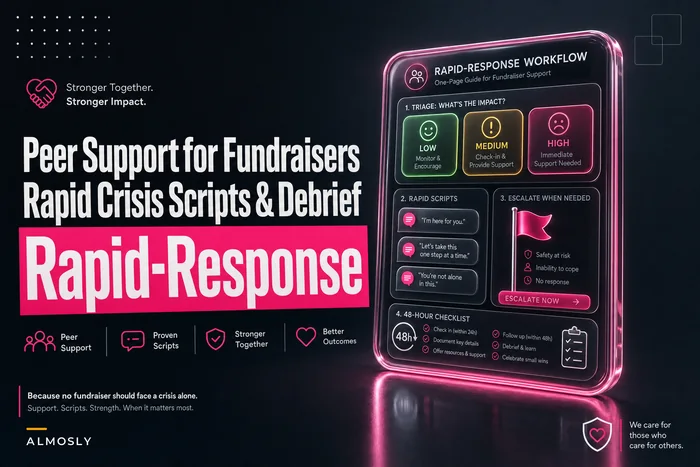
The human side of incidents also matters more than people plan for. Front-line volunteers who absorb a hostile donor or a chaotic moment need a check-in, not just a thank-you. The escalation and debrief thinking in this rapid crisis scripts and debrief guide is worth adapting for your event leads — a two-minute "how are you doing" after a rough interaction keeps good volunteers coming back.
Step 7: Reconcile the night *that* night (the part everyone skips)
Before the last staff member leaves the venue, produce one number per capture method and compare it to what your records say. Not a full reconciliation — a first-pass reconciliation.
-
Cash counted vs. cash logged — do they match within a tolerance you set in advance?
-
Card total on the processor vs. card gifts logged — same count?
-
Checks in hand vs. checks logged — same number of physical checks?
-
Pledges captured — do they all have a name, amount, and due date?
-
Any flagged anomalies written down with enough detail to investigate Monday?
This takes 30–45 minutes with two people and saves days. The gap you can close at 11pm, standing next to the person who ran the station, is often impossible to close on Wednesday from an email thread. A mid-sized arts nonprofit running a spring benefit found a $600 card/log mismatch at the end-of-night pass and traced it in ten minutes to two gifts entered under the wrong stationortable — a non-issue caught in the room. Left until Monday, that same mismatch would've eaten half a day of someone's week and probably ended in a shrug.
Step 8: The 7-day post-event workflow to close the books
The week after an event is where donor trust is either reinforced or quietly spent. Acknowledgment speed is the signal donors read most clearly — a thank-you that arrives within two days says "we're organized and we respect you." One that arrives three weeks later says the opposite, no matter how warm the language.
Day 1 (morning after) — Full reconciliation of every capture method against the CRM. Resolve or formally log every variance. Lock the batches. This is the day the numbers become official; everything after builds on them.
Day 2 — Send acknowledgments and receipts for all collected gifts (cash, card, check, charged-tonight pledges). Check the receipt_sent field to avoid double-sends. Respect anonymous flags.
Day 3 — Process and confirm card-on-file pledge charges due now. Any failures go into a gentle recovery sequence, not a dunning notice.
Day 4 — Outreach on open pledges (invoice-to-follow). Warm, specific: reference what they committed to and what it funds. This is a stewardship moment disguised as a collections task.
Day 5 — Sponsor and major-gift personal thank-yous. These are phone calls or handwritten notes from leadership or a board member, not automated email. Anyone who gave or pledged above your major-gift threshold gets a human.
Day 6 — Data cleanup: merge any duplicate records created during fast event entry, confirm soft credits, verify event attribution so this event's numbers are trustworthy in six months.
Day 7 — Final tally and short internal debrief. Collected vs. pledged vs. outstanding, variance notes, what to fix next time. One page. Capture the operational lessons while they're still fresh.
One edge case worth flagging: events occasionally surface that a longtime donor has passed away, often when a family member attends in their place or a gift comes in from an estate. Handle those with care and a defined process rather than improvising — the approach in this compassionate deceased‑donor SOP keeps a sensitive moment from becoming a painful mistake.
Step 9: Know when the full apparatus is overkill
Not every event needs a cash-count chain and a five-method capture plan. Part of running this well is scaling the process to match the event.
When the full checklist makes sense: ticketed galas and benefits with a live auction or paddle raise, events expecting meaningful cash, anything over roughly 100 attendees, or any event where you're accepting pledges from the stage. The variance risk and the trust stakes justify the overhead.
When it's a bad idea to over-build: a small cultivation dinner for 20 known donors where no money changes hands on-site, or a volunteer appreciation event with no ask. Standing up a five-station capture operation there just creates friction and makes a warm event feel transactional.
Who should not try to run this with a skeleton crew: teams attempting a first-ever large gala with three staff and no named reconciliation owner. If you can't staff the floor lead role and the two-person cash chain, shrink the event or cut cash capture before you cut the controls. The controls are the part that protects you.
Step 10: Centralize so the handoffs stop leaking
Everything above fails at the same point: the handoff. Volunteer captures a gift → it needs to reach the CRM. Pledge made → it needs a due date and an owner. Variance found → it needs to route to Monday's reconciliation. Each handoff done on paper or by memory is a place money and trust leak out.
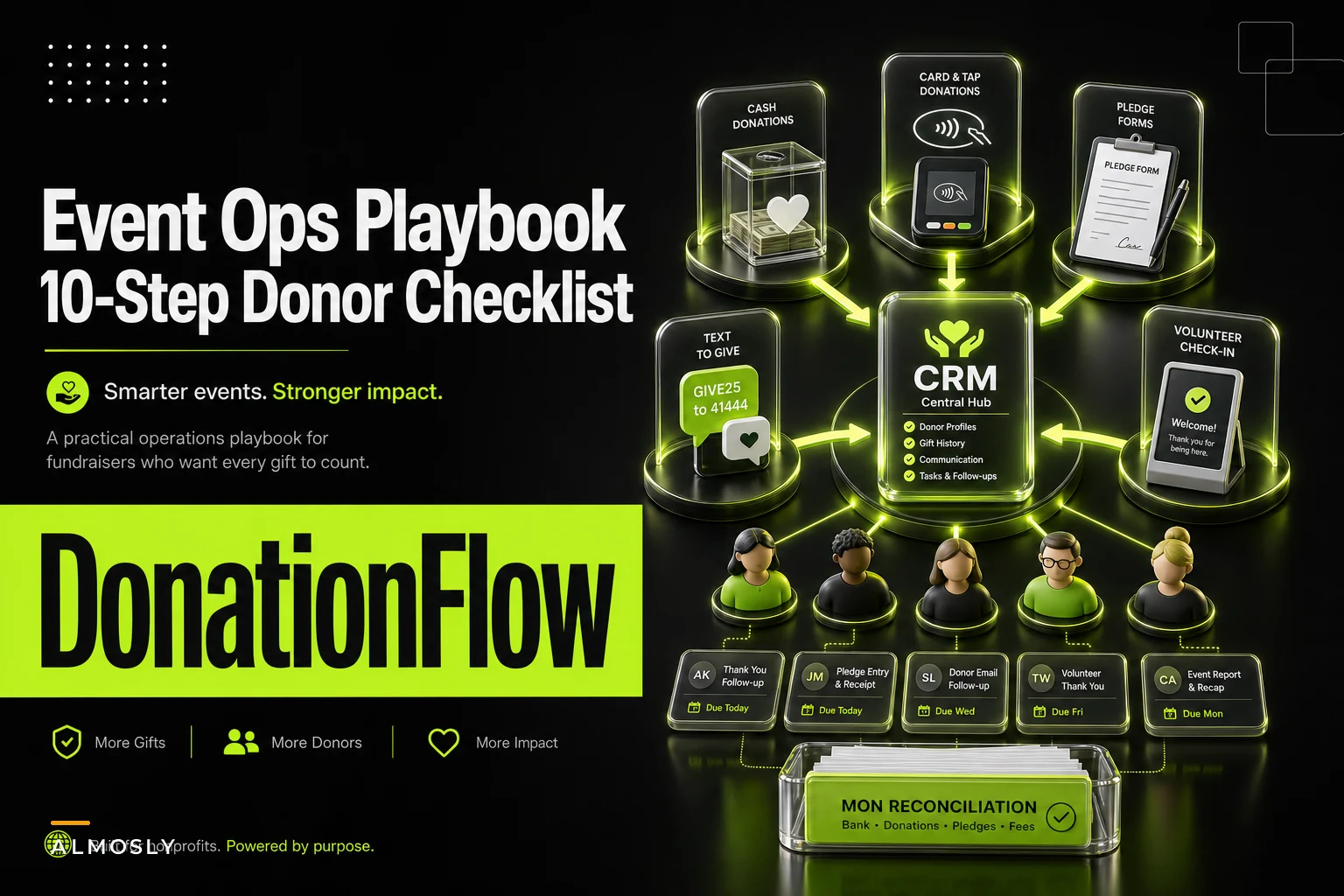
This is where a single operational system — whether that's a well-structured CRM or a workflow platform that ties event capture, task routing, and reconciliation together — earns its keep. The value isn't flashy. A pledge captured at a station on Saturday automatically becomes a follow-up task with a due date. A gift_status of "pending-charge" surfaces on the Day 3 list without anyone remembering it. Your end-of-night tally and your CRM batch are looking at the same numbers instead of two separate spreadsheets.
A quick visual of that routing looks like this.
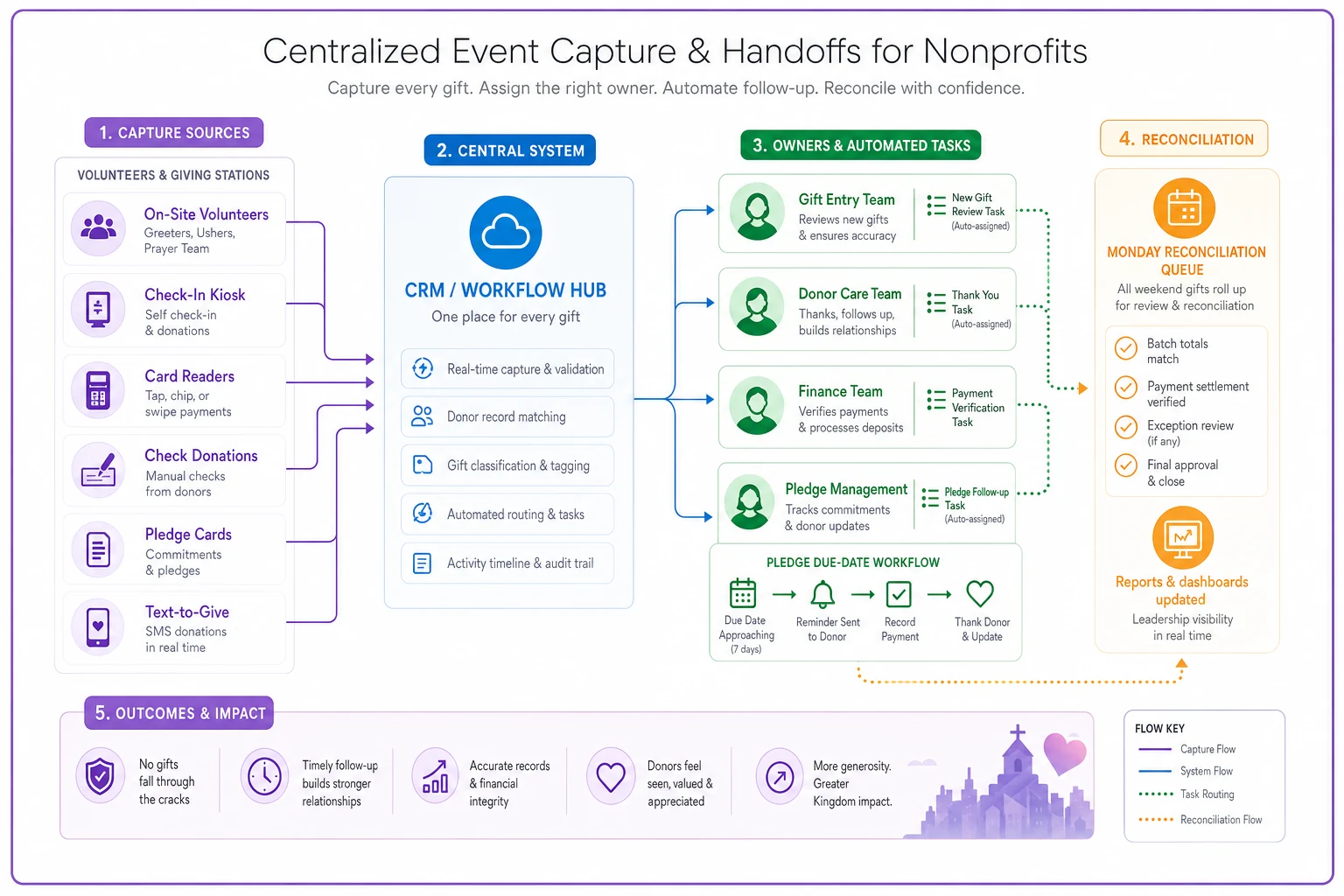
That kind of quiet routing removes the "someone was supposed to..." failures that cause most post-event messes. You don't need software to run a clean event. You need named owners, documented handoffs, and the discipline to reconcile fast. But at a certain event size, trying to hold all the handoffs in your head stops working, and a system that enforces the routing for you is the difference between a team that dreads the week after the gala and one that closes the books by Friday.
A quick real scenario
A regional literacy nonprofit ran an annual dinner-and-auction, around 180 guests, raising somewhere in the $70k–$85k range each year. Their recurring problem wasn't the total — it was that the "final" number kept moving for weeks after the event, and roughly a third of paddle-raise pledges never came in.
The fixes were unglamorous. They split collected from pledged with a gift_status field, assigned a floor lead whose only job was chasing down un-captured big pledges before guests left, and added a 40-minute end-of-night first-pass reconciliation. The next event, their pledge collection rate climbed from roughly 65% to the high 80s, the final tally was locked within 48 hours instead of three weeks, and the finance committee stopped asking why the number kept changing. No new fundraising. Just capture and follow-through that didn't leak.
Closing thought
A fundraising event is two events happening at once: the one guests experience, and the one your operations team lives through. Guests remember the room and the mission. Your team remembers the cash box that didn't balance and the pledge that got away.
The playbook above is about making sure those two experiences don't diverge — that the generosity in the room actually lands in your accounts, gets acknowledged fast, and leaves every donor feeling like they gave to an organization that has its act together. That feeling, more than any single gift, is what brings them back next year.
Ready to elevate your nonprofit impact?
Join 2,000+ nonprofits using Almosly to boost fundraising efficiency, deepen donor relationships, and scale philanthropic impact.