

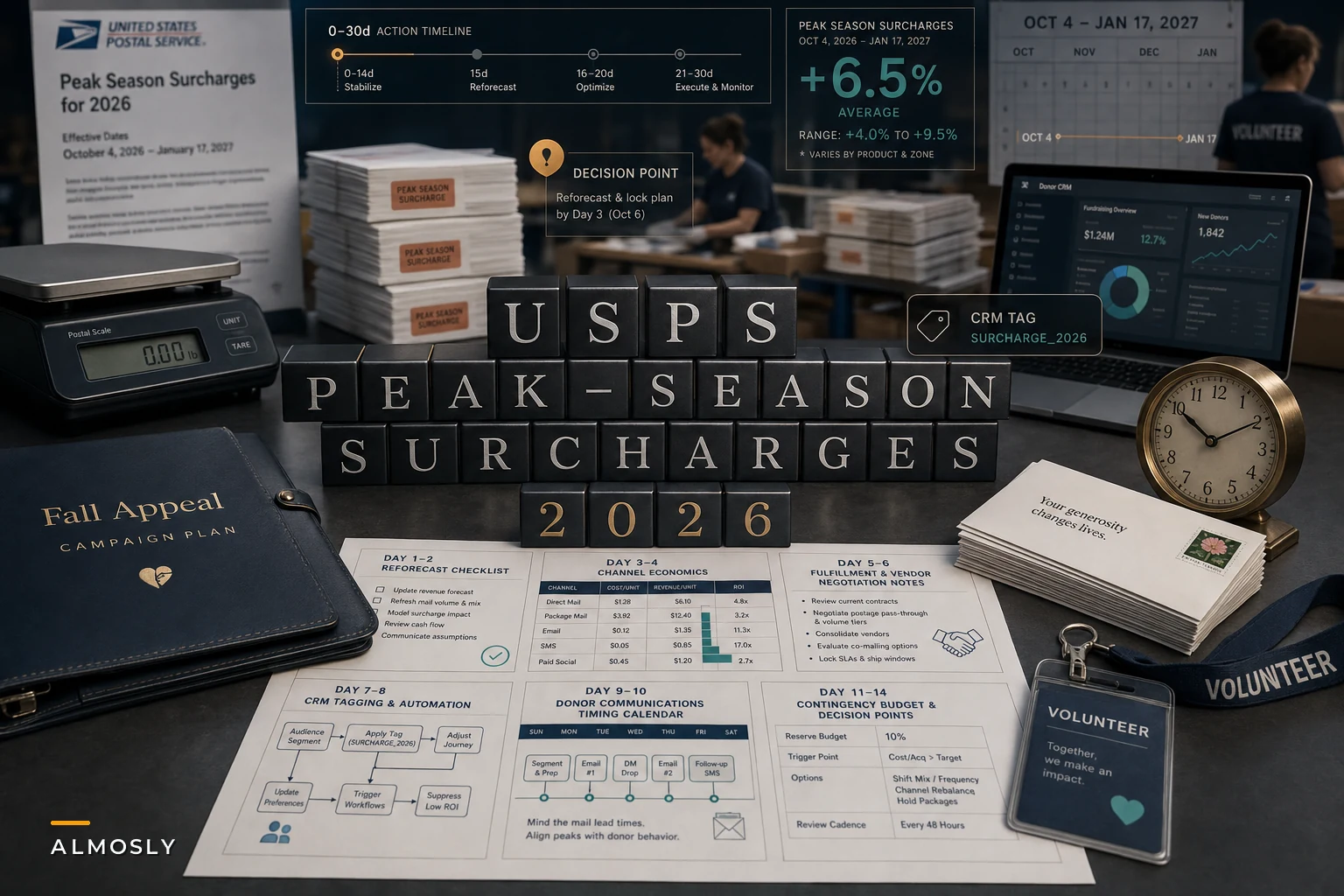

The USPS dropped the final version of its time‑limited peak‑season price files on September 18, 2026, locking in temporary surcharges running October 4, 2026 through January 17, 2027. If you want to look at the actual numbers yourself, the final Notice 123 files live on Postal Explorer, and the Postal Service outlined the broad strokes back in late August.
That window lands directly on top of your year‑end appeal, your premium‑mailing fulfillment, and every acknowledgment letter you plan to drop between Giving Tuesday and December 31. Most of the coverage treats this as a shipping story for retailers. For nonprofits it's quietly a budget story, a channel‑mix story, and — if you're not watching — a donor‑experience story.
This isn't a "postage went up, sorry" post. The surcharge itself is manageable. What it exposes is how fragile a lot of year‑end fundraising budgets are when a single cost input moves two weeks before launch.
First, separate what's hit from what isn't
The surcharges are weighted toward packages and certain retail parcel products — not your standard nonprofit bulk letter mail. That distinction matters more than anything else before you start reforecasting.
What this means in practice:
-
Your core direct‑mail appeal (letters, reply envelopes, standard nonprofit marketing mail) is largely insulated from the peak surcharge mechanics, though it sits inside the broader rate environment.
-
Your fulfillment operation — tote bags, calendars, address labels, premium thank‑you gifts, event merchandise, anything that ships as a package — is directly in the crosshairs.
-
Expedited and tracked donor communications you send as parcels get more expensive right when you need them most.
A common mistake: development teams treat "postage" as one line item. It isn't. The letter shop invoice and the fulfillment shipping invoice behave completely differently under this surcharge, and lumping them together produces a reforecast that's either wildly overblown or dangerously optimistic.
The real exposure is your merchandise and premium fulfillment
If your year‑end campaign leans on physical premiums — the branded blanket for a $100 gift, the signed book for major donors, the "adopt an animal" plush — your cost structure just shifted under you.
Stop missing fundraising opportunities.
Almosly helps you plan, track, and optimize every campaign with ease.
- Centralized donor and volunteer management
- Automated engagement workflows
- Impact and fundraising analytics
No credit card required
A realistic example. Say a mid‑sized humane society ships roughly 1,800 premium packages between early November and late December. Pre‑surcharge, blended shipping sat around $7.40 a package. The peak adjustments push a chunk of those into higher brackets, and the blended cost drifts toward $8.60–$9.10. That's somewhere in the range of $2,200–$3,000 in unbudgeted spend on a single premium program — not catastrophic, but enough to erase the margin on the lowest‑tier premium entirely.
That's the part most teams miss: the surcharge doesn't hurt your program evenly — it hurts your cheapest offers most. The $25‑gift tote that was already barely breaking even on fulfillment is now underwater. The $500 major‑donor premium absorbs the increase fine. So the question isn't "how much more will we spend?" It's "which specific offers no longer make sense to ship?"
Run the offer‑by‑offer math, not the program average
Before you touch anything else, build a quick table that looks at each premium or fulfillment offer on its own. Program averages hide the offers that are now losing money.
| Offer | Gift level | Old ship cost | New ship cost (est.) | Net after premium + ship | Decision |
|---|---|---|---|---|---|
| Sticker pack | $25 | $4.10 | $5.20 | ~$16 | Switch to digital/none |
| Branded tote | $50 | $7.40 | $8.90 | ~$33 | Keep, raise threshold to $60 |
| Calendar + card | $100 | $7.90 | $9.30 | ~$78 | Keep |
| Premium blanket | $250 | $11.20 | $13.50 | ~$210 | Keep |
| Signed book bundle | $500 | $14.00 | $16.80 | ~$455 | Keep |
The pattern is almost always the same. Your top two tiers are fine. Your bottom tier is the problem. The cleanest move is usually to retire the low‑tier physical premium, convert it to a digital alternative (a printable certificate, a named‑donor web page, an impact email), or quietly raise the gift threshold required to unlock it.
Your reforecast: a 14‑day sequence
You don't have months. The window opens in less than two weeks. Below is a tight order of operations that fits the time you actually have.
-
Pull your Notice 123 bracket exposure (Day 1–2). Get your fulfillment vendor or mailhouse to tell you exactly which of your package SKUs move brackets. Don't estimate this — ask for the specific per‑piece delta.
-
Rebuild the offer table above (Day 2–3). One row per premium. Flag anything that goes net‑negative or drops below a margin you're comfortable with.
-
Make kill/keep/convert decisions (Day 3–4). Retire the losers, convert where you can, keep the rest. Get sign‑off from whoever owns the campaign P&L.
-
Renegotiate or consolidate shipments (Day 4–7). Ask about batching, zone skipping, or shifting some volume to regional carriers for the surcharge window only. Even partial consolidation helps.
-
Update your CRM tagging (Day 5–8). Every retired or converted premium needs a flag so gift processing doesn't promise something you've discontinued. This is where teams get burned.
-
Rewrite the affected donor messaging (Day 8–11). Any appeal copy, landing page, or confirmation email referencing a now‑retired premium has to change.
-
Brief gift processing and volunteers (Day 11–14). Everyone touching fulfillment needs to know what changed before the first gift lands.
Steps 5 through 7 have nothing to do with postage. That's deliberate. The cost change is the easy part. The coordination is what fails.
Don't estimate this — ask for the specific per‑piece delta.
Here's a quick visual of the 14‑day sequence.
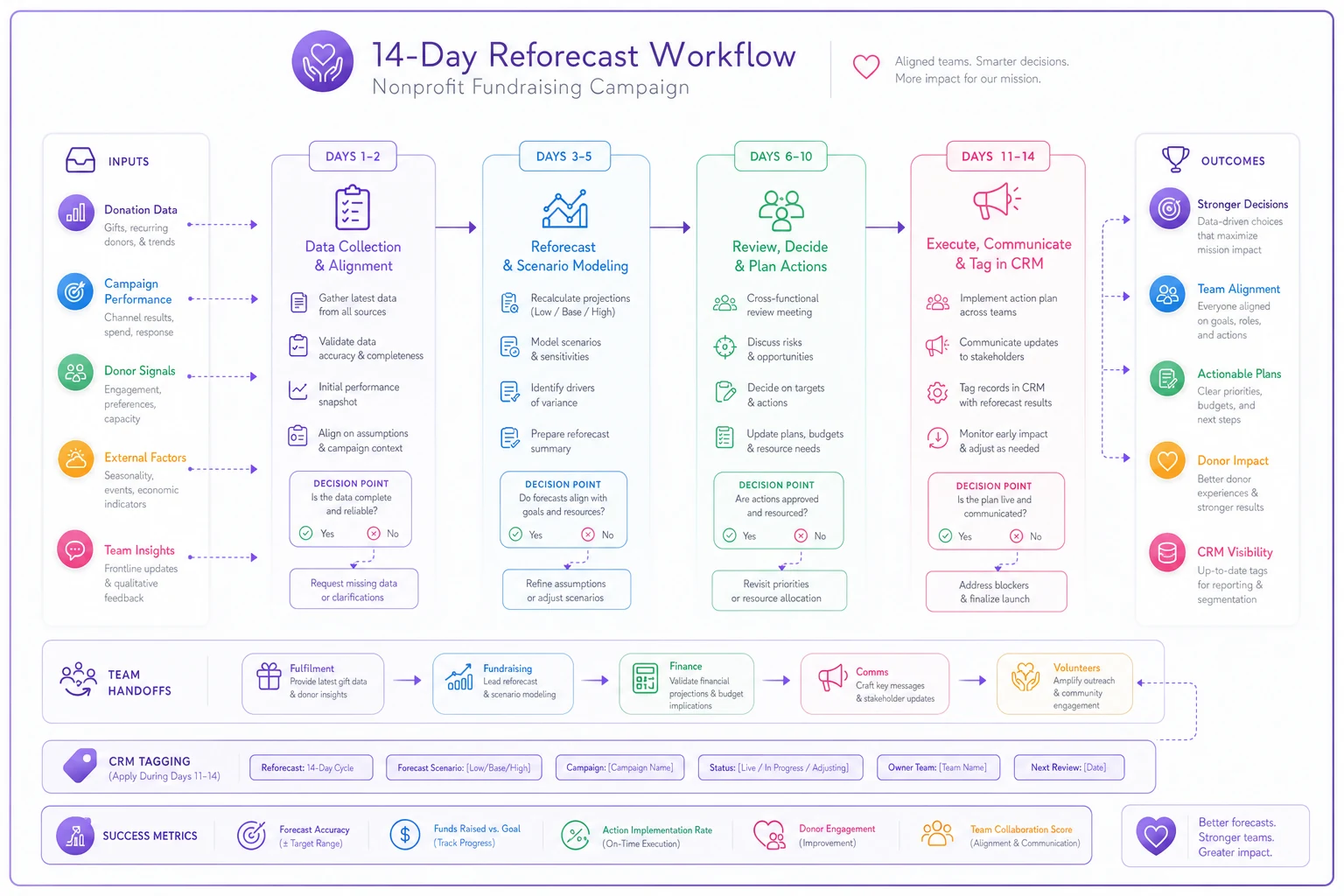
Use this to walk stakeholders through the short timeline.
The deeper problem this exposes
What the surcharge really reveals is that most fall campaigns are built as a sequence of handoffs that assume nothing upstream changes after launch. Fundraising sets the offers. Comms writes the copy. Finance builds the budget. The fulfillment vendor ships. Volunteers assemble. Each function trusts that the version they received is final.
When a single input moves — postage, paper cost, a vendor delay, a mismatched gift premium — the breakage doesn't show up where the change happened. It shows up three handoffs downstream, usually in the form of a donor who gets an acknowledgment promising a tote you stopped shipping two weeks ago.
This typically happens because the premium list in the appeal letter, the premium list in the CRM, and the premium list the fulfillment house is actually packing have quietly drifted out of sync. Nobody did anything wrong. There just wasn't a single source of truth that all three functions were working from.
That's not a postage problem — that's a cross‑team orchestration problem, and it's the exact failure mode we broke down in the cross‑functional orchestration playbook for fundraising, comms and volunteers. The surcharge is just the thing forcing the change this quarter. Next quarter it'll be something else.
A real scenario: regional food bank, year‑end premium program
A regional food bank runs a classic year‑end premium ladder: holiday cards at $35, a cookbook at $75, a branded insulated bag at $150. They ship roughly 2,400 premium packages in the November–December push, mostly through USPS parcel services.
When the peak files landed, their first instinct was to eat the cost — a few thousand dollars felt survivable. But when they built the offer‑by‑offer table, the holiday‑card tier was the real issue: the card itself cost about $2.80, shipping jumped from roughly $4.90 to $6.30, and the $35 gift was now returning under $26 after fulfillment. Across roughly 900 of those low‑tier gifts, that's a meaningful chunk of net revenue walking out the door on the cheapest product.
Their fix wasn't dramatic. They converted the $35 card to a digital‑only e‑card plus a printable thank‑you, raised the physical‑card threshold to $50, and left the two higher tiers alone. They also flagged the retired physical card in their CRM so gift entry would stop auto‑assigning it. Net effect: they recovered most of the margin erosion, cut their surcharge‑window package volume by around a third, and — almost by accident — reduced the volunteer hours they'd have needed during their busiest weeks. The donors who received the e‑card instead didn't churn at any meaningful rate.
The lesson wasn't "go digital." It was "the surcharge made us finally kill an offer that was barely working anyway."
When to shift budget from mail to digital — and when not to
The surcharge will tempt some teams to yank dollars out of mail entirely and pour them into email and ads. Sometimes that's right. Often it's a trap.
When a shift to digital makes sense:
-
The affected spend is fulfillment (packages), not acquisition mail. Fulfillment is the most convertible to digital.
-
You have an audience segment that already engages heavily by email and web.
-
The premium's emotional value survives digitization (a certificate, a named page, an impact video).
When it's a bad idea:
-
You're tempted to cut your core acquisition or renewal letter mail because "postage went up." That mail is largely outside the surcharge and remains your most reliable channel for older, high‑value donors.
-
Your major and mid‑level donors expect a physical touch. Cheaping out on their fulfillment to save a few dollars is penny‑wise and relationship‑foolish.
-
You'd be shifting budget into channels you don't already run well. The surcharge window is not the time to learn paid acquisition from scratch.
Who should mostly ignore this: small shops whose year‑end program is almost entirely letter‑based with no physical premiums. For you, the practical impact is near zero — spend your energy on your appeal copy and reply‑device, not on reforecasting a fulfillment line you don't have.
A pre‑launch checklist for the surcharge window
Run through this before your first November drop:
-
Confirmed with the fulfillment vendor which specific SKUs change brackets Oct 4–Jan 17
-
Built an offer‑by‑offer margin table and flagged net‑negative premiums
-
Made explicit kill / keep / convert decisions with P&L sign‑off
-
Explored shipment batching, zone optimization, or regional carrier options for the window
-
Retired or converted premiums flagged in the CRM so gift entry stays accurate
-
Updated all appeal copy, landing pages, and confirmation emails referencing changed premiums
-
Briefed gift processing and fulfillment volunteers on what changed and when
-
Set a single shared document of "current active premiums" all three teams work from
-
Scheduled one mid‑campaign check‑in (early December) to catch drift before year‑end crunch
The last two items are the ones most teams skip and most regret.
The part nobody budgets for: volunteer and ops redeployment
There's a second‑order effect worth naming. If you cut low‑tier physical premiums or consolidate shipments, you also change how many volunteer hours you need for assembly and packing — usually downward during your busiest stretch. That's a win, but only if you plan for it.
Teams that handle this well treat freed‑up volunteer capacity as something to redeploy, not just lose — shifting people to thank‑you calls, data cleanup, or donor stewardship touches that actually move retention. Teams that handle it badly just have idle volunteers wondering why the packing tables are half empty, and a coordinator who scheduled for a volume that no longer exists.
Either way: a cost change in one channel ripples into staffing, data, and donor experience. If you only reforecast the dollars, you'll miss most of the actual operational impact.
Bringing it together
The 2026 peak‑season surcharges are a small, time‑limited cost shock — but they're a useful stress test. They reveal whether your fall campaign is a coordinated operation with a single source of truth, or a chain of handoffs that falls apart the moment one input moves.
Do the offer‑by‑offer math instead of the program average. Kill the low‑tier premiums that were already marginal. Keep your core letter mail where it belongs. Update your CRM flags and your copy before the first gift lands, not after a donor emails asking where their tote is. Use the two weeks you have to get fundraising, comms, finance, and volunteers all reading from the same list. Handle it that way and the surcharge becomes a footnote. Ignore the coordination and it becomes the story your January debrief opens with.
Ready to elevate your nonprofit impact?
Join 2,000+ nonprofits using Almosly to boost fundraising efficiency, deepen donor relationships, and scale philanthropic impact.