

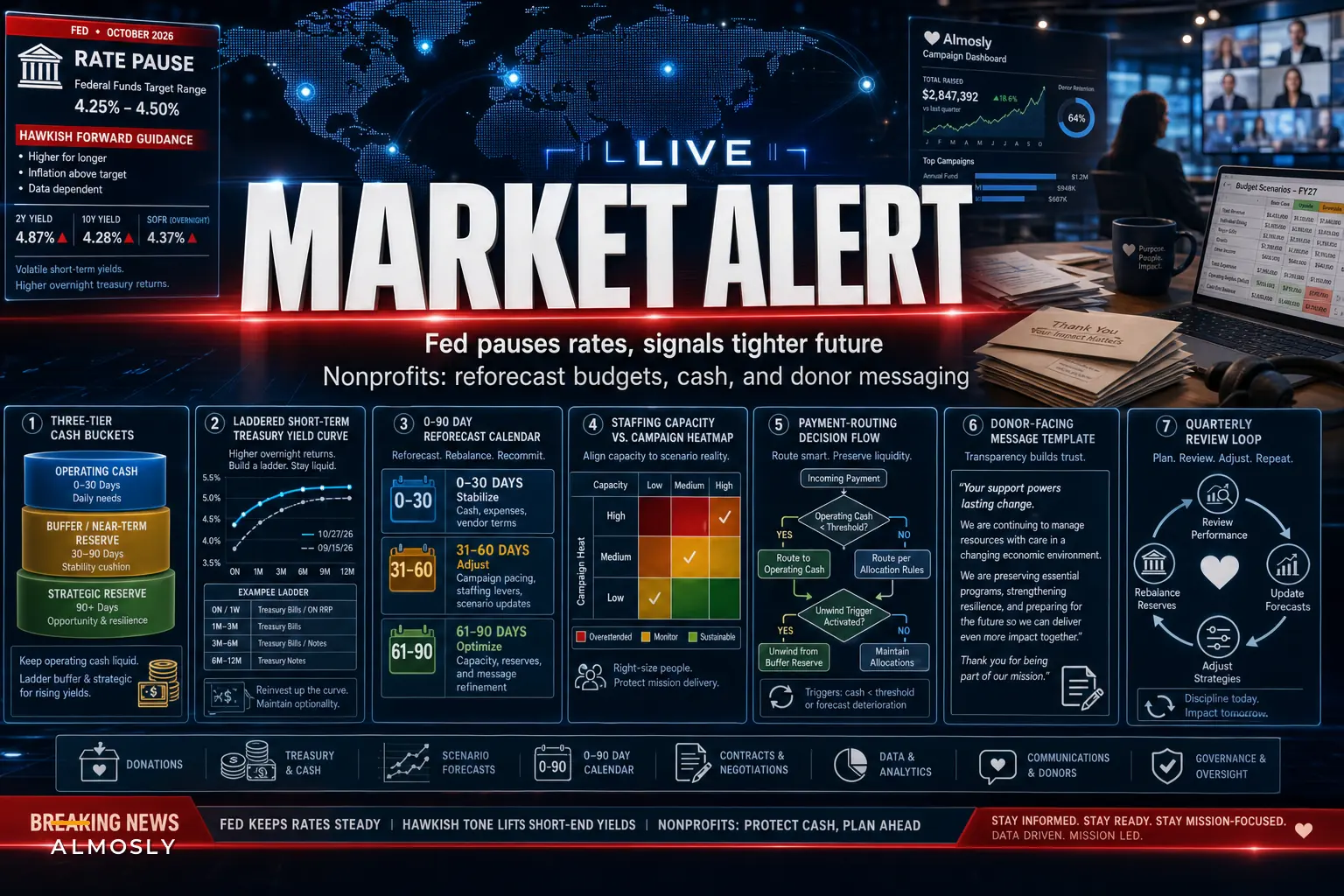

A rate hold sounds like nothing happened. That's the trap. When the Fed kept its policy rate at 3.75%–4.00% at the October 28–29 FOMC meeting and paired it with language suggesting further increases are still on the table, it quietly reset the planning assumptions a lot of nonprofit budgets are built on. According to Reuters' coverage of the decision, the combination of a strong-economy read and a hawkish tilt muddied the outlook for Treasuries — which is exactly the kind of ambiguity that wrecks a budget built on a single interest-rate assumption.
For most small-to-mid nonprofits, the question isn't "will rates go up." It's "which of my fixed assumptions just became a range I can't ignore." Reserve yield, line-of-credit interest, vendor pricing, and year-end donor capacity all sit downstream of what the Fed just signaled. If your FY plan assumed a steady glide downward in rates, that assumption is now weaker than it was two weeks ago.
The headline-reading version of this is useless to a CFO trying to close out Q4, so here's where it actually lands operationally.
Start with the three line items that move first
When rate expectations shift, nonprofit budgets don't move evenly. A few specific items react fast, and the rest lag. If you only have a few hours to respond to the October signal, spend them here.
1. Your short-term reserves and operating cash. If you're holding six figures in a near-zero checking account while rates sit near 4%, that's not conservative — it's a quiet loss. A $400k operating reserve earning nothing instead of a conservative ~3.8% money market is leaving somewhere around $15k a year on the table. That's a part-time program coordinator's wages.
2. Any variable-rate debt or line of credit. Nonprofits that drew on a line of credit to bridge a grant reimbursement gap are the most exposed here. If the Fed's hawkish lean keeps short rates elevated into next year, your bridge financing stays expensive longer than your budget assumed.
3. Vendor and fulfillment contracts tied to inflation or renewal pricing. Print houses, mail fulfillment, SaaS renewals, event vendors — they all reprice based on their own cost-of-capital and inflation expectations. A hawkish Fed signal tends to keep those renewal quotes firm rather than softening.
One pattern worth noting: organizations that treat the reserve question as a "finance committee someday" item usually discover the gap during an audit, long after the yield was recoverable.
What the pause exposes: single-point budgeting
The deeper problem the October meeting reveals has nothing to do with the Fed specifically. It's that most nonprofit budgets are built on single-point assumptions — one number for reserve yield, one for year-end giving, one for vendor costs — in an environment where every one of those is now a range.
Stop missing fundraising opportunities.
Almosly helps you plan, track, and optimize every campaign with ease.
- Centralized donor and volunteer management
- Automated engagement workflows
- Impact and fundraising analytics
No credit card required
A single-point budget is comfortable because it's simple. It's also brittle. When the macro picture gets "muddied" — the exact word the market used after this meeting — a single-point plan gives you no way to answer the board's first question: what happens if we're wrong?
Single-point vs. scenario budgeting
| Planning element | Single-point approach | Scenario approach |
|---|---|---|
| Reserve yield | "We'll assume 3.5%" | Low 2.8% / Base 3.8% / High 4.2% |
| Year-end giving | "Flat to last year" | Down 6% / Flat / Up 4% |
| Line-of-credit cost | "Same as this year" | +0 / +0.5% / +1.0% |
| Vendor renewals | "Budget 3% increase" | 3% / 6% / 9% |
| Decision trigger | None — react when numbers miss | Pre-agreed action per threshold |
The right column isn't more work once it's set up. It's one spreadsheet with three columns instead of one. The real shift is deciding in advance what you'll do when you cross a threshold — not debating it in a February board meeting while cash tightens.
Treasury and cash management: the quiet win most teams skip
Cash management is where a hawkish-hold environment creates actual upside, and it's the piece most small nonprofits leave untouched because "we're not a finance shop."
The mistake is treating all your cash the same. In reality, your cash sits in three buckets with very different jobs:
-
Operating cash — needs instant liquidity, should never chase yield
-
Buffer / near-term reserve — predictable needs 1–6 months out, can sit in a money market or short T-bill ladder
-
Strategic reserve / board-designated funds — 6+ months out, tolerates a slightly longer, laddered maturity
With rates held firm and possibly rising, a simple laddered approach on the buffer and strategic buckets captures yield without sacrificing the liquidity your operating account needs. A mid-sized org with roughly $900k across these buckets, moving only the buffer and strategic portions into conservative instruments, might pick up somewhere in the $20k–$28k range in annual yield versus leaving it idle — with no real change in risk tolerance.
A short process to run this cleanly:
-
Classify every dollar into operating / buffer / strategic. Most teams have never done this explicitly.
-
Set a minimum operating floor you will never dip below (e.g., 45–60 days of expenses).
-
Map maturities to needs — don't lock up money you need for March payroll in a 6-month instrument.
-
Write a liquidity trigger
if operating cash drops below X, you auto-unwind the buffer bucket first.
-
Review quarterly, not annually, while the rate picture stays ambiguous.
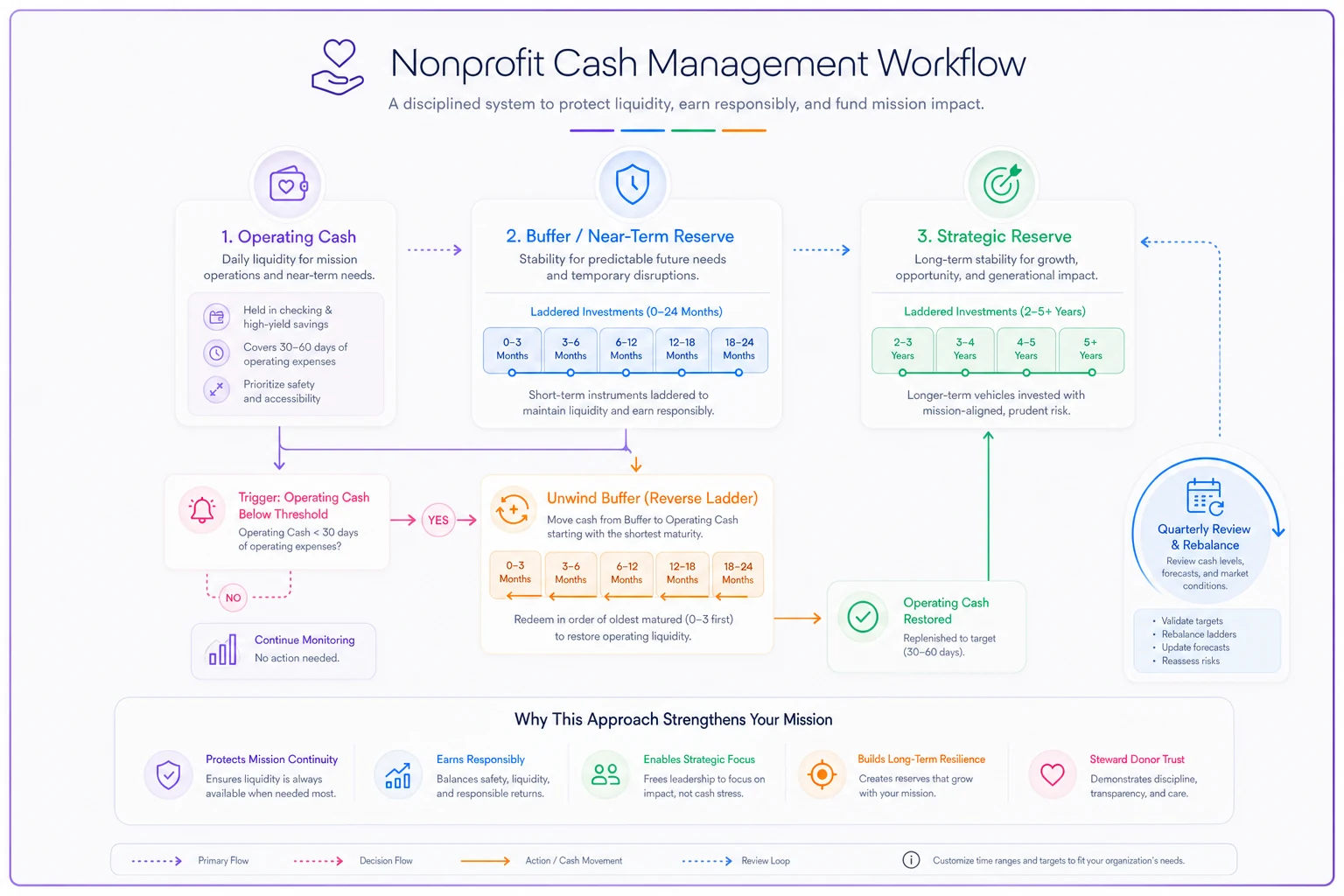
This simple diagram shows the cash buckets, laddering, and liquidity trigger in one view.
If you haven't explicitly split cash into buckets before, run the classification with your controller and program lead together — it surfaces assumptions quickly.
The nonprofits that get burned here almost always do it by over-locking. Yield is nice; a missed payroll is a crisis. When in doubt, keep more in the liquid bucket than feels necessary.
Fundraising forecasts: donor capacity is the variable you can't control
The uncomfortable part of a hawkish signal is what it implies for donor behavior. The Fed's read on economic strength sounds good in the abstract, but "rates may stay higher" filters down to your donors as higher mortgage costs, firmer credit card rates, and more cautious discretionary spending — heading into exactly the season you depend on.
This doesn't mean cut your year-end goal. It means stop treating that number as a single line.
Across a lot of year-end cycles, the mid-level and recurring segments are far more rate-sensitive than most teams assume, while committed major donors barely flinch. A hawkish macro turn tends to compress the middle — the $250–$2,500 givers who are doing fine but feel squeezed enough to downgrade their gift rather than skip it entirely.
So your reforecast should segment by sensitivity, not just by giving level:
-
Low sensitivity — committed major donors, multi-year pledges. Hold assumptions steady.
-
Medium sensitivity — mid-level and lapsed-reactivation prospects. Build a downside case (−5% to −10%).
-
High sensitivity — new acquisition and small recurring. Expect slower conversion; adjust acquisition cost expectations accordingly.
This is also where your capacity planning has to match your revenue planning. If you're running a downside revenue scenario but keeping an upside staffing and campaign plan, you've built a mismatch that only shows up when you can't afford the team you scheduled. Tying realistic output ranges to roles and FTEs is exactly the discipline laid out in this breakdown of a fundraising capacity model boards can actually use — and it's the natural partner to scenario budgeting. Your capacity model and your revenue scenarios should move together, or neither one is real.
A real scenario: a $2.1M human-services org reforecasting in November
Consider a human-services nonprofit with roughly $2.1M in annual revenue, about $600k in operating reserves, and a $150k line of credit it uses to bridge a government grant that reimburses on a 60-day lag.
Going into fall, their plan assumed rates drifting down, the line of credit costing roughly what it did the prior year, and year-end giving flat. After the October hold-plus-hawkish signal, the finance lead made three quick adjustments:
-
Reserves moved roughly $350k of buffer and strategic cash into a short T-bill ladder, picking up an estimated $12k–$14k in annual yield that was previously sitting idle.
-
Line of credit rebudgeted interest assuming rates hold rather than fall, adding roughly $1,200–$1,800 to projected carrying cost — small, but now expected instead of a surprise.
-
Giving split the year-end target into base/down cases, with a pre-agreed rule to delay one planned hire if year-end tracked below the down case by December 15.
Nothing dramatic happened. That's the point. When December donations came in slightly soft in the mid-level band — down about 7% — there was no emergency meeting. The trigger was already written, the hire was deferred, and the yield gain roughly offset the softness. The org absorbed a macro wobble without a single crisis conversation.
When this level of rework makes sense — and when it doesn't
Not every organization needs to overhaul its treasury policy over one FOMC meeting. Be honest about where you sit.
Worth doing now if you:
-
Hold more than roughly $250k in reserves earning little or nothing
-
Carry any variable-rate debt or rely on a line of credit for bridge financing
-
Depend heavily on mid-level and recurring donors for year-end revenue
-
Have vendor contracts renewing in the next two quarters
Probably overkill if you:
-
Run near-breakeven with minimal reserves (your energy belongs in revenue, not yield)
-
Have all debt locked at fixed rates
-
Already operate scenario budgets and a tiered cash policy — in which case, just refresh your assumptions and move on
Genuinely slow down if: you're a very small all-volunteer org with no finance staff. Chasing a few hundred dollars of yield by locking up cash you might need is a bad trade. Keep it liquid, keep it simple.
The part that actually sticks: make it a standing cadence
The organizations that handle rate uncertainty well don't react to each Fed meeting. They have a quarterly rhythm where reforecasting, cash classification, and vendor-renewal review already live on the calendar — so a hawkish signal just updates inputs rather than triggering a fire drill.
A lightweight quarterly checklist that holds up well:
-
[ ] Re-confirm operating / buffer / strategic cash split
-
[ ] Update reserve yield assumption to current money-market reality
-
[ ] Refresh base/down giving scenarios by donor sensitivity tier
-
[ ] Check any upcoming vendor renewals for rate/inflation exposure
-
[ ] Confirm each scenario still has a written action trigger
-
[ ] Reconcile the revenue scenario against the staffing/capacity plan
The Fed's actual October statement is worth skimming once a quarter for exactly one reason: to update the numbers in your scenarios, not to predict the future. Nobody at your organization needs to forecast rates. You need to make sure a surprise in either direction doesn't catch your budget flat-footed.
The pause isn't the story. The ambiguity is. And ambiguity is manageable the moment you stop planning around a single number and start planning around a range you've already decided how to respond to.
Ready to elevate your nonprofit impact?
Join 2,000+ nonprofits using Almosly to boost fundraising efficiency, deepen donor relationships, and scale philanthropic impact.