

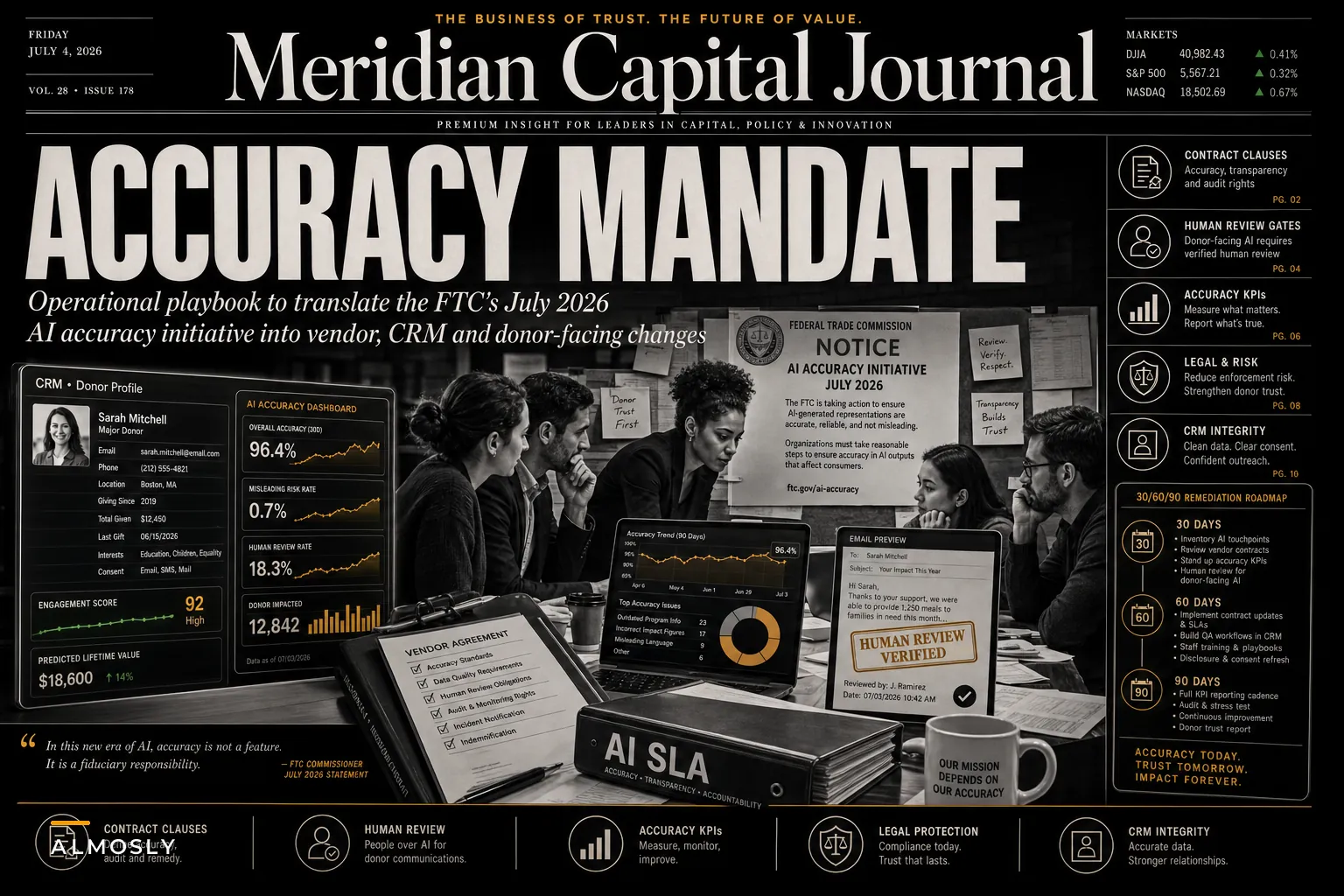

Last week, the FTC opened public comment on AI accuracy standards while federal officials met with tech companies about voluntary compliance measures. According to the FTC's announcement, they're specifically targeting organizations using AI for consumer communications and automated decisions. For nonprofits running donor personalization, automated thank-yous, or predictive giving models, this isn't some distant regulatory concern—it's an operational problem that's already sitting inside your systems.
Most mid-sized nonprofits are already running somewhere between four and seven different tools with AI features buried inside them. Their donor management platform auto-generates impact statements. Their email tool uses predictive send times. Their analytics dashboard segments donors using machine learning. Their chat widget responds to donor questions. None of these vendors are talking to each other about accuracy standards, and nobody on the nonprofit side is tracking what's automated versus what a human actually reviewed.
Here's what the nightmare scenario looks like: a major donor receives an AI-generated impact report claiming their $50,000 gift helped 500 families, when the actual number was 50. The donor discovers the error, files an FTC complaint, and suddenly your nonprofit is ground zero for AI accuracy enforcement. Donor trust collapses, recurring gifts get cancelled, foundation grants require new compliance attestations, and your development team spends the next six months in damage control instead of fundraising.
The vendor liability shell game nobody's winning
Every nonprofit vendor contract I've reviewed in the past year includes some version of this clause: "Customer acknowledges that AI features are experimental and provided as-is without warranty of accuracy." Translation: when the FTC comes knocking about that inaccurate donor communication, the vendor points to their terms of service and walks away.
This isn't theoretical. A food bank got burned by this exact scenario not long ago. Their CRM vendor's AI feature miscalculated meal equivalencies in donor reports for three months. When donors started asking questions, the vendor's response was essentially "check section 14.3 of our terms—AI outputs require customer verification." The food bank had to manually review and correct around 1,800 donor communications, send apology letters, and lost roughly $120,000 in year-end giving from confused donors.
The operational fix most nonprofits attempt—adding a human review step for all AI outputs—completely defeats the efficiency gains that justified the AI investment in the first place. One education nonprofit assigned their development coordinator to review all AI-generated content. She's now spending 15 hours a week on reviews, which means she's not doing donor calls, event planning, or any of the relationship-building work that actually moves the needle on donations.
Building an AI accuracy compliance framework that actually works operationally
The instinct is to create a massive compliance checklist and force everyone to follow it. That's exactly what fails. Your development team is already underwater, your operations manager is juggling twelve priorities, and your executive director thinks AI is something from a sci-fi movie.
Stop missing fundraising opportunities.
Almosly helps you plan, track, and optimize every campaign with ease.
- Centralized donor and volunteer management
- Automated engagement workflows
- Impact and fundraising analytics
No credit card required
What you need is a framework that embeds accuracy controls into existing workflows without adding friction. Here's what that looks like in practice:
Prioritize human review for donor-facing impact statements and automate low-risk outputs to preserve efficiency.
Start with output classification. Not all AI outputs carry the same risk. A predictive model suggesting which donors to call next? Low risk if wrong. An automated email telling donors their gift impact? High risk if inaccurate. Create three categories: no review needed, spot-check monthly, and human approval required. Most nonprofits find roughly 20% of their AI outputs need human approval, 30% need spot-checking, and 50% can run unsupervised.
Next, implement cascade documentation. This isn't about creating binders nobody reads. It's about building a simple audit trail that answers three questions: What AI tool generated this output? What data did it use? Who verified it? A development director at a healthcare nonprofit showed me their solution—a simple spreadsheet with columns for date, AI tool, output type, data sources, reviewer initials, and any corrections made. Takes 30 seconds per entry, and it saved them from a messy situation when a donor questioned their impact metrics.
The vendor accountability piece requires getting aggressive during contract negotiations. Stop accepting "AI is experimental" disclaimers. Start requiring specific accuracy benchmarks, error correction SLAs, and liability allocation. One environmental nonprofit now includes this clause in all vendor contracts: "Vendor guarantees 95% accuracy for donor-facing AI outputs or provides credit equal to 10x the monthly platform fee per documented error."
The hidden operational costs of AI accuracy compliance
Everyone talks about the efficiency gains from AI. Nobody mentions the shadow work it creates. Based on what's visible across the nonprofit sector, organizations are spending somewhere between $18,000 and $45,000 annually on AI accuracy management—and most don't even realize it.
Here's the breakdown from a typical 15-person nonprofit development team:
-
Staff time for output reviews
8–12 hours weekly ($24,000 annually)
-
Vendor management and contract negotiations
20 hours quarterly ($4,000 annually)
-
Error correction and donor communication fixes
40 hours per incident, average 3 incidents ($9,000 annually)
-
Compliance documentation and reporting
4 hours monthly ($3,600 annually)
-
Training and process updates
16 hours quarterly ($4,800 annually)
The organizations handling this well aren't trying to eliminate these costs—they're building them into operational planning. A performing arts nonprofit in Chicago added a 0.25 FTE "AI Operations Coordinator" role specifically to handle accuracy reviews, vendor management, and compliance documentation. Sounds excessive until you realize they're processing 12,000 donor communications monthly and a single accuracy error could trigger hundreds of complaints.
Proactive accuracy monitoring before the FTC forces your hand
Waiting for accuracy problems to surface through donor complaints is like waiting for the smoke alarm—by then, the damage is already done. The nonprofits avoiding AI accuracy disasters have built proactive monitoring into their operations.
A youth services nonprofit developed what they call "accuracy honeypots"—test donor records with known values that should trigger specific AI outputs. Every week, they check if their AI tools correctly calculate giving levels, segment donors accurately, and generate appropriate thank-you messages. When outputs drift from expected results, they catch it before real donors see errors.
Another approach: statistical sampling of AI outputs. An animal welfare organization reviews a random 2% sample of all AI-generated donor communications weekly. Takes their development associate about 90 minutes, but they've caught three significant accuracy issues before they became donor-facing problems. One was their email platform's AI subject line generator creating misleading urgency ("Last chance to save pets today!" when the campaign had two weeks left).
The monitoring that actually matters focuses on accuracy drift over time. AI models don't suddenly fail—they gradually degrade as data patterns change. Track accuracy metrics monthly: percentage of correct donor segmentations, accuracy of predicted giving amounts, error rates in automated thank-you messages. When accuracy drops below 90% for any metric, that's your trigger to investigate before donors notice.
Donor disclosure and consent in an AI-automated world
The consent language most nonprofits use was written before AI touched donor communications. "We may share your information with service providers" doesn't cover AI analyzing giving patterns to generate personalized appeals. This gap between old consent language and new AI practices is exactly where FTC enforcement will hit hardest.
Reuters reported that the FTC is particularly focused on disclosure requirements for automated decision-making. For nonprofits, this means every AI touchpoint needs clear disclosure. But slapping "This message was generated by AI" on every communication kills donor engagement faster than a broken donation form.
The operational sweet spot is contextual disclosure. When AI makes decisions that affect donors—like excluding them from campaigns, changing ask amounts, or determining communication frequency—that needs explicit disclosure. When AI simply helps format a thank-you letter that a human reviews, disclosure can be lighter. A social services nonprofit nailed this balance with tiered disclosure: full explanation for AI-driven decisions, brief mention for AI-assisted content, no mention for AI backend operations that don't affect donor experience.
Update your privacy policy, but don't stop there. Create an "AI in Our Operations" page that donors can actually understand. Explain what you automate, what stays human, and how donors can request human review of any automated decision. A disability advocacy nonprofit created a simple flowchart showing exactly which donor interactions involve AI and which remain fully human. Donor complaints dropped significantly after they published it.
When AI accuracy failures cascade through nonprofit operations
The real damage from AI accuracy failures isn't the initial error—it's the operational cascade that follows. A museum's AI-powered donor segmentation tool miscategorized 400 mid-level donors as major donors. The development team sent them exclusive event invitations meant for $10,000+ donors. When these $500 annual donors showed up to a black-tie gala expecting a standard fundraising dinner, the awkwardness was just the beginning.
The cascade looked like this: confused donors at the wrong event level, emergency staff meetings to figure out what happened, 400 apology calls taking roughly 200 hours of staff time, reissued event invitations, three weeks of database cleanup, a vendor investigation revealing a data field mapping error, contract renegotiation, new QA processes adding five hours weekly to workload, and ultimately around $280,000 in lost donations from donors who felt misled by the mix-up.
Each accuracy failure creates its own cascade pattern. Email personalization errors lead to donor trust issues, then increased unsubscribes, then campaign performance drops, then panic overcorrection. Impact reporting errors trigger donor questions, then manual report regeneration, then delayed campaign launches, then missed fundraising targets. Predictive model failures cause resource misallocation, then staffing scrambles, then donor relationship gaps, then retention drops.
The vendor audit process that actually protects you
Auditing your AI vendors isn't about checking boxes—it's about understanding exactly how their AI could blow up your donor relationships. Skip the generic security questionnaires. Focus on operational AI accuracy.
Questions that matter:
-
What percentage of your AI outputs have been flagged as inaccurate by clients in the past year?
-
How do you measure and track AI accuracy over time?
-
What happens when your AI makes an error that damages donor relationships?
-
Who pays for the cleanup when AI accuracy failures occur?
-
How quickly can AI features be disabled if accuracy problems emerge?
-
What training data was used for AI models that touch donor data?
A conservation nonprofit created an "AI Vendor Scorecard" tracking five metrics across all their tools: accuracy rate from spot-checks, error severity when mistakes occur, vendor responsiveness to accuracy issues, contractual liability acceptance, and ease of disabling AI features. They review scores quarterly and have already switched two vendors based on poor accuracy performance.
The audit process should also map data flows between systems. Your email platform's AI might be making decisions based on data from your CRM's AI segmentation, which uses outputs from your analytics platform's AI predictions. When accuracy errors compound across systems, small mistakes become major disasters. One nonprofit discovered their donation ask amounts were off by 300% because three different AI systems were each "optimizing" the amounts sequentially.
Building staff capacity for AI accuracy management
Your development team didn't sign up to be AI accuracy cops, but that's exactly what AI accuracy compliance demands. The organizations managing this well aren't trying to turn fundraisers into tech experts—they're building practical capacity that fits how nonprofits actually operate.
Start with role-based training. Your major gifts officer needs to know how to spot AI errors in donor research briefs. Your communications manager needs to understand when AI-generated content requires human review. Your data analyst needs to know how to validate AI model outputs. But nobody needs to understand machine learning algorithms. A homeless services nonprofit created one-page "AI accuracy checklists" for each role—simple, specific, and actually used.
Create accuracy champions, not another committee. Pick one person per department who spends two hours monthly reviewing AI outputs from their area. They're not responsible for fixing everything—just for flagging patterns and problems. These champions meet monthly for 30 minutes to share what they're seeing. This distributed model catches accuracy issues faster than centralized monitoring ever could.
Documentation beats training every time. Instead of quarterly training sessions everyone forgets, build accuracy checks into daily workflows. One international development nonprofit added accuracy checkpoints to their existing process documents. Now their gift processing workflow includes "Verify AI-calculated donation receipt amounts" as step 4, right between payment processing and receipt generation. Simple, integrated, actually happens.
The technical architecture of AI accuracy compliance
Behind every nonprofit's donor communication is a tangle of integrated systems, each with its own AI features making decisions nobody fully understands. The operational challenge isn't just tracking accuracy—it's knowing which system made which decision when everything's interconnected.
A refugee resettlement organization mapped their AI touchpoints and found 23 different places where AI affected donor communications. Their email platform used AI for send-time optimization. Their CRM used AI for donor scoring. Their analytics tool used AI for segmentation. Their chat system used AI for initial responses. Each system passed data to others, creating what one operations manager called "an AI game of telephone where nobody knows who said what."
The fix isn't ripping out all AI features. It's building what works best as an "AI decision log"—a central record of which AI system made which decision for each donor interaction. Sounds complex, but the implementation is straightforward. They added a custom field to their CRM that tracks AI involvement using simple codes: "E-ST" for email send-time optimization, "C-DS" for CRM donor scoring, "A-SEG" for analytics segmentation. Takes seconds to code, saves hours when investigating accuracy issues.
Your operational software needs to support accuracy tracking, not just AI features. The platforms getting this right provide AI audit logs showing exactly what the AI did, what data it used, and what output it generated. One nonprofit discovered their email platform's AI was making send-time decisions based on three-month-old engagement data because the API connection had partially failed. Without audit logs, they never would have found the problem.
Below is a simple visual to help teams design an AI decision logging workflow for donor communications.
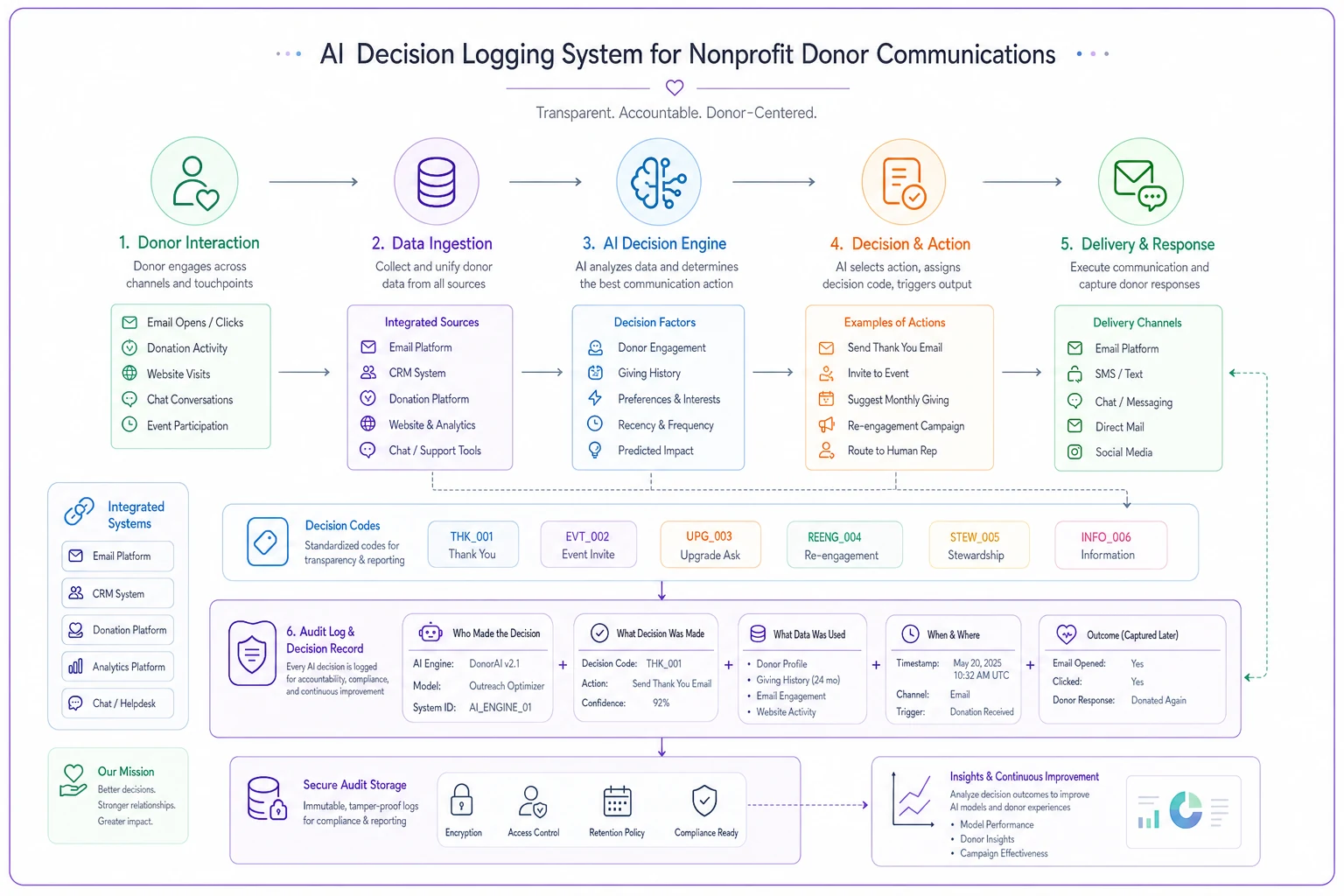
A practical implementation: add AI decision codes to CRM records, ensure each downstream system writes to the decision log, and surface the log in vendor audits and incident investigations.
Creating a donor-first response plan for AI errors
When AI accuracy failures hit donor communications, your response in the first 48 hours determines whether you lose ten donors or ten thousand. Most nonprofits panic, overcommunicate, and make the situation worse. The ones that maintain donor trust have a response plan ready before anything goes wrong.
First principle: segment your response based on actual impact, not potential exposure. An education nonprofit discovered their AI had been overstating program impact by 15% in automated thank-you emails. Instead of blasting an apology to all 8,000 donors, they identified the 400 who received incorrect messages, the 50 who opened them, and the 12 who clicked through for more information. They called those 12 personally, emailed the remaining 38 who opened, and monitored the rest. No mass panic, no viral complaint threads, no donor exodus.
Your response team shouldn't be your entire leadership. Pick three people: someone who understands the technical error, someone who owns donor relationships, and someone with decision authority. Everyone else is operational support, not decision-makers. When an environmental nonprofit's AI generated wildly inaccurate carbon offset calculations, their three-person response team made decisions in 15-minute stand-ups while everyone else executed fixes.
The communication itself matters less than the operational fix. Donors forgive errors—they don't forgive patterns. Your response should explain not just what went wrong, but what systematic changes prevent recurrence. A food security nonprofit turned an AI accuracy failure into a donor retention win by sharing their new "human verification guarantee" for all impact claims. Donors actually increased giving after seeing the organization's commitment to accuracy.
The integration layer between AI accuracy compliance and donor data governance
AI accuracy compliance doesn't exist in isolation—it's inseparably linked to your broader donor data governance framework. The nonprofits struggling with AI accuracy are usually the same ones with messy data governance. Bad data plus AI equals exponentially bad outputs.
Your AI segmentation tool can only be as accurate as the donor data it's analyzing. If half your donors have outdated giving histories because gift processing is three weeks behind, your AI will generate segments that are wrong before you even account for AI-specific errors. An arts nonprofit learned this the hard way when their AI tool excluded major donors from a capital campaign because recent gifts hadn't been processed yet.
The operational fix is treating AI accuracy as an extension of data quality management. Every data governance process needs an "AI impact assessment" step. When you update data retention policies, consider how that affects AI training data. When you implement new consent processes, include AI use cases. When you clean donor records, track how that changes AI outputs. A human services nonprofit added "AI Accuracy Impact" as a column in their data governance tracking sheet—takes seconds to fill out, prevents hours of downstream problems.
Your data governance team—even if that's just one person with multiple hats—needs to own AI accuracy standards too. They already understand data quality, validation rules, and system dependencies. Adding AI accuracy to their scope is more efficient than creating a parallel process. They're also usually the only ones who actually understand how data flows between systems, which is critical for tracking AI decision chains.
Measurable outcomes and realistic timelines
Here's what AI accuracy compliance actually looks like at a functioning nonprofit. A community health organization started their accuracy overhaul in January after a near-miss with incorrect donor impact statements. Here's their six-month trajectory:
| Month | Details |
|---|---|
| Month 1: | Mapped all AI touchpoints (found 18 across 6 systems), identified high-risk outputs (4 donor-facing, 2 operational), assigned accuracy owners (one per department). Time investment: 20 hours total. Accuracy errors caught: 0 (weren't looking yet). |
| Month 2: | Implemented weekly spot-checks on high-risk outputs, created basic documentation templates, started vendor conversations about liability. Time investment: 15 hours total. Accuracy errors caught: 3 minor (wrong donation ask amounts). |
| Month 3: | Launched monthly accuracy reviews, added AI disclosure to privacy policy, negotiated first amended vendor contract with accuracy SLAs. Time investment: 25 hours total. Accuracy errors caught: 1 major (segmentation excluding 200 active donors). |
| Month 4: | Deployed automated accuracy monitoring for two systems, trained staff on role-specific accuracy checks, created donor-facing AI transparency page. Time investment: 18 hours total. Accuracy errors caught: 2 minor (predictive model drift). |
| Month 5: | Completed vendor audit process, implemented AI decision logging, ran first accuracy fire drill. Time investment: 12 hours total. Accuracy errors caught: 1 minor (proactively found through monitoring). |
| Month 6: | Achieved steady-state operations with 8 hours monthly for ongoing accuracy management. Donor complaints about communications: zero. Confidence in AI outputs: actually measurable. |
The pattern holds across organizations: two months of heavy lifting, two months of refinement, two months of optimization, then ongoing maintenance at roughly 25% of initial effort. The nonprofits that fail try to do everything at once or nothing at all.
The FTC's focus on AI accuracy isn't just a regulatory burden—it's forcing nonprofits to fix problems that were already quietly eroding donor trust and operational efficiency. The organizations that build robust accuracy management now won't just avoid regulatory issues. They'll have donor communications that actually work, operations that run cleanly, and AI investments that deliver real value instead of creating hidden work.
Start with the high-risk AI outputs that touch donors directly. Build accuracy checks into existing workflows rather than creating new processes. Push vendors for real accountability instead of accepting weak disclaimers. Track accuracy metrics that matter for donor trust, not just technical performance.
AI accuracy management is really just operational excellence under a different name. Every accuracy control you implement makes your nonprofit run better, regardless of what the FTC does next. The development directors who understand this are building accuracy management that strengthens their entire operation, not just checking compliance boxes.
The nonprofits thriving in twelve months won't be the ones with perfect AI—they'll be the ones with operational systems that catch and correct AI errors before donors ever notice. That's not just compliance. That's competitive advantage in an increasingly automated nonprofit sector.
Ready to elevate your nonprofit impact?
Join 2,000+ nonprofits using Almosly to boost fundraising efficiency, deepen donor relationships, and scale philanthropic impact.