


The email from Wells Fargo's corporate giving team hit my inbox at 8:47 AM yesterday morning. Three sentences. Program suspended indefinitely. Thanks for understanding.
Four hours later, a board member texted me about her neighbor—a senior software engineer at Meta who just got cut and wants to volunteer full-time while job hunting. By lunch, our food bank partner called asking if we could handle a 40% spike in families needing assistance next month.
This is what May 2026 looks like for nonprofits. According to Reuters, companies are cutting thousands of positions as they restructure operations around AI capabilities. The ripple effects are hitting nonprofits from every angle—donor revenue, volunteer availability, and service demand all shifting at once.
It's not just about managing through a temporary downturn. These layoffs represent a fundamental shift in how corporations allocate resources, how individuals engage with causes, and how communities need support. The nonprofits that adapt operations now will emerge stronger. Those waiting for things to "normalize" might not make it through.
Corporate giving programs are shifting, not just shrinking
Most nonprofits treat corporate layoffs as simple math—fewer employees means less payroll giving. Companies restructuring their philanthropy during cuts reveals something different.
Tech companies cutting staff by 15-20% are simultaneously increasing their AI ethics and digital equity giving by similar percentages. Healthcare organizations eliminating administrative roles are doubling down on community health initiatives that demonstrate measurable ROI. Financial services firms reducing headcount maintain total giving levels but concentrate funds among fewer, larger recipients who can prove direct business alignment.
Your existing corporate partnerships probably target the wrong metrics. That three-year employee engagement partnership you negotiated in 2024? The matching gift program tied to headcount? The volunteer hours commitment based on team-building days? All built on assumptions that no longer hold.
Start by auditing every corporate partnership for vulnerability. Pull your agreements and flag anything tied to employee counts, office locations, or departmental budgets. A midwest credit union foundation discovered 60% of their corporate funding had triggers that would reduce or eliminate support if employment dropped below certain thresholds. They renegotiated four major partnerships in March, shifting metrics from employee participation rates to community impact scores.
Then rebuild your corporate pitch around their new reality. Companies restructuring around AI need philanthropy that supports their narrative. A youth coding nonprofit in Austin completely rewrote their corporate deck after the first wave of tech layoffs. Instead of emphasizing volunteer coding instructors (which reminded companies of the engineers they just cut), they focused on preparing underserved students for the "AI-augmented workforce." Their corporate revenue actually increased by roughly $400K between January and April.
Create flexible engagement models that work regardless of headcount. Traditional employee giving campaigns assume stable workforces and predictable participation. Instead, design programs that scale automatically. One environmental nonprofit switched from annual workplace campaigns to project-based sponsorships—companies fund specific conservation initiatives that run whether they have 500 or 5,000 employees.
Individual donors need different math when their income disappears
About 30% of affected donors maintain some giving even during unemployment—but only if you handle the transition right. Another 40% will resume giving within 6 months of reemployment, assuming you don't alienate them during the gap. The remaining 30% are genuinely lost, at least temporarily.
Stop missing fundraising opportunities.
Almosly helps you plan, track, and optimize every campaign with ease.
- Centralized donor and volunteer management
- Automated engagement workflows
- Impact and fundraising analytics
No credit card required
Most nonprofits treat all payment failures the same. Your systems probably flag a declined recurring donation, send three automated emails over two weeks, then mark the donor as lapsed. That process works fine for expired credit cards. It's exactly wrong for someone who just lost their income.
Build a layoff response workflow that actually protects donor relationships. When a recurring donation fails, check if it's from a company email domain experiencing layoffs. A human services nonprofit in Seattle built a simple tracking system: they monitor news for major local layoffs, flag all donors with those email domains, and proactively reach out before the first payment failure.
The outreach matters more than the ask. Don't send a donation reminder to someone who might be updating their LinkedIn profile and rationing groceries. Send a message acknowledging the situation, offering your services if relevant, and explicitly stating you're pausing their donation with no action required. Include one sentence about resuming support "whenever the time is right" with a link they can bookmark.
Your donor database probably can't handle this elegantly. Most nonprofit CRMs treat donors as either active or lapsed, with no middle ground for "temporarily paused due to life circumstances." You need a parallel tracking system—even a basic spreadsheet works—that monitors paused donors separately from truly lapsed ones.
Design re-engagement campaigns specifically for returning donors. Someone reemployed after four months of job searching has different motivations than a standard lapsed donor. They often feel guilty about the gap and worry you'll judge them for stopping. Your messaging should emphasize continuity—"welcome back" rather than "we missed you"—and make resuming support frictionless.
Volunteer capacity shifts create opportunity if you move fast
A laid-off marketing director with 15 years of experience wants to volunteer 30 hours a week while job hunting. Fantastic, except your volunteer coordinator is overwhelmed managing existing volunteers whose availability just became erratic due to job uncertainty. You have three weeks, maybe four, before that marketing director finds new employment and disappears.
The challenge isn't finding volunteers—it's rapidly matching sophisticated skill sets to meaningful work before the window closes. Most volunteer management systems assume steady-state operations: predictable tasks, stable time commitments, gradual onboarding. Layoff-driven volunteering breaks all these assumptions.
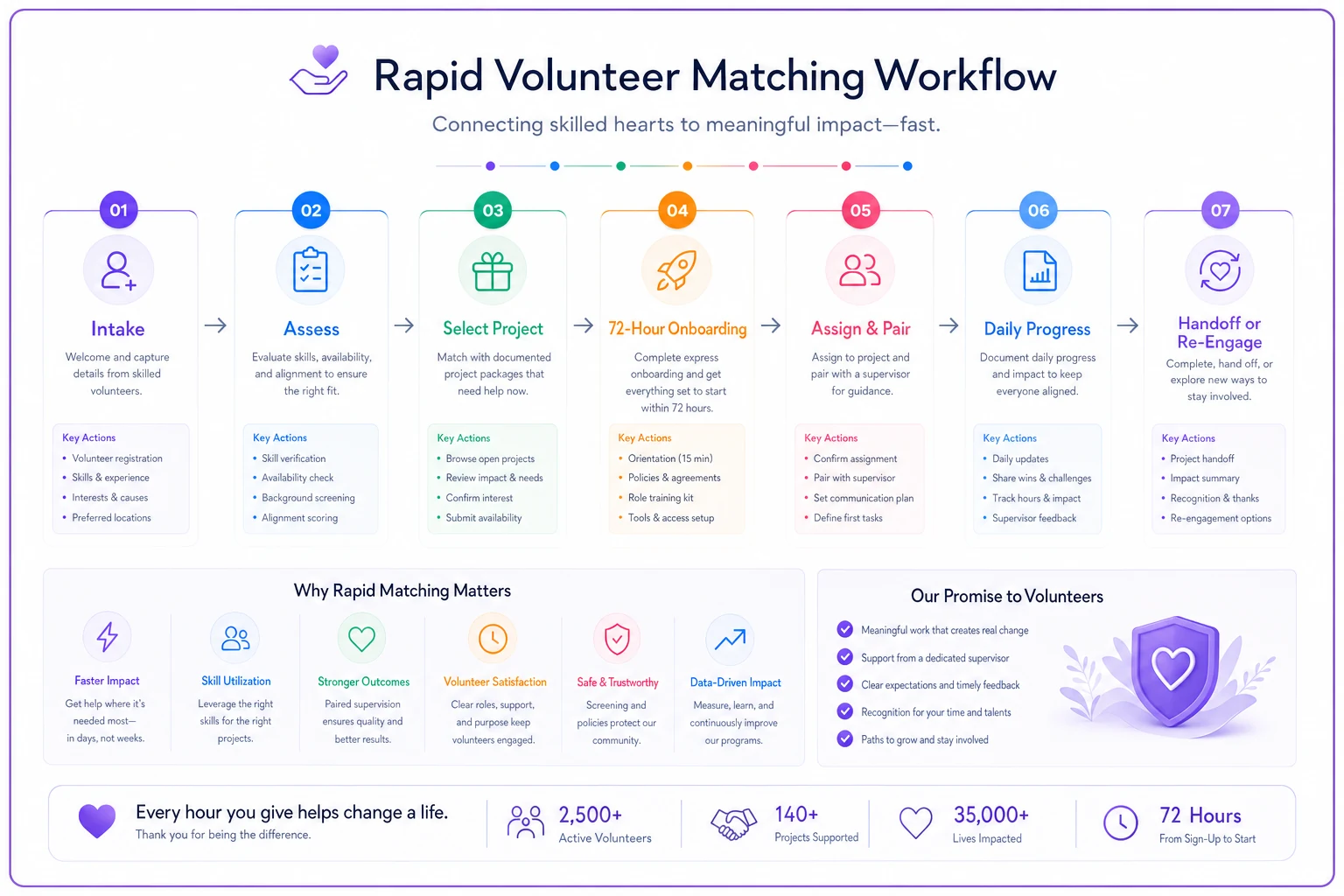
Create rapid deployment pathways for high-skill temporary volunteers. Instead of your standard volunteer orientation (usually scheduled monthly), build an express track that gets professional volunteers working within 72 hours. An education nonprofit in Denver created "sprint volunteering"—two-week intensive projects designed for professionals between jobs. Their first sprint volunteer, a laid-off data analyst, built a student outcome tracking system that would have cost $30K to outsource.
Prepare project packages before you need them. Document 10-15 high-value projects that skilled volunteers could complete in 2-4 weeks with minimal supervision. Include clear scope, required skills, and expected deliverables. When a qualified volunteer appears, you match them to a ready project instead of scrambling to invent meaningful work.
This quick visual shows the core steps of a rapid volunteer matching workflow.
But watch for capacity mismatches that destabilize operations. A food bank in Portland learned this when eight tech workers started volunteering full-time simultaneously. They had more strategic planning help than they could absorb while still needing people to sort donations and stock shelves. The executive director spent more time managing volunteer consultants than running programs.
Pro-tip: Keep 10-15 short, documented project briefs with clear deliverables in a shared folder so you can match and deploy skilled volunteers immediately.
Balance strategic volunteer projects with operational needs by setting ratios. For every professional volunteer doing strategic work, ensure you have three handling routine tasks. This might mean turning away some high-skill volunteers or asking them to split time between strategic projects and operational support.
Your volunteer scheduling system needs adjustments too. Standard volunteer capacity planning assumes relatively stable availability patterns. Post-layoff volunteers have intense but unpredictable schedules—fully available until they get an interview, then gone for three days, then back until they start their new job.
Build flexibility into critical roles. Never let a laid-off volunteer become the single point of failure for any program. A youth mentorship organization learned this when their volunteer grant writer—a laid-off development director—got hired mid-cycle and left three proposals half-finished. Now they require all temporary volunteers to work in pairs or document progress daily.
Revenue forecasting breaks when historical patterns stop predicting
Traditional nonprofit revenue forecasting relies on year-over-year comparisons and seasonal patterns. May 2026 broke every model.
A performing arts nonprofit ran their standard mid-year forecast in early May. The model predicted a 3% increase in annual giving based on Q1 results and five-year trends. By May 20, after the second wave of regional layoffs, actual pledges were tracking 18% below projection. Their fall gala—usually 40% of annual revenue—had corporate table sales down 50% from the same period last year.
The problem isn't that forecasting is impossible during disruption. Most nonprofits keep using models built for stability when they need models built for volatility.
Start with scenario planning instead of point predictions.
| Scenario | Assumption |
|---|---|
| Aggressive | assume layoffs stop, recovery begins |
| Moderate | current trends continue |
| Defensive | situation worsens |
The gaps between scenarios tell you more than any single forecast.
Weight recent data more heavily than historical patterns. Your 2023 donor behavior means less than what happened last week. A social services organization rebuilt their forecasting to weight the most recent 30 days at 40%, the previous 60 days at 30%, and everything else at 30%. This helped them spot the revenue decline two weeks faster than their traditional quarterly review would have caught it.
Track leading indicators, not just lagging revenue. Payment failures, email engagement rates, and donor service inquiries predict revenue changes before they show up in your bank account. When a museum noticed donor email open rates dropping from 31% to 22% in one week, they correctly predicted a corresponding donation decline would follow within the month.
Most importantly, shorten your planning cycles. Annual budgets and quarterly reviews can't respond fast enough to rapid change. Move to monthly rolling forecasts that extend 90 days forward. Yes, this means more frequent finance meetings and faster decision-making. The alternative is being surprised by preventable crises.
Proving impact when everyone questions every dollar
When nonprofits most need flexible funding to adapt operations, donors demand more proof of specific impact than ever before.
A donor who gave $10,000 annually for "general operations" for six years suddenly wants quarterly reports on exactly how their remaining $5,000 donation creates measurable change. Corporate partners who never asked about attribution now require documentation linking their support to specific outcomes. Board members who trusted your judgment now scrutinize every program expense.
This isn't donor greed or corporate heartlessness. It's human psychology under financial stress. When resources shrink, people need to feel their remaining contributions matter more.
You can't just "send more reports." You need systematic impact capture built into program delivery, not bolted on afterward.
Choose metrics that actually indicate change, not just activity. An after-school program tracking "students served" tells funders nothing about impact. "Students improving reading scores by one grade level" demonstrates value. You can't retroactively collect outcome data. If you weren't measuring reading improvement six months ago, you can't prove it now.
Design data collection that program staff will actually complete. A homelessness prevention nonprofit tried implementing a 40-question outcome survey for every client interaction. Case workers revolted. They simplified to five critical questions integrated into existing intake forms, and compliance jumped to 95%.
Create impact dashboards that update automatically, not manually. If producing donor impact reports requires someone spending three days pulling data from different systems, you'll never maintain it during crisis periods. A youth development organization connected their program database to a simple visualization tool. Donors can now see real-time impact metrics through a password-protected portal—no staff time required after initial setup.
Don't over-promise measurability. Some impacts can't be captured in numbers, and pretending otherwise undermines credibility. A arts education nonprofit tried quantifying "cultural enrichment" through standardized metrics. The resulting reports felt hollow and actually reduced donor confidence. They switched to combining quantitative academic outcomes with qualitative story collection, giving donors both data and meaning.
Building operational resilience before the next shock
More disruption is coming. The question isn't whether another wave of layoffs, economic shifts, or funding changes will hit—it's whether your operations can handle it without grinding to a halt.
Rigid systems break. Flexible ones bend but survive. The difference isn't resources or size—it's how quickly you can reconfigure operations when fundamental assumptions change.
Start with your revenue architecture. Diversification isn't just about having multiple funding sources—it's ensuring those sources respond differently to economic shocks. If corporate giving, major donors, and foundation grants all decline simultaneously (as they do during layoffs), your diversification strategy failed. Build revenue streams with negative correlation: when corporate support drops, government contracts might increase. When major donors pause, program fees could expand.
Fix your volunteer management infrastructure. The standard volunteer database tracks hours and contact information. You need skill inventories, availability patterns, and project matching capabilities. When the next disruption brings an influx of temporary skilled volunteers or suddenly changes your regular volunteer pool, you should be able to redeploy people within days, not weeks.
Your impact measurement systems need rebuilding too. Annual reports and quarterly grant reports assume stable operations and predictable outcomes. Build continuous measurement that captures impact daily, aggregates automatically, and can be packaged for any audience instantly.
The technology infrastructure supporting these changes matters more than most nonprofits realize. Spreadsheets and basic donor databases worked when change happened annually. Now you need operational software that adapts as quickly as your environment shifts.
Modern AI-powered operational platforms can help nonprofits automatically match volunteers to urgent needs based on skills and availability, track program outcomes in real-time without manual data entry, and predict revenue changes weeks before they impact operations. The same AI automation that's driving corporate restructuring can help nonprofits respond more effectively to the disruption.
But technology alone doesn't create resilience. The organizations successfully navigating post-layoff volatility make decisions weekly not quarterly, test multiple small responses instead of betting on single large changes, and communicate uncertainty honestly rather than projecting false confidence.
Six months to rebuild before the new normal sets
Based on what we're seeing across hundreds of nonprofits right now, you have roughly six months to rebuild operations before the new normal solidifies. Organizations that adapt by November will be positioned for growth. Those that don't will spend 2027 trying to recover.
The immediate steps aren't complicated, but they require decisiveness.
-
Audit every revenue stream for layoff vulnerability this week.
-
Build rapid volunteer onboarding pathways before skilled professionals disappear.
-
Start measuring impact daily, not quarterly.
-
Renegotiate corporate partnerships around new metrics.
-
Create donor pause protocols that preserve relationships through unemployment.
None of these changes require massive investment. They need operational discipline and willingness to abandon processes that no longer serve your mission. The nonprofits thriving through this transition aren't the largest or best-funded—they're the ones that recognized the permanent shift early and adapted accordingly.
The layoffs reshaping corporate America aren't a temporary disruption to wait out. They're an operational reset that demands equivalent transformation from nonprofits. The question isn't whether you'll need to change, but whether you'll lead that change or be forced into it by circumstances.
Your donors, volunteers, and community are all navigating the same uncertainty. Show them you can operate effectively through volatility, deliver impact despite disruption, and emerge stronger from transformation. That's how nonprofits don't just survive layoff cycles—they become essential partners in rebuilding what comes next.
Ready to elevate your nonprofit impact?
Join 2,000+ nonprofits using Almosly to boost fundraising efficiency, deepen donor relationships, and scale philanthropic impact.