

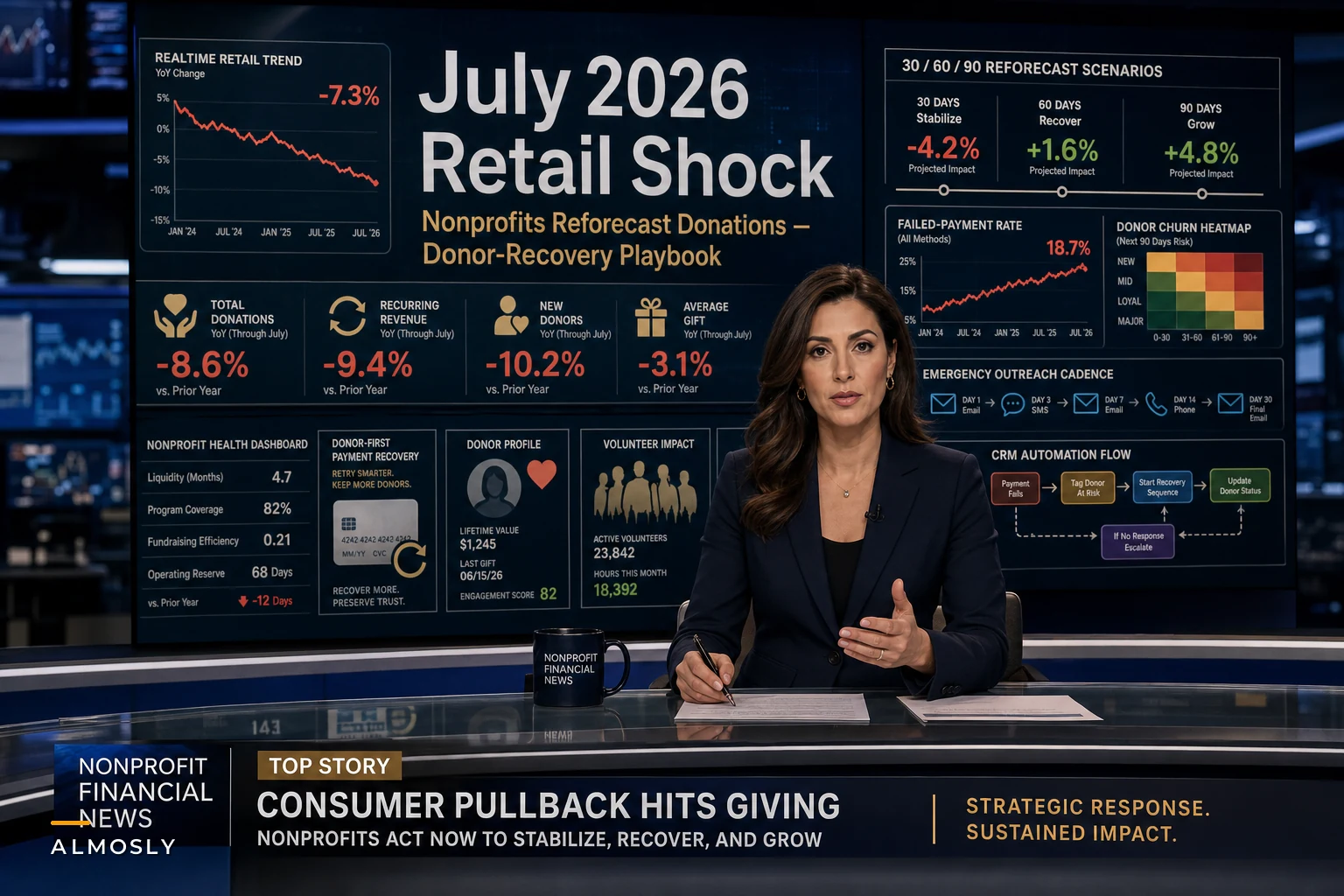

The 0.6% drop in U.S. retail sales in July 2026 — the first monthly decline in nine months according to Reuters — isn't something most fundraising teams need to panic over. But it's worth reading carefully, because consumer pullbacks don't hit nonprofits immediately. You don't feel it the week the number prints. You feel it six to ten weeks later, when your recurring gift decline rate quietly ticks up, your event RSVPs come in soft, and your fall appeal underperforms the model your board already approved.
That lag is the dangerous part. Most teams reforecast reactively — after the November numbers come in ugly. By then you've already sent the appeal, printed the gala materials, and locked staffing. Moving now means you still have room to adjust cadence, retry logic, and outreach targeting before the money is committed.
This isn't about doom. It's about doing the boring reforecast work in August instead of scrambling in December.
Why a retail dip hits donations on a delay
When household spending softens, giving doesn't drop uniformly. It fractures along predictable lines, and knowing which lines break first gives you a real head start.
The first thing that moves is card declines on recurring gifts. When people tighten discretionary spending, they hit card limits more often, delay paying down balances, and let cards expire without updating them. Your monthly donor file doesn't announce this — it just starts failing more transactions. A file that normally sees 4–6% monthly involuntary churn can drift toward 8–9% during a pullback, and most teams don't notice until three months of quiet decline have compounded.
Second is mid-level attrition, not major gifts. Major donors giving from wealth are largely insulated from a retail slowdown. The $50–$500 donor giving from monthly cash flow isn't. This segment silently lapses — no angry email, they just don't renew — and the following year's LYBUNT report is where you finally see the hole.
Third is event economics. Ticket sales soften, but the sneakier problem is the auction and paddle-raise. Live giving at events is highly sensitive to how financially comfortable the room feels. A gala that netted close to $180k last year can come in $30k–$45k light not because attendance dropped, but because the average paddle number shrank.
The underlying issue the retail number exposes isn't that people care less. It's that most nonprofit forecasts assume donor behavior is static, when it's actually elastic and tied to the same signals driving consumer spending. If your model treats last year's retention curve as a constant, a pullback breaks your plan invisibly.
The reforecast that actually helps (not the annual budget re-do)
You don't need to rebuild your whole budget. You need a targeted near-term reforecast on the three or four line items most exposed to a consumer slowdown. Here's how those exposures typically shake out:
Stop missing fundraising opportunities.
Almosly helps you plan, track, and optimize every campaign with ease.
- Centralized donor and volunteer management
- Automated engagement workflows
- Impact and fundraising analytics
No credit card required
| Revenue line | Sensitivity to pullback | Lag before you see it | Where to adjust now |
|---|---|---|---|
| Recurring / monthly gifts | Medium-high (via card failures) | 4–10 weeks | Retry logic, card updater, dunning cadence |
| Mid-level renewals ($50–$500) | High | 1–2 quarters | Retention outreach, personalized asks |
| Event / gala revenue | High | Next event cycle | Ticket pricing, sponsor backfill, paddle strategy |
| Major gifts | Low | Slow / minimal | Steady stewardship, no change |
| Grants / institutional | Low short-term | 6–12 months | Watch for later cycles |
Laying it out this way stops the panic-cut reflex. When a board sees a scary economic headline, the instinct is often to slash across the board — including major-gift cultivation, which is the least affected line. That's exactly backward. You protect the elastic revenue and leave the stable revenue alone.
-
Pull your last 24 months of monthly recurring decline rates and flag the trailing 3-month trend. Establish your normal baseline before you can spot drift.
-
Segment mid-level donors by renewal window — who's due to renew in the next 90 days, and who renewed last year around this time. That's your outreach priority list.
-
Re-run event revenue on two scenarios — flat attendance with a 10% lower average gift, and 15% lower attendance with flat average gift. Whichever number scares you more tells you where to focus.
-
Set a trigger threshold. Decide now
"If recurring decline crosses X% for two consecutive months, we activate the recovery workflow." Pre-deciding removes the emotional delay.
-
Bring the board one page, not ten. Scenario ranges, not false precision. Boards act on clarity, not spreadsheets.
Ranges are fine here — the goal is to know your exposure order, not predict the future to the dollar.
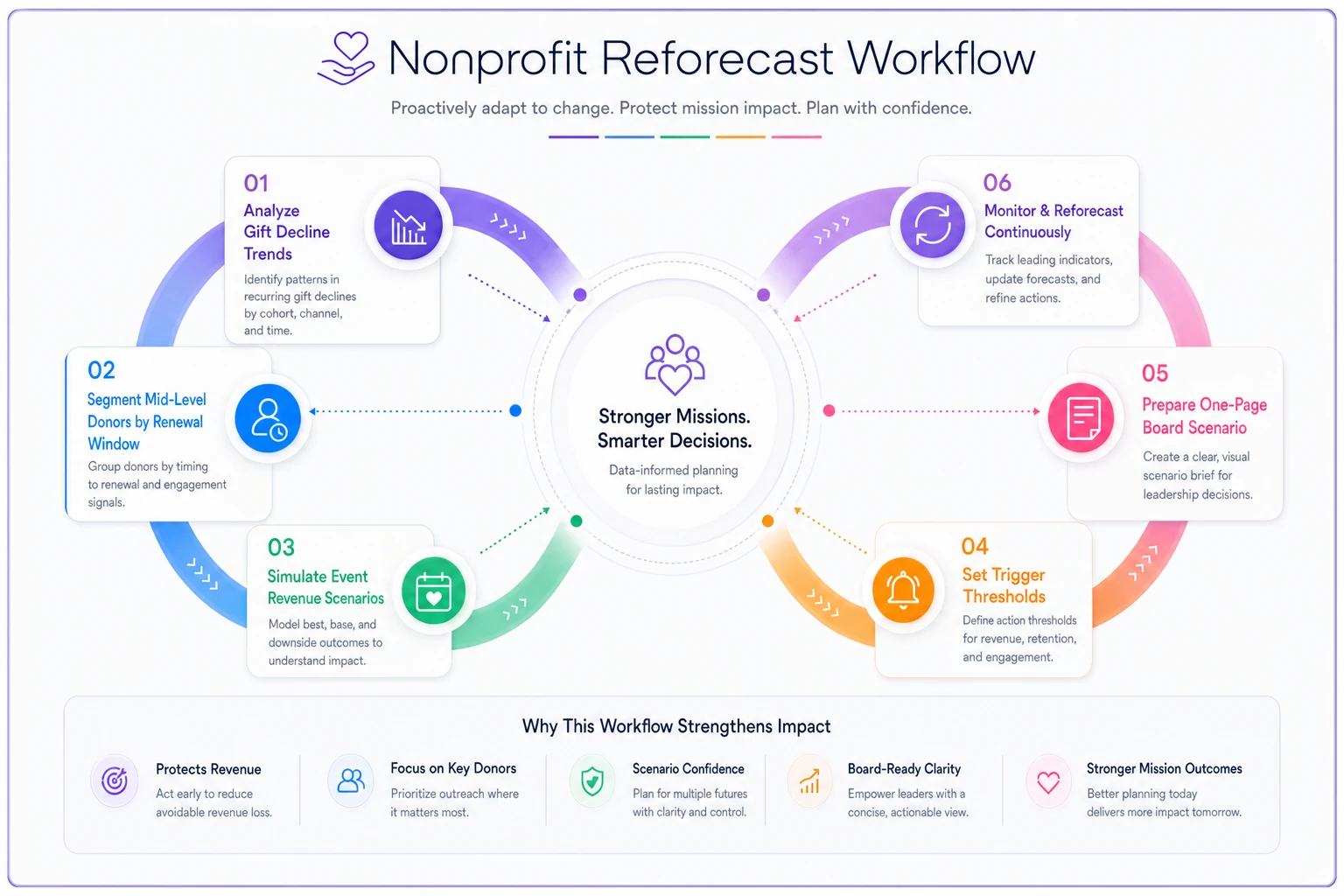
This simple diagram maps the steps to reforecast and act quickly.
Where the real money leaks: failed recurring gifts
Of everything on that table, involuntary recurring churn is the one you can fix fastest and most quietly. It doesn't require a new campaign or a board conversation. It's plumbing.
Here's what typically happens. A monthly donor's card fails on the 15th. The payment processor retries automatically once or twice on a fixed schedule — usually the wrong days — then gives up. The donor gets a generic "payment failed" email that reads like spam, ignores it, and their gift just stops. Nobody on your team sees it as a lost donor. It shows up in the aggregate as a slightly lower recurring total and gets written off as normal churn.
But a meaningful chunk of those failures are fixable — expired cards, temporary limits, a bank fraud-hold on an unfamiliar merchant. The donor still wants to give. They just never got a recovery message that felt human, or a retry that hit on a day the funds were actually there.
-
Smarter retry timing. Retrying on the 1st–3rd of the month — right after paydays and benefit deposits — recovers meaningfully more than retrying two days after failure.
-
Segmented messaging by failure reason. An expired-card donor needs a one-tap update link. A hard-declined donor needs a warmer "we noticed something went wrong" note. Treating them identically wastes both.
-
A human handoff for higher-value monthlies. For donors giving above a threshold — say $50/month or more — a personal email or call from a real staffer recovers far better than any automated sequence.
-
A hard stop before over-messaging. If someone doesn't respond after a defined cadence, suppress. Chasing a failed gift into annoyance costs you the future one-time gift too.
Prioritize early-month retries for the most recent failure cohort and route $50+/month failures to a staff callback list first.
Tightening retry rules and dunning sequences inside your CRM and payment system is often the single highest-ROI move available in a slow quarter. You're not acquiring anything new — you're keeping donors you already earned.
Redeploying volunteer capacity when giving softens
A pullback doesn't only hit money. Volunteer availability tends to soften alongside it — people picking up extra shifts or side work have less time to give. That makes the fall exactly the wrong time to spread volunteer hours thin across low-leverage tasks.
The pattern worth watching: teams keep volunteers assigned to things like stuffing envelopes or staffing a table that generates little, out of habit, while donor-facing work like thank-you calls and stewardship touches goes undone. In a soft quarter, a volunteer making retention calls to lapsing mid-level donors is worth far more than one doing back-office busywork.
Reprioritize by asking one simple question of each volunteer role: does this protect or grow donor relationships? If yes, staff it heavily. If no, let it flex.
When to act — and when you're overreacting
Not every economic wobble deserves a full response. Reading the signal correctly matters as much as responding to it.
Move now if:
-
Your recurring decline rate has trended up for two or more consecutive months
-
Mid-level renewals are lagging the same period last year
-
A large share of your annual revenue lands in Q4 appeals and year-end
-
Your fall event is a major line item and tickets are pacing slow
You're probably overreacting if:
-
Your revenue is mostly grants and major gifts locked in commitments
-
One soft month follows many strong ones with no other warning signs
-
You're about to cut cultivation spending — that's the wrong lever
Who should NOT overhaul anything: small all-volunteer nonprofits with a handful of stable recurring donors. Your energy is better spent on a few personal check-in calls than building retry infrastructure you don't have the volume to justify. The context around this pullback is genuinely mixed — CNBC noted the S&P 500 climbed on a tame inflation report even as spending softened. This isn't a crisis. It's a reason to be deliberate.
A real scenario
A regional food-security nonprofit with around 2,100 monthly donors noticed their recurring revenue had quietly slipped over the summer — roughly a 3-percentage-point rise in monthly failures they'd been logging as normal attrition. When they reforecasted the near-term picture, they realized that drift, if it held through year-end, represented somewhere in the range of $40k–$55k in lost annualized recurring revenue.
Instead of launching a new campaign, they did three unglamorous things: moved payment retries to early-month dates, split their dunning emails by failure reason, and had two staffers personally reach out to the roughly 90 monthly donors giving $50 or more whose gifts had failed. Over about eight weeks they recovered a solid majority of the higher-value failures and pulled their involuntary churn back toward its old baseline. No new acquisition spend. Just plumbing and a few phone calls.
The lesson wasn't sophisticated. The revenue was already leaking — they'd just never built the process to notice or catch it.
The takeaway for the fall
A single soft retail month isn't a verdict. But it's a cheap early warning, and the teams that treat it that way — reforecasting the exposed lines, tightening recurring-gift recovery, pointing volunteer hours at donor relationships — will head into year-end with far fewer surprises than the ones who wait for the December numbers to tell them what August already hinted at.
Do the boring work now. Your December self will be grateful.
Ready to elevate your nonprofit impact?
Join 2,000+ nonprofits using Almosly to boost fundraising efficiency, deepen donor relationships, and scale philanthropic impact.